Fundamental
Prepare and test your skills

Fundamental
Prepare and test your skills
Custom Machine Type Memory Sizing Rules
Free sample question with answers and detailed explanation below. The Associate Cloud Engineer practice bank has an additional 2,014 practice questions.Try 10 free realistic questions: instant score, no credit card, and no account required.
An organization is deploying an internal batch-processing application on Google Cloud Compute Engine. The workload requires a non-standard configuration of 6 vCPUs and 26 GB of RAM to operate efficiently without over-allocating unused resources.
Which requirement must the cloud engineer satisfy when configuring the custom machine type for this VM instance?
Explanations
Any arbitrary vCPU count can be assigned alongside any memory size without minimum or maximum memory-per-core limitations.
Any arbitrary vCPU count can be assigned alongside any memory size without minimum or maximum memory-per-core limitations.
What Arbitrary Sizing Represents
Arbitrary sizing assumes that virtual machine creation on Google Cloud allows totally unrestricted entry of odd vCPU numbers (such as 3, 5, or 7 vCPUs) and arbitrary RAM values without any upper or lower bounds per core.
Why It Doesn't Meet the Requirement
- vCPU constraints: Compute Engine requires custom vCPU allocations to adhere to specific allowed core lists. For example, custom instances generally require an even number of vCPUs (with the exception of single-core N1 instances).
- Ratio validation: Compute Engine enforces strict minimum memory-per-core (e.g., 512 MB per vCPU for N2/E2, 922 MB per vCPU for N1) to prevent VMs from underperforming or destabilizing the hypervisor.
- Maximum memory validation: Maximum memory limits per vCPU (e.g., 6.5 GB or 8 GB per vCPU) and total instance maximums are validated by the platform during provisioning.
Key Characteristics and Limitations
- Cloud hypervisors enforce physical hardware alignment rules to maintain virtualization stability and performance isolation.
- Sizing requests that violate allowed core lists or memory-per-core ratios return immediate API validation errors.
This Answer Would Be Correct If
Compute Engine possessed no architectural hardware bounds, validation schemas, or hypervisor memory-to-core ratios when creating custom compute instances.
The total memory must be allocated in multiples of 256 MB and adhere to the minimum and maximum memory-per-vCPU limits of the selected machine family.
The total memory must be allocated in multiples of 256 MB and adhere to the minimum and maximum memory-per-vCPU limits of the selected machine family.
What Custom Machine Types Are
Custom machine types in Google Cloud Compute Engine enable administrators to independently configure the exact number of vCPUs and amount of system memory for a virtual machine. This flexibility prevents overprovisioning compute resources when an application does not align with predefined machine shape ratios.
How It Meets the Configuration Requirements
When creating a custom machine type (such as within the N1, N2, or E2 series), Compute Engine enforces fundamental platform validation rules:
- Memory granularity: Memory size must always be defined in exact multiples of 256 MB (0.25 GB).
- Memory-to-core ratios: The requested memory must fall within the specific hardware family's boundaries. For instance, standard general-purpose series require memory to be at or above a minimum threshold (such as 512 MB or 922 MB per core) and below the maximum standard ceiling per core unless extended memory is explicitly configured.
- vCPU increments: The requested 6 vCPUs is an allowable core count (an even number within the permitted core range for general-purpose series).
Custom Machine Type Memory Validation
Decision Tree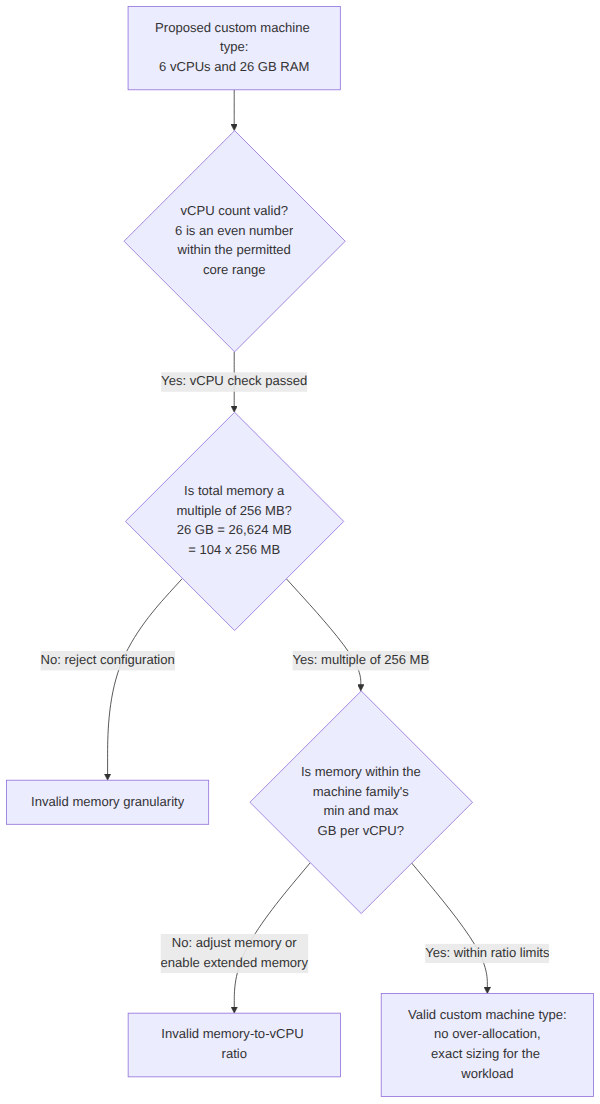
Key Advantages and Capabilities
- Cost optimization: Tailors resource sizing directly to workload demand, eliminating unnecessary spending on unused CPU or RAM capacity.
- Granular sizing: Offers memory increments down to 256 MB rather than rounding up to full gigabytes.
- Broad machine family support: Available across multiple general-purpose families, including E2, N1, N2, and N2D.
- Extended memory options: Allows exceeding typical memory-per-core limits when memory-heavy workloads require fewer processing cores.
Why This Is Optimal
Configuring the instance with 6 vCPUs and 26 GB of RAM (which is 26,624 MB, a valid multiple of 256 MB) satisfies both the vCPU and memory ratio rules without forcing the administrator to purchase an expensive predefined 8-vCPU or 32 GB standard instance.
Custom machine types only support vCPU counts that follow powers of 2 (such as 2, 4, 8, or 16) and must select memory from predefined preset sizes.
Custom machine types only support vCPU counts that follow powers of 2 (such as 2, 4, 8, or 16) and must select memory from predefined preset sizes.
What Power-of-Two Sizing Is
Power-of-two core allocation refers to selecting compute configurations that double sequentially (such as 1, 2, 4, 8, 16, 32, 64). Many predefined machine types follow this pattern in their standard catalog offerings.
Why It Doesn't Meet the Requirement
- Even core flexibility: Custom machine types on series like N1, N2, and E2 allow even core counts that are not powers of two, such as 6, 10, 12, 14, 20, 22, and higher.
- Independent memory selection: Custom machine types do not require choosing from fixed memory presets. The core purpose of custom VM sizing is allowing engineers to independently define custom RAM amounts rather than using rigid predefined profiles.
Key Characteristics and Limitations
- N1 series: Supports 1 vCPU and any even number of vCPUs up to 96.
- N2 series: Supports even numbers of vCPUs from 2 to 32, and increments of 4 thereafter up to 128.
- E2 series: Supports even numbers of vCPUs up to 32.
- Rigid power-of-two constraints would defeat the efficiency goal of provisioning exactly 6 vCPUs.
This Answer Would Be Correct If
The engineer were restricted exclusively to standard predefined machine type tiers (such as n2-standard-4 or n2-standard-8) rather than utilizing Compute Engine's custom machine type capability.
The memory must be configured in whole gigabyte increments (1024 MB) and cannot exceed a fixed ceiling of 4 GB per vCPU across all machine families.
The memory must be configured in whole gigabyte increments (1024 MB) and cannot exceed a fixed ceiling of 4 GB per vCPU across all machine families.
What Whole-Gigabyte Allocation Is
Configuring virtual machine capacity strictly in whole gigabyte (1024 MB) increments with a rigid 4 GB per vCPU cap represents an assumption derived from traditional fixed virtualization templates rather than Google Cloud's actual custom machine specification rules.
Why It Doesn't Meet the Requirement
- Granularity misconception: Compute Engine does not require memory to be sized in whole gigabytes; it natively allows granular increments of 256 MB.
- Ratio limitations: The maximum memory-per-core limit is not fixed at 4 GB. For example, the N2 and E2 series support up to 8 GB (8192 MB) per vCPU in standard configurations, and N1 allows up to 6.5 GB (6656 MB) per vCPU.
- Extended memory capabilities: Several machine series also support extended memory beyond standard ratios, well exceeding a 4 GB per core boundary.
Key Characteristics and Limitations
- Enforcing full gigabyte increments leads to sub-optimal sizing.
- Restricting memory to 4 GB per core would unnecessarily prevent provisioning memory-intensive workloads like in-memory caches or databases on custom VM instances.
- Platform APIs validate memory against multiples of 256 MB and family-specific maximum boundaries.
This Answer Would Be Correct If
A virtualization platform strictly enforced integer gigabyte memory stepping and hard-capped standard instance shapes at a 1:4 vCPU-to-memory ratio without supporting custom machine types or extended memory configurations.
Try 10 interactive questions like this one, free
Answer them yourself and get your score the moment you finish. No account needed.
Full access includes
- 2,014 practice questions across all 4 exam domains
- Every answer explained: why it is right, and why the others are not
- Scout, an AI tutor that answers your follow-up questions
- Readiness tracking by domain, so you know when to book the exam
Related free sample questions
Keep the momentum going with these hand-picked practice scenarios
FundamentalAssociate Cloud Engineer
Spot VMs with Custom Machine Types
Using Spot VM instances and custom machine types
FundamentalAssociate Cloud Engineer
Spot VM Preemption Shutdown Scripts
Using Spot VM instances and custom machine types
FundamentalAssociate Cloud Engineer
Artifact Registry Docker Image URI Format
Deploying a containerized application to GKE
FundamentalAssociate Cloud Engineer
VPC Network Peering Cross-Project
Establishing network connectivity (e.g., Cloud VPN, VPC Network Peering, Cloud Interconnect)
FundamentalAssociate Cloud Engineer
Cloud Identity for Organization Resource
Setting up standalone organizations
FundamentalCloud Digital Leader
Digital Transformation vs Traditional IT
Define the terms: cloud, cloud technology, data, digital transformation, cloud-native, open source, open standard.
Last updated