Fundamental
Prepare and test your skills

Fundamental
Prepare and test your skills
Using Shutdown Scripts for Spot VM Preemption
Free sample question with answers and detailed explanation below. The Associate Cloud Engineer practice bank has an additional 2,014 practice questions.Try 10 free realistic questions: instant score, no credit card, and no account required.
A media company processes thousands of overnight video rendering jobs using a fault-tolerant batch application. The workload is stateless, automatically saves progress checkpoints every five minutes, and can tolerate unexpected server interruptions.
The engineering team wants to drastically reduce compute costs while ensuring that running instances can execute a graceful cleanup whenever Compute Engine reclaims the underlying capacity.
Which compute configuration and lifecycle strategy should the team implement?
Explanations
Provision Spot VM instances and implement a shutdown script to capture state during the 30-second preemption notice window.
Provision Spot VM instances and implement a shutdown script to capture state during the 30-second preemption notice window.
What Spot VMs and Preemption Notices Are
Spot VMs are Compute Engine virtual machine instances priced at a significant discount (typically 60–91% compared to standard on-demand prices) in exchange for allowing Google Cloud to reclaim (preempt) capacity when it is needed for other workloads.
How It Meets the Requirements
- Massive Cost Reduction: Spot VMs offer the lowest pricing model available in Google Cloud Compute Engine without requiring long-term contractual commitments.
- Fault-Tolerant Batch Workload: Because video rendering progress is checkpointed every five minutes, the workload can gracefully tolerate unexpected node restarts or terminations.
- Graceful Cleanup and 30-Second Notice: When Compute Engine needs to reclaim capacity, it issues a preemption notice. Compute Engine provides a 30-second termination notice via metadata changes and ACPI signals, allowing an attached shutdown script to save final state, clean up locks, or upload intermediate output before the instance stops.
Spot VM Checkpoint Recovery Cycle
Process Flow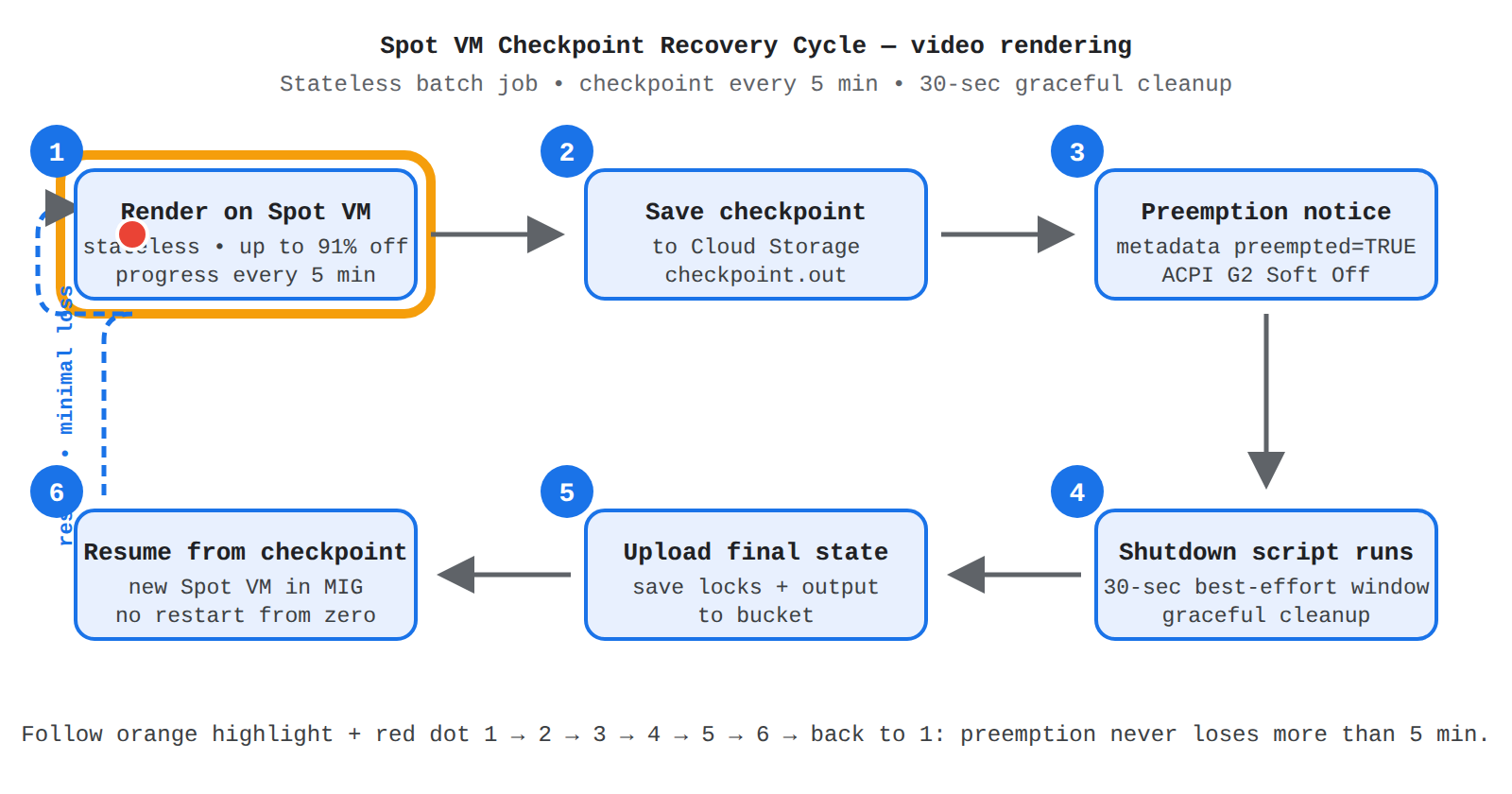
Key Advantages of Spot VMs
- Significant Savings: Up to 91% savings relative to standard VM list pricing.
- No Maximum Runtime Limit: Unlike legacy preemptible VMs which had a strict 24-hour limit, Spot VMs do not have a hard lifetime limit and run as long as capacity is available.
- Automated Re-creation: When used within a Managed Instance Group (MIG), preempted instances are automatically replaced as soon as resources become available again.
- Programmatic Handling: Applications can monitor the
instance/preemptedmetadata endpoint to trigger internal shutdown procedures alongside shutdown scripts.
Why This Is Optimal
For stateless or checkpointed batch processing, Spot VMs provide optimal economics. Pairing them with a 30-second shutdown script ensures that any in-flight operations or metadata are cleanly finalized before the VM terminates.
Provision Spot VM instances with high availability policies enabled to guarantee capacity cannot be reclaimed.
Provision Spot VM instances with high availability policies enabled to guarantee capacity cannot be reclaimed.
What Spot VM Policies and Guarantees Are
By definition, Spot VMs do not provide capacity guarantees or high availability reservations. The entire economic trade-off of Spot instances relies on Google Cloud retaining the right to reclaim compute capacity at any time without guaranteed availability.
Why It Doesn't Meet the Requirement
- Contradictory Configuration: Compute Engine does not allow setting strict high availability guarantees that prevent Spot preemption. There is no setting to disable preemption on a Spot VM.
- Misunderstanding of Service Level Agreements (SLAs): Spot VMs are excluded from Compute Engine availability SLAs and cannot be shielded from preemption events.
Key Characteristics and Limitations
- Always Preemptible: Spot VMs are strictly transient resources and can be preempted whenever regional or zonal resource pressure occurs.
- No Reservation Protection: Reservations cannot be applied to prevent Spot VMs from being reclaimed.
- Best-Effort Allocation: While Google Cloud attempts to minimize preemption rates, availability is subject to real-time datacenter demand.
This Answer Would Be Correct If
Compute Engine offered an SLA-backed non-preemptible Spot tier, but such a feature does not exist because the low price is directly enabled by excess, reclaimable capacity.
Provision custom machine type VMs with preemptible flags disabled and configure a 10-minute graceful shutdown period.
Provision custom machine type VMs with preemptible flags disabled and configure a 10-minute graceful shutdown period.
What Custom Machine Types and Standard Shutdown Are
Custom machine types allow configuring exact ratios of vCPUs and memory for a standard VM instance. When an instance is stopped manually or by an orchestration tool, standard operating system shutdown scripts run, but these are standard on-demand VMs rather than deeply discounted transient instances.
Why It Doesn't Meet the Requirement
- High Cost: Disabling the preemptible/Spot flag means the VM runs as a standard on-demand instance, missing out on the 60–91% discount provided by Spot instances.
- Invalid Preemption Window: Compute Engine preemption notices for Spot/Preemptible instances provide exactly 30 seconds, not 10 minutes. A user cannot unilaterally configure a 10-minute preemption window on Google Cloud.
Key Characteristics and Limitations
- Standard Pricing Applied: Non-preemptible custom machine types are billed at standard on-demand custom rates.
- Fixed 30-Second Warning: Preemption notifications on Google Cloud provide a fixed 30-second interval before ACPI power-off occurs; shutdown scripts that exceed this limit are forcefully terminated.
This Answer Would Be Correct If
The workload required a non-standard vCPU-to-RAM memory ratio and could not tolerate any random preemption events, requiring standard on-demand pricing.
Provision standard VM instances with Committed Use Discounts (CUDs) and rely on live migration to prevent preemption.
Provision standard VM instances with Committed Use Discounts (CUDs) and rely on live migration to prevent preemption.
What Committed Use Discounts and Live Migration Are
Committed Use Discounts (CUDs) provide discounted pricing in exchange for committing to a continuous resource spend or usage level for a term of 1 or 3 years. Live migration keeps standard instances running during host system maintenance events without downtime.
Why It Doesn't Meet the Requirement
- Cost-Efficiency for Transient Workloads: Standard VMs with CUDs require long-term commitments (1 or 3 years) and continuous baseline utilization. For intermittent or bursty overnight batch rendering, paying for ongoing commitments is significantly less cost-effective than using Spot VMs.
- Overkill for Fault-Tolerant Jobs: The rendering workload is explicitly fault-tolerant and checkpointed, meaning high-availability features like live migration are unnecessary overhead for this specific architecture.
Key Characteristics and Limitations
- Contractual Lock-in: CUDs require consistent resource consumption across months or years to yield positive return on investment.
- Discount Ceiling: CUD discounts (typically up to 57% for standard compute) are considerably lower than Spot VM discounts (up to 91%).
- Not Intended for Transient Bursts: CUDs target predictable, steady-state baseline production applications rather than bursty, off-peak batch pipelines.
This Answer Would Be Correct If
The workload were a continuous 24/7 mission-critical database or core web tier that could never tolerate sudden interruptions or terminations.
Try 10 interactive questions like this one, free
Answer them yourself and get your score the moment you finish. No account needed.
Full access includes
- 2,014 practice questions across all 4 exam domains
- Every answer explained: why it is right, and why the others are not
- Scout, an AI tutor that answers your follow-up questions
- Readiness tracking by domain, so you know when to book the exam
Related free sample questions
Keep the momentum going with these hand-picked practice scenarios
FundamentalAssociate Cloud Engineer
Custom Machine Type Memory Constraints
Using Spot VM instances and custom machine types
FundamentalAssociate Cloud Engineer
Spot VMs with Custom Machine Types
Using Spot VM instances and custom machine types
FundamentalAssociate Cloud Engineer
Coldline Storage Access Frequency
Estimating costs of data storage resources
FundamentalAssociate Cloud Engineer
GCE Spot VM Provisioning Model
Launching a compute instance (e.g., availability policy, SSH keys)
FundamentalAssociate Cloud Engineer
Data Access Audit Logs
Configuring audit logs
FundamentalCloud Digital Leader
Shared Responsibility Model Customer IAM
Discuss fundamental cloud security concepts.
Last updated