Fundamental
Prepare and test your skills

Fundamental
Prepare and test your skills
Cross-Project VPC Peering with Private IPs
Domain: Establishing network connectivity (e.g., Cloud VPN, VPC Network Peering, Cloud Interconnect)
Free sample question with answers and detailed explanation below. The Associate Cloud Engineer practice bank has an additional 2,014 practice questions.Try 10 free realistic questions: instant score, no credit card, and no account required.
An enterprise organization operates two separate VPC networks named vpc-app (using subnet 10.10.0.0/16) and vpc-data (using subnet 10.20.0.0/16) across two different Google Cloud projects.
Workloads in vpc-app need to communicate directly with database VMs in vpc-data using private internal IP addresses without traffic traversing the public internet or incurring the latency and maintenance of virtual routing appliances.
Which solution should you implement to establish this private internal communication?
Explanations
Configure VPC Network Peering between vpc-app and vpc-data
Configure VPC Network Peering between vpc-app and vpc-data
What VPC Network Peering Is
VPC Network Peering is a native Google Cloud networking feature that connects two Virtual Private Cloud (VPC) networks, allowing workloads across both networks to communicate directly using internal IP addresses without routing traffic through the public internet or intermediate gateway devices.
How It Meets the Requirements
- Internal IP Communication: VPC Network Peering automatically exchanges subnet routes between peered networks. Compute Engine VMs in
vpc-appcan reach database instances invpc-datadirectly using their private RFC 1918 internal IP addresses (10.20.0.0/16). - No Public Internet Traversal: All traffic remains entirely within Google's private software-defined network infrastructure, eliminating exposure to public network paths.
- Low Latency and No Gateway Overhead: Peering does not rely on virtual appliances, VPN tunnels, or external gateways. Packets travel with the same bandwidth and latency as intra-VPC communications.
- Non-Overlapping IP Ranges: Because
vpc-app(10.10.0.0/16) andvpc-data(10.20.0.0/16) use distinct CIDR blocks, the peering relationship can be established without IP address conflicts.
VPC Network Peering Between vpc-app and vpc-data
System Architecture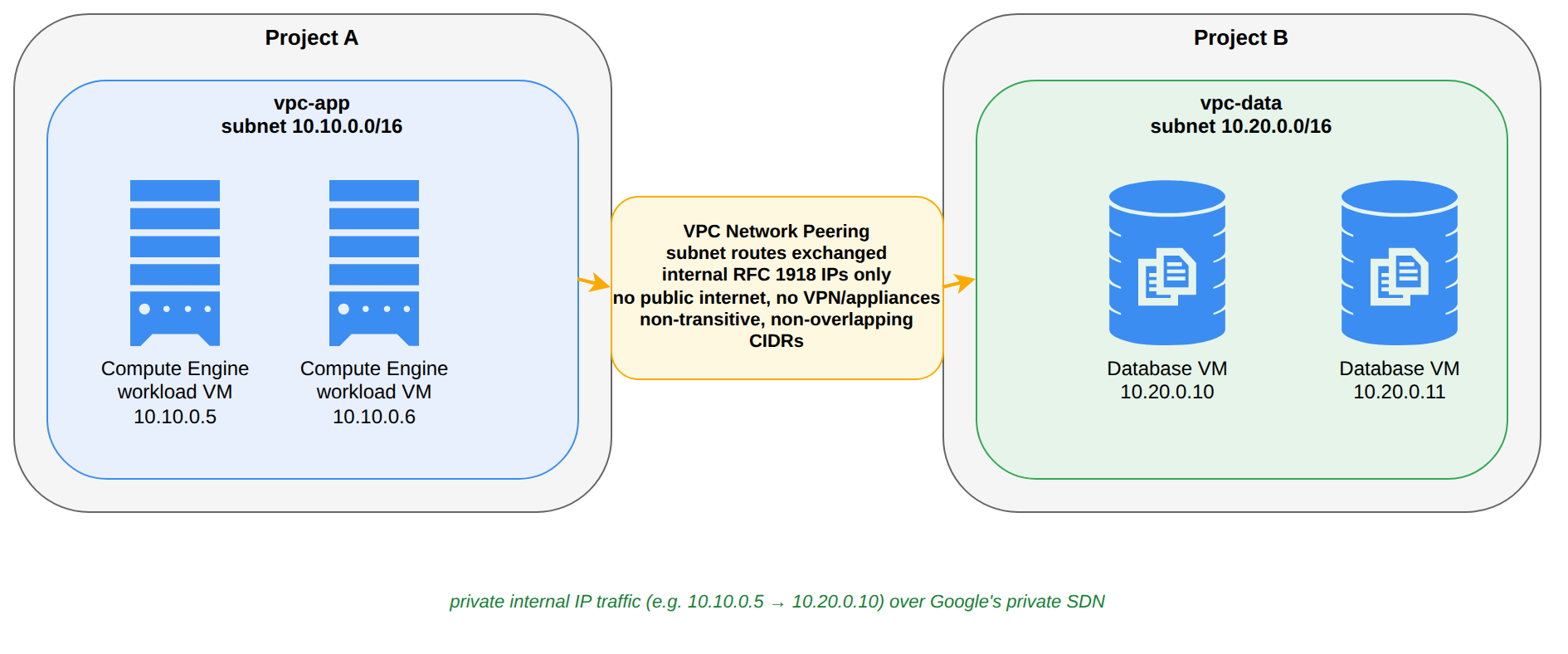
Key Advantages and Capabilities
- Cross-Project and Cross-Organization Support: Connects VPC networks located within the same project, across different projects, or across different Google Cloud organizations.
- Decentralized Administration: Each VPC network maintains independent IAM permissions, routing policies, and firewall configurations.
- Non-Transitive Connectivity: Peering relationships are strictly point-to-point. If
vpc-apppeers withvpc-data,vpc-appcannot transitively access networks peered tovpc-data. - No Performance Bottlenecks: Bandwidth and latency match internal network capabilities rather than gateway appliance throughput limits.
Why This Is Optimal
Unlike VPN solutions or proxy appliances, VPC Network Peering creates direct software-defined routing paths at zero egress cost for intra-zone traffic, avoiding unnecessary encapsulation overhead, recurring gateway charges, and single-point-of-failure bottlenecks.
Enable Shared VPC and designate both projects as host projects to merge the subnets
Enable Shared VPC and designate both projects as host projects to merge the subnets
What Shared VPC Is
Shared VPC allows an organization to share a centrally managed VPC network from a single host project with multiple service projects, allowing resources in service projects to attach to common subnets while maintaining separate project administrative boundaries.
Why It Doesn't Meet the Requirement
- Cannot Merge Existing VPCs: Shared VPC does not connect two pre-existing, distinct VPC networks. Instead, it shares subnets from a single centralized network across projects.
- Invalid Configuration: A single VPC cannot be designated across multiple host projects in this manner; a project can be a host project or attach to a single host project, but you cannot "merge" two independent VPC networks by declaring them both host projects.
- Requires Rebuilding Infrastructure: Adopting Shared VPC would require migrating or recreating VMs from one network into the shared subnets of the host network rather than linking the two existing networks.
Key Characteristics and Limitations
- Organization Level Requirement: Shared VPC operates within a single Google Cloud organization boundary.
- Centralized Network Administration: Network admins control subnets and firewall rules in the host project, while service project admins manage compute resources attached to those subnets.
- Not a Peering Mechanism: It is an architectural model for sharing a single network, not an interconnectivity bridge between disparate networks.
This Answer Would Be Correct If
You were designing a greenfield multi-project architecture from scratch and wanted all teams to deploy resources into centralized, shared subnets managed by a dedicated networking team.
Deploy Cloud NAT gateways in each VPC network to route traffic between the subnets
Deploy Cloud NAT gateways in each VPC network to route traffic between the subnets
What Cloud NAT Is
Cloud NAT (Network Address Translation) is a managed, software-defined Google Cloud service that allows private VM instances without external IP addresses to access outbound internet destinations or specific external endpoints.
Why It Doesn't Meet the Requirement
- No Inbound or East-West Connectivity: Cloud NAT provides only outbound NAT gateway functionality for internet access. It does not establish private, internal connectivity between two isolated VPC networks.
- No Subnet Route Exchange: Cloud NAT does not exchange internal subnet routes between
vpc-appandvpc-data. - Cannot Facilitate Direct Internal Calls: Database instances in
vpc-datacannot receive inbound requests over internal IP addresses through a Cloud NAT gateway.
Key Characteristics and Limitations
- Unidirectional Egress Only: Cloud NAT allows internal instances to initiate outbound connections to the internet, but outside systems cannot initiate connections back to internal instances.
- Allocates Public IP Pools: Uses public NAT IP addresses rather than enabling private RFC 1918 internal routing between VPCs.
- Not a Routing Protocol: It does not link internal routing tables across multiple VPC environments.
This Answer Would Be Correct If
Private VMs in vpc-app needed to download software patches or access public APIs on the internet without assigning them individual external IP addresses.
Configure Cloud VPN gateways and Cloud Routers to establish an IPsec tunnel between the two VPCs
Configure Cloud VPN gateways and Cloud Routers to establish an IPsec tunnel between the two VPCs
What Cloud VPN Is
Cloud VPN securely connects a VPC network to an external network—such as an on-premises data center or another cloud provider—or another VPC network by creating an encrypted IPsec VPN tunnel over public or private networks using Cloud Router for dynamic BGP route exchange.
Why It Doesn't Meet the Requirement
- Unnecessary Gateway Overhead: While Cloud VPN can connect two Google Cloud VPC networks, it introduces tunnel encapsulation overhead, bandwidth constraints per tunnel (e.g., 3 Gbps per tunnel), and gateway infrastructure management.
- Suboptimal Latency: Encrypting and routing internal traffic through IPsec tunnels adds unnecessary latency compared to native software-defined VPC peering.
- Additional Costs: Cloud VPN incurs continuous hourly charges for active VPN gateways and tunnels, whereas VPC Network Peering is a built-in feature with no tunnel management fees.
Key Characteristics and Limitations
- Primary Use Case: Designed primarily for hybrid connectivity between Google Cloud and on-premises environments or third-party cloud providers.
- Bandwidth Limits: Single tunnels are subject to strict throughput caps and packet processing limits.
- Complexity: Requires configuring gateway endpoints, BGP sessions, shared secrets, and IKE protocols.
This Answer Would Be Correct If
The workload required encrypted transport across an untrusted network, or if you were connecting a Google Cloud VPC to an on-premises data center router.
Try 10 interactive questions like this one, free
Answer them yourself and get your score the moment you finish. No account needed.
Full access includes
- 2,014 practice questions across all 4 exam domains
- Every answer explained: why it is right, and why the others are not
- Scout, an AI tutor that answers your follow-up questions
- Readiness tracking by domain, so you know when to book the exam
Related free sample questions
Keep the momentum going with these hand-picked practice scenarios
FundamentalAssociate Cloud Engineer
Cloud HA VPN with Cloud Router BGP
Establishing network connectivity (e.g., Cloud VPN, VPC Network Peering, Cloud Interconnect)
FundamentalAssociate Cloud Engineer
Dedicated vs Partner Interconnect
Establishing network connectivity (e.g., Cloud VPN, VPC Network Peering, Cloud Interconnect)
FundamentalAssociate Cloud Engineer
ClusterPodMonitoring vs PodMonitoring
Deploying Google Cloud Managed Service for Prometheus
FundamentalAssociate Cloud Engineer
Windows Sysprep Specialize Script Metadata
Launching a compute instance (e.g., availability policy, SSH keys)
FundamentalAssociate Cloud Engineer
Cloud Storage Dual-Region Location
Choosing and deploying storage products (e.g., Cloud Storage, Filestore, Google Cloud NetApp Volumes) and Cloud Storage options (e.g., Standard, Nearline, Coldline, Archive)
IntermediateProfessional Cloud Architect
Shared VPC Global Dynamic Routing
Using migration methodologies, workload testing, network planning, and dependency planning
Last updated