Fundamental
Prepare and test your skills

Fundamental
Prepare and test your skills
Provisioning Organization Root with Cloud Identity
Free sample question with answers and detailed explanation below. The Associate Cloud Engineer practice bank has an additional 2,014 practice questions.Try 10 free realistic questions: instant score, no credit card, and no account required.
Your company currently has several development teams managing standalone Google Cloud projects using individual, unmanaged Google accounts with no centralized administrative oversight.
Your management team wants to transition from this unorganized state to a centralized resource hierarchy rooted under the corporate domain name (example.com). The company does not require email or office productivity tools (such as Gmail or Google Drive).
What should you do to establish the Google Cloud Organization resource?
Explanations
Use the Cloud Resource Manager API to execute an organization creation request using a project service account.
Use the Cloud Resource Manager API to execute an organization creation request using a project service account.
What the Cloud Resource Manager API Does
The Cloud Resource Manager API enables programmatic management of metadata, access control policies, and structural relationships across resources such as organizations, folders, and projects. It provides endpoints to search, get, and update metadata for existing organizations.
Why It Doesn't Meet the Requirement
- Cannot Create Organization Resources Arbitrarily: In public Google Cloud, standard Organization resources cannot be arbitrarily instantiated via direct API calls or service accounts without an associated Google Workspace or Cloud Identity customer account.
- Requires Domain Identity Verification: An Organization resource represents a verified enterprise domain. Verification of DNS TXT/CNAME records or HTML files must take place through the Google Admin interface during Cloud Identity or Google Workspace onboarding.
- Service Accounts Lack Domain Authority: A service account in a project cannot verify domain ownership or act as a Domain Super Administrator to bind a new enterprise identity root.
Key Characteristics and Limitations
- Read and Modify Only: The Resource Manager API methods for organizations (such as
organizations.getandorganizations.search) inspect and update existing resources, but cannot create a root Organization out of thin air. - CLI / API Querying: Tools like
gcloud organizations listororganizations.search()query an established Organization ID after domain setup is complete.
This Answer Would Be Correct If
The organization already existed and an automated CI/CD pipeline or infrastructure-as-code script needed to search for organization metadata or update organization-level IAM bindings programmatically.
Create a top-level Folder in the Google Cloud console and move all existing projects under it.
Create a top-level Folder in the Google Cloud console and move all existing projects under it.
What Folder Resources Are
In the Google Cloud resource hierarchy, Folders are organizational nodes located between the Organization resource and Projects. Folders allow administrators to group projects by department, environment (such as production, staging, and development), or workload, and apply shared IAM policies across those groupings.
Why It Doesn't Meet the Requirement
- Cannot Exist Without an Organization: Folders cannot exist in a standalone "no-organization" state. A Folder must always reside under an Organization resource or another parent Folder.
- Fails to Establish the Root Resource: You cannot create a Folder to replace or bootstrap an Organization resource. Creating an Organization resource requires domain ownership verification through an identity provider such as Cloud Identity or Google Workspace.
- No Domain Integration: Folders do not establish domain-level identity verification, user account management, or administrative ownership of domain users.
Key Characteristics and Limitations
- Dependent on Organization: Folders require an existing Organization resource to be provisioned first.
- Role Delegation: Folders use the Folder Administrator role (
roles/resourcemanager.folderAdmin) to manage permissions within their subtree, but cannot control domain-wide root settings. - Nesting Structure: Folders can be nested up to a maximum depth of 300 levels beneath the Organization node.
This Answer Would Be Correct If
An Organization resource had already been created and verified, and the requirement was to group multiple related projects into department-specific or environment-specific containers for unified policy management.
Sign up for Cloud Identity with your corporate domain, verify domain ownership, and use the automatically provisioned Organization resource.
Sign up for Cloud Identity with your corporate domain, verify domain ownership, and use the automatically provisioned Organization resource.
What Cloud Identity Is
Cloud Identity is an Identity as a Service (IDaaS) and enterprise mobility management (EMM) solution that provides managed user accounts and administrative control for Google services, including Google Cloud. It allows administrators to manage users, security policies, and device access from the Google Admin console without requiring paid subscriptions to Google Workspace productivity applications.
How It Meets the Requirements
- Establishing the Organization Resource: A Google Cloud Organization resource is strictly associated with a verified corporate domain managed via either Google Workspace or Cloud Identity. Signing up for Cloud Identity and verifying domain ownership automatically creates the root Organization resource corresponding to that domain.
- Avoiding Unneeded Productivity Software: Cloud Identity provides free-of-charge accounts and licensing specifically designed for organizations that only need identity and access management features without purchasing Google Workspace tools like Gmail, Calendar, or Google Drive.
- Centralized Administrative Root: Once the Organization resource is established, it becomes the root node of the resource hierarchy. All new projects created by users in the domain belong to the organization by default, and existing standalone projects can be migrated under this central root.
Organization Auto-Provisioning via Cloud Identity
Process Flow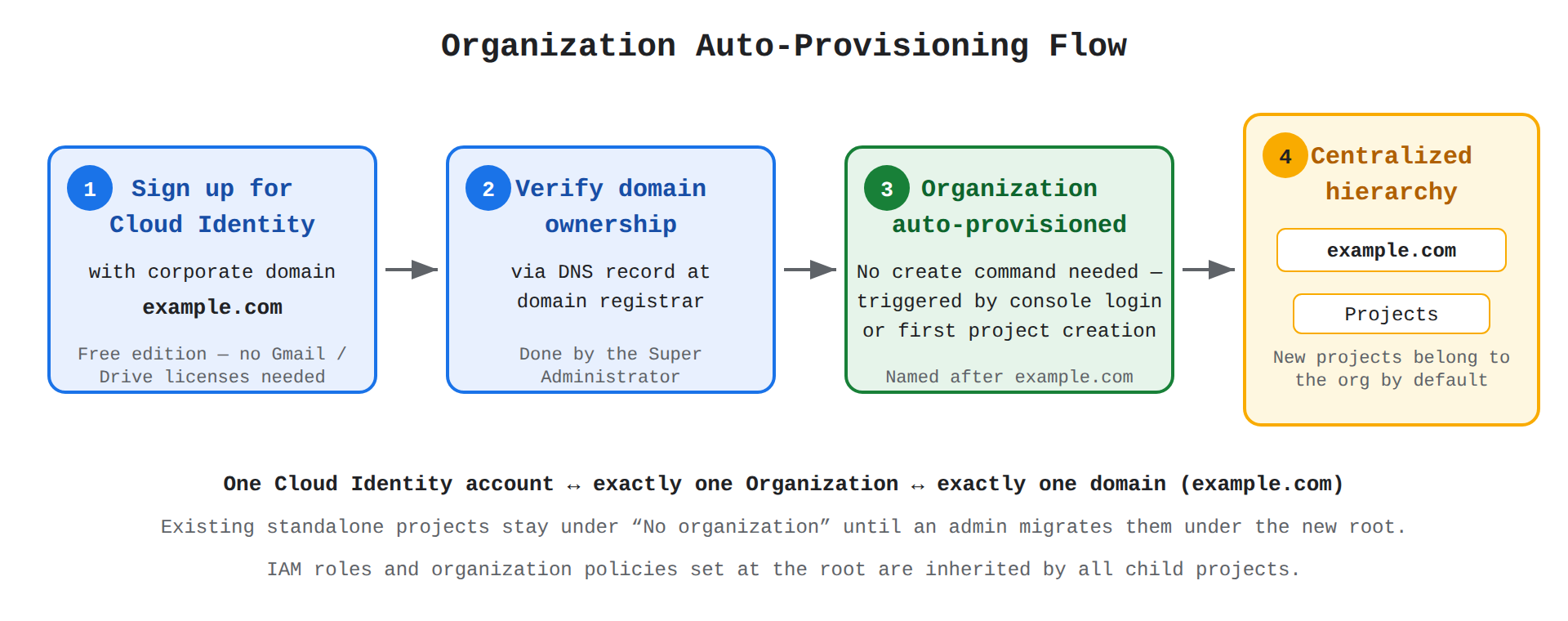
Key Advantages and Capabilities
- Automatic Provisioning: Once domain ownership is verified in Cloud Identity, Google Cloud automatically provisions the Organization resource.
- Separation of Roles: The initial domain administrator can designate a dedicated Organization Administrator (
roles/resourcemanager.organizationAdmin) to handle cloud IAM policies while keeping domain management distinct. - Policy Inheritance: Enables centralized governance through IAM role inheritance and Organization Policy constraints across all downstream folders and projects.
- Cost Efficiency: Cloud Identity Free edition provides identity management and the Organization root at zero licensing cost.
Why This Is Optimal
Cloud Identity directly satisfies the need for a centralized root hierarchy and corporate identity management without the overhead or ongoing license cost of an office productivity suite.
Link all standalone projects to a single shared Cloud Billing account to automatically generate the Organization resource.
Link all standalone projects to a single shared Cloud Billing account to automatically generate the Organization resource.
What Cloud Billing Accounts Do
A Cloud Billing account is a financial construct that tracks resource usage costs across one or more Google Cloud projects and connects to a Google payments profile to pay for accrued charges.
Why It Doesn't Meet the Requirement
- Billing Accounts Are Not IAM Parents: Cloud Billing accounts are linked to projects for cost tracking and invoicing, but they are not structural parents in the IAM resource hierarchy. Projects do not inherit IAM permissions from linked billing accounts.
- No Organization Generation: Linking standalone projects to a shared billing account does not create an Organization resource. In a no-organization state, multiple unmanaged projects can link to the same billing account while remaining completely uncentralized from an administrative and governance standpoint.
- Identity Missing: A Cloud Billing account does not manage corporate identities, verify domain names, or provide a top-level security boundary.
Key Characteristics and Limitations
- Resource Associations: A single Cloud Billing account can pay for projects across different organizations or standalone projects.
- Permissions Boundary: Granting billing roles (such as Billing Account User or Billing Account Administrator) provides authority over billing functions, but does not grant project management or organization-level administration rights.
This Answer Would Be Correct If
The objective was solely to consolidate payment methods and centralize invoice generation across multiple projects without altering the IAM resource hierarchy or establishing domain identity governance.
Try 10 interactive questions like this one, free
Answer them yourself and get your score the moment you finish. No account needed.
Full access includes
- 2,014 practice questions across all 4 exam domains
- Every answer explained: why it is right, and why the others are not
- Scout, an AI tutor that answers your follow-up questions
- Readiness tracking by domain, so you know when to book the exam
Related free sample questions
Keep the momentum going with these hand-picked practice scenarios
FundamentalAssociate Cloud Engineer
Organization Administrator vs Billing Account Administrator
Setting up standalone organizations
FundamentalAssociate Cloud Engineer
Folder-Level Project Creator and Billing Account User
Creating a resource hierarchy
FundamentalAssociate Cloud Engineer
Private GKE Cluster with Master Authorized Networks
Deploying a GKE cluster with different configurations (e.g., GKE Autopilot, regional clusters, private clusters)
FundamentalAssociate Cloud Engineer
Cloud SQL Query Insights Index Advisor
Using cloud diagnostics to research an application issue (e.g., Cloud Trace, Cloud Profiler, Query Insights, index advisor)
FundamentalAssociate Cloud Engineer
Organization Policy Service Constraints
Using Active Assist to optimize resource utilization
IntermediateProfessional Cloud Database Engineer
Terraform Cloud VCS-Driven Workspaces
Automate database instance provisioning
Last updated