Intermediate
Prepare and test your skills
Intermediate
Prepare and test your skills
VPC Service Controls Perimeter with Time Limited Signed URLs
Free sample question, answered and explained below. The Professional Cloud Architect practice bank has 2,335 more like it. Try 10 free: instant score, no account.
An enterprise stores proprietary financial analytics data inside private Cloud Storage buckets located in a dedicated project. The organization has two key security requirements:
- Prevent data exfiltration risks, such as unauthorized users or compromised credentials attempting to copy sensitive data to external Cloud Storage buckets outside organizational boundaries.
- Provide external auditing firms with temporary, time-limited access to specific financial datasets without creating dedicated Google Workspace or Cloud Identity accounts for external users.
Which architectural strategy should you implement to satisfy both requirements?
Explanations
Enclose the Cloud Storage project within a VPC Service Controls service perimeter, and generate Signed URLs with short expiration times for external auditors to access specific objects.
Enclose the Cloud Storage project within a VPC Service Controls service perimeter, and generate Signed URLs with short expiration times for external auditors to access specific objects.
What VPC Service Controls and Signed URLs Are
VPC Service Controls allows organizations to create secure network and service perimeters around sensitive Google Cloud resources, such as Cloud Storage, preventing multi-tenant service communication from crossing perimeter boundaries. Signed URLs provide time-limited, cryptographically signed access to specific Cloud Storage objects without requiring the recipient to possess Google Cloud Identity credentials or direct Identity and Access Management (IAM) roles.
How It Meets the Requirements
- Exfiltration Prevention: Placing the storage project within a VPC Service Controls perimeter guarantees that Cloud Storage APIs are shielded at the network layer. Even if an insider obtains valid credentials, VPC Service Controls blocks requests attempting to transfer or copy data to unmanaged storage buckets outside the designated perimeter.
- Temporary External Access: Generating Signed URLs allows external auditors to perform HTTP
GETrequests against designated files for a predetermined lifespan (e.g., 60 minutes). This avoids persistent IAM role assignments or tenant account provisioning.
VPC Perimeter Blocks Exfiltration, Signed URLs Allow Auditors
System Architecture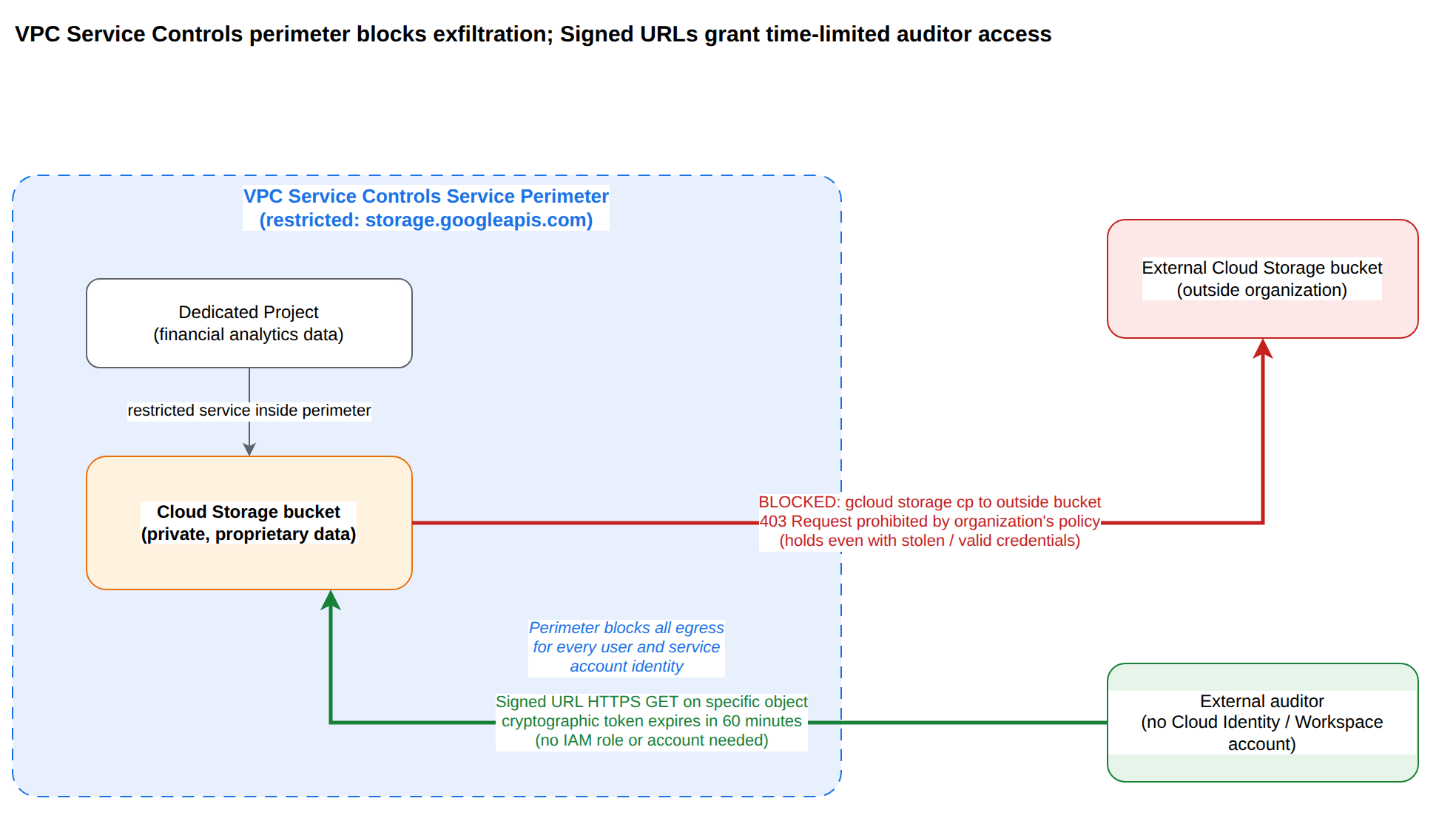
Key Advantages
- Context-Aware Security: Mitigates credential theft risks by enforcing perimeter boundaries regardless of user IAM permissions.
- No Account Overhead: External entities do not need corporate directory accounts or Google Workspace identities.
- Granular Least Privilege: Signed URLs restrict access specifically to target URI paths and single objects rather than exposing entire buckets.
- Built-in Expiration: Access automatically expires after the cryptographic token timeout without manual revocation.
Why This Is Optimal
This architecture pairs foundational perimeter defense against data exfiltration with temporary, zero-footprint delegation of access to external partners.
Enable Data Security Posture Management (DSPM) in Security Command Center, and attach Object Lifecycle Management rules to auto-delete objects after 24 hours.
Enable Data Security Posture Management (DSPM) in Security Command Center, and attach Object Lifecycle Management rules to auto-delete objects after 24 hours.
What This Option Is
This solution activates Data Security Posture Management (DSPM) within Security Command Center (SCC) to discover sensitive assets, and uses Object Lifecycle Management to purge data 24 hours after creation.
Why It Doesn't Meet the Requirement
- Destructive Deletion: Deleting the objects after 24 hours destroys the primary dataset rather than granting a temporary viewing window to an external user while preserving the organization's files.
- Passive Posture vs. Active Perimeter: DSPM detects sensitive data posture issues and monitors compliance frameworks, but it does not proactively isolate the Cloud Storage service inside an enforceable exfiltration boundary.
- No External Access Channel: Lifecycle rules and DSPM do not generate secure download links for third-party auditors.
Key Limitations
- Object Lifecycle Management permanently purges underlying business analytics data.
- DSPM provides visibility, reporting, and posture analytics rather than data-plane access control.
This Answer Would Be Correct If
The requirement was to automatically detect sensitive data exposure risks across organizational projects and enforce data retention limits on temporary log files.
Deploy Private Service Connect endpoints in a Shared VPC host project, and assign the roles/storage.objectViewer IAM role to a public Google Group containing the external auditors.
Deploy Private Service Connect endpoints in a Shared VPC host project, and assign the roles/storage.objectViewer IAM role to a public Google Group containing the external auditors.
What This Option Is
This configuration uses Private Service Connect (PSC) to expose Google APIs or managed services over private internal IP addresses within a Shared VPC, while granting the roles/storage.objectViewer role to a Google Group.
Why It Doesn't Meet the Requirement
- Persistent IAM Exposure: Granting the
roles/storage.objectViewerrole provides ongoing, persistent access to all objects in the bucket rather than time-limited, object-specific access. - No Boundary Protection: Private Service Connect provides internal routing to APIs but does not establish a security boundary to prevent exfiltration across distinct projects or unmanaged storage targets unless combined with a VPC Service Controls perimeter.
- External Account Dependency: Adding external auditors to a Google Group requires external Google accounts and does not enforce automatic expiration on specific dataset downloads.
Key Characteristics
- Private Service Connect targets private VPC routing rather than authorization management.
- IAM group bindings remain active indefinitely until manually modified or removed.
This Answer Would Be Correct If
The primary objective was to enable private, RFC 1918 internal connectivity from on-premises systems to Google APIs without traversing the public internet.
Configure uniform bucket-level access on the Cloud Storage buckets, and apply Cloud Armor security policies directly to the bucket storage endpoints.
Configure uniform bucket-level access on the Cloud Storage buckets, and apply Cloud Armor security policies directly to the bucket storage endpoints.
What This Option Is
This approach relies on uniform bucket-level access (UBLA) to unify IAM permissions across all objects within the bucket, while attempting to attach Google Cloud Armor edge security policies directly to Cloud Storage endpoints.
Why It Doesn't Meet the Requirement
- Cloud Armor Endpoint Incompatibility: Google Cloud Armor policies attach to external Application Load Balancers, not directly to standard multi-tenant Cloud Storage regional API endpoints.
- Exfiltration Vulnerability: Uniform bucket-level access controls permissions inside the bucket but does not restrict data movement across Google Cloud project boundaries. An authorized user with read access in Project A and write access in external Project B could still copy data out.
- No External Temporary Mechanism: UBLA alone does not provide a mechanism for unauthenticated or non-IAM external parties to securely fetch files temporarily.
Key Limitations
- Cannot prevent authorized identities from copying data to external buckets without VPC Service Controls.
- Does not eliminate the need for Google Cloud user identity provisioning for external auditors.
This Answer Would Be Correct If
You needed to standardize bucket permissions exclusively via IAM policies and protect web application frontends behind an external Application Load Balancer from DDoS attacks.
Try 10 interactive questions like this one, free
Answer them yourself and get your score the moment you finish. No account needed.
Full access includes
- 2,335 practice questions across all 6 exam domains
- Every answer explained: why it is right, and why the others are not
- Scout, an AI tutor that answers your follow-up questions
- Readiness tracking by domain, so you know when to book the exam
Related questions
Keep the momentum going with these hand-picked practice scenarios
IntermediateProfessional Cloud Architect
CMEK Service Agent CryptoKey Encrypter/Decrypter Role
Security and access management
IntermediateProfessional Cloud Architect
Uniform Bucket-Level Access
Security and access management
IntermediateProfessional Cloud Architect
Global External Load Balancer with Regional MIGs Auto-Healing
High availability and fail-over design
IntermediateProfessional Cloud Architect
Cloud Deploy Skaffold deploy.statusCheck
Deployment and release management
IntermediateProfessional Cloud Architect
NotebookLM Source Grounding
Integrating Gemini Enterprise features (AI Agents and NotebookLM) to enhance workflows
AdvancedProfessional Cloud DevOps Engineer
Workload Identity Federation for Cloud KMS
Key management (e.g., Cloud Key Management Service)
Last updated