Intermediate
Prepare and test your skills
Intermediate
Prepare and test your skills
Uniform Bucket-Level Access with Least-Privilege IAM
Free sample question, answered and explained below. The Professional Cloud Architect practice bank has 2,335 more like it. Try 10 free: instant score, no account.
A financial enterprise is deploying an automated transaction processing application on Compute Engine virtual machines (VMs). The application needs to read input batch files from a raw ingestion Cloud Storage bucket and write processed summary outputs to a designated archive bucket.
The security architecture must satisfy the following compliance requirements:
- Centralize and simplify access governance by managing all permissions exclusively through Identity and Access Management (IAM) policies, disabling per-object Access Control Lists (ACLs).
- Follow the principle of least privilege for the Compute Engine workload without relying on default service accounts or broad basic roles.
- Grant the finance administrator group (
grp-fin-admins@example.com) permission to administer bucket configurations and policies without granting full administrative rights across the entire project.
Which combination of actions should the cloud architect recommend?
Explanations
Configure fine-grained access with object-level ACLs on both buckets. Use the Compute Engine default service account with the basic Editor role for the VMs, and assign the project-level Owner role to the finance administrator group.
Configure fine-grained access with object-level ACLs on both buckets. Use the Compute Engine default service account with the basic Editor role for the VMs, and assign the project-level Owner role to the finance administrator group.
What This Approach Does
This option relies on fine-grained access control using object-level Access Control Lists (ACLs), keeps the default Compute Engine service account with basic Editor privileges, and grants project Owner permissions to administrators.
Why It Doesn't Meet the Requirement
- Fails Centralized Governance: Using fine-grained ACLs contradicts the explicit requirement to disable per-object ACLs and manage access exclusively through IAM allow policies.
- Violates Least Privilege for Workloads: Relying on the Compute Engine default service account with the basic Editor (
roles/editor) role grants broad read/write access across almost all Google Cloud services in the project rather than scoping permissions to specific storage buckets. - Over-Privileged Administration: Granting the project Owner (
roles/owner) role gives full control over billing, IAM policies, and all cloud services, far exceeding the requirement to manage storage configurations.
Key Characteristics and Limitations
- ACL Management Complexity: Object ACLs cannot be audited or managed easily at scale via centralized IAM policies.
- Excessive Blast Radius: Default service accounts shared across VMs introduce substantial privilege escalation and lateral movement risks.
- Basic Roles: Basic roles (Owner, Editor, Viewer) are legacy constructs that provide overly coarse permissions across all resources in a project.
This Answer Would Be Correct If
This design would only be applicable in a legacy development prototype where individual file ownership must be transferred among heterogeneous external accounts using legacy S3-compatible APIs and fine-grained ACL mechanisms.
Enable Uniform Bucket-level Access on both buckets. Create a dedicated user-managed service account attached to the VMs, and grant it predefined Cloud Storage object roles on each bucket. Assign the Storage Admin predefined role to the finance administrator group on the buckets.
Enable Uniform Bucket-level Access on both buckets. Create a dedicated user-managed service account attached to the VMs, and grant it predefined Cloud Storage object roles on each bucket. Assign the Storage Admin predefined role to the finance administrator group on the buckets.
What Uniform Bucket-level Access and Dedicated IAM Roles Provide
Uniform Bucket-level Access disables object-level Access Control Lists (ACLs) across a Cloud Storage bucket, ensuring that access to all objects in the bucket is managed uniformly and exclusively through Google Cloud Identity and Access Management (IAM). Coupling this with user-managed service accounts and predefined IAM roles establishes least-privilege security tailored to application workloads.
Least-Privilege Bucket IAM Grants
System Architecture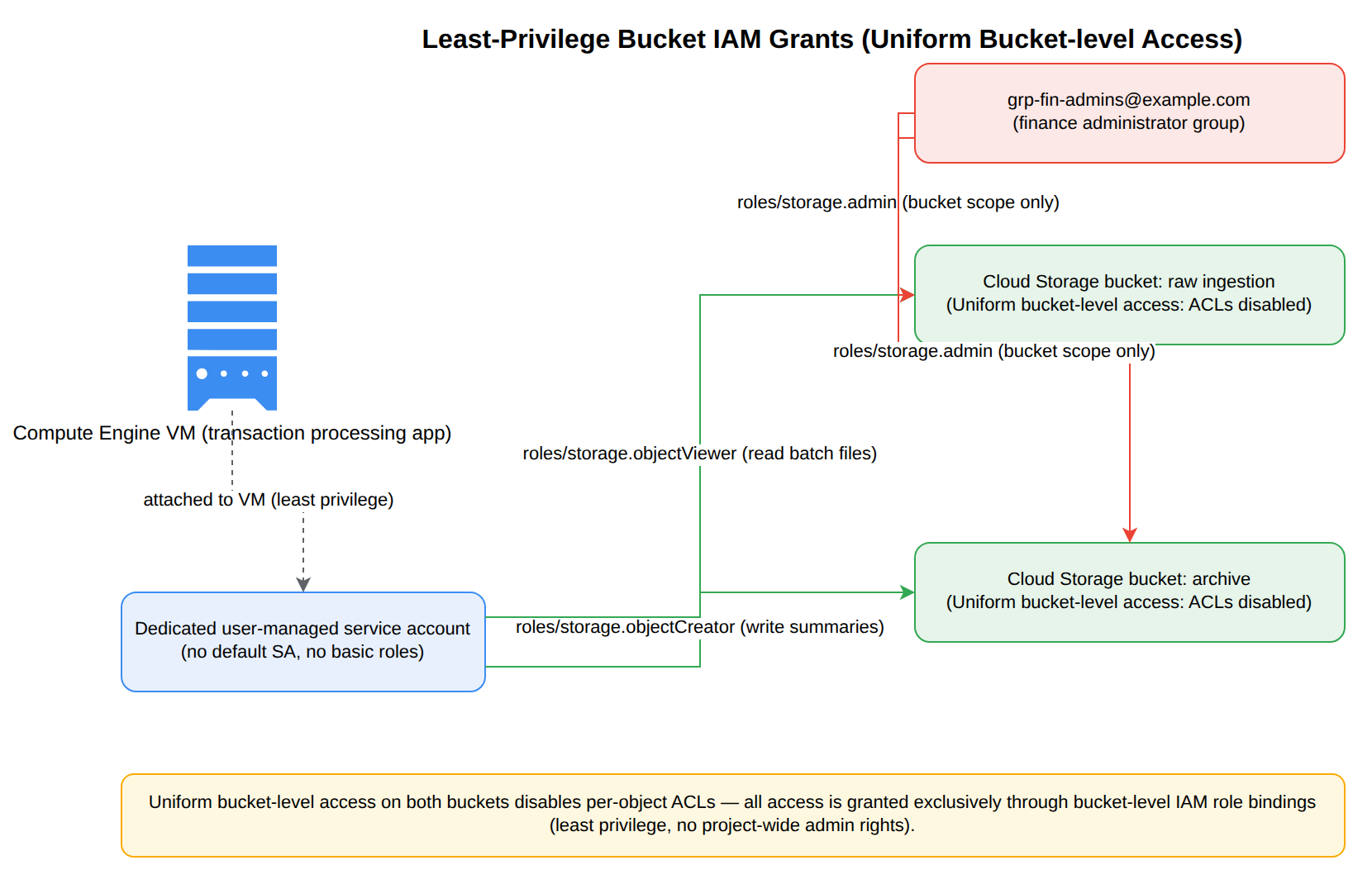
How It Meets the Requirements
- Simplified and Centralized Administration: Enabling Uniform Bucket-level Access on the ingestion and archive buckets completely disables per-object ACLs. This ensures access is evaluated purely through Cloud IAM allow policies, eliminating configuration drift and unintended public exposure.
- Workload Least Privilege: Creating a dedicated user-managed service account attached to the Compute Engine instances replaces the overly broad default Compute Engine service account. Granting specific predefined roles (such as
roles/storage.objectVieweron the raw data bucket androles/storage.objectCreatororroles/storage.objectUseron the archive bucket) ensures the VM can only access required resources. - Scoped Administrative Delegation: Granting the predefined Storage Admin role (
roles/storage.admin) togrp-fin-admins@example.comat the bucket or storage level gives them full administrative control over storage resources without exposing project-wide management rights.
Key Advantages and Capabilities
- Consistent Access Control: Prevents users and applications from accidentally or maliciously granting public or unauthorized access via object ACLs.
- Enhanced Auditability: All access determinations flow through IAM, simplifying compliance tracking with Cloud Audit Logs.
- Isolation of Application Identities: Single-purpose service accounts ensure that permissions do not accumulate across multiple distinct workloads.
- Fine-Grained Predefined Roles: Avoids high-privilege basic roles like
roles/editororroles/owner.
Why This Is Optimal
This solution adheres directly to Google Cloud security best practices by combining IAM-only bucket security with dedicated service accounts and role-based access control, eliminating the maintenance complexity of ACLs while strictly enforcing least privilege.
Maintain fine-grained access on both buckets, and use Cloud Storage object ACLs to grant read access on raw files and write access on archive files. Grant the finance administrator group the project-level Editor role.
Maintain fine-grained access on both buckets, and use Cloud Storage object ACLs to grant read access on raw files and write access on archive files. Grant the finance administrator group the project-level Editor role.
What This Approach Does
This option retains fine-grained object ACLs to specify read and write permissions on individual files in Cloud Storage, while assigning the project-wide basic Editor role to the finance administrator group.
Why It Doesn't Meet the Requirement
- Fails Uniform Access Requirement: Maintaining fine-grained access allows object-level ACLs to override bucket-level governance, contradicting the goal of centralized IAM management.
- Administrative Over-Privilege: Assigning the project Editor role (
roles/editor) allows administrators to modify all computing, networking, and security resources in the project rather than scoping access to storage administration. - Operational Overhead: Managing permissions via object-level ACLs requires setting access rules on every uploaded object, leading to management overhead and potential access inconsistencies.
Key Characteristics and Limitations
- Bypasses IAM Policy Inheritance: Fine-grained access permits ACL manipulation at the object level, bypassing project-level and bucket-level IAM policies.
- Lack of Least Privilege: Project-level basic roles grant expansive permissions that violate organizational security separation of duties.
This Answer Would Be Correct If
The application required per-object access management where distinct end-users own and individually grant access to individual files within a single shared bucket.
Enable Uniform Bucket-level Access on both buckets. Download a service account JSON private key, embed it in the VM startup script, and grant the service account the basic Viewer role at the project level.
Enable Uniform Bucket-level Access on both buckets. Download a service account JSON private key, embed it in the VM startup script, and grant the service account the basic Viewer role at the project level.
What This Approach Does
This option enables Uniform Bucket-level Access but authenticates the VM by downloading and embedding a long-lived service account JSON key into a startup script, while assigning the basic Viewer role (roles/viewer) at the project level.
Why It Doesn't Meet the Requirement
- Security Risk with Static Keys: Using exported service account private keys on Compute Engine VMs violates security best practices. Compute Engine instances can securely attach service accounts directly via the instance metadata server without downloadable keys.
- Violates Workload Permissions: The basic Viewer role grants read access to all resources across the entire project, while simultaneously preventing the VM from writing processed output files to the archive bucket.
- Missing Administrator Permissions: This option fails to configure administrative access for the finance administrators group (
grp-fin-admins@example.com).
Key Characteristics and Limitations
- Credential Leakage Hazard: Hardcoding or embedding JSON keys in startup scripts or disk images creates high exposure risks for credential theft and non-repudiation issues.
- Coarse Basic Permissions: The basic Viewer role does not provide fine-grained control and fails to accommodate write/create operations on storage buckets.
This Answer Would Be Correct If
Exported service account keys are generally only acceptable for workloads hosted outside of Google Cloud on-premises or in other clouds where Workload Identity Federation cannot be configured.
Try 10 interactive questions like this one, free
Answer them yourself and get your score the moment you finish. No account needed.
Full access includes
- 2,335 practice questions across all 6 exam domains
- Every answer explained: why it is right, and why the others are not
- Scout, an AI tutor that answers your follow-up questions
- Readiness tracking by domain, so you know when to book the exam
Related questions
Keep the momentum going with these hand-picked practice scenarios
IntermediateProfessional Cloud Architect
CMEK Service Agent CryptoKey Encrypter/Decrypter Role
Security and access management
IntermediateProfessional Cloud Architect
VPC Service Controls and Signed URLs
Security and access management
IntermediateProfessional Cloud Architect
Migrate to Virtual Machines Test Clones
Data and system migration and management tooling
IntermediateProfessional Cloud Architect
Google Cloud APM Suite
Observability
IntermediateProfessional Cloud Architect
Eventarc Private Network Access
Serverless computing
FundamentalAssociate Data Practitioner
Cloud SQL Read Replicas
Determine when to use replication
Last updated