Fundamental
Prepare and test your skills
Fundamental
Prepare and test your skills
Customer Data Control Privacy and Governance
Customizable Solutions and Agent Deployment is the use of pre-built and adjustable AI building blocks to tailor generative AI to an organization's needs while keeping architectural control. Cloud Run (opens in a new tab) is the serverless container platform that hosts these solutions, including intelligent agents. Because teams package their own code and dependencies in containers, they can connect the AI workload to other Google Cloud services and shape it for specific operational requirements.
Why Cloud Run Fits AI Workloads
Why Cloud Run fits AI workloads is its combination of flexible packaging, network access, scaling, hardware acceleration, and built-in connections to data and security services. A team deploys a Cloud Run service or instance and receives a secure Cloud Run URL endpoint that clients call over HTTP. Streaming for interactive AI responses is supported through HTTP chunked transfer encoding, HTTP/2, and WebSockets. The platform handles much of the operations work while the team keeps control of the container and architecture.
Cloud Run provides the following features for AI applications:
- Flexible container support: Package an app with its libraries and dependencies and use any supported language, library, or framework.
- HTTP endpoint: Expose each service or instance through a secure Cloud Run URL that supports streaming.
- Automatic or manual scaling: Scale Cloud Run services automatically based on demand and pay only for what is used, or set services to manual scaling.
- GPU support: Attach GPUs to Cloud Run resources to accelerate AI models, with GPU-enabled services able to scale down to zero when idle.
- Integrated ecosystem: Connect to Vertex AI (opens in a new tab), BigQuery, Cloud SQL, Memorystore, Pub/Sub, AlloyDB for PostgreSQL, Cloud CDN, Secret Manager, and custom domains, with monitoring and logging from Google Cloud Observability.
- Enterprise controls: Use direct VPC connectivity and granular security and networking controls to keep the workload inside enterprise boundaries.
Exam tip: Cloud Run services scale automatically based on demand or can use manual scaling, while Cloud Run instances do not autoscale and run as singletons that are started and stopped manually.
Hosting AI Agents and Chatbots on Cloud Run
Hosting AI agents and chatbots on Cloud Run means running the backend logic that orchestrates model calls, manages state, and integrates with tools and APIs. An agent receives a user request at its Cloud Run endpoint, calls an AI model such as Gemini on Vertex AI, and then calls tools, APIs, or data sources before returning an answer. This separation keeps the agent logic in the customer-controlled container while the model runs as a managed capability.
Three patterns support agent development on Cloud Run:
- Microservices for agents: Deploy individual agent capabilities as separate Cloud Run services or instances that call each other.
- Agent2Agent (A2A) communication: Build collaborative systems where agents communicate using the A2A protocol.
- Model Context Protocol (MCP) servers: Implement MCP servers that provide standardized context to large language models (LLMs) from tools and data sources.
Securing Agents and Supporting Other AI Workloads
Securing agents and supporting other AI workloads on Cloud Run extends the same container and networking controls to agents, retrieval systems, and APIs. Cloud Run integrates with Agent Platform to provide built-in capabilities for AI agents, MCP servers, and tools. That integration helps organizations secure agent deployments without giving up control over how services are packaged, connected, and scaled.
Beyond agents, Cloud Run supports several other AI workloads:
- Serve AI/ML models for inference: Host a packaged model behind an HTTP endpoint for predictions.
- Build Retrieval-Augmented Generation (RAG) systems: Combine model calls with retrieval from enterprise data.
- Host AI-powered APIs and backends: Run the application backend that calls models and data services.
- Prototype and experiment: Quickly deploy and test new AI ideas in containers.
Data Privacy, Security, and Governance Protocols are the rules, controls, and services that keep customer data under customer control in Google Cloud. They define who may access data, how data is encrypted, how violations are detected, and which independent standards verify the controls. A central commitment is that data stored on Google systems belongs to the customer and is not used to train foundation models without permission.
Data Ownership and AI Training Limits
Data ownership and AI training limits define what Google may and may not do with customer data. Data stored on Google systems belongs to the customer, and Google does not scan it for advertising, sell it to third parties, or use it to train AI models without permission. The Data Processing Addendum for Google Cloud states that Google will not process data for any purpose other than meeting contractual obligations. If use of the services stops, tools allow data to be taken elsewhere without penalty or additional cost.
Administrative Access and Transparency Controls
Administrative access and transparency controls determine when Google employees can reach customer data and how that access is recorded. Google logically isolates each customer's data from other customers even when data shares the same physical server. Only a small group of employees can access customer data, with access rights based on job function and role using least privilege and need-to-know. Requests for additional access follow a formal process with approval from the data or system owner, manager, or other executives, while workflow tools keep audit records and security, privacy, and internal audit teams monitor access.
Access Approval (opens in a new tab) and Access Transparency work together to control and record support access. Access Transparency logs administrative access by authorized Google personnel when they support an organization or maintain service availability. Access Approval requires customer approval before an authorized Google administrator can access data for support, and approved requests are logged with Access Transparency logs linked to the approval request. After approval, access must still be properly privileged within Google before it is permitted, and support is provided only to authorized customer administrators.
Exam tip: Access Transparency records administrative access after it happens, while Access Approval requires explicit customer approval before an authorized Google administrator can access data.
Encryption and Isolation Controls
Encryption and isolation controls protect customer data at rest, in transit, and in use while keeping keys and data separated when required. Cloud KMS with Cloud EKM (opens in a new tab) lets data be encrypted with keys stored and managed in a third-party key management system outside Google infrastructure, so data at rest stays separate from keys while cloud compute and analytics can still be used. Confidential Computing encrypts data in use during processing. BigQuery automatically encrypts all data at rest and in transit while allowing customized encryption settings.
Network isolation adds defense in depth around the data. Only authorized services and protocols that meet security requirements may traverse Google's network, while firewalls and access control lists enforce network segregation. Traffic is routed through GFE servers to detect and stop malicious requests and distributed denial-of-service (DDoS) attacks. Logs are examined for exploitation of programming errors, and access to networked devices is restricted to authorized employees.
Incident Detection and Response Cycle
The incident detection and response cycle is the ordered process Google uses to find and handle suspected access violations. It combines expert investigation teams with manual and automated controls that use machine learning, data processing pipelines, and threat intelligence. Each stage feeds the next, so signals become detections, detections become investigations, and investigations improve future protections.
Incident Response Cycle in 4 Steps
Process Flow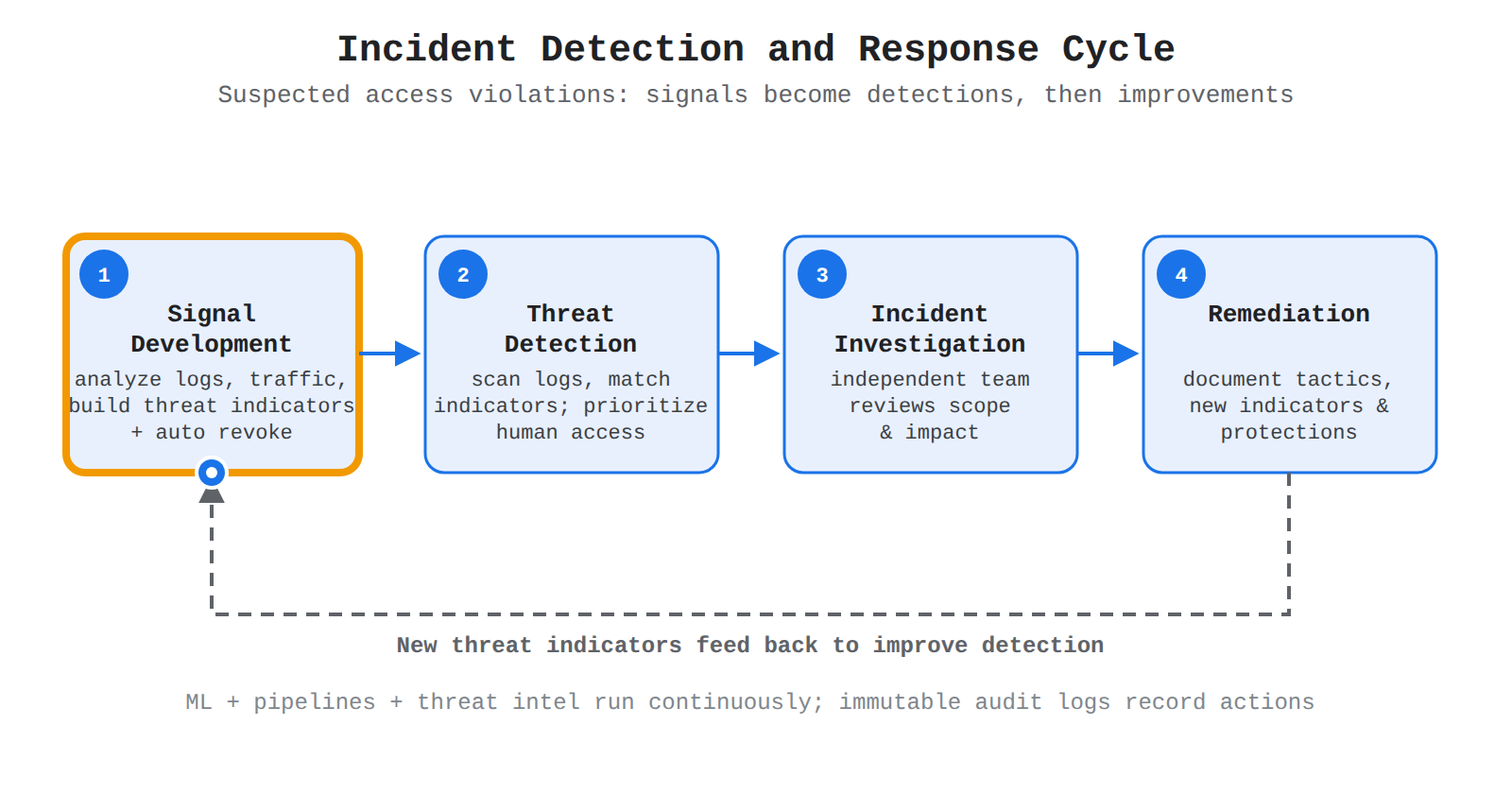
A left-to-right process flow showing Signal Development to Threat Detection to Incident Investigation to Remediation, with a feedback loop returning new threat indicators to the start.
- Signal development: Build threat intelligence from past incidents, network traffic, internal data, system access logs, anomalous behavior, offensive security exercises, and proprietary alerts, with dedicated teams producing a dynamic database of threat indicators used to build detection systems that monitor systems, alert staff, and trigger automated responses such as revoking access.
- Threat detection: Scan logs and match entries to threat indicators, using strong authentication to separate human events, service events, and service impersonation events so investigations prioritize real human access, with access to user data, source code, and sensitive information logged and requiring business justification or an exception.
- Incident investigation: Have security teams separate from engineering and operations review whether access was intentional, unintentional, accidental, caused by a bug or misconfiguration, or caused by inadequate controls, remediating unintentional access immediately and escalating suspected malicious behavior with collection of data and system access logs to determine scope and impact.
- Remediation: Document all incidents and extract metadata to identify tactics, techniques, and procedures for each exploit, then develop new threat indicators, reinforce protections, or request security improvements, with AI actions during response recorded in immutable audit logs.
Compliance and Governance Frameworks
Compliance and governance frameworks are independent certifications, attestations, and audit reports that verify Google Cloud security, privacy, and compliance controls. Key international standards include ISO/IEC 27001 for information security management, ISO/IEC 27017 for cloud security, ISO/IEC 27018 for cloud privacy, and ISO/IEC 27701 for privacy, with SOC 2 and SOC 3 reports available to customers. Sector and country programs include FedRAMP for the US government, BSI C5 for Germany, and MTCS for Singapore.
Assured Workloads (opens in a new tab) helps enterprises that need dedicated regional support, certified programs such as FedRAMP or ITAR, or programs such as Sovereign Controls for EU. It provides an enablement workflow to create and monitor the lifespan of required control packages. For law enforcement requests, the data owner is primarily responsible for responding, Google reviews direct government and court requests for legal validity, requests generally must be in writing under appropriate law and signed by an authorized official, and Google notifies the customer unless prohibited by law or court order. Third-party suppliers are assessed for security and privacy before onboarding and must accept security, confidentiality, and privacy contract terms.
Services That Control Google Access to Data
Services that control Google access to data give customers technical ways to require approval, record access, enforce regulatory controls, manage keys, or protect data in use. Each service sits between Google administrators or infrastructure and customer data, so support flows from a Google request to customer control to logged access.
| Google Cloud service | Control it provides |
|---|---|
| Access Approval | Requires customer approval before an authorized Google administrator can access data for support, with approved requests logged and linked to Access Transparency logs |
| Access Transparency | Logs administrative access by authorized Google personnel during support or maintenance of service availability |
| Assured Workloads | Provides workflow to create and monitor control packages for regional support and regulatory programs such as FedRAMP, ITAR, or Sovereign Controls for EU |
| Cloud KMS with Cloud EKM | Encrypts data with keys managed outside Google infrastructure while still allowing cloud compute and analytics |
| Confidential Computing | Encrypts data in use during processing |
Data Governance and Sharing in BigQuery
Data governance and sharing in BigQuery (opens in a new tab) applies privacy, security, and governance principles to analytics without losing control of the data. BigQuery audit logs record user activity and system events to enforce governance policies and identify risks. Data masking obscures sensitive values while allowing access to surrounding data. Access controls include predefined roles, custom roles, row-level and column-level controls, VPC Service Controls perimeters, and Sensitive Data Protection scans for personally identifiable information (PII), financial data, and health information.
BigQuery sharing allows data owners to share insights within and across organizational boundaries while retaining control. Shareable assets include datasets, tables, views, real-time streams with Pub/Sub topics, SQL stored procedures, and BigQuery ML models. Data owners define rules or policies that restrict access and usage. Live, zero-copy sharing shares data in place with no movement or replication through linked datasets that act as live pointers to the shared asset. Publishers can monitor usage metrics such as jobs executed, total bytes scanned, and subscribers, and data clean rooms allow collaboration on sensitive data.
Model Ecosystem and Selection Flexibility is the ability to choose among leading first-party models and open-source alternatives based on performance, cost, and transparency needs while keeping data under customer control. A diverse ecosystem avoids locking users into a single model and lets different workloads use different models. Google Cloud applies the same security, privacy, and governance protections regardless of which model is selected.
Why Model Choice Gives Control
Why model choice gives control is that different models offer different tradeoffs, so the workload determines the selection instead of platform limits. A team can select a high-capability first-party model when accuracy and managed features matter most, or select an open model when inspection, portability, and customization matter most. This flexibility ties the decision to performance, cost, and transparency needs while the same data protections continue to apply underneath.
How Customer Data Stays Under Customer Control
How customer data stays under customer control is through ownership rules, contractual limits, and infrastructure isolation that apply behind any model. Stored customer data belongs to the customer, and Google Cloud does not scan it for advertising, sell it to third parties, or use it to train AI models without permission. The Data Processing Addendum states that Google will not process data for any purpose other than meeting contractual obligations, and tools support moving data elsewhere without penalty or additional cost when service use stops.
Administrative isolation reinforces ownership on shared infrastructure. Each customer's data is logically isolated from other customers even on the same physical server, and only a small group of employees can access customer data. Access follows least privilege and need-to-know tied to job function and role, with extra access requiring a formal request and approval workflow that maintains audit records. Dedicated security, privacy, and internal audit teams monitor employee access, with visibility provided through logging and approval controls.
Services That Monitor and Restrict Support Access
Services that monitor and restrict support access give users visibility into Google administrator activity and technical means to limit it. These services sit between Google administrators and customer data, so a support request flows from Google personnel to customer approval to logged, privileged access.
- Access Approval requires customer approval before an authorized Google administrator can access highly sensitive or restricted data for support, with approved requests logged and linked to Access Transparency logs and access still requiring proper privilege inside Google.
- Access Transparency (opens in a new tab) logs administrative access by authorized Google personnel when they support an organization or maintain service availability.
- Assured Workloads provides an enablement workflow to create and monitor control packages for dedicated regional support, certified programs such as FedRAMP or ITAR, or programs such as Sovereign Controls for EU.
- Cloud KMS with Cloud EKM (opens in a new tab) encrypts data with keys stored in a third-party system outside Google infrastructure, separating data at rest inside Google Cloud from keys outside it while allowing compute and analytics.
- Confidential Computing (opens in a new tab) encrypts data in use to protect data during processing.
Exam tip: Access Transparency logs Google administrator access, while Access Approval requires customer approval before that access is permitted.
Incident Response Cycle Behind Any Model Choice
The incident response cycle behind any model choice protects data through a continuous loop from signals to detection to investigation to improvement. Threat intelligence from past incidents, network traffic, access logs, anomalous behavior, and offensive security exercises feeds detection systems that monitor internal systems, alert staff, and trigger automated responses such as revoking access to a resource. The same cycle applies no matter which first-party or open model the workload uses.
- Signal development: Analyze incidents, logs, and alerts in dedicated teams to produce a dynamic database of threat indicators used across Google.
- Threat detection: Scan logs and match entries to threat indicators, with strong authentication separating human, service, and service impersonation events to prioritize real human access, while access to user data, source code, and sensitive information is logged and requires business justification or an exception.
- Incident investigation: Have security teams separate from engineering and operations determine whether access was intentional, unintentional, accidental, caused by a bug or misconfiguration, or caused by inadequate controls such as stolen credentials, remediating unintentional access directly and escalating suspected malicious behavior with log collection to determine scope and impact.
- Remediation: Document incidents and extract metadata to identify tactics, techniques, and procedures for each exploit, then develop new indicators, reinforce protections, or request security improvements.
Key Facts
- Cloud Run hosts customizable AI solutions and agents in containers with automatic scaling, GPU support, secure HTTP endpoints, and connections to Vertex AI, BigQuery, Cloud SQL, and other Google Cloud services.
- Customer data stored on Google systems belongs to the customer and is not used to train AI foundation models without permission.
- Access Transparency logs administrative access by authorized Google personnel, while Access Approval requires customer approval before that access is permitted.
- Cloud KMS with Cloud EKM separates data at rest inside Google Cloud from encryption keys managed outside Google infrastructure, while Confidential Computing encrypts data in use.
- BigQuery governance uses audit logs, data masking, row-level and column-level controls, and live zero-copy sharing so data owners retain control while sharing insights.
Frequently Asked Questions
What is the difference between Access Transparency and Access Approval in Google Cloud?
Access Transparency logs administrative access by authorized Google personnel when they support an organization or maintain service availability, while Access Approval requires customer approval before an authorized Google administrator can access data for support. Approved requests are logged with Access Transparency logs linked to the approval request, and access must still be properly privileged within Google before it is permitted.
How does Cloud Run host AI agents and other AI workloads?
Cloud Run hosts AI agents, chatbots, and other AI workloads in containers that expose a secure Cloud Run URL endpoint over HTTP with streaming support and connect to services such as Vertex AI, BigQuery, Cloud SQL, Memorystore, Pub/Sub, AlloyDB for PostgreSQL, Cloud CDN, and Secret Manager. It offers flexible container packaging, automatic scaling based on demand or manual scaling, GPU support that can scale down to zero when idle, direct VPC connectivity, and granular security and networking controls. Beyond agents, it supports serving AI/ML models for inference, building Retrieval-Augmented Generation (RAG) systems, hosting AI-powered APIs and backends, and prototyping new AI ideas.
How does Google Cloud ensure customer data is not used to train AI models without permission?
Data stored on Google systems belongs to the customer, and Google does not scan it for advertising, sell it to third parties, or use it to train AI models without permission. The Data Processing Addendum for Google Cloud states that Google will not process data for any purpose other than meeting contractual obligations, and tools allow data to be taken elsewhere without penalty or additional cost if use of the services stops.
Sample Question
An enterprise is designing a corporate generative AI strategy across multiple departments with differing requirements:
- The marketing team requires access to leading, fully managed first-party foundation models with cutting-edge multimodal capabilities for content creation.
- The data privacy and engineering team requires open-weight models that allow deep customization, code inspectability, and cost-effective hosting on private infrastructure.
What is the primary strategic advantage of leveraging a diverse model ecosystem that combines first-party foundation models and open-source alternatives?
How learners score on this domain
Last updated