Fundamental
Prepare and test your skills
Fundamental
Prepare and test your skills
Secure and Responsible Gen AI Business Strategies
4.1 Describe the Google Cloud-recommended steps to successfully implement a transformational gen AI solution
Matching Solution Types and Modalities to Business Needs
Matching solution types to business needs means choosing the output type that solves the problem and then choosing the Google Cloud model built for that output. Foundation models are large models trained on vast text, image, video, and audio that predict likely responses and generate new content. Vertex AI (opens in a new tab) provides access to these models through a managed API and Vertex AI Model Garden, so teams do not train from scratch. Text, image, code, video, music, and personalized conversational experiences are the main solution types, and personalized solutions often combine several types with enterprise data.
The choice of model follows the modality produced:
| Modality | Google Cloud model or function | Output produced |
|---|---|---|
| Text | Gemini, AI.GENERATE, AI.GENERATE_TEXT | Written answers, summaries, structured data |
| Image | Imagen | Generated or edited images and captions |
| Code | Pre-trained code generation models | Code predictions, unit tests, retrieval embeddings |
| Video and music | Veo, Lyria | High-resolution video, music with vocals |
Gemini models handle text and multimodal work, Imagen generates and edits images, Veo generates video, and Lyria generates music. Imagen can edit with a mask, add content with inpainting, and produce captions, while Vision AI analyzes images that already exist. Text generation in BigQuery uses AI.GENERATE as a flexible scalar function and AI.GENERATE_TEXT as a table-valued version that requires a remote model first.
Personalized Search, Agents, and Tool Connections
Personalized search and agents are systems that combine foundation models with enterprise data to give specific, reasoned answers. A personalized virtual agent synthesizes historical support cases, websites, product documentation, inventory, emails, and old chats into conversational responses. A multi-agent AI system (opens in a new tab) can split work across cooperating agents, while intelligent search finds information by meaning rather than exact words.
Meaning-based search depends on embeddings and retrieval-augmented generation (RAG). An embedding is a numerical representation of text, image, or video as arrays of floating point numbers called vectors, where closer vectors mean similar meanings. The RAG retrieval flow runs in fixed order: first the user query is converted into an embedding, then the query embedding is compared with document embeddings in a knowledge base, then a similarity search retrieves the most relevant documents for the response. Function calling then connects large language models (LLMs) to external tools such as APIs, databases, and customer relationship management systems:
LLM Function Calling in 6 Steps
Sequence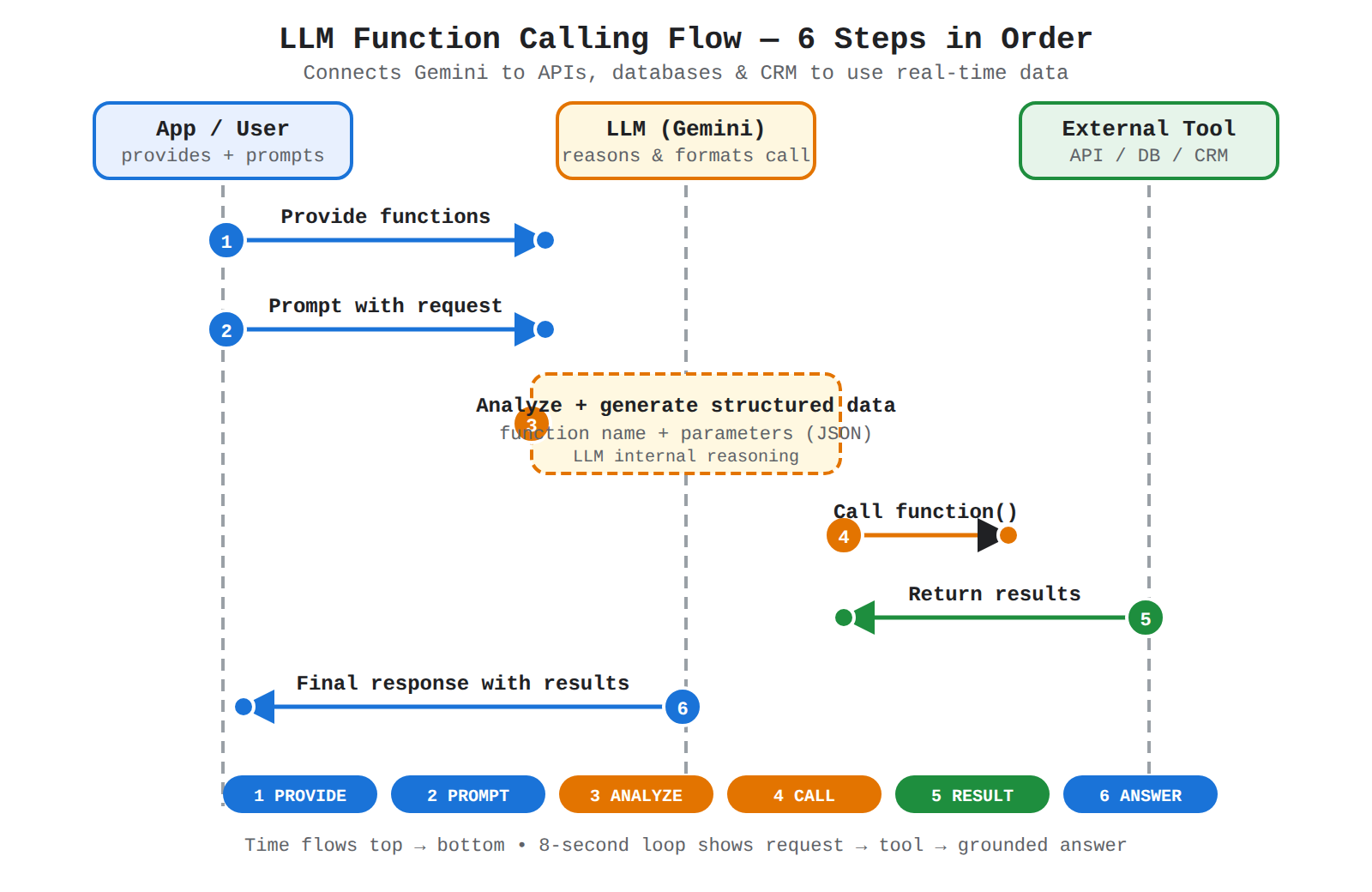
A sequence diagram with App/User, LLM (Gemini), and External Tool lifelines showing the six function-calling messages in order: provide functions, prompt, analyze and generate structured call, call function, return results, and final response. Animation moves dots along each arrow in order.
- Provide the model with a set of functions.
- Prompt the model with a request.
- The model analyzes the prompt and generates structured data with function name and parameters.
- The structured output calls the function.
- The function returns results to the model.
- The model incorporates results into its response.
A large context window lets the solution handle more enterprise context at once. A 1-million-token window can process 50,000 lines of code, 8 average English novels, or about 9.5 hours of audio.
Business Goals, Technical Limits, and Governance Guardrails
Identifying generative AI needs means working backward from measurable business goals and then checking technical and regulatory limits. Common goals include increasing efficiency, reducing cost while keeping quality, improving customer experience, and creating competitive advantage. Return on Investment (ROI) proves value through direct financial gains such as revenue or cost savings, operational efficiency such as faster time-to-market, and customer experience such as satisfaction and retention. Machine learning best practices (opens in a new tab) start with this goal-first check before any model is chosen.
Technical constraints decide which model and platform can deliver the goal. The three main constraints are data quality and readiness, latency requirements, and computational cost. These constraints determine whether the team uses a pre-trained traditional model, a custom-trained traditional model, or a generative AI model, and whether it runs on Vertex AI, Google Kubernetes Engine (GKE), or Compute Engine:
| Option | When to choose | Data requirement |
|---|---|---|
| Pre-trained traditional AI model | Classification or detection where Document AI or Vision AI already meets needs | No custom training data needed |
| Custom-trained traditional AI model | Pre-trained model fails and high control is priority | Enough training data to custom train |
| Generative AI with prompt engineering | No dataset exists, datasets are too small, or speed matters | Can start with prompts, optional tuning |
Regulatory and security rules shape scope from the start by limiting which data can be ingested, where data can be stored, and who can access it. For RAG applications, private connectivity keeps traffic inside trusted boundaries instead of the public internet. Responsible AI adds human review, such as review before generated marketing content is uploaded to Cloud Storage, plus feedback loops so the model learns from impact over time.
Exam tip: Choose a pre-trained or managed service when generalized categories fit the need, and choose Vertex AI tuning only when the business requires custom labels, custom entities, or control over the model and prompt.
Choosing Build-Versus-Buy and Bringing AI to Governed Data
Build-versus-buy is the decision between calling a ready-made pre-trained service and building a custom model on company data. The buy path calls models Google already trained through an API, so traffic flows from the application to the Google-hosted model and back with upkeep staying with Google. The build path trains or tunes on company data with Vertex AI, which unifies AutoML and AI Platform for custom labels and entities. Buying is faster and optimized for cost and quality, while building is slower and pays for training but gives full control over model, prompt, and parameters.
Bringing AI to governed data reduces movement by running AI where the data already lives under existing controls. BigQuery ML lets SQL practitioners train, evaluate, and run inference with GoogleSQL inside BigQuery. General-purpose functions give full control over model, prompt, and parameters and include AI.GENERATE, AI.GENERATE_TEXT, AI.GENERATE_TABLE, AI.GENERATE_BOOL, AI.GENERATE_DOUBLE, and AI.GENERATE_INT. Managed functions use streamlined syntax where BigQuery chooses the model to optimize cost and quality and include AI.IF for filtering, AI.SCORE for rating, AI.CLASSIFY for classifying, and AI.AGG for summarizing. AI.COUNT_TOKENS estimates tokens before execution to forecast cost and stay within limits.
Selecting foundation models via Vertex AI Model Garden means balancing performance, latency, and cost. Performance is how well the model handles the task, latency is how fast it responds, and cost grows with how much text the model processes. Partner models and open models give alternatives when license or cost fits better. Reliability (opens in a new tab) depends on both the model and the underlying compute, storage, and networking, with token tracking and monitoring to manage spend and errors. Generative AI security best practices (opens in a new tab) guide how these models are deployed without exposing sensitive data.
Integrating Data, Use Cases, and Change Management
Integration combines trusted data, governed infrastructure, high-value use cases, and change management in one ordered framework. Data readiness means data is accurate, complete, relevant, secure, and accessible to approved teams. Google Cloud organizes distributed data without forcing it into one place through Knowledge Catalog for lakes and zones, BigQuery sharing for exchanges and clean rooms, Agent Platform Feature Store for reusable tabular features, Cloud Storage for unstructured data, and Vector Search for embeddings. Reuse avoids redundant engineering and lowers cost.
Strategic use-case identification works backward from outcome to technology in five steps: define the business goal and success criteria with ROI and compliance limits, decide the type of AI or whether AI is needed, define user experience expectations, connect the solution to business requirements, and identify required business process changes. Traditional AI learns from historical data to classify or predict, while generative AI summarizes and generates new content. A common combined pattern feeds traditional AI output into a generative prompt, such as forecasting churn and letting a chatbot explain it. Change follows plan, then design, then implementation, because design depends on the plan and implementation depends on the design.
Measuring Technical Performance and Business Value
Measuring impact means separating how well the system runs from what it delivers to the organization. Technical performance metrics are model-centric measurements such as accuracy, latency, and token count, while business value metrics are Key Performance Indicators (KPIs) such as cost savings, revenue, and time-to-market acceleration. Token usage is technical, but token usage multiplied by pricing becomes a tracked business cost. Engineers use technical signals to tune prompts and models, while leaders use business signals to decide whether to continue, expand, or stop.
Qualitative feedback at scale turns surveys and transcripts into structured signals with managed functions. AI.IF narrows the dataset with natural language conditions, AI.CLASSIFY sorts input into human-defined categories, AI.SCORE rates quality or sentiment, and AI.AGG summarizes the result. Long-term ROI compares cumulative value against cumulative cost over time. Vertex AI evaluation follows a fixed order: define the evaluation specification with model, prompts, and metrics, evaluate against test data or references, and retrieve metrics such as ROUGE for summarization quality. BigQuery tracks token and query costs where data lives, and Looker visualizes both sides together.
Protecting the Machine Learning Lifecycle From Data to Deployment
Security throughout the machine learning lifecycle means protecting models, data, and inference systems from ingestion through training, deployment, and monitoring. Gemini Enterprise Agent Platform (opens in a new tab) provides a secure and governed environment to develop and deploy models with Google Cloud security controls for models and training data. A weakness at any stage — exposed data, unverified code, open endpoints, or missing monitoring — can lead to data theft, model misuse, or disruption. The lifecycle therefore hardens infrastructure, filters traffic, verifies builds, governs data, locks access, and watches behavior continuously.
Hardening infrastructure places model deployments inside network boundaries and exposes predictions only through controlled paths. VPC Service Controls (VPC-SC) creates a security perimeter around Google Cloud resources, so a model deployment inside the boundary rejects outside requests unless explicitly allowed. Not every feature inherits the same protections:
| Feature | Data residency at-rest | Customer-managed encryption key (CMEK) | VPC Service Controls (VPC-SC) | Access Transparency (AXT) |
|---|---|---|---|---|
| Gemini Enterprise Agent Platform | Yes | Yes | Yes | Yes |
| RAG Engine | No | No | Yes | No |
| Vector Search | Yes | No | Yes | No |
A workflow that depends on RAG Engine must rely on VPC-SC for isolation because it cannot rely on CMEK or Access Transparency. Google Cloud Armor filters hostile traffic at the edge, so traffic flows from the internet to Google Cloud Armor first and only filtered traffic flows onward to the web application or inference API. Security Command Center aggregates findings, while Web Security Scanner scans web applications for common vulnerabilities.
Verifying builds ensures only trusted code runs near models and data. The Supply-chain Levels for Software Artifacts (SLSA) framework defines checks for source, build, and provenance, while Binary Authorization enforces provenance by allowing only verified workloads to run. Governing training data follows an ordered flow: first define confidential data such as credit card numbers and personally identifiable information (PII), then classify with Sensitive Data Protection, then tag, tokenize, or de-identify before storage. Data flows from ingestion through Sensitive Data Protection for masking, then to Dataplex Catalog, then to storage and training, so only masked values move forward.
Exam tip: Choose Gemini Enterprise Agent Platform when you need all four controls, but remember RAG Engine supports only VPC-SC.
Google Secure AI Framework Pillars and AI-Specific Defenses
The Secure AI Framework (SAIF) is a set of principles that extends traditional security to generative AI and harmonizes controls across organizational boundaries. SAIF treats prompt injection, data poisoning, and harmful generation as system-level risks from input through model behavior to output. Prompt injection hides a malicious instruction in input to make the model ignore rules, data poisoning corrupts training or retrieval data, and harmful generation produces dangerous, harassing, or explicit content. SAIF organizes defense into six peer pillars:
- Expand strong security foundations to the AI ecosystem.
- Extend detection and response to bring AI into the threat universe.
- Automate defenses to keep pace with existing and new threats.
- Harmonize controls to maximize security and accelerate adoption.
- Adapt controls to adjust mitigations and create faster feedback loops.
- Contextualize AI system risks in surrounding business processes.
Foundations support detection and automation, harmonization aligns controls across teams, adaptation updates controls as systems change, and contextualization ties risk to business processes. Automated defenses in Vertex AI evaluate every generation with safety settings and block unsafe output without human review. Data flows from the application to the Gemini model as a package with user prompt, optional system instruction, and safety settings, and the model returns candidates with text plus safety ratings for category, blocked status, probability, and severity. When a rating meets its threshold, generation is blocked before reaching the user. The example uses BLOCK_LOW_AND_ABOVE, a sensitive threshold that blocks even low-probability harm, for HARM_CATEGORY_DANGEROUS_CONTENT, HARM_CATEGORY_HARASSMENT, HARM_CATEGORY_HATE_SPEECH, and HARM_CATEGORY_SEXUALLY_EXPLICIT.
Business value comes from treating secure AI as strategy, not only technology. The same secure foundation covers a customer chatbot and a finance forecast even though goals differ, which avoids one-off fixes and helps leaders decide what is safe to scale. Contextualizing risk in daily workflows prioritizes protections where fraud, leakage, or incorrect customer outputs would cause greatest harm.
Shared Responsibility and Tools for Identity and Threat Detection
The shared responsibility model divides cloud security into protecting the cloud itself and protecting what the customer puts in the cloud. Google is always responsible for underlying infrastructure, while the customer is always responsible for their own data:
| Service model | Google's responsibility | Customer's responsibility |
|---|---|---|
| IaaS | Hardware, storage, and network | Everything above hardware, storage, and network, including data |
| SaaS | Everything except data and its access and usage | Data and its access and usage |
Secure-by-design infrastructure builds security into servers, operating system, network, and data centers with defense in depth. Physical safeguards strengthen closer to the data center floor with fencing, badges, biometrics, cameras, and guards, while servers omit unneeded parts and use Titan chips for authentication and full disk encryption.
Identity controls enforce least privilege so every identity gets only needed permissions. Identity and Access Management (IAM) attaches permissions to roles for users, service accounts, and workloads, with phishing-resistant sign-in and context-aware zero-trust checks for identity, device, and location. Google personnel have no default access to customer data, and privileged access requires justification plus multi-party approval. Access Approval requires customer approval before access, while Access Transparency logs that access afterward.
Centralized detection collects signals for triage and response. Security Command Center (opens in a new tab) aggregates and prioritizes findings, with AI Protection discovering models, datasets, and applications and detecting hijacking and exfiltration. Threat services send findings for prioritization, including Event Threat Detection for malware and exfiltration, Container and Cloud Run Threat Detection for runtime attacks, and agentic AI (opens in a new tab) threat detection for agents on the agent platform. Google Security Operations provides security information and event management (SIEM) to scan logs and security orchestration, automation, and response (SOAR) to manage cases. Platform logs are always collected, audit logs must be enabled, and Access Transparency logs record Google-side access.
Transparency, Explainability, and Google AI Principles
Responsible AI and transparency explain why safe, fair, and understandable AI is needed for business trust and sustainable use. Generative AI on Vertex AI is designed with Google's AI Principles, but safe use still depends on how each team tests, customizes, and deploys its models. Large language models (LLMs) are highly versatile, so responses are difficult to predict and must be checked before and after launch. A model stays in an untested state until prompts and customizations are evaluated, then moves to a validated state only after testing shows acceptable performance.
Google's AI Principles require safety, fairness, and social benefit. Safety means proactively testing models and verifying inputs before deployment, avoiding unfair bias means not creating unfair outcomes through data or prompts, and social benefit means building user-centric solutions that stay relevant and drive adoption. Transparency makes behavior, limitations, data, and outputs clear enough to verify for decisions, while interpretability explains how and why a model produced a result. Model choice trades control for speed: custom training of traditional AI can provide explainability with control over algorithm and hyperparameters, while generative AI offers faster go-to-market with less detailed control.
Evaluation, grounding, and function calling make outputs measurable and verifiable. Evaluation needs a dataset with prompt and ground-truth pairs aligned to the task, grounding connects outputs to verifiable sources to reduce hallucinations, and retrieval-augmented generation (RAG) retrieves external information to enhance responses. Two evaluation methods differ in scale and context:
| Evaluation method | How it works | Strength | Limitation |
|---|---|---|---|
| Metrics-based evaluation | Uses quantifiable metrics | Automated and scalable | Can miss context or nuance |
| Side-by-side evaluation | Compares two models; a third model picks higher quality | Quicker than human review | Judging model can have bias; still needs human checks |
Privacy Controls With Anonymization and Pseudonymization
Privacy considerations recognize how sensitive data can leak through prompts, outputs, and memorized training data. Customer data belongs to the customer and is not used to train models without permission, not scanned for advertising, and not sold. Google Cloud limits access, logs administrative access, encrypts data at rest and in use, and detects violations. Data risk management asks what kind of data a workload handles, whether data is exposed to the right users for an approved purpose, and whether minimization and obfuscation can reduce risk. Sharing with more people and environments increases exposure because data is stored in more places.
Pseudonymization hides an identifier but preserves referential integrity for analysis. Data flows from the collecting team through pseudonymization to the analytics team to the model, creating a trust boundary. A structured identifier such as a customer email used as a primary key is replaced by tokenization with a consistent token. The analytics team never sees the email but can still group reviews by the same customer. Utility stays high, but re-identification risk remains if the mapping is exposed, so access controls must separate the mapping from tokenized data.
Anonymization inspects data and masks or removes sensitive values so the person cannot be recovered. Freeform product reviews may contain intermittent phone numbers and addresses in unstructured text, which the protection service scans and masks before sharing. The analytics team keeps meaning without receiving the sensitive values:
| Approach | What happens to data | Utility preserved | Re-identification risk |
|---|---|---|---|
| Pseudonymization with tokenization | Structured PII replaced with consistent token | High for per-customer aggregation | Reduced, but reversible if mapping exposed |
| Anonymization with masking | Sensitive values in unstructured text masked | High for content analysis, low for linking | Lower, because value cannot be recovered |
Google Cloud controls add visibility and encryption. Access Transparency logs administrative access by Google personnel, while Access Approval blocks that access until the customer approves it first. Cloud KMS with Cloud EKM encrypts with keys outside Google infrastructure, Confidential Computing encrypts data in use, and VPC Service Controls creates a perimeter around resources with row-level, column-level, and masking controls in BigQuery.
Exam tip: Tokenize structured identifiers when you must keep referential integrity across records; mask unstructured findings when you must remove them entirely.
Data Quality, Bias, and Human Oversight for Fair Outcomes
Data quality, bias, and fairness explain how data problems affect reliability and ethical outcomes. A model is only as good as the data it receives, so inaccurate, incomplete, or irrelevant data leads to false summaries and decisions. Accuracy means data and prompts correctly represent facts, completeness means enough data exists to learn, and relevance means data matches the task with RAG adding relevant facts. All three matter at once because accuracy controls truthfulness, completeness controls learning, and relevance controls fit.
Algorithmic bias produces discriminatory results from problems in data, design, or use. Representation bias occurs when groups are missing or underrepresented, so the model performs poorly for those groups. Historical bias occurs when data reflects past discrimination, so the model repeats unfair patterns. The difference is source: representation bias is about who is included, while historical bias is about what past treatment the data records.
Data quality applies across the generative lifecycle in fixed order: first prompt design authors prompt and response pairs, then customization builds a dataset for tuning if prompts are not enough, then evaluation tests against prompt and ground-truth pairs, then grounding connects the model to verifiable sources, then responsible use verifies safe behavior. Each later stage depends on the earlier one. Human oversight keeps incident response (opens in a new tab) accountable: during identification models correlate alerts, during investigation agents recommend resolutions but only suggest them, and during resolution models are prohibited from executing commands directly and must generate structured payloads that pass validation and receive explicit human confirmation with immutable audit logs.
Accountability for AI Decisions and Actions
Accountability and explainability show who is responsible for AI outcomes and how decisions can be checked. Accountability defines ownership, monitoring, and review, while explainability shows reasons behind predictions so customers, regulators, and leaders can evaluate fairness and manage risk. The business-value decision process connects requirements to choice in order: first define business goal and success criteria, then determine whether generative AI, traditional AI, or no AI is needed, then identify user experience expectations, then connect the solution to executive priorities, and finally identify business process changes. ROI is measured through financial gains, operational efficiency, and customer experience alongside security and regulatory constraints identified up front.
Interpretability and transparency make predictions reviewable. Model interpretability explains a prediction in terms a non-technical stakeholder can understand, such as main factors behind a loan approval, while transparency discloses training data, intended use, confidence, and limits. Clear justifications, bias checks, and error detection create a cycle of prediction, explanation, and review, with feature attributions showing which inputs most influenced a forecast.
Identity-based accountability ties every AI action to an owner through permissions. Identity and Access Management (IAM) gives permissions to users, service accounts, and AI agents, where a service account is a non-human identity an application uses to call Google Cloud APIs. Because every agent acts under an identity, every action can be logged and traced. Detection watches environments and raises findings in Security Command Center: Event Threat Detection watches control-plane activity, Container Threat Detection watches Kubernetes workloads, Cloud Run Threat Detection watches Cloud Run, and Agent Platform Threat Detection watches agents. Discovery findings show probing, execution findings show code run, and persistence and privilege escalation findings show attempts to keep or expand access. A human then decides whether to revoke permissions or confirm legitimacy.
Continue with this study guide: 4.3 Describe the importance of responsible AI in business
Key Facts
- Personalized generative AI combines conversational agents, meaning-based search with embeddings and retrieval-augmented generation (RAG), and function calling to external tools to answer from enterprise data.
- If a pre-trained traditional AI model meets requirements use it, and if no training dataset exists or datasets are too small use generative AI with prompt engineering rather than custom training.
- VPC Service Controls creates a security perimeter that blocks outside requests to model deployments unless explicitly allowed, while Google Cloud Armor filters hostile traffic at the edge before it reaches inference APIs.
- The Secure AI Framework (SAIF) organizes AI security into six pillars covering foundations, detection, automation, harmonization, adaptation, and business context to stop prompt injection, data poisoning, and harmful generation.
- Pseudonymization replaces structured identifiers with consistent reversible tokens that preserve linkability, while anonymization masks sensitive values so they cannot be recovered.
Frequently Asked Questions
When should I use a pre-trained traditional AI model instead of generative AI with prompt engineering?
Use a pre-trained traditional AI model for classification or detection when Document AI or Vision AI already meets the need because no custom training data is needed. Use generative AI with prompt engineering when no dataset exists, datasets are too small, or speed matters because work can start with prompts and optional tuning.
What is the difference between pseudonymization with tokenization and anonymization with masking?
Pseudonymization with tokenization replaces structured identifiers such as a customer email with a consistent token that preserves referential integrity for analysis, while anonymization with masking scans unstructured text and masks sensitive values so the person cannot be recovered. Pseudonymization keeps high utility for per-customer aggregation but remains reversible if the mapping is exposed, while anonymization keeps high utility for content analysis with lower re-identification risk because the value cannot be recovered.
How does retrieval-augmented generation (RAG) retrieve relevant documents for a response?
Retrieval-augmented generation (RAG) follows a fixed order where the user query is first converted into an embedding, then the query embedding is compared with document embeddings in a knowledge base, and then a similarity search retrieves the most relevant documents for the response. An embedding is a numerical representation of text, image, or video as arrays of floating point numbers called vectors, where closer vectors mean similar meanings.
What risks does the Secure AI Framework (SAIF) address and how is the Secure AI Framework organized?
The Secure AI Framework (SAIF) treats prompt injection, data poisoning, and harmful generation as system-level risks from input through model behavior to output. It organizes defense into six peer pillars covering expansion of strong security foundations to the AI ecosystem, extension of detection and response, automation of defenses, harmonization of controls, adaptation of controls, and contextualization of AI system risks in surrounding business processes.
Subdomains
Explaining the importance of responsible AI and transparency means showing why safe, fair, and understandable AI is needed for business trust and sustainable use. Generative AI on Vertex AI (Gener…
Explaining security throughout the ML lifecycle means protecting models, data, and inference systems from ingestion through training, deployment, and monitoring. Gemini Enterprise Agent Platform p…
Recognizing the different types of generative AI solutions means matching the kind of output a business needs to the right Google Cloud model and pattern. Text, image, code, video, music, and personal…
How learners score on this domain
Last updated