Fundamental
Prepare and test your skills
Fundamental
Prepare and test your skills
SAIF Proactive Security Across the AI Pipeline
Free sample question, answered and explained below. The Generative AI Leader practice bank has 2,191 more like it. Try 10 free: instant score, no account.
A financial services organization is deploying generative AI applications to automate customer interactions and assist analysts with internal research. To defend against novel AI-specific risks, such as runtime prompt injection and training data poisoning, the security team implements Google's Secure AI Framework (SAIF).
How does adopting SAIF help the organization maintain a proactive security posture against these unique vulnerabilities?
Explanations
By removing access controls and input filtering layers to maximize model response speed and minimize operational latency during peak traffic.
By removing access controls and input filtering layers to maximize model response speed and minimize operational latency during peak traffic.
What removing controls and filtering entails
This approach prioritizes raw computational speed and low inference latency by stripping away security guardrails, input filters, sanitization checks, and identity access verifications.
Why it doesn't meet the requirement
- Maximizes vulnerability to prompt injection: Without input validation and filtering, attackers can easily manipulate the model into revealing system prompts, bypassing safety guidelines, or executing unintended actions.
- Increases risk of data leakage: Disabling least privilege access controls allows unauthorized users and processes to manipulate model artifacts, training sets, and sensitive business data.
- Violates core security principles: Removing controls directly contradicts security-by-design and framework-driven protections.
Key characteristics and limitations
- Leaves the entire AI attack surface exposed to malicious actors.
- Neglects regulatory compliance, data privacy laws, and governance requirements.
- Sacrifices system integrity, safety, and reliability for marginal gains in processing speed.
This answer would be correct if
The team were conducting an isolated, synthetic hardware benchmark in a secure sandbox where security controls were intentionally disabled solely to measure raw GPU throughput.
By relying solely on post-deployment manual audits and end-user incident reports after unverified model outputs have been generated.
By relying solely on post-deployment manual audits and end-user incident reports after unverified model outputs have been generated.
What manual post-deployment auditing is
Manual auditing and user feedback collection is a reactive approach where security teams periodically inspect system logs or wait for users to flag harmful, inaccurate, or hijacked model outputs after an event has already occurred.
Why it doesn't meet the requirement
- Purely reactive posture: It allows compromised outputs and active exploits to reach users before any intervention occurs, exposing the organization to significant operational, financial, and reputational risk.
- Unscalable across large workloads: Generative AI applications process thousands or millions of interactions daily, making human-only review infeasible for real-time risk mitigation.
- Fails to prevent pipeline poisoning: Manual audits at inference time cannot trace whether the underlying training data or model weights were subtly manipulated during the training lifecycle.
Key characteristics and limitations
- High latency in threat detection and incident response.
- Inability to block adversarial prompt injections at runtime before generation occurs.
- Relies on damage control rather than proactive defense and prevention.
This answer would be correct if
The objective was to perform retrospective quarterly compliance assessments or gather qualitative human feedback for user satisfaction evaluations.
By applying standard network perimeter firewalls and restricting AI security measures strictly to the underlying virtual machine host infrastructure.
By applying standard network perimeter firewalls and restricting AI security measures strictly to the underlying virtual machine host infrastructure.
What standard perimeter defense entails
Perimeter-based defense focuses on securing network boundaries using tools like traditional firewalls, bastion hosts, and virtual machine (VM) isolation. It monitors network ports and packets entering or leaving the hosting infrastructure.
Why it doesn't meet the requirement
- Inability to inspect application-layer AI payloads: Traditional network firewalls cannot interpret semantic language constructs, meaning they cannot detect a prompt injection hidden inside a legitimate HTTPS request.
- No data pipeline visibility: Perimeter tools do not evaluate whether training data has been poisoned with subtle bias or adversarial triggers during model fine-tuning.
- Ignores model-specific threats: AI systems introduce new attack surfaces—such as model inversion, extraction, and automated prompt jailbreaking—that easily bypass network-layer boundaries.
Key characteristics and limitations
- Operates at network layers (Layer 3/4) rather than application or model layers (Layer 7 / semantic level).
- Assumes all authenticated internal traffic or valid HTTPS payloads are benign.
- Lacks data provenance, model artifact lineage tracking, and automated input/output sanitization.
This answer would be correct if
The organization were only looking to secure traditional network boundaries against unauthorized IP access, DDoS attacks, or unauthenticated network scans on hosting compute clusters.
By automating defenses such as input validation and lineage tracking, while continuously adapting security controls across the entire AI pipeline lifecycle.
By automating defenses such as input validation and lineage tracking, while continuously adapting security controls across the entire AI pipeline lifecycle.
What Google's Secure AI Framework (SAIF) is
Google's Secure AI Framework (SAIF) is a conceptual framework designed to establish holistic, end-to-end security standards for artificial intelligence and machine learning applications. It translates modern cybersecurity practices into an actionable methodology tailored specifically to the unique risks introduced by AI systems, including generative models.
How SAIF meets the security requirements
SAIF addresses AI-specific risks like prompt injection and data poisoning by embedding proactive security mechanisms throughout every phase of the development and operational lifecycle:
- Automated input validation and sanitization: Defends runtime generative models against prompt injection, malicious instructions, and jailbreaking attempts before prompts reach model weights.
- Asset lineage and tracking: Enforces granular data and pipeline lineage to trace training datasets and artifacts, detecting any unauthorized tampering or data poisoning.
- Continuous monitoring and telemetry: Automatically evaluates both inputs and generated outputs in real time to capture anomalies and evolving threat vectors.
- Adaptive security controls: Ensures controls evolve dynamically as attack methods shift, rather than relying on static, one-time security checks.
SAIF Adaptive Pipeline Lifecycle Flow
Process Flow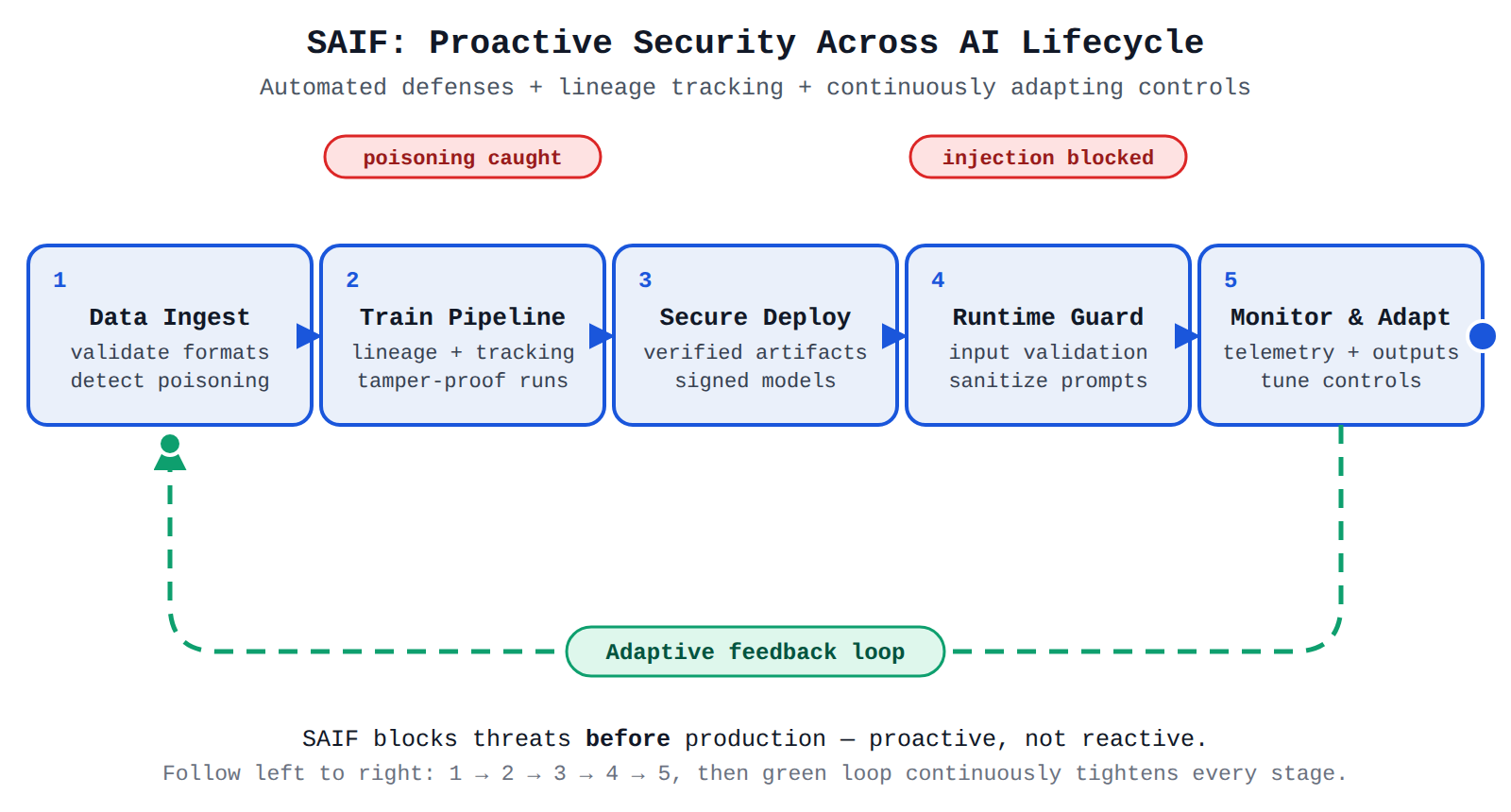
Key advantages and capabilities
- Comprehensive lifecycle protection: Secures data ingestion, training pipelines, model artifacts, deployment infrastructure, and user inference interfaces.
- Proactive threat response: Identifies and neutralizes adversarial inputs automatically without requiring manual intervention for every transaction.
- Robust provenance and governance: Verifies the integrity of training datasets, model weights, and code dependencies.
- Alignment with business goals: Balances strong protection with operational agility, allowing teams to deploy generative AI safely.
Why this approach is optimal
Adopting automated defenses and adaptive controls allows organizations to preemptively block threats at the input and pipeline stages. This strategy prevents compromised models from ever reaching production or generating harmful outputs, offering significantly stronger protection than traditional perimeter defenses or reactive post-incident reviews.
Try 10 interactive questions like this one, free
Answer them yourself and get your score the moment you finish. No account needed.
Full access includes
- 2,191 practice questions across all 4 exam domains
- Every answer explained: why it is right, and why the others are not
- Scout, an AI tutor that answers your follow-up questions
- Readiness tracking by domain, so you know when to book the exam
Related questions
Keep the momentum going with these hand-picked practice scenarios
FundamentalGenerative AI Leader
SAIF Security Foundations Pillar
Identifying the purpose and benefits of Google's Secure AI Framework (SAIF)
FundamentalGenerative AI Leader
Speech-to-Text Translation Document AI APIs
Identifying relevant Google Cloud services and pre-built AI APIs for agent tooling (e.g., Cloud Storage, databases, Cloud Functions, Cloud Run, Vertex AI, Speech-to-Text API, Text-to-Speech API, Translation API, Document Translation API, Document AI API)
FundamentalGenerative AI Leader
Iterative Prompt Engineering
Defining prompt engineering and describing its significance in interacting with large language models (LLMs)
FundamentalGenerative AI Leader
Cloud Storage BigQuery Dataflow Data Preparation
Identifying the stages of the machine learning lifecycle; data ingestion, data preparation, model training, model deployment, and model management; and the Google Cloud tools for each stage
FundamentalGenerative AI Leader
Vertex AI Enterprise Generative AI Platform
Describing how Google's AI-first approach and commitment to future innovation translate into cutting-edge gen AI solutions
IntermediateProfessional Cloud Architect
Workload Identity Federation and VPC Service Controls
Integration patterns with external systems
Last updated