Fundamental
Prepare and test your skills
Fundamental
Prepare and test your skills
Responsible AI, Transparency and Privacy in Business
Explaining the importance of responsible AI and transparency means showing why safe, fair, and understandable AI is needed for business trust and sustainable use. Generative AI on Vertex AI (Generative AI on Vertex AI (opens in a new tab)) is designed with Google's AI Principles in mind, but safe use still depends on how each team tests, customizes, and deploys its own models. Large language models (LLMs) are highly versatile, so their responses can be difficult to predict and must be checked for limitations, misuse, and unintended issues before and after launch. A model stays in an untested state until a team evaluates its prompts and customizations, then moves to a validated state only after testing shows acceptable performance.
Google's AI Principles for Safe and Fair Development
Google's AI Principles are foundational guidelines for building AI that is safe, fair, and beneficial for society. Safety means proactively testing models to ensure they are used safely and responsibly, including verifying that input data and prompts are accurate before deployment. Avoiding unfair bias means not creating or reinforcing unfair outcomes through data, prompts, or evaluation choices, because a model is only as good as the data it receives. Commitment to social benefit means building business-driven and user-centric solutions that stay relevant, drive adoption, enhance efficiency, and foster innovation.
Transparency and Interpretability for Trustworthy Outputs
Transparency and interpretability are two related practices that make generative AI understandable and trustworthy. Transparency means making a system's behavior, limitations, data, and outputs clear enough that people can verify them and use them for informed decision-making. Interpretability, also called explainability, is the ability to explain how a model reaches its output and why it produced a particular result. When interpretability is missing, stakeholders must accept outputs on faith, which increases risk and weakens ethical oversight.
Model choice creates a tradeoff between control and speed. Custom training of a traditional AI (opens in a new tab) model can provide explainability along with control over the algorithm, loss functions, number of layers, learning rate, and other hyperparameters. If faster go-to-market is the priority, generative AI may be chosen instead, with less detailed control and explainability. The choice therefore depends on how much understanding and control the use case requires.
Evaluation Grounding and Function Calling for Verifiable AI
Evaluation, grounding, and function calling are methods that make AI outputs measurable and verifiable. Evaluation assesses how prompts and customizations affect performance, and every evaluation needs an evaluation dataset with prompt and ground truth pairs that include diverse examples aligned with the task. Grounding connects a model's output to verifiable sources of information, which improves accuracy and reduces hallucinations where the model generates content that is not factual. Retrieval-augmented generation (RAG) is a common type of grounding that retrieves relevant external information to enhance responses, while function calling connects LLMs to external tools like APIs, databases, customer relationship management systems, and document repositories.
Two common evaluation methods differ in speed, scale, and context:
| Evaluation method | How it works | Strength | Limitation |
|---|---|---|---|
| Metrics-based evaluation | Uses quantifiable metrics to measure performance | Automated and scalable | Can oversimplify and miss context or nuance |
| Side-by-side evaluation | Compares two models against ground truth; a third model selects the higher-quality response | Quicker than human evaluators and on par with them | Requires a larger model that can have biases; still needs human evaluation |
Function calling follows an ordered flow that lets the model use real-time information beyond static knowledge. First, the team provides the model with a set of functions, then prompts the model. Next, the model analyzes the prompt and selects functions, then generates structured data that specifies which function to call and the parameter values. Finally, the structured output calls the function, the function returns results to the model, and the model incorporates those results into its response.
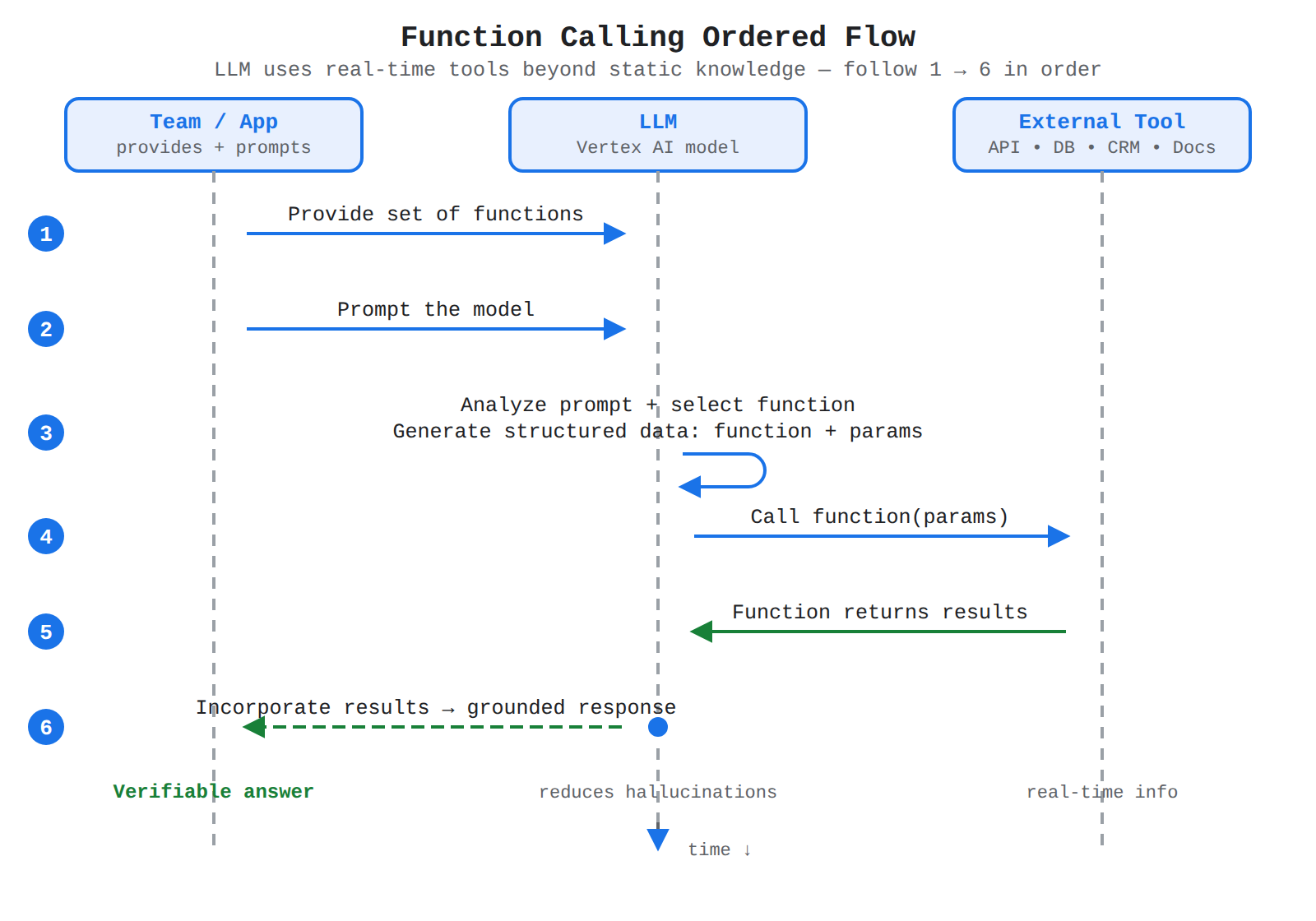
A sequence diagram with Team, LLM, and External Tool lifelines showing the six ordered function-calling steps from providing functions to grounded response. Animation highlights each step in order and moves a time dot downward.
Exam tip: Metrics-based evaluation is fast and quantifiable but can miss context; side-by-side evaluation is quicker than human review but still requires human checks because the larger judging model can introduce bias.
Ethical Governance and Shared Responsibility for Risk
Ethical governance is the set of policies, roles, and review steps that decide which AI use cases are allowed, how they are monitored, and who is accountable. A business-value decision starts with measurable business goals and success criteria, including return on investment (ROI), then checks whether AI is the right approach, identifies user expectations, and connects the solution to executive priorities. Business constraints such as security, privacy, industry compliance, and country regulatory requirements are identified up front, so legal and social harms become design requirements rather than afterthoughts.
Business risks and mitigations connect each category of harm to a governance action:
| Risk | How it harms the business | Governance or mitigation |
|---|---|---|
| Legal and regulatory | Fines, blocked deployments, noncompliance | Identify security, privacy, and regulatory requirements early |
| Reputational and trust | Loss of customer trust and brand damage | Use transparency and involve end users and domain experts |
| Operational and business | AI does not meet goals or ROI | Start with measurable goals and align with executive priorities |
| Social and environmental | Harm to communities or environment | Apply shared responsibility and optimize workloads |
Security and sustainability are shared across a provider boundary. Google is responsible for sustainability of Google Cloud, including energy efficiency and water stewardship of data centers and core services. The customer is responsible for sustainability in the cloud, which means optimizing workloads through right-sizing resources, using serverless services that scale to zero, and managing data lifecycles. Stakeholder input flows from business needs to model behavior to end use, with business leaders approving alignment, product owners aligning behavior, domain experts improving effectiveness, and end users applying outputs to decisions.
Continue with this study guide: Explaining the importance of responsible AI and transparency
Describing privacy considerations means recognizing how sensitive data can leak in generative AI workflows and knowing the controls that limit that exposure. Privacy risks appear where sensitive data moves through prompts, outputs, and training data memorized during fine-tuning. Google Cloud limits who can access customer data, logs administrative access, encrypts data at rest and in use, and detects and responds to access violations. Customer data belongs to the customer and is not used to train AI models without permission, not scanned for advertising, and not sold to third parties.
Data Risk Management and Privacy Exposure
Data risk management is the practice of storing, processing, and using data within a risk level that fits the business. Sensitive Data Protection (opens in a new tab), which includes Cloud Data Loss Prevention (Cloud DLP), focuses on discovering and classifying data, understanding exposure risk, and protecting data with controls or de-risking it through obfuscation. When a workload is evaluated, three questions define privacy risk: what kind of data it handles and whether any is sensitive, whether data is exposed to the right users in the right environment for an approved purpose, and whether risk can be reduced through data minimization and obfuscation. Sharing data with more people and more development environments increases exposure because data is stored and processed in more places.
Pseudonymization That Preserves Linkability
Pseudonymization is the technique that hides an original identifier but preserves referential integrity so analysis can still group records by the same person. Data flows from the collecting team to the analytics team to the machine learning model, and pseudonymization sits in between to reduce risk across that trust boundary. A common example is customer feedback where a structured identifier such as a customer email used as a primary key is replaced through tokenization. The analytics team never sees the actual email, yet the token stays consistent so the team can tell which reviews belong to the same customer and aggregate per customer.
Because the same token always stands for the same person, utility for training and analysis stays high. Re-identification risk is lowered but not removed, since someone with access to the original mapping could reverse the tokens. Pseudonymization therefore depends on access controls that keep the mapping separate from the tokenized dataset and limit who can see each side.
Anonymization That Removes Identifiability
Anonymization is the technique that inspects data and masks or removes sensitive values so the original person cannot be recovered from the shared dataset. Freeform product reviews are a clear example because unstructured text can contain intermittent sensitive data like phone numbers and addresses. The protection service scans the review text, finds those values, and masks them before the dataset is shared. The analytics team receives the meaning of the feedback without receiving the phone number or address inside it.
Comparing the two approaches shows how each balances re-identification risk against utility:
| Approach | What happens to the data | Utility preserved | Re-identification risk |
|---|---|---|---|
| Pseudonymization with tokenization | Structured PII such as customer email is replaced with a consistent token | High for per-customer aggregation | Reduced, but reversible if mapping is exposed |
| Anonymization with masking | Intermittent sensitive data in unstructured text is masked | High for content analysis, low for linking by identity | Lower, because masked value cannot be recovered |
Exam tip: Tokenize structured identifiers when you must keep referential integrity across records; mask unstructured findings when you must remove them entirely.
Google Cloud Controls for Data Access and Compliance
Google Cloud controls for data access give customers visibility into administrative access and control over encryption keys and regulated workloads. Access Transparency logs administrative access by authorized Google personnel when they support an organization or maintain availability. Access Approval requires the customer's explicit approval before an authorized administrator can access data for support, and approved requests are logged with Access Transparency logs. Assured Workloads (opens in a new tab) creates and monitors control packages for regulatory programs such as FedRAMP, ITAR, or Sovereign Controls for EU.
Encryption and internal controls further separate customers from each other and from Google personnel. Cloud KMS with Cloud EKM encrypts data with keys stored in a third-party key management system outside Google's infrastructure, while Confidential Computing encrypts data while it is in use. Administrative access is logically isolated per customer even on shared hardware, limited to a small group under least privilege and need-to-know, and tracked through formal approval workflows with audit records. Within the customer's own organization, VPC Service Controls establishes an access perimeter around resources, row-level and column-level security restrict table access, and BigQuery supports column-level masking, automatic encryption, audit logs, and live zero-copy sharing without data movement.
Incident Detection and Compliance Verification
Incident detection is the ordered workflow Google uses to find and fix suspected access violations with threat intelligence and automated controls. First, signal development builds threat indicators from past incidents, network traffic, access logs, and offensive security exercises. Then threat detection scans logs and matches them to indicators, with activities involving user data and source code requiring business justification. Next, security teams separate from engineering investigate whether access was intentional, accidental, caused by a bug, or due to inadequate controls. Finally, remediation uses past incidents to identify vulnerabilities and improve detection.
Compliance verification comes from independent checks of security, privacy, and compliance controls. Key standards include ISO/IEC 27001 for Information Security Management, ISO/IEC 27017 for Cloud Security, ISO/IEC 27018 for Cloud Privacy, and ISO/IEC 27701 for Privacy, along with SOC 2 and SOC 3 reports and sector frameworks such as FedRAMP, BSI C5, and MTCS.
Describing the implications of data quality, bias, and fairness means explaining how data problems affect model reliability and ethical business outcomes. A model is only as good as the data it receives, so inaccurate, incomplete, or irrelevant data leads to false or suboptimal summaries, recommendations, and decisions. Bias controls, quality checks, and human oversight work together so AI outcomes stay fair, trustworthy, and useful for end users who must understand outputs to make informed decisions.
Representation Bias and Historical Bias
Algorithmic bias is when an AI system produces discriminatory or skewed results because of problems in its data, design, or use. Representation bias occurs when some groups are missing or underrepresented in training or evaluation data, so the model learns an incomplete picture and performs poorly for those groups. Historical bias occurs when training data reflects past discrimination or unfair outcomes, so the model repeats or amplifies those unfair patterns. The key difference is the source: representation bias is about who is included in the data, while historical bias is about what the data records about past treatment.
| Bias form | Source | Effect |
|---|---|---|
| Representation bias | Some groups missing or underrepresented | Poor or unfair performance for those groups |
| Historical bias | Data reflects past discrimination | Model repeats past unfair patterns |
Exam tip: Representation bias comes from who is missing in the data, while historical bias comes from unfair patterns recorded in the data.
Data Quality Dimensions and Model Integrity
Data quality is the accuracy, completeness, and relevance of data used to train, tune, prompt, evaluate, and ground a model. Accuracy means data and prompts correctly represent facts or instructions, and grounding to verifiable sources improves trust and reduces hallucinations. Completeness means enough data exists for the task, while missing or too-small datasets limit learning and can block custom training. Relevance means data matches the task and context, and retrieval-augmented generation (RAG) adds relevant facts to the prompt by using search to find information. All three dimensions matter at once because accuracy controls truthfulness, completeness controls whether the model can learn, and relevance controls whether the output fits the task.
Data Quality Across the Generative AI Lifecycle
Data quality across the generative AI lifecycle means each stage depends on different data in a fixed order. The stages connect as follows:
- Prompt design: Author prompt and response pairs to give context and instructions; inaccurate prompts can lead to false outputs.
- Customization and tuning: If prompts are not enough, build a training dataset and choose supervised tuning, reinforcement learning from human feedback (RLHF) tuning, or model distillation.
- Evaluation: Build an evaluation dataset with prompt and ground truth pairs, including diverse examples aligned with the task.
- Grounding: Connect the model to a data source so responses are anchored to verifiable information and the latest facts.
- Responsible use: Test large language models (opens in a new tab) to ensure safe use and verify that inputs are accurate, because versatile models can produce unintended responses.
Each later stage depends on the earlier one: tuning depends on prompt design proving insufficient, evaluation depends on data that reflects the real task, and grounding depends on connecting the evaluated model to trustworthy sources.
Human Oversight and Accountability in Incident Response
Human oversight in data incident response (opens in a new tab) is an ordered process where AI suggests actions and humans approve them. During identification, machine-learning models analyze alert signals and correlate events to spot potential incidents. During investigation, AI agents parse diagnostics to identify root causes and recommend resolutions, but AI is strictly limited to suggesting resolutions. During resolution, AI models are prohibited from executing commands directly and instead generate structured action payloads that must pass validation checks and receive explicit human-in-the-loop confirmation.
Transparency and accountability controls make this work visible and reviewable. Validation checks test structured payloads before they are applied, human confirmation approves them, and immutable audit logs record AI actions in records that cannot be altered. Cloud Monitoring provides alerts based on logs and metrics, and the Advisory Notifications Viewer role lets security administrators view advisories in the Google Cloud console. Together, monitoring, access control, and immutable records connect each AI suggestion to a named human approver and a reviewable history, which maintains stakeholder trust.
Continue with this study guide: Describing the implications of data quality, bias, and fairness
Describing the importance of accountability and explainability means showing who is responsible for AI outcomes and how decisions can be checked and trusted. Accountability defines who owns what an AI system does and how its actions are watched, recorded, and reviewed. Explainability shows the reasons behind predictions so customers, employees, regulators, and leaders can evaluate fairness, detect errors, and manage risk.
Business-Value Decision Process for AI Choice
The business-value decision process is an ordered sequence that connects measurable requirements to the right AI choice. The process depends on defining the goal first and selecting technology second, so the solution does not exist in isolation from business goals:
- Business goal and success criteria: Identify measurable goals and how success will be measured.
- Type of AI/ML: Determine whether the goal requires generative AI, traditional AI, or does not require AI.
- User experience expectation: Identify end users and how they will interact with the application.
- Business driven and user-centric solution: Connect the technology use case to measurable requirements, executive priorities, and user expectations.
- Business process change: Identify changes to workflows needed to adapt to the use case.
Choosing generative AI, traditional AI for classification and predictive analytics, or no AI happens in step two, after expectations are set. Return on investment (ROI) is measured alongside business constraints through direct financial gains such as increased revenue or reduced costs, operational efficiency such as faster time-to-market, and customer experience such as satisfaction and retention. Business constraints include ensuring security and privacy meet specific industry compliances or country regulatory requirements.
Exam tip: Identify industry compliance and country regulatory requirements with the business goal, before deciding between generative AI, traditional AI, or no AI.
Interpretability and Transparency in Predictions
Interpretability and transparency describe how clearly an AI system shows the reasons behind its predictions. Model interpretability is the ability to explain a prediction in terms a non-technical stakeholder can understand, showing the main factors that led to a result such as approving a loan or flagging an image. Transparency in outputs is the practice of disclosing training data, intended use, confidence, and limits, so users know what the output should and should not be used for. The model owner maintains documentation and controls on one side of the trust boundary, while the user on the other side uses that information to decide whether to act.
Clear outputs create a cycle of prediction, explanation, and review that builds trust over time. Clear justifications show which inputs influenced a prediction so reviewers can confirm fair reasons, bias checks reveal when outputs disadvantage a group so teams can trace unbalanced data or flawed rules, and error detection highlights inconsistent or overconfident predictions so teams can correct the model or add human review. Feature attributions (opens in a new tab) are one way to show which inputs most influenced a forecast, supporting this review cycle.
Identity-Based Accountability for AI Actions
Identity-based accountability uses permissions to create clear lines of responsibility for AI-driven outcomes. Identity and Access Management (IAM) gives identities such as users, service accounts, and AI agents their permissions. A service account is a non-human identity that an application or AI agent uses to call Google Cloud APIs, so its permissions define exactly what the AI is allowed to do. Because every AI agent acts under an identity, every action can be detected, logged, and traced back to an owner.
Governance watches for changes that expand AI power across project boundaries. Persistence events such as sensitive AI permission added to a custom role or sensitive role granted to an external AI agent mark moments when authority is created or handed outside. Privilege escalation findings such as AI agent cross-project access token generation or anomalous impersonation of a service account show an agent reaching beyond its expected boundary. Each finding points back to a named identity, which preserves accountability even when the actor is software.
Detection and Human Review Across AI Environments
Detection across services is the monitoring layer that observes what identities and workloads do and raises a finding when behavior looks abnormal. Security Command Center is the central place where findings appear, and each finding is produced by a detection service that watches a specific environment. Event Threat Detection watches IAM and control-plane activity, Container Threat Detection watches Google Kubernetes Engine workloads, Cloud Run Threat Detection watches Cloud Run services, and Agent Platform Threat Detection watches AI agents on the agent platform.
Findings are grouped by tactics that show how behavior escalates. Discovery findings show probing, such as unauthorized service account API calls or port scanning from an AI agent. Execution findings show code being run, such as added malicious binary, library, or skill executed. Persistence, privilege escalation, and evasion findings show attempts to keep access, gain authority, or hide activity. Human-in-the-loop oversight completes the framework: detection supplies evidence about the identity, environment, and behavior, and a human decides whether to revoke permissions, disable a service account, or confirm the action was legitimate.
Key Facts
- Transparency makes AI behavior, limitations, data, and outputs understandable and verifiable, while interpretability explains how a model reaches its output.
- Grounding connects model outputs to verifiable sources and retrieval-augmented generation (RAG) retrieves external information to reduce hallucinations.
- Pseudonymization replaces structured identifiers with consistent reversible tokens that preserve linkability, while anonymization masks sensitive values so they cannot be recovered.
- Access Transparency logs Google administrative access after it happens, while Access Approval blocks that access until the customer approves it first.
- AI models in incident response are prohibited from executing commands directly and must generate structured payloads that pass validation and receive explicit human confirmation.
Frequently Asked Questions
What is the difference between transparency and interpretability (explainability) in generative AI?
Transparency means making a system's behavior, limitations, data, and outputs clear enough that people can verify them and use them for informed decision-making. Interpretability, also called explainability, is the ability to explain how a model reaches its output and why it produced a particular result. When interpretability is missing, stakeholders must accept outputs on faith, which increases risk and weakens ethical oversight.
How does grounding with retrieval-augmented generation (RAG) make generative AI outputs more trustworthy?
Grounding connects a model's output to verifiable sources of information, which improves accuracy and reduces hallucinations where the model generates content that is not factual. Retrieval-augmented generation (RAG) is a common type of grounding that retrieves relevant external information to enhance responses.
When should I use pseudonymization with tokenization instead of anonymization with masking for sensitive data?
Use pseudonymization with tokenization when structured identifiers such as a customer email used as a primary key must be replaced with a consistent token that preserves referential integrity for per-customer aggregation. The same token always stands for the same person, so utility for training and analysis stays high but re-identification risk remains because the mapping could be reversed if exposed. Use anonymization with masking when intermittent sensitive data in unstructured text such as phone numbers and addresses must be removed entirely so the original person cannot be recovered from the shared dataset.
What is the difference between metrics-based evaluation and side-by-side evaluation for generative AI models?
Metrics-based evaluation uses quantifiable metrics to measure performance and is automated and scalable but can oversimplify and miss context or nuance. Side-by-side evaluation compares two models against ground truth where a third model selects the higher-quality response, which is quicker than human evaluators and on par with them. Side-by-side evaluation requires a larger model that can have biases and still needs human evaluation.
Subdomains
Algorithmic bias is when an AI system produces discriminatory or skewed results because of problems in its data, design, or use. Identifying algorithmic bias means recognizing which type of bias is pr…
Google's AI Principles are foundational guidelines for building and using artificial intelligence that is safe, fair, and beneficial for society. Generative AI on Vertex AI is designed with these …
Business Value and Risk Mitigation through Explainable AI is the practice of showing how a generative AI solution creates measurable business value while controlling risk. A business-value-driven appr…
Differentiate Between Anonymization and Pseudonymization means comparing two ways to hide personal data while keeping it useful for AI development. Pseudonymization replaces a direct identifier with a…
How learners score on this domain
Last updated