Fundamental
Prepare and test your skills
Fundamental
Prepare and test your skills
Responsible AI Principles and Transparency
Google's AI Principles are foundational guidelines for building and using artificial intelligence that is safe, fair, and beneficial for society. Generative AI on Vertex AI (opens in a new tab) is designed with these principles in mind, but safe use still depends on how each team tests, customizes, and deploys its own models. Because large language models are highly versatile, their responses can be difficult to predict, so teams must check for limitations, misuse, and unintended issues before and after launch.
Prioritizing Safety in Development
Safety in Google's AI Principles means proactively testing models to ensure they are used safely and responsibly. A model stays in an untested state until a team evaluates its prompts and customizations, then moves to a validated state only after testing shows acceptable performance. This duty continues after launch because the versatility of large language models makes unforeseen responses possible. Teams meet this duty by verifying that input data and prompts are accurate before deployment.
Avoiding Unfair Bias
Avoiding unfair bias means not creating or reinforcing unfair outcomes through model data, prompts, or evaluation choices. A generative AI model is only as good as the data it receives, so inaccurate or incomplete input data leads to suboptimal performance or false outputs. To detect bias, an evaluation dataset must include prompt and ground truth pairs with a diverse set of examples that align with the task being evaluated. Automatic side-by-side evaluation compares the output of two models against ground truth with help from a third, larger model, but that larger model can exhibit inherent biases, so teams must still perform some human evaluations.
Exam tip: Automatic side-by-side evaluation is quicker than human review and on par with human evaluators, but still requires human checks because the larger judging model can introduce bias.
Committing to Social Benefit and Transparency
Commitment to social benefit means building business-driven and user-centric solutions that stay relevant, drive adoption, enhance efficiency, and foster innovation. Transparency supports this commitment because stakeholders need to understand model outputs and how to use them for informed decision-making. Model selection therefore depends on input from both technical and non-technical roles, not only data scientists and machine learning engineers. The stakeholder input that guides responsible choices flows from business needs to model behavior to end use:
- Business leaders and decision-makers: Approve the selection when the model aligns with business priorities.
- Product owners: Influence or control model behavior to align it with product priorities.
- Domain experts: Apply domain expertise to improve model effectiveness.
- End users: Need to understand model output and how to incorporate it into decisions.
Transparency and interpretability are two related practices that make generative AI understandable and trustworthy. Transparency means making a system's behavior, limitations, data, and outputs clear enough that people can verify them. Interpretability, also called explainability, is the ability to explain how a model reaches its output, and together they help stakeholders trust outputs and keep humans accountable for decisions.
Transparency in Responsible AI
Transparency in responsible AI means openly testing models, understanding their limits, and verifying the inputs that shape their outputs. Generative AI on Vertex AI is designed with Google's AI principles in mind, but models still need testing to ensure safe and responsible use. Because large language models (LLMs) (opens in a new tab) are versatile, unintended or unforeseen responses are difficult to predict. A model is only as good as its data, so inaccurate or incomplete data can lead to suboptimal performance or false outputs. Transparency therefore requires verifying that input data and prompts are accurate and considering model limitations so potential misuse and unintended issues can be mitigated.
Interpretability and Model Choice
Interpretability is the ability to understand how a model works and why it produces a particular output. When a use case requires high control over model training, custom training of a traditional AI model can provide explainability along with control over the algorithm, loss functions, number of layers, learning rate, and other hyperparameters. If faster go-to-market is the priority, generative AI may be chosen instead. This creates a tradeoff with explainability and detailed control on one side and speed to market on the other, so the choice depends on how much understanding and control the use case requires.
Evaluation for Understandable and Verifiable Outputs
Evaluation is the process of assessing how prompts and customizations affect a model's performance. Two common evaluation methods differ in how they measure quality, how fast they scale, and what context they miss:
| Evaluation method | How it works | Strength | Limitation |
|---|---|---|---|
| Metrics-based evaluation | Uses quantifiable metrics to measure performance | Automated and scalable | Can oversimplify and miss context or nuance |
| Side-by-side evaluation | Compares two models against ground truth; a third model selects the higher-quality response | Quicker than human evaluators, on demand, and on par with human evaluators | Requires a larger model than those evaluated, which can have biases; still needs human evaluation |
For all evaluation methods, an evaluation dataset is needed. The dataset includes prompt and ground truth, or ideal response, pairs. The dataset should include a diverse set of examples that align with the task being evaluated to produce meaningful results.
Exam tip: Metrics-based evaluation is fast and quantifiable but can miss context; side-by-side evaluation is quicker than human evaluators but still requires human evaluation because the larger comparison model can have biases.
Grounding and Function Calling for Verifiability
Grounding is the process of connecting a model's output to verifiable sources of information. Grounding improves the accuracy, reliability, and usefulness of AI outputs and reduces the likelihood of hallucinations, where the model generates content that is not factual. A common type of grounding is retrieval-augmented generation (RAG), which retrieves relevant external information to enhance the model's responses. Function calling connects LLMs to external tools like APIs and functions so the model can use real-time information and services such as databases, customer relationship management systems, and document repositories.
Function calling follows an ordered flow that lets the model go beyond static knowledge and perform tasks that require external data:
Function Calling Flow in Order
Sequence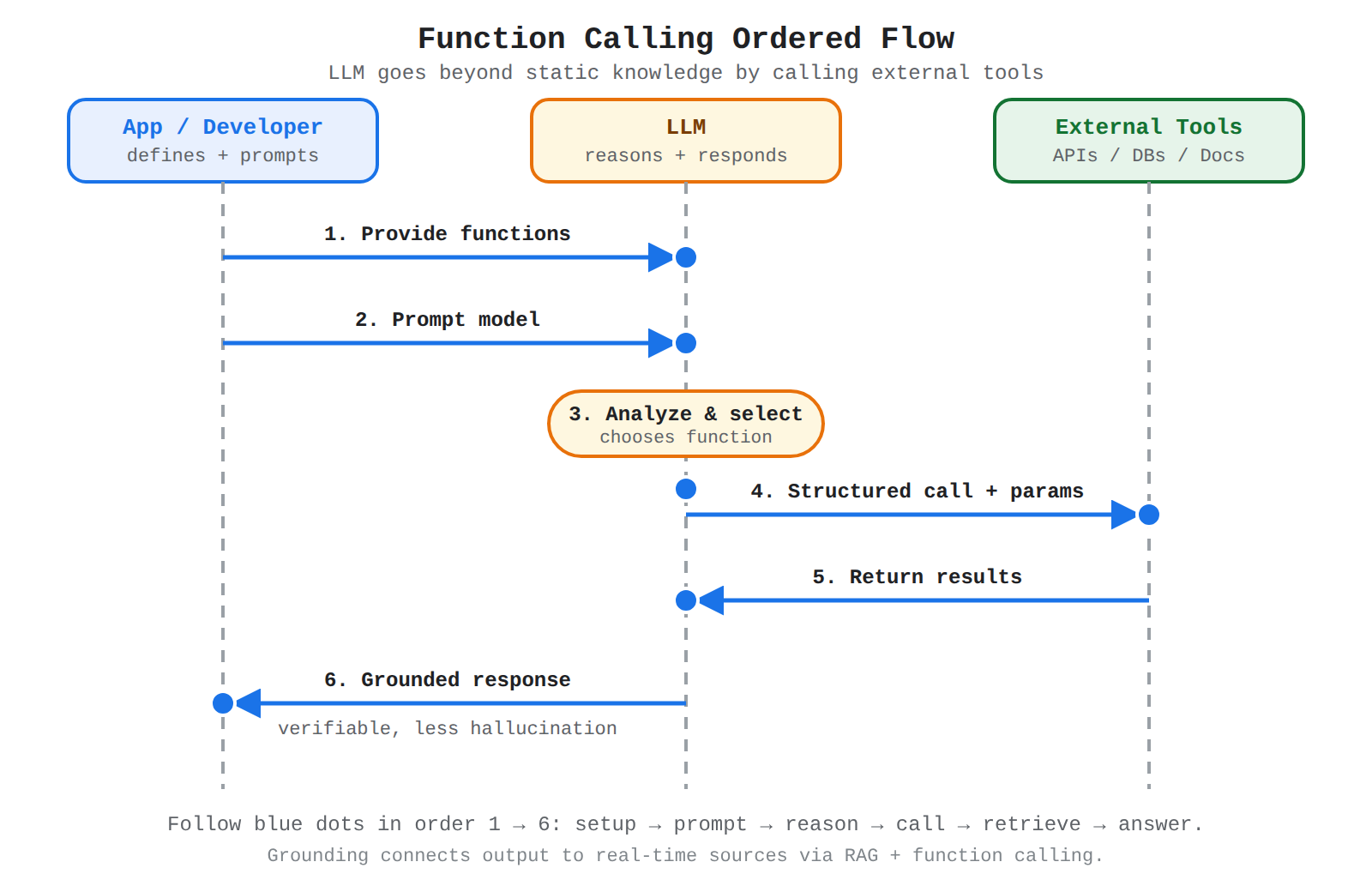
A sequence with App, LLM, and External Tools lifelines showing six steps in order: provide functions, prompt, analyze and select, structured call, return results, and grounded response.
- Provide the model with a set of functions.
- Prompt the model.
- The model analyzes the prompt and selects and calls functions based on the request.
- The model generates structured data that specifies which function to call and the parameter values.
- The structured data output calls the function, and the function returns results to the model.
- The model incorporates the results into its reasoning to generate a response.
Stakeholder Trust and Human Accountability
Stakeholder trust in generative AI depends on people being able to understand and verify model outputs. Data scientists and machine learning engineers commonly lead model selection, but business leaders, product owners, domain experts, and end users should also contribute to keep decisions accountable:
- Business leaders and decision-makers approve the selection when it aligns with business priorities.
- Product owners may influence or have more control over model behavior to align it with product priorities.
- Domain experts apply their expertise to improve model effectiveness.
- End users may need to understand the model's output and how to incorporate it for more informed decision-making.
Transparency gives these stakeholders the information to question, verify, and use outputs responsibly. Human accountability is maintained through human evaluations, stakeholder approval, input verification, and grounding outputs to verifiable sources.
Evaluating business risk and ethical governance for generative AI means judging how an AI use case could affect legal standing, reputation, and social impact, then putting oversight in place to keep those effects acceptable. Responsible AI and transparency are central because they build trust, reduce ethical and legal harms, and support sustainable deployment. Governance turns AI from an isolated technical project into a business decision that is measured, reviewed, and aligned with organizational priorities (opens in a new tab).
Responsible AI, Transparency, and Trust
Responsible AI is the practice of designing and operating AI so it is accountable, safe, fair, and aligned with laws and organizational values. Transparency means stakeholders can understand what an AI system does, what data and assumptions it uses, and where its limits are. When transparency is weak, people cannot judge whether outputs are reliable or fair, which raises reputational, legal, and social risk. Transparency also helps end users incorporate AI outputs into informed decisions, which is a key part of responsible deployment.
Ethical Governance and Risk Management
Ethical governance is the set of policies, roles, and review steps that decide which AI use cases are allowed, how they are monitored, and who is accountable. A business-value decision process starts with measurable business goals and success criteria, including return on investment (ROI), then checks whether AI is the right approach, identifies user expectations, and connects the solution to executive priorities. Business constraints such as security, privacy, industry compliance, and country regulatory requirements are identified up front, so legal and social harms become design requirements rather than afterthoughts. Stakeholders share ownership of risk: leaders approve alignment with business priorities, product owners align model behavior with product priorities, domain experts improve effectiveness, and end users need to understand outputs for informed decisions.
Exam tip: Business constraints such as security, privacy, industry compliance, and country regulatory requirements belong in the use case definition stage, not after deployment.
Business Risks and How Governance Reduces Them
A risk management framework connects each category of harm to a governance action. The main business risks and the mitigations supported by responsible AI practices differ in how they harm the business and how governance addresses them:
| Risk | How it harms the business | Governance or mitigation |
|---|---|---|
| Legal and regulatory | Fines, blocked deployments, noncompliance | Identify security, privacy, industry compliance, and country regulatory requirements early; use data for regulatory compliance |
| Reputational and trust | Loss of customer trust and brand damage | Use transparency so stakeholders understand outputs and limits; involve end users and domain experts |
| Operational and business | AI does not meet goals or ROI | Start with measurable business goals and ROI; choose the AI type based on the use case; align with executive priorities |
| Social and environmental | Harm to communities or the environment | Apply shared responsibility and shared fate; optimize workloads; use AI for transparency and risk |
Shared Responsibility and Shared Fate
Security and sustainability for cloud workloads are shared between Google and the customer across a provider boundary. Google is responsible for sustainability of Google Cloud, which includes the energy efficiency and water stewardship of data centers, infrastructure, and core services. The customer is responsible for sustainability in the cloud, which means optimizing workloads to be energy efficient, such as right-sizing resources, using serverless services that scale to zero, and managing data lifecycles. The shared fate model treats sustainability as a collaborative partnership. For ethical governance, this means risk ownership must be defined across provider and customer boundaries, and transparency about those boundaries helps prevent gaps.
Using AI to Improve Transparency and Manage Risk
AI can transform large datasets into actionable insights, helping organizations move from reactive compliance to proactive optimization. It supports operational efficiency through inventory management, supply chain optimization, and intelligent energy management. It supports transparency and risk through granular supply chain transparency, regulatory compliance, and climate risk modeling. It supports value and growth through sustainable finance and recommerce. Google products that support these goals include Google Earth AI for planetary-scale geospatial analysis, WeatherNext for weather forecasting and climate risk analytics, Geospatial insights with Google Earth for location context, and Google Maps routes optimization for logistics efficiency. These tools help organizations monitor environmental changes, build resilience, and reduce emissions, which supports both business risk management and social responsibility.
Model Selection as a Governance Decision
Choosing between traditional AI and generative AI is also a governance decision because it affects control, explainability, data needs, and speed to market. Traditional AI excels at classification and prediction from historical data, while generative AI excels at content creation, summarization, conversational search, and code generation. If a pre-trained traditional model meets requirements, teams use it. If requirements are not met and enough training data exists, teams choose custom training for high control and explainability or generative AI for faster go-to-market. If training data is insufficient, teams use generative AI with prompt engineering and tuning. Stakeholder input from business leaders, product owners, domain experts, and end users should guide the selection so the model aligns with business priorities and user needs.
Key Facts
- Google's AI Principles guide ethical development by prioritizing safety, avoiding unfair bias, and committing to social benefit and transparency.
- Transparency makes AI behavior, limitations, data, and outputs understandable and verifiable, while interpretability explains how a model reaches its output.
- Grounding connects model outputs to verifiable sources, and retrieval-augmented generation (RAG) retrieves external information to reduce hallucinations.
- Ethical governance identifies security, privacy, industry compliance, and country regulatory requirements during use case definition to reduce legal, reputational, operational, and social risks.
- Sustainability of Google Cloud is Google's responsibility for data centers and infrastructure, while sustainability in the cloud is the customer's responsibility to optimize workloads.
Frequently Asked Questions
What is the difference between transparency and interpretability in responsible AI for generative AI?
Transparency means making a system's behavior, limitations, data, and outputs clear enough that people can verify them, while interpretability, also called explainability, is the ability to explain how a model reaches its output. Together they help stakeholders trust outputs and keep humans accountable for decisions.
How does grounding with retrieval-augmented generation (RAG) make generative AI outputs more trustworthy?
Grounding is the process of connecting a model's output to verifiable sources of information to improve accuracy, reliability, and usefulness and reduce hallucinations where the model generates content that is not factual. Retrieval-augmented generation (RAG) is a common type of grounding that retrieves relevant external information to enhance the model's responses.
What is the difference between metrics-based evaluation and side-by-side evaluation for generative AI models?
Metrics-based evaluation uses quantifiable metrics to measure performance and is automated and scalable but can oversimplify and miss context or nuance. Side-by-side evaluation compares the output of two models against ground truth with help from a third, larger model that selects the higher-quality response, which is quicker than human review and on par with human evaluators but still requires human checks because the larger model can exhibit inherent biases.
Sample Question
A public policy organization is deploying a generative AI application to analyze socioeconomic datasets and recommend community resource allocation strategies. The leadership team wants to establish ethical governance based on foundational Responsible AI principles to ensure the model does not reflect or amplify historical discrimination or produce skewed, inequitable outcomes across demographic groups.
Which foundational AI principle directly guides this objective?
Avoid creating or reinforcing unfair bias
Be built and tested for safety
Incorporate privacy design principles
Uphold high standards of scientific excellence
How learners score on this domain
Last updated