Fundamental
Prepare and test your skills

Fundamental
Prepare and test your skills
Reliable Operations with SRE and Observability
Modern operations, reliability, and resilience in the cloud mean keeping applications working through failures, traffic spikes, and change without constant manual work. Reliability comes from spreading work across independent failure domains (opens in a new tab), automating detection and recovery, and protecting data with managed backup. Together these practices support scalable, secure, and continuously available services.
Redundancy Across Zones and Regions
Redundancy is duplicating critical components so one failure does not stop the whole application. A failure domain is a level that can fail independently, from a single virtual machine (VM) to a zone or a region, and a single point of failure is a component whose loss makes the whole stack unavailable. To remove single points of failure, teams map failure domains, replicate critical components across machines, zones, and regions, and configure automatic failover.
Location scope controls how far a failure can spread. Zonal resources such as Compute Engine VMs must be managed for redundancy by the team, while regional resources such as App Engine applications and regional managed instance groups spread automatically across zones. Managed multi-regional resources such as Cloud Storage, Datastore, Firestore, and Spanner are designed to keep working after the loss of a single region. Wider scope costs more in resources, cross-location traffic, and replication, so teams choose the lowest scope that meets business needs.
| Architecture | Target availability | Workload fit |
|---|---|---|
| Single-zone | 99.9% | Workloads that tolerate downtime or redeploy easily |
| Multi-zone | 99.99% | Workloads needing resilience to zone outages |
| Multi-region | 99.999% | Business-critical workloads such as retail and social media |
Automated Recovery, Monitoring, and Data Protection
Automated recovery keeps services available by detecting unhealthy components and shifting traffic without human action. Load balancers check backend health and route traffic from unhealthy backends to healthy backends, while regional managed instance groups and Google Kubernetes Engine (GKE) regional clusters can be tested by simulating zone outages. Visibility for these decisions comes from Cloud Monitoring (opens in a new tab) for metrics, the Google Cloud Service Health dashboard and Personalized Service Health for service status, and Site Reliability Engineering (SRE) practices that balance releases with stability.
Data protection depends on where data lives and how it is copied. Managed multi-regional storage protects data against zonal or regional failures, and Backup and DR is itself a multi-regional service. If workloads use zonal or regional resources, teams snapshot data to a multi-regional resource or manage replication to other regions. Regional persistent disks are synchronously replicated across zones in a region, so data survives a single-zone loss, while explicit backups to other regions depend on cross-region networking.
Exam tip: Single-zone targets 99.9% availability, multi-zone targets 99.99%, and multi-region targets 99.999%; targets describe design goals, not guarantees for every service.
Modernizing operations on Google Cloud means replacing manual, repetitive work with automation, shared delivery practices, and full-stack observability. This shift improves consistency, speeds up releases, and reduces mean time to resolution because the same pipeline, metrics, and logs guide every change. The result is higher reliability at lower operational burden.
How SRE and DevOps Work Together
Site Reliability Engineering (SRE) and DevOps are complementary ways to deliver software quickly without breaking reliability. SRE focuses on running reliable systems at scale, while DevOps focuses on processes, culture, and tooling that break silos between development, operations, and related teams.
| Discipline | Primary focus | Main goal | Key practices |
|---|---|---|---|
| SRE | Running reliable systems at scale | Efficiency and reliability | Eliminate toil, monitor everything, codify infrastructure, manage incidents, blameless postmortems |
| DevOps | How teams build and deliver together | Agility and reduced time-to-market | Break silos, continuous integration, automated testing, deployment automation |
SRE uses service-level objectives (SLOs), service-level agreements (SLAs), and error budgets to balance stability with innovation. An SLA is the entire agreement for a service, an SLO is a specific measurable target inside that agreement, and the error budget is the allowed unreliability before the SLO is violated. Recovery planning adds recovery time objective (RTO) for maximum acceptable downtime and recovery point objective (RPO) for maximum acceptable data loss in time.
Automation and Infrastructure as Code
Automation reduces operational toil, which is manual work that grows with the environment without improving the service. The optimization loop (opens in a new tab) improves operations in order:
- Assess the environment, teams, and loop: Establish a baseline and list skills and gaps.
- Establish requirements and goals: Express needs as measurable goals.
- Optimize and train: Carry out improvements and build skills.
- Tune the loop: Measure results, then complete the iteration or refine goals.
Infrastructure as Code (IaC) defines infrastructure through code for consistent, repeatable, and testable deployments. Terraform provisions Google Cloud resources, Ansible, Chef, and Puppet configure resources after provisioning, Open Policy Agent defines policies as code, and GitOps defines operations as code. Autoscaling then turns measured data into action: Compute Engine managed instance groups scale VM groups on signals such as CPU, GKE autoscaling adjusts nodes and Pods, and Cloud Run scales instances up and down with incoming traffic.
Observability Through the Operations Suite
Google Cloud Observability collects metrics, logs, traces, and errors in one place so teams detect problems, find causes, and fix them faster. Cloud Monitoring collects metrics, events, and metadata for dashboards and alerts, Cloud Logging stores and analyzes log data, Cloud Trace collects latency data for distributed tracing, and Error Reporting aggregates application errors.
Telemetry flows from instrumented application code into Monitoring as metrics and into Logging as structured logs. Exemplars link a metric measurement to a representative trace, so a team moves from a spike on a dashboard directly to the request that caused it. Alert policies notify the right people when thresholds cross, while Personalized Service Health shows whether the cause is inside the project or on the Google side.
Exam tip: Setting the sampled flag in the trace header to true is only a hint; each component still makes its own sampling decision and Google Cloud services enforce their own rate limits.
Important cloud operations terms define how teams share responsibility for reliability, measure it, and observe it. SRE and DevOps describe how teams work, service-level indicators, objectives, and agreements describe what is measured and promised, and observability pillars describe what signals are collected. Together they let teams detect problems early and improve over time.
SRE, DevOps, and Error Budgets
Site Reliability Engineering (SRE) applies engineering practices to operations, while DevOps brings development and operations teams together with shared processes and tools. An application is reliable when it meets objectives for availability and resilience, where availability is the share of time the application is usable or the share of requests served successfully. Reliability depends on application design, dependent systems, infrastructure resources, provisioned capacity and scaling, and DevOps processes.
An error budget is the allowed failure between 100% uptime and the chosen SLO, such as 99.99%. While budget remains, teams can release features; when the budget is depleted, teams pause releases and focus on stability. Incident learning supports this balance through blameless postmortems that fix systems rather than blame people, plus defined roles for incident commanders, investigators, communicators, and technical experts.
SLIs, SLOs, and SLAs Compared
A service-level indicator (SLI) measures performance, a service-level objective (SLO) sets a target for that measurement over time, and a service-level agreement (SLA) is the uptime commitment Google makes for a service. Cloud Monitoring (opens in a new tab) collects metrics such as HTTP request counts and response latency that become SLIs. An availability SLI is the ratio of successful responses to all responses, while a latency SLI is the ratio of calls below a threshold to all calls.
| Metric | What it represents | Who sets it | Example |
|---|---|---|---|
| SLI | Measurement of performance | Derived from service metrics | Ratio of successful responses to all responses |
| SLO | Target for an SLI over a compliance period | Team specifies it for its service | 99% availability over a calendar week |
| SLA | Contractual uptime commitment | Google, per service | 99.999% for multi-region Bigtable with multi-cluster routing |
An SLO is built from an SLI, a performance goal, and a compliance period, and up to 500 SLOs can be created per service. The error budget starts at 1 minus the SLO and shrinks as failures accumulate, so alerting on burn rate warns teams before the budget is exhausted. A Bigtable instance shows how configuration changes the SLA: clusters in three or more regions carry 99.999% with multi-cluster routing but only 99.9% with single-cluster routing.
Metrics, Logs, and Traces
Observability collects telemetry as metric data, log data, and trace data. Metric data records numeric health measurements at intervals, log data records timestamped events in one component, and trace data records the path of a request across components as spans. Cloud Logging (opens in a new tab) stores and searches logs, Cloud Trace follows request flow and latency, and Cloud Profiler gathers CPU and heap data.
Cloud Monitoring answers questions about load, correctness, performance, and application health, with alerting policies that notify channels such as email, PagerDuty, and Slack. An incident record links status, logs, metric charts, labels, and duration for troubleshooting. Cloud Logging supports Logs Explorer for entry-level troubleshooting and SQL-based analysis for trends, plus log-based metrics that count matching entries or extract values such as response times.
Exam tip: An SLI measures, an SLO targets, and an SLA commits; logs describe events in one component, while traces connect a request across components.
Continue with this study guide: Define important cloud operations terms.
Describe the importance of designing resilient, fault-tolerant, and scalable infrastructure and processes for high availability and disaster recovery.
Resilient, fault-tolerant, and scalable infrastructure keeps serving users as demand changes and as failures occur. Resilience means surviving zone or region failures, fault tolerance means redundant copies take over automatically, and scalability means capacity grows with load. In Google Cloud these goals are met by choosing location scope, balancing high availability with disaster recovery, and removing single points of failure.
Failure Domains and Location Scope
A failure domain is a resource or group of resources that can fail independently. A standalone Compute Engine VM is a single-resource failure domain, while regions and zones are failure domains made of groups of resources. Distributing redundantly across failure domains raises aggregate availability above what any single domain provides.
| Resource scope | Resilience | Examples | Mitigation |
|---|---|---|---|
| Zonal | Low | Compute Engine VMs, single-zone GKE clusters, Filestore Basic | Deploy redundantly in multiple zones or regions |
| Regional | Medium | Regional MIGs, regional GKE clusters, Cloud Run services | Deploy redundantly in multiple regions |
| Multi-region | High | Multi-region Cloud Storage (opens in a new tab), multi-region Spanner | Manage changes carefully with fallbacks |
| Global | High | VPC networks, Cloud DNS zones, global load balancers | Manage changes carefully with fallbacks |
Zonal resources fail with their zone, regional resources survive zone incidents but not region outages, and multi-region and global resources survive single-region outages. Global resources are easy to set up as single instances, but a configuration error can make a global resource a single point of failure across all geographies.
High Availability Compared With Disaster Recovery
High availability (HA) and disaster recovery (DR) differ in scope, replication, and recovery goals. HA generally applies to regional deployments with synchronous replication between zones, supporting zero or near-zero RTO and RPO. DR generally applies to multi-region deployments and typically uses asynchronous replication when multi-regional or global services are not used.
| Concept | Scope | Replication | Recovery behavior |
|---|---|---|---|
| HA | Regional deployments | Synchronous between zones, often by default | Active-active topology with near-zero RTO and RPO |
| DR | Multi-region deployments | Typically asynchronous | Requires RTO and RPO assessment and manual or semi-automated failover |
Disaster recovery (DR) is a subset of business continuity planning and starts from RTO for acceptable downtime and RPO for acceptable data loss in time. Smaller RTO and RPO values cost more and add complexity. Managed multi-regional services such as Spanner and Cloud Storage simplify DR, while zonal or regional data needs snapshots in multi-region locations and replication to other regions.
Aggregate Availability and Fault Tolerance
Aggregate availability is the overall availability of a multi-tier stack. For chained tiers where every tier must work, availability multiplies: tier1 x tier2 x tierN. Four services at 99.9% produce about 99.6%. For parallel services that run independently, availability is 1 - (1 - A) x (1 - B), so two chained services at 99% give 98% while two parallel services give 99.99%. Where feasible, teams choose parallelization over chaining.
Fault tolerance removes single points of failure through a managed, ordered path. Traffic flows from clients to a global external Application Load Balancer, then to a regional managed instance group across zones, then to a Cloud SQL primary instance that replicates synchronously to a standby. If a VM crashes, the load balancer sends traffic to healthy VMs while the group replaces the failed VM. If a zone fails, the standby database takes over, and multi-region backups allow restore in another region.
Exam tip: HA usually uses synchronous replication within a region, while DR usually spans regions and often uses asynchronous replication.
Key reliability, DevOps, and SRE terms explain how teams deliver changes safely and keep services reliable enough for users without overspending. DevOps defines the delivery path, reliability targets define how much failure is acceptable, and SRE defines the cycle for understanding, observing, responding, and learning. Google Cloud tools support each part of that work.
CI/CD Flow From Build to Delivery
DevOps brings development and operations together with continuous integration, continuous delivery, automation, and shared ownership. Continuous integration builds and tests every change right away, while continuous delivery prepares tested changes for release automatically. Only artifacts that pass build and test move forward, so development, testing, and production receive the same trusted output.
CI/CD Flow: Build to Delivery on Google Cloud
Process FlowA left-to-right process flow showing code moving from the source repository to Cloud Build, then to Artifact Registry for storage, then to Cloud Deploy, which delivers the tested artifact to development, testing, and production environments in sequence.
Code moves through Google Cloud in a fixed order where each step depends on the previous step:
- Build and test: Code flows from the source repository to Cloud Build, which builds, tests, and deploys containers.
- Store artifact: The tested image flows from Cloud Build to Artifact Registry, which stores, manages, and secures it.
- Deliver to environments: The stored artifact flows from Artifact Registry to Cloud Deploy, which delivers it to target environments in sequence.
Artifact Analysis adds insight into software components along that path, and software supply chain security protects the automated flow from code to deployment.
Reliability Targets and Error Budgets
Sufficient reliability is the level where users are happy and further improvements cost more than they return. A 100% uptime goal is often ineffective because each extra increment adds cost and can limit new features. Teams instead set realistic SLOs tied to user experience, such as 99.99% instead of 100%, and prioritize the most critical components.
The error budget is the gap between 100% and the target, and it funds risk while the service stays within budget. Availability rises with wider placement, while specific SLAs can differ by configuration:
| Deployment scope | Availability target | Maximum downtime in 30 days |
|---|---|---|
| Single zone | 99.9% | 43.2 minutes |
| Multiple zones in a region | 99.99% | 4.3 minutes |
| Multiple regions | 99.999% | 26 seconds |
Stricter RTO and RPO objectives push toward more redundancy and higher cost because recovery must be faster and data loss smaller. Teams weigh requirements, consequences of failure, and risk tolerance against budget to find an acceptable level.
SRE Cycle and Building Blocks
SRE applies engineering principles to keep services reliable and scalable. Work follows a cycle that starts with understanding the system and ends with preventing recurrence:
- Scoping: Analyze architecture, interactions, and data and action flows to find risks.
- Observation: Monitor continuously to understand trends and catch problems early.
- Response: Respond and recover efficiently, including through automation.
- Learning: Conduct blameless postmortems and act to prevent recurrence.
Platform building blocks reduce manual work behind that cycle: geographically separated regions, hardware redundancy, live migration of Compute Engine VMs during maintenance, secure-by-design infrastructure, high-performance backbone with software-defined networking and edge caching, continuous monitoring through the Service Health Dashboard, annual Disaster Recovery Testing events, and change management across the lifecycle. These blocks combine with reliability targets (opens in a new tab) and horizontal scalability to support reliability at scale.
Exam tip: The error budget is the gap between 100% and the target, such as 99.99%, not the target itself.
Continue with this study guide: Define key cloud reliability, DevOps, and SRE terms.
Describe how organizations benefit from using Google Cloud Customer Care to support their cloud adoption.
Google Cloud Customer Care (opens in a new tab) is the support portfolio that helps organizations adopt cloud faster and operate reliably at scale. Customer Care provides how-to advice, best practices, troubleshooting, and operational knowledge through support cases in the Google Cloud console. By helping teams resolve blockers, optimize spend and performance, and prepare for critical events, it connects daily support work to business goals.
Support Tiers and Response Times
Tiered support gives a central way to resolve technical blockers for outages, defects, unexpected behavior, usage questions, billing issues, and feature requests. Basic Support is included for all customers with documentation, community support, billing support, and Active Assist recommendations. Paid tiers add unlimited one-to-one technical support and differ mainly in response objectives, availability, and added services.
| Tier | Best fit | P1 / P2 / P3 / P4 response | Highest-priority availability |
|---|---|---|---|
| Standard Support | Small to medium organizations, workloads under development | No P1 listed / 4h / 8h / 8h | Local business days |
| Enhanced Support | Medium to large companies, production workloads | 1h / 4h / 8h / 8h | 24/7 |
| Premium Support | Enterprises, priority workloads | 15 min / 4h / 8h / 8h | 24/7 |
All paid tiers use the console to create and manage cases, with live chat as the quickest connection and the Cloud Support API for programmatic access. Enhanced Support adds Third-Party Technology Support and Recommender, while Premium Support adds Customer Aware Support, an assigned Technical Account Manager, Operational Health Reviews, Event Management Service, and training credits.
Technical Account Management and Health Reviews
A Technical Account Manager (TAM) is a strategic advisor included with Premium Support that focuses on operational rigor, platform health, and architectural stability. The TAM helps with onboarding, billing and cost management, adoption roadmaps, cost-optimization best practices, connections to product and consulting experts, training, and preparation for critical events. Because the TAM coordinates across architecture, support, and training, the organization gains a single point of accountability.
Operational Health Reviews are regular TAM-led touchpoints that measure progress and address blockers. Reviews typically cover efficiency of cloud operations including support and spend trends, trends in operational metrics, incidents, escalations, and outages, and status of high-priority projects. Recommender insights for cost, security, performance, and manageability turn those trends into actions that reduce waste and prevent repeat incidents.
Value-Add Services for Critical Workloads
Value-Add Services are optional purchases for Enhanced and Premium customers that extend reliability for critical and regulated workloads. Mission Critical Services protects environments where disruption would cause significant impact, starting with assessment of architecture, observability, measurement, and control, followed by gap analysis and continuous proactive engagement. After onboarding, the organization receives drills, proactive monitoring and case generation, incident management, and impact prevention follow-ups.
Mission Critical Services grants Priority 0 (P0) filing with a 5-minute response, which is faster than the Premium P1 response of 15 minutes. Other services include Technical Account Advisor Service for oversight, Planned Event Support and Event Management Service for launches and peak events, and Assured Support for personnel and compliance controls. Event Management follows an ordered sequence: first prepare systems, then test with load and disaster tests, then engage Customer Care during the event, then review outcomes for future events.
Exam tip: Premium Support responds to P1 in 15 minutes, while Mission Critical Services responds to P0 in 5 minutes.
The life of a support case moves from creation and triage through communication and investigation to resolution and learning. A user starts the case in the Google Cloud console with product, priority, and context, Customer Care routes and works it based on priority and support package, and feedback after closure improves future operations. Clear, timely updates on both sides keep the case moving.
Creating and Classifying a Case
Support cases are started in the console by a user with the Tech Support Editor (opens in a new tab) role, which grants read-write access to cases at the organization, folder, or project level. The selected organization or project controls where the case is filed and who can view it. Creation follows a fixed flow:
- Start the request: Go to Support > Cases, select the resource, and click Get help.
- Identify product and issue: Select a product such as Compute Engine, describe the issue, and enter error messages.
- Set priority: Choose P1 through P4, with P4 Low impact as the default.
- Classify the case: Select category and sub-category so the case reaches the correct team.
- Choose channel and impact: Choose live chat or email, select business impact, and add affected resources.
- Submit: Provide full details and click Submit, then track the case on the Cases page.
Strong cases include timestamps, locations, project IDs, affected resources, error messages and logs, steps tried, recent changes, and business impact. For access issues, teams add requesting identities, working versus failing examples, IAM policies, access source, and Cloud Logging errors, with tokens and credentials redacted.
Tracking Status and Communication
Customer Care engineers engage through a status lifecycle that shows who is working the case. A new case starts as New when unassigned, moves to Assigned when a specialist takes ownership, continues as In progress Cloud Customer Care during specialist work, and may shift to In progress Google engineering or In progress Google other when product engineers or another team must investigate. The status becomes Waiting on customer response when more customer information is needed, which pauses work until the customer replies.
Priority signals business impact and sets engagement speed:
| Priority | Definition | Example situation |
|---|---|---|
| P1 | Critical impact, service unusable in production | High user errors with revenue loss or data risk |
| P2 | High impact, service severely impaired | Degraded production with noticeable errors |
| P3 | Medium impact, service partially impaired | Limited scope with no user-visible impact |
| P4 | Low impact, service fully usable | Consultative request preferring analysis over speed |
P1 triggers immediate dedicated handling with a live troubleshooting call that the customer should join within 15-30 minutes. P1 cases follow the sun with 24-hour engagement across regions, while P2-P4 cases generally stay with the current owner. Tracking happens on the Cases page (opens in a new tab), where users add comments, upload screenshots and logs, edit attributes, and escalate, close, or reopen.
Resolution, Escalation, and Learning
Resolution behavior depends on priority and support package. If a P2-P4 case begins impacting production, it can be raised to P1 and reassigned to an available expert. If a P1 customer becomes unresponsive for more than 3 hours, priority may drop to P2 until re-engagement. Escalation adds resources when impact grows or progress stalls, but escalating shortly after a priority change can slow resolution, so teams first set the correct priority for an adequate time.
To close a resolved case, the customer opens View case, clicks Close case in General Information, and confirms with Yes. A closed case can be reopened only within 15 days and returns to the last specialist, though initial response times do not apply. After closure, a Customer Effort Score survey collects feedback, and teams analyze issues, use retrospective forms, and share support processes internally to improve reliability.
Exam tip: Choose P1 when production service is unusable with critical impact; a closed case can be reopened only within 15 days.
Key Facts
- Redundancy across zones and regions raises target availability from 99.9% for single-zone to 99.99% for multi-zone to 99.999% for multi-region deployments.
- An SLI measures performance, an SLO sets a target for that measurement over a compliance period, and an SLA is the contractual uptime commitment for a service.
- High availability generally applies to regional deployments with synchronous replication, while disaster recovery generally applies to multi-region deployments with typically asynchronous replication.
- Google Cloud Observability combines Cloud Monitoring for metrics, Cloud Logging for logs, Cloud Trace for latency data, and Error Reporting for aggregated errors.
- Premium Support responds to P1 cases in 15 minutes, while Mission Critical Services responds to P0 cases in 5 minutes.
Try the scenario
Availability Targets and Error Budget Release Gating
Change the inputs and watch how the outcome changes.
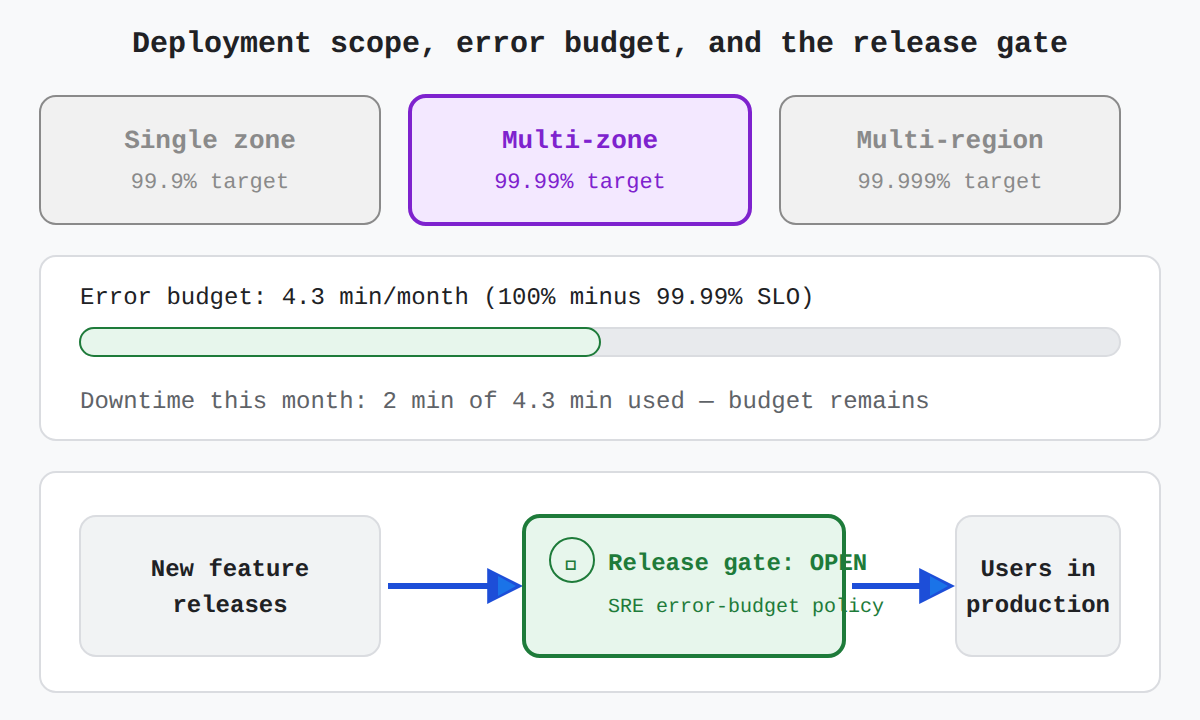
Change the deployment scope and monthly downtime to see how the remaining error budget opens or closes the release gate.
Frequently Asked Questions
What is the difference between a service-level indicator (SLI), a service-level objective (SLO), and a service-level agreement (SLA) in Google Cloud operations?
A service-level indicator (SLI) measures performance such as the ratio of successful responses to all responses, a service-level objective (SLO) sets a target for that measurement over a compliance period, and a service-level agreement (SLA) is the contractual uptime commitment Google makes for a service. An SLO is built from an SLI, a performance goal, and a compliance period, up to 500 SLOs can be created per service, and the error budget starts at 1 minus the SLO and shrinks as failures accumulate.
What is the difference between high availability (HA) and disaster recovery (DR) in Google Cloud?
High availability generally applies to regional deployments with synchronous replication between zones and supports active-active topology with near-zero recovery time objective (RTO) and recovery point objective (RPO). Disaster recovery generally applies to multi-region deployments with typically asynchronous replication and requires RTO assessment for acceptable downtime and RPO assessment for acceptable data loss in time.
When should I use single-zone, multi-zone, or multi-region deployment in Google Cloud for availability?
Single-zone targets 99.9% availability for workloads that tolerate downtime or redeploy easily, multi-zone targets 99.99% for workloads needing resilience to zone outages, and multi-region targets 99.999% for business-critical workloads such as retail and social media. Wider scope costs more in resources, cross-location traffic, and replication, so teams choose the lowest scope that meets business needs.
Subdomains
Site Reliability Engineering (SRE) and DevOps are related ways of working that keep cloud applications reliable while still releasing changes quickly. SRE applies engineering practices to oper…
Site Reliability Engineering (SRE) and DevOps are complementary approaches for delivering software quickly without breaking reliability. SRE is the discipline Google developed to run global infrastruc…
Scalability and performance continuity mean an application keeps serving users as demand changes and as failures or stress occur. In Google Cloud, these goals are met by combining failure domains, loc…
Resilient cloud architectures on Google Cloud keep working when parts fail or traffic spikes. Resilience comes from removing single points of failure, copying critical resources across independent loc…
Google Cloud Customer Care is the support portfolio that helps organizations adopt cloud faster and operate reliably at scale. Customer Care provides how-to advice, best practices, troubleshooting, an…
Examine Case Creation and Initial Triage is the first stage in the life of a support case in Google Cloud Customer Care. A user with the right role starts the case in the Google Cloud console, describ…
DevOps is a way of working that brings development and operations teams together to deliver software faster and more reliably. DevOps practices focus on continuous integration, continuous delivery…
How learners score on this domain
Last updated