Simulation
Availability Targets and Error Budget Release Gating
Change the deployment scope and monthly downtime to see how the remaining error budget opens or closes the release gate.
Try the scenario
Availability Targets and Error Budget Release Gating
Change the inputs and watch how the outcome changes.
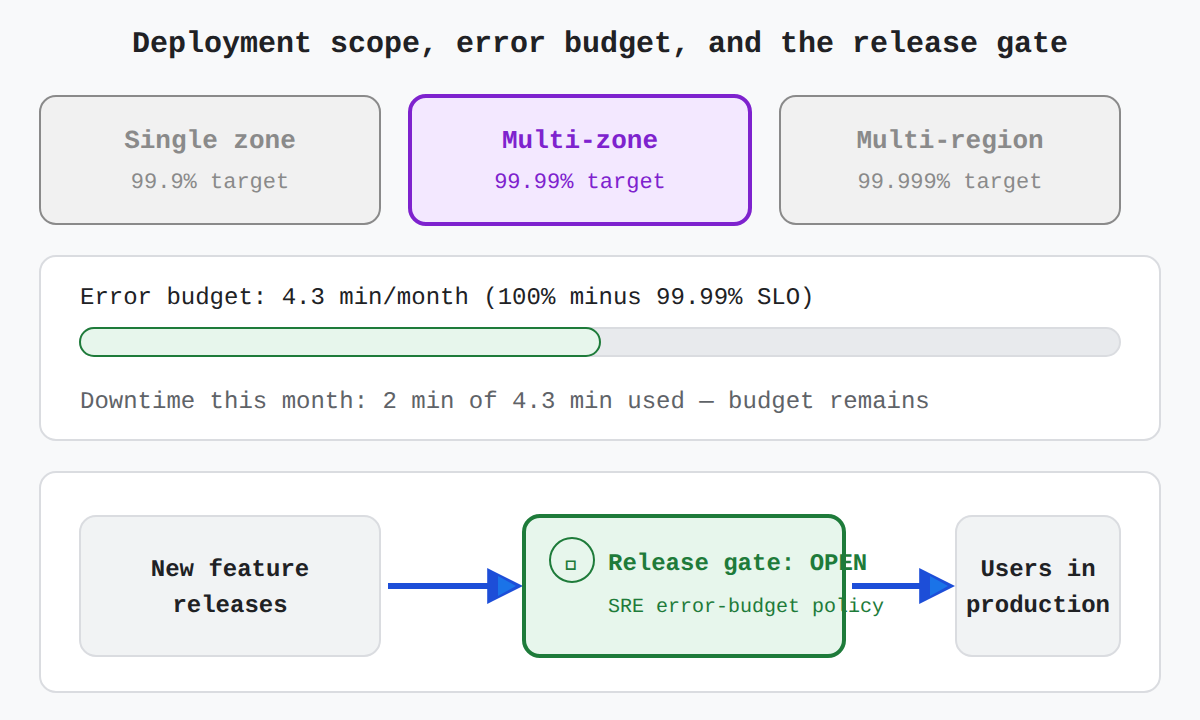
Change the deployment scope and monthly downtime to see how the remaining error budget opens or closes the release gate.
Every outcome
Succeeds
2 outcomesMulti-zone: budget remains, releases proceed
A multi-zone deployment targets 99.99% availability, which leaves a 4.3-minute error budget in a 30-day month. With only 2 minutes of downtime used, about 2.3 minutes of budget remain, so the SRE policy keeps the release gate open and feature releases continue.
Starting scenarioEvery input at its default
Single zone: large budget absorbs the outage
A single-zone deployment targets 99.9% availability, giving the largest error budget: about 43.2 minutes in a 30-day month. Even 15 minutes of downtime leaves roughly 28 minutes of budget, so releases continue — but the lower target also means users tolerate more downtime than in the multi-zone default.
Fails
3 outcomesMulti-zone: budget exhausted, releases frozen
With 15 minutes or more of downtime this month, the 4.3-minute error budget of the 99.99% multi-zone target is fully consumed. When the budget is depleted, teams pause feature releases and focus on stability work until reliability recovers.
What changed
- Downtime accumulated this month2 minutesto15 minutes
Multi-region: 26-second budget breached
The 99.999% multi-region target allows only 26 seconds of estimated maximum downtime in a 30-day month, so even 2 minutes of downtime breaches the entire budget. Unlike the summary's multi-zone configuration, this tighter scope leaves almost no room for failure, and the release gate freezes deployments to prioritize stability.
What changed
- Deployment scopeMulti-zone (99.99% SLO)toMulti-region (99.999% SLO)
Single zone: even 43 minutes can run out
The 99.9% single-zone target allows about 43.2 minutes of downtime in a 30-day month, but 60 minutes of accumulated downtime exceeds it. Even the loosest scope has a limit: once the budget is gone, the release gate freezes and the team shifts to stability work.
What changed
- Deployment scopeMulti-zone (99.99% SLO)toSingle zone (99.9% SLO)
- Downtime accumulated this month2 minutesto60 minutes
Mixed
1 outcomeMulti-region: tight budget still holds
A multi-region deployment targets 99.999% availability, so the whole monthly error budget is only 26 seconds. Even the smallest downtime setting here leaves only about 11 seconds of budget, but that is enough for the release gate to stay open — barely. Note this configuration differs from the summary's multi-zone default: the budget shrank because the scope widened.
What changed
- Deployment scopeMulti-zone (99.99% SLO)toMulti-region (99.999% SLO)
- Downtime accumulated this month2 minutesto15 seconds
In the Domain
SRE, DevOps, and Error Budgets
Site Reliability Engineering (SRE) applies engineering practices to operations, while DevOps brings development and operations teams together with shared processes and tools. An application is reliable when it meets objectives for availability and resilience, where availability is the share of time the application is usable or the share of requests served successfully. Reliability depends on application design, dependent systems, infrastructure resources, provisioned capacity and scaling, and DevOps processes.
An error budget is the allowed failure between 100% uptime and the chosen SLO, such as 99.99%. While budget remains, teams can release features; when the budget is depleted, teams pause releases and focus on stability. Incident learning supports this balance through blameless postmortems that fix systems rather than blame people, plus defined roles for incident commanders, investigators, communicators, and technical experts.
Domain 2 of 3
Operational excellence and reliability at scale
Read the Domain summaryPractice this Domain
194 practice questions
Practice this DomainMore from this Domain
Last updated