Fundamental
Prepare and test your skills

Fundamental
Prepare and test your skills
Reliable Cloud Operations and Resilient Architectures
Resilient cloud architectures on Google Cloud keep working when parts fail or traffic spikes. Resilience comes from removing single points of failure, copying critical resources across independent locations, automating recovery, and protecting data with managed backup. Location scopes for these choices are zonal, regional, multi-regional, and global.
Redundancy and Failure Domains
Redundancy is duplicating critical components so one failure does not stop the whole application. A failure domain is a level that can fail independently, from a single virtual machine (VM) to a zone or a region (opens in a new tab). A single point of failure (SPOF) is a component whose failure can make the whole stack unavailable. To build redundancy (opens in a new tab), map failure domains, replicate critical components across multiple machines, zones, and regions, and configure automatic failover. For example, a critical database should not live in only one region, and a metadata server should not live in only one zone or region, because loss of that single location can cause a global outage.
Multi-Zone and Multi-Region Deployments
Multi-zone and multi-region deployments spread resources across independent locations so a zone or region outage does not take down the whole workload. Use regional resources such as App Engine (opens in a new tab) applications and regional managed instance groups, or managed multi-regional resources such as Cloud Storage, Datastore, Firestore, and Spanner. Zonal resources such as Compute Engine VMs can be used, but you manage redundancy across zones or regions yourself. Multi-regional services are designed to function after the loss of a single region, and they trade off latency or consistency model on a product-specific basis.
The choice of scope sets the availability target and the recommended workload fit:
| Architecture | Target availability | Workload recommendation |
|---|---|---|
| Single-zone | 99.9% | Workloads that can tolerate downtime or can be redeployed elsewhere with minimal effort |
| Multi-zone | 99.99% | Workloads needing resilience against zone outages but that can tolerate some downtime from region outages |
| Multi-region | 99.999% | Business-critical workloads where high availability is essential, such as retail and social media |
Exam tip: A single-zone deployment targets 99.9% availability, multi-zone targets 99.99%, and multi-region targets 99.999%; choose the lowest level that meets business needs because cost and complexity rise with distribution.
Distributed architectures cost more and add operational complexity because they provision more resources, create more cross-location network traffic, and store and replicate more data. For business-critical applications, the availability advantage can outweigh that cost. Guidance for financial services (opens in a new tab) often recommends a multi-region topology across at least two regions and three zones within each region. Global load balancing directs traffic from users to a healthy region closest to them, and points of presence let customer traffic travel within the Google network until it is close to its destination.
Automated Recovery and Health Monitoring
Automated recovery keeps services available by detecting unhealthy components and shifting traffic without human intervention. Configure automatic failover so services continue during zone or region outages. Load balancers detect backend health and automatically route traffic from unhealthy backends to healthy backends. Monitor service status with the Google Cloud Service Health dashboard and Personalized Service Health, and test failover regularly by simulating zone outages for regional managed instance groups and Google Kubernetes Engine (GKE) regional clusters.
Consistency also comes from automation and Site Reliability Engineering (SRE). SRE balances releasing new software and keeping the environment secure with the risk that changes can cause downtime. Automation through infrastructure as code (IaC), immutable infrastructure, CI/CD, Infrastructure Manager, Config Connector, Terraform, Chef, and Puppet improves consistency and reduces human error.
Managed Backup and Data Resilience
Managed backup and replication protect data so applications can recover from zonal or regional failures. For disaster recovery (opens in a new tab), use managed multi-regional storage services such as Cloud Storage, Datastore, Firestore, or Spanner. If you use zonal or regional resources, snapshot data to a multi-regional resource or manage your own replication to one or more other regions. Backup and DR is itself a multi-regional service.
Explicit backups and replication to other regions depend on cross-region networking. For compute disaster recovery, run zonal or regional resources such as Compute Engine or App Engine, but bring up the application in another region if the primary region fails, referring to copies of primary data when data is not already in a managed multi-regional resource. Regional persistent disks are synchronously replicated across zones in a region, so data survives a single-zone loss within that region.
Handling Unexpected Load
Unexpected load is handled by scaling resources and balancing traffic across healthy capacity. Compute Engine VMs and GKE clusters integrate with autoscalers that grow or shrink based on metrics you define. The serverless platform provides managed compute, database, and other services that scale quickly from zero to high request volumes, and you pay only for what you use. Database products such as BigQuery, Spanner, and Bigtable deliver consistent performance across massive data sizes.
Visibility guides scaling decisions and traffic management. Cloud Monitoring provides metrics across applications and infrastructure for data-driven scaling. Load balancing manages application traffic, including global load balancing that can direct traffic to a healthy region closest to users.
Shared Dependencies That Affect Resilience
Resilience also depends on shared services and lower-level infrastructure that many products use. All Google Cloud services rely on core internal tools for networking, data center access, and identity authorization. The main dependency groups are:
- Common dependencies: identity data plane, logging, metadata storage, workflow management, DNS, globally distributed load balancers, points of presence, and replicated databases for global configurations such as IAM policies, global firewall rules, global load balancer configurations, and Pub/Sub topics.
- Compute Engine dependencies: VM and Persistent Disk data planes depend on lower-level Compute Engine and Cloud Storage services such as Borg and Colossus.
- Storage dependencies: Spanner, Bigtable, and Cloud Storage depend on encryption and key management, logging and auditing, internal data replication, and cross-region networking for explicit backups.
- Networking dependencies: global load balancing, DNS, and failover between regions depend on physical networking infrastructure; DDoS prevention depends on lower-level Compute Engine infrastructure.
- Managed and hosted service dependencies: GKE and Cloud SQL depend on Compute Engine and either Container Registry or Artifact Registry for VM images.
If a single region fails, only customers solely in that region are impacted, while customers with multi-region products are not impacted. Google Cloud aims to prevent correlated failures across regions.
Modern cloud operations is the practice of running cloud workloads so they stay consistent, visible, and available without constant manual work. In Google Cloud, modern operations depends on automation that handles routine recovery, monitoring that provides operational visibility, and Site Reliability Engineering (SRE) practices such as testing, learning from failures, and managing change safely. Together these practices reduce operational burden while supporting scalable, secure, and continuously available services.
Modern Operations as a Continuous Cycle
Modern operations in Google Cloud follows a continuous cycle that moves from understanding the system to improving it after failures. The cycle connects visibility to consistency because observation finds issues early, response limits harm, and learning improves future scoping and automation. The four stages build on each other in order:
Modern Operations Cycle in Four Steps
Process Flow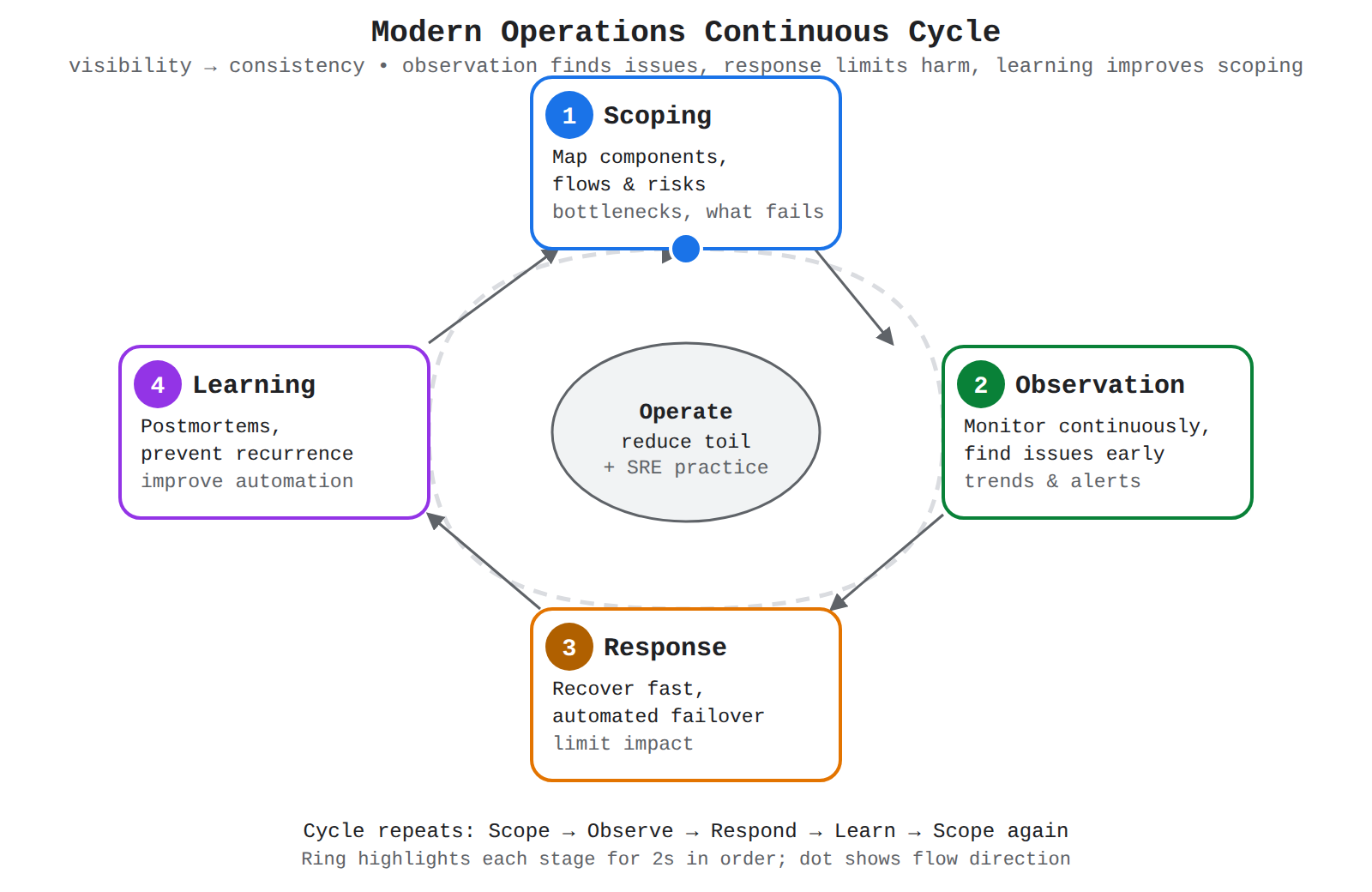
Four cards in a loop — Scoping, Observation, Response, Learning — with a dot traveling clockwise to show the order of modern operations.
- Scoping: Analyze the architecture to understand components, how data and actions flow through the system, and what could go wrong, including bottlenecks and risks.
- Observation: Apply comprehensive and continuous monitoring to understand trends and identify potential problems proactively.
- Response: Respond appropriately and recover efficiently to reduce the impact of failures, including using automated responses where possible.
- Learning: Learn from each experience and take action so the same failure does not recur.
Failure Domains as Reliability Building Blocks
Failure domains are the building blocks of reliability in Google Cloud, and a failure domain is a resource or group of resources that can fail independently of other resources. A standalone Compute Engine (opens in a new tab) virtual machine (VM) is a single-resource failure domain, while regions and zones are failure domains made of groups of resources. Regions are independent geographic areas that consist of Zones, which are logical abstractions of underlying physical resources.
When an application is distributed redundantly across failure domains, it achieves a higher aggregated level of availability than any single failure domain provides. For example, traffic can shift from an inaccessible instance to a live instance in another zone, and replicated data can survive a zone or region failure. This is why spreading workloads across zones and regions is a core decision for resilience.
Platform Availability Targets by Deployment Scope
Platform availability targets describe the uptime Google Cloud infrastructure is designed to support for most customer workloads at each deployment scope. Expected availability grows as workloads spread across more failure domains because the system can survive loss of one location. These percentages are targets for most customer workloads, not guarantees for every service.
| Deployment location | Availability (uptime) % | Estimated maximum downtime |
|---|---|---|
| Single zone | 3 nines: 99.9% | 43.2 minutes in a 30-day month |
| Multiple zones in a region | 4 nines: 99.99% | 4.3 minutes in a 30-day month |
| Multiple regions | 5 nines: 99.999% | 26 seconds in a 30-day month |
Exam tip: A single zone targets 99.9% uptime, multiple zones in a region target 99.99%, and multiple regions target 99.999% — targets are not the same as a service-specific SLA.
The uptime service-level agreements (SLAs) for specific Google Cloud services can differ from these platform targets. For example, a Bigtable instance SLA depends on the number of clusters, their distribution, and the routing policy. Teams must check the SLA for each service they use.
Platform Capabilities That Reduce Operational Burden
Platform capabilities reduce manual operational work by building redundancy, automation, and visibility into the infrastructure itself. Because maintenance, failover capacity, and health reporting are handled by the platform, teams spend less time on routine upkeep and more time improving services. These capabilities help provide a reliable platform (opens in a new tab) for cloud workloads:
- Geographically separated regions to limit the effects of natural disasters and region outages on global services.
- Hardware redundancy and replication to avoid single points of failure.
- Live migration of resources during maintenance, where Compute Engine VMs move to another host in the same zone without manual intervention.
- Secure-by-design infrastructure with physical, software, and operational security controls to protect data and workloads.
- High-performance backbone network using software-defined networking (SDN) with edge-caching services for consistent performance that scales.
- Continuous monitoring and reporting through the Google Cloud Service Health Dashboard, which shows the status of Google Cloud services in every location.
- Annual company-wide Disaster Recovery Testing (DiRT) events to verify that services and business operations continue during a disaster.
- Change management approach that emphasizes reliability (opens in a new tab) across all phases of the software development lifecycle for platform changes.
Principles for Consistent and Observable Systems
Core principles for reliable cloud systems focus on user experience, realistic goals, redundancy, and learning from operations. Reliability starts by defining success from user-experience goals and then setting realistic targets, so teams know what level of availability actually matters. Systems then use resource redundancy and horizontal scalability to handle growth and survive failures of individual VMs, zones, or regions.
Operational visibility comes from observability, which means detecting potential failures through monitoring before users are affected. Designs also plan for graceful degradation, so a partial failure reduces function rather than stopping the whole service. Recovery is verified through testing for recovery from failures and testing for recovery from data loss, including backups and disk replication across zones. Finally, teams conduct thorough postmortems after incidents to capture lessons and prevent recurrence, which directly supports the learning stage of modern operations.
Designing Resilient Compute Systems with Compute Engine
A resilient compute system is a system that can withstand failures or disruptions without interrupting service or harming the user experience. Common failure types include unexpected single-instance failure from hardware or system faults, unexpected single-VM reboot where Compute Engine automatically restarts the VM, and rare zone or region failures that make all instances in that location inaccessible. Each type requires a different mitigation, from saving data on persistent disks to spreading workloads across locations.
Resilient design on Compute Engine combines distribution, automation, and backup so recovery happens quickly and consistently. Data flows from running VMs to Persistent Disk or Hyperdisk volumes and backups, so state survives when an instance is lost. Startup and shutdown scripts then reconfigure software automatically when a VM restarts, while load balancing directs traffic from an inaccessible instance to a live instance. Together, distribution across regions and zones, automated restart and configuration, and replicated backups keep services available even when individual components fail.
Reliability strategies in Google Cloud combine failure-domain design, availability targets, error budgets, redundancy, and managed services. A failure domain is a resource or group of resources that can fail independently of other resources. Distributing an application redundantly across failure domains raises aggregate availability above what any single failure domain provides.
Regions, Zones, and Failure Domains
Regions (opens in a new tab) are independent geographic areas that consist of zones. Zones and regions are logical abstractions of underlying physical resources. A standalone Compute Engine VM is a failure domain, while a region or zone is a failure domain made of a group of resources. When an application is distributed redundantly across failure domains, it can achieve higher aggregated availability than each failure domain provides on its own.
Google Cloud platform availability relies on several built-in capabilities. Geographically separated regions help mitigate natural disasters and region outages on global services, while hardware redundancy and replication help avoid single points of failure. Live migration moves Compute Engine VMs to another host in the same zone during planned infrastructure maintenance. A secure-by-design infrastructure foundation, a high-performance backbone network using software-defined networking (SDN) and edge caching, continuous monitoring through the Google Cloud Service Health Dashboard, annual Disaster Recovery Testing (DiRT) events, and a change management approach focused on reliability across the software development lifecycle all support that availability.
Availability Targets, SLAs, and Error Budgets
Availability targets, SLAs, and error budgets define how much uptime a team aims for and how much failure it can tolerate. A service-level objective (SLO) (opens in a new tab) is the availability target a team aims to meet, while a service-level agreement (SLA) is a formal uptime commitment. Google Cloud infrastructure is designed to support the following target levels for most customer workloads:
| Deployment location | Availability (uptime) % | Estimated maximum downtime |
|---|---|---|
| Single zone | 99.9% (3 nines) | 43.2 minutes in a 30-day month |
| Multiple zones in a region | 99.99% (4 nines) | 4.3 minutes in a 30-day month |
| Multiple regions | 99.999% (5 nines) | 26 seconds in a 30-day month |
Exam tip: The error budget is the gap between 100% uptime and the chosen availability target, such as 99.99%; it is the allowance for failure, not a promise of zero downtime.
These percentages are targets, and the uptime SLAs for specific services might differ. For example, the uptime SLA for a Bigtable instance depends on the number of clusters, their distribution across locations, and the routing policy configured. A Bigtable instance with clusters in three or more regions has a minimum uptime SLA of 99.999% when multi-cluster routing is configured, but only 99.9% when single-cluster routing is configured, regardless of clusters and distribution. The error budget is the gap between 100% uptime and the chosen target, and it helps teams take risks and innovate. Teams prioritize reliability for the most critical components, balance reliability and cost against requirements and risk tolerance, and consider disaster recovery metrics such as recovery time objective (RTO) and recovery point objective (RPO).
Fault-Tolerant Design with Managed Services
Fault-tolerant design means spreading resources across independent failure domains and using managed services that include redundancy. Managed services can provide higher availability without requiring the team to build all redundancy itself. Examples of managed service availability include:
- Cloud SQL for PostgreSQL in Enterprise edition with high availability (HA) configuration: 99.95% monthly uptime SLA, about 21.6 minutes maximum downtime in a 30-day month.
- AlloyDB for PostgreSQL in HA configuration: 99.99% monthly uptime SLA, about 4.3 minutes maximum downtime.
- Spanner multi-region instance: 99.999% monthly uptime SLA.
- Bigtable with multi-cluster routing across three or more regions: 99.999% minimum uptime SLA; with single-cluster routing: 99.9% regardless of clusters and distribution.
- Compute services: Compute Engine VM 99.9%, Google Kubernetes Engine (GKE) Autopilot pods in multiple zones 99.9%, and Cloud Run service 99.95%.
Fault-tolerant practices also include load balancing, distributing instances across regions and zones, creating groups of VMs, using zone-specific internal DNS names, using Cloud DNS, using startup and shutdown scripts, and backing up data. These practices help a system continue serving users when one instance, zone, or service fails.
Aggregate Availability in a Layered Stack
Aggregate availability is the availability you can expect from an infrastructure stack made of multiple resources. It depends on Google Cloud SLAs, resource redundancy, and stack depth. In a dual-zone example, a request flows through the stack in a fixed order:
Aggregate Availability: Layered Stack
Layered StackA layered stack showing a request flowing through a regional external load balancer (99.99%), a web-tier regional managed instance group of two Compute Engine VMs across zones (99.99%), an internal load balancer (99.99%), an application-tier regional MIG (99.99%), and a Cloud SQL HA pair with synchronous replication to a standby (99.95%). The banner shows the aggregate availability formula 0.9999 × 0.9999 × 0.9999 × 0.9999 × 0.9995 ≈ 99.91%, illustrating that stack depth lowers aggregate availability.
- A regional external Application Load Balancer receives and responds to user requests.
- The load balancer routes requests to a regional managed instance group (MIG) that contains two Compute Engine VMs in different zones, each hosting a web server.
- An internal load balancer handles communication between the web servers and application servers.
- A second regional MIG is the backend for the internal load balancer and contains two Compute Engine VMs in different zones, each hosting an application server.
- A Cloud SQL instance configured for HA is the database; the primary database instance is replicated synchronously to a standby database instance.
This flow shows how redundancy across zones and managed HA database replication work together. Aggregate availability is influenced by each component's SLA, how much redundancy is built into the stack, and how many dependent layers the request must pass through.
Resilience Planning for Compute Engine Failures
Resilience planning on Compute Engine (opens in a new tab) matches each failure type to a specific mitigation so service continues without interrupting the user experience. A resilient system can withstand a certain amount of failures or disruptions without interrupting service or affecting user experience.
| Failure type | Mitigation |
|---|---|
| Unexpected single instance failure | Use persistent disks and startup scripts to save data and re-enable software after restart. |
| Unexpected single VM reboot | Compute Engine automatically reboots the VM; use backups, Hyperdisk or Persistent Disk, and startup scripts to reconfigure software quickly. |
| Zone or region failure | Create diversity across regions and zones, implement load balancing, and back up data or replicate disks across multiple zones. |
Live migration keeps planned infrastructure maintenance transparent by default by moving VMs to another host in the same zone. For untrusted code, such as AI-generated scripts or build tasks for an external user like a CI system, place worker instances in a dedicated project. Compute Engine quota and abuse detection mechanisms enforce policies such as the Acceptable Use Policy; detected abuse can limit capacity, add stricter rate limits, or shut down instances within the project. Segregating untrusted workloads keeps anti-abuse actions from affecting primary workloads, which aligns with the shared responsibility model for content and usage in infrastructure as a service (IaaS).
Reliability Practices Across the Lifecycle
Reliability work follows a lifecycle (opens in a new tab) that links target setting, design, monitoring, response, and learning. The cycle has four stages that repeat:
- Scoping: Analyze the architecture, components, interactions, data and action flows, and what could go wrong.
- Observation: Implement continuous monitoring to understand trends and find potential problems proactively.
- Response: Respond appropriately and recover efficiently; automated responses can reduce failure impact.
- Learning: Learn from each experience and take actions to prevent recurring failures.
The reliability pillar of the Google Cloud Well-Architected Framework maps recommendations to core principles: define reliability based on user-experience goals, set realistic targets, build highly available systems through resource redundancy, take advantage of horizontal scalability, detect potential failures by using observability, design for graceful degradation, perform testing for recovery from failures, perform testing for recovery from data loss, and conduct thorough postmortems. These practices support scalable, secure, and continuously available services.
Key Facts
- Redundancy duplicates critical components across failure domains, and automatic failover plus load balancing shift traffic from unhealthy backends to healthy backends without human intervention.
- Google Cloud targets 99.9% availability for single-zone workloads, 99.99% for multi-zone workloads, and 99.999% for multi-region workloads.
- The error budget is the gap between 100% uptime and the chosen availability target, such as 99.99%, and it represents the allowance for failure.
- Managed multi-regional storage services such as Cloud Storage, Firestore, and Spanner protect data against zonal or regional failures, while regional persistent disks are synchronously replicated across zones in a region.
- Aggregate availability of an infrastructure stack depends on each component's SLA, the amount of redundancy built into the stack, and how many dependent layers a request must pass through.
Frequently Asked Questions
What availability targets do single-zone, multi-zone, and multi-region deployments provide in Google Cloud?
Single-zone deployments target 99.9% availability with about 43.2 minutes maximum downtime in a 30-day month, multi-zone deployments target 99.99% with about 4.3 minutes, and multi-region deployments target 99.999% with about 26 seconds. These percentages are targets for most customer workloads, not guarantees for every service, and the uptime service-level agreements for specific services can differ. Choose the lowest level that meets business needs because cost and complexity rise with distribution.
What is an error budget and how does it relate to an availability target in Google Cloud?
The error budget is the gap between 100% uptime and the chosen availability target, such as 99.99%. It represents the allowance for failure rather than a promise of zero downtime and helps teams take risks and innovate.
Which Google Cloud storage services protect data against zonal or regional failures?
Managed multi-regional storage services such as Cloud Storage, Datastore, Firestore, and Spanner protect data so applications can recover from zonal or regional failures. If you use zonal or regional resources, snapshot data to a multi-regional resource or manage your own replication to one or more other regions, while regional persistent disks are synchronously replicated across zones in a region so data survives a single-zone loss within that region.
Sample Question
An organization is establishing modern reliability practices for an application deployed on Google Cloud. The engineering team wants to balance releasing new features quickly with maintaining target system availability over a 30-day compliance period.
Which concept defines the allowable amount of downtime or bad requests a service can tolerate before violating its reliability target?
Service Level Agreement (SLA)
Service Level Indicator (SLI)
Financial Credit
Error budget
How learners score on this domain
Last updated