Fundamental
Prepare and test your skills

Fundamental
Prepare and test your skills
DevOps Principles Reliability and SRE Methods
DevOps is a way of working that brings development and operations teams together to deliver software faster and more reliably. DevOps practices focus on continuous integration, continuous delivery, automation, and collaboration with shared ownership. On Google Cloud, these practices run through common CI/CD services so every change follows the same secure and repeatable path to production.
Continuous Integration and Continuous Delivery
Continuous integration and continuous delivery (CI/CD) is the practice of building, testing, and delivering code changes in small, frequent, automated steps. Continuous integration means every code change is built and tested right away, so defects are found early when they are cheaper to fix. Continuous delivery means tested changes are prepared for release automatically, so deployment is consistent instead of manual and risky.
On Google Cloud, code moves forward in a fixed order where each step depends on the previous step:
CI/CD Artifact Flow to Production
Process FlowA left-to-right process flow showing source code going to Cloud Build for build and test, then to Artifact Registry for storage, then to Cloud Deploy for staged delivery to dev, test, and prod.
- Build and test: Code flows from the source repository to Cloud Build (opens in a new tab), which builds, tests, and deploys containers using Google Cloud infrastructure.
- Store artifact: The tested container image or language package flows from Cloud Build to Artifact Registry (opens in a new tab), which stores, manages, and secures the artifact until deployment.
- Deliver to environments: The stored artifact flows from Artifact Registry to Cloud Deploy (opens in a new tab), which automates delivery to a series of target environments in a defined sequence.
Only artifacts that pass build and test move forward, so development, testing, and production all receive the same trusted output.
Automation in DevOps
Automation in DevOps is the use of tools and pipelines to perform build, test, and deployment work without manual steps. Automated deployment replaces hand-run commands with a pipeline that runs the same way for every change. This speeds up releases, reduces human error, and keeps results consistent from one release to the next.
Google Cloud also automates security insight along that path. Artifact Analysis (opens in a new tab) helps organizations gain insight into software components, securely store and manage metadata, and use detection points built into Google Cloud products. Software supply chain security uses a modular set of Google Cloud products to protect the supply chain, so the automated path from code to deployment stays fast and secure.
Collaboration and Shared Ownership
Collaboration in DevOps means developers, operators, and other stakeholders share responsibility for delivery and reliability. Instead of one team writing code and another team separately deploying and fixing it, both sides share ownership of the pipeline, releases, and production behavior. Shared ownership improves communication, speeds up problem solving, and makes reliability a joint goal.
Automation supports collaboration by giving all teams the same process and history to trust. When builds, tests, artifact storage, and staged delivery run through common Google Cloud services, teams work from the same artifacts and deployment record. That shared foundation smooths handoffs and makes it easier to scale operations, a goal tied to operational excellence (opens in a new tab).
Google Cloud Tools That Support DevOps
Google Cloud tools for DevOps divide CI/CD work by stage, from building code to securing and delivering releases:
| Service | Primary role | What it handles |
|---|---|---|
| Cloud Build | Build and test | Continuously builds, tests, and deploys containers using Google Cloud infrastructure |
| Artifact Registry | Store and manage | Stores, manages, and secures container images and language packages |
| Cloud Deploy | Staged delivery | Automates delivery of applications to a series of target environments in a defined sequence |
Cloud Build starts the flow by turning source changes into tested containers. Artifact Registry sits in the middle as the trusted store, so deployments depend on versioned and secured artifacts rather than manual rebuilds. Cloud Deploy finishes the flow by moving those artifacts through each target environment in order, which improves reliability at scale.
Exam tip: Cloud Build builds and tests containers, while Cloud Deploy delivers already-built applications to a series of target environments in a defined sequence.
Core reliability and resilience means designing a system to be reliable enough to keep users happy without overspending or blocking innovation. Reliability comes from understanding how components interact, watching trends to catch problems early, responding efficiently to failures, and learning to prevent repeat failures. Realistic targets, error budgets, and redundancy across failure domains guide those decisions.
Sufficient Reliability and Realistic Targets
Sufficient reliability is the level of reliability where users are happy and further improvements cost more than they return in value. A goal of 100% uptime is often not effective because each extra increment of reliability adds significant cost and can limit new features. Teams instead find the point where the cost of improvement begins to outweigh the benefit, then spend saved resources on features that add more value.
Realistic targets are often expressed as service-level objectives (SLOs) (opens in a new tab) tied to user-experience goals, such as 99.99% uptime instead of 100%. Teams prioritize the most critical components and accept more failure tolerance in less critical components. Disaster recovery goals, system requirements, consequences of failure, and risk tolerance shape the target, including recovery time objective (RTO) (opens in a new tab), which defines how quickly recovery must complete, and recovery point objective (RPO), which defines how much data loss is tolerable.
Error Budgets Balance Reliability With Innovation
An error budget (opens in a new tab) is the allowance for failure between 100% uptime and the chosen reliability target. For example, the gap between 100% and a 99.99% target is the budget that accepts that some failures are inevitable. While the service stays within budget, teams can release updates, take risks, and innovate to stay competitive. When failures consume the budget, teams pause feature work and focus on stability until reliability recovers.
Exam tip: The error budget is the gap between 100% and the target, such as 99.99%, not the 99.99% target itself.
Redundancy Across Failure Domains
A failure domain is a resource or group of resources that can fail independently of other resources. In Google Cloud, regions are independent geographic areas and zones are isolated locations within a region, and both serve as foundational failure domains. A standalone Compute Engine virtual machine (VM) is a single-resource failure domain, while a region or zone groups many resources that can fail together.
Redundancy (opens in a new tab) removes single points of failure through duplicated capacity and replicated data. When an application is distributed redundantly across failure domains, it reaches higher aggregate availability than any single domain provides alone. Google Cloud supports this design with geographically separated regions, hardware redundancy and replication, live migration of Compute Engine VMs to another host in the same zone during planned maintenance, a high-performance backbone network, continuous monitoring through the Google Cloud Service Health Dashboard (opens in a new tab), and disciplined change management.
Availability Targets and Design Choices
Availability targets show how placement across zones and regions changes expected uptime. Google Cloud is designed to support the following target levels for most customer workloads:
| Deployment scope | Availability target | Estimated maximum downtime in a 30-day month |
|---|---|---|
| Single zone | 99.9% | 43.2 minutes |
| Multiple zones in a region | 99.99% | 4.3 minutes |
| Multiple regions | 99.999% | 26 seconds |
These percentages are platform targets, while Service Level Agreements (SLAs) for specific services can differ by configuration. For example, a Bigtable instance with clusters in three or more regions can carry a 99.999% minimum uptime SLA with multi-cluster routing, but only 99.9% with single-cluster routing regardless of cluster count. The aggregate availability of a stack also depends on the SLAs of each service in the stack, the level of resource redundancy, and the depth of the stack from load balancer through compute to database.
Balancing Reliability and Cost
Balancing reliability and cost requires cost-benefit analysis for each application. Teams weigh system requirements, business consequences of downtime or data loss, and organizational risk tolerance against budget and other constraints. Stricter RTO and RPO objectives push toward more redundancy and higher cost because recovery must be faster and data loss must be smaller. Teams then seek efficiency gains that lower cost without removing the essential reliability features that protect user happiness.
Site Reliability Engineering (SRE) (opens in a new tab) applies engineering principles to keep services reliable and scalable on Google Cloud. SRE work is organized into a cycle of understanding the system, observing it, responding to failures, and learning to prevent recurrence. DevOps automation and Google Cloud platform capabilities support that cycle and reduce repetitive manual operations work.
SRE Responsibilities and Reliability Focus Areas
SRE responsibilities in the Google Cloud reliability framework are organized into four focus areas: Scoping, Observation, Response, and Learning. These areas form a cycle that starts with understanding the system and ends with learning from failures to prevent recurrence:
SRE Cycle: Scope to Learn in Order
Process Flow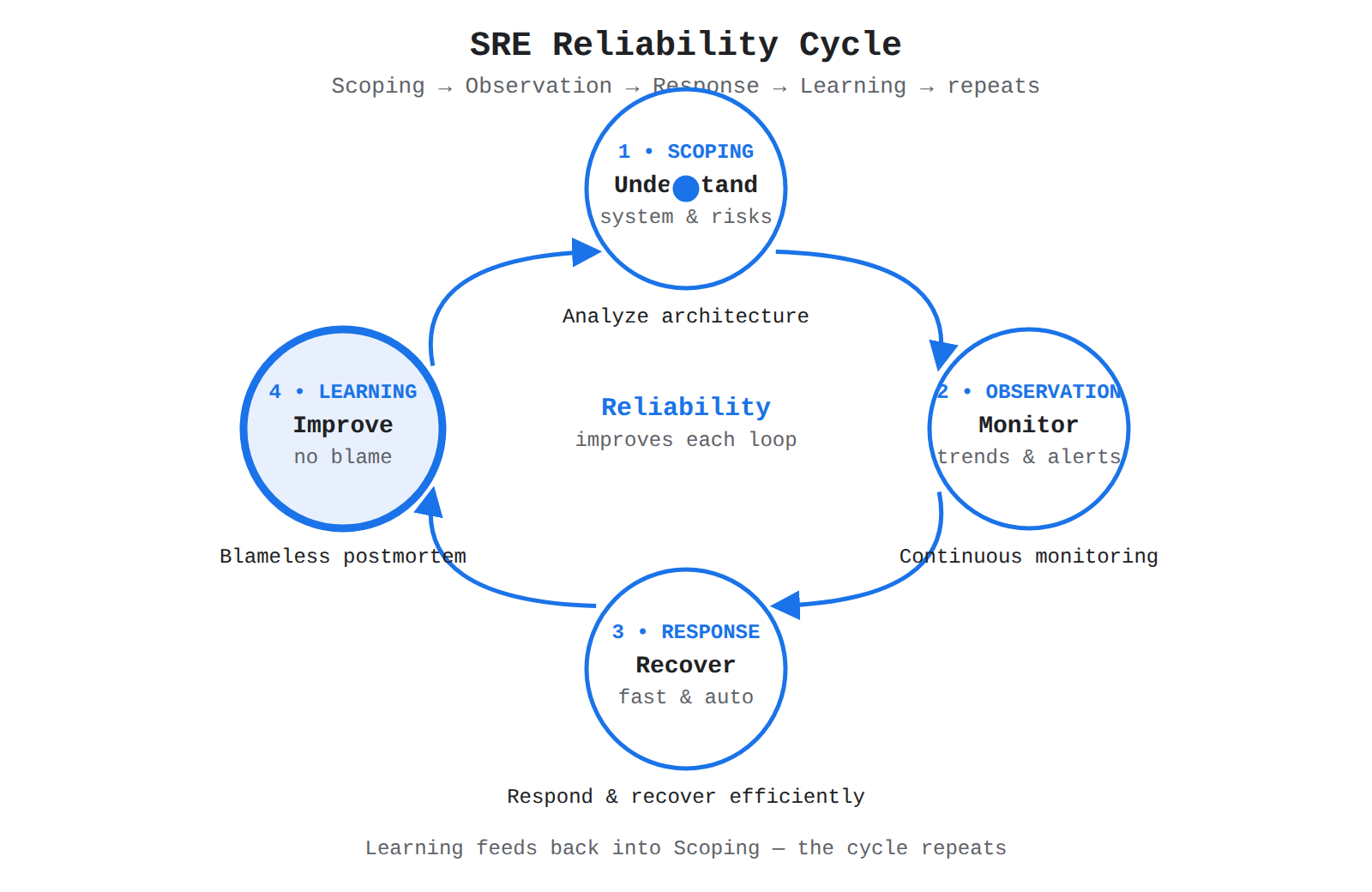
A four-step circular flow showing Scoping to Observation to Response to Learning and back to Scoping. A blue dot travels the loop in order while each step highlights in sequence.
- Scoping: Analyze the system architecture in detail, including components, how they interact, how data and actions flow, and what could go wrong.
- Observation: Implement comprehensive and continuous observation and monitoring to understand trends and identify potential problems proactively.
- Response: Respond appropriately and recover efficiently to reduce the impact of failures, including through automated response and incident response.
- Learning: Learn from each experience and act to prevent recurrence, including thorough postmortems that are blameless so the focus stays on learning rather than blame.
Scoping identifies potential failures, bottlenecks, and risks so they can be mitigated before users are affected. Observation, Response, and Learning then keep the service healthy and ensure each incident improves future reliability.
Core Principles for Reliable and Scalable Services
The reliability pillar of the Google Cloud Well-Architected Framework maps reliability work to nine core principles. These principles connect user expectations to technical design and operational testing:
- Define reliability based on user-experience goals.
- Set realistic targets for reliability.
- Build highly available systems through resource redundancy.
- Take advantage of horizontal scalability.
- Detect potential failures by using observability.
- Design for graceful degradation.
- Perform testing for recovery from failures.
- Perform testing for recovery from data loss.
- Conduct thorough postmortems.
Together, the principles guide SRE and DevOps teams from setting targets through designing redundant systems to testing recovery and learning from incidents.
Setting Realistic Reliability Targets and Error Budgets
SRE teams set reliability targets that are just reliable enough for user happiness, not 100%. A goal of 100% reliability is often not effective because higher reliability can significantly increase cost and limit innovation. The gap between 100% uptime and a target such as 99.99% is the error budget (opens in a new tab), which is the allowance for failure that can fund risk and innovation.
Exam tip: An error budget is the gap between 100% uptime and a reliability target like 99.99%, and it is the allowance for failure that can fund risk and innovation.
To set realistic targets, teams prioritize the most critical components and accept higher failure tolerance in less critical components. Teams balance reliability and cost with analyses that consider system requirements, consequences of failure, organizational risk tolerance, and disaster recovery metrics such as RTO and RPO. Teams then choose a level that is acceptable within budget and look for efficiencies that do not compromise essential reliability features.
Building Blocks of Reliability: Regions, Zones, and Failure Domains
Google Cloud infrastructure is built on failure domains called regions (opens in a new tab) and zones. A failure domain is a resource or group of resources that can fail independently of other resources. A standalone Compute Engine VM is a failure domain, and a Google Cloud region or zone is a failure domain made of a group of resources. When an application is distributed redundantly across failure domains, it can achieve higher aggregate availability than each domain provides alone.
Google Cloud infrastructure is designed to tolerate and recover from failures, with the following target availability levels for most customer workloads:
| Deployment location | Availability (uptime) % | Estimated maximum downtime |
|---|---|---|
| Single zone | 99.9% (3 nines) | 43.2 minutes in a 30-day month |
| Multiple zones in a region | 99.99% (4 nines) | 4.3 minutes in a 30-day month |
| Multiple regions | 99.999% (5 nines) | 26 seconds in a 30-day month |
These percentages are targets, while uptime SLAs for specific services can differ. For example, a Bigtable instance with clusters in three or more regions has a 99.999% minimum uptime SLA with multi-cluster routing, while single-cluster routing results in a lower SLA.
Operational Approaches for Reliability at Scale
Operational approaches for reliability combine Google Cloud platform capabilities with DevOps practices. Platform capabilities include geographically separated regions to mitigate disasters and region outages, hardware redundancy and replication, live migration of Compute Engine VMs during maintenance, secure-by-design infrastructure, a high-performance backbone network using software-defined networking (SDN) with edge caching, continuous monitoring through the Service Health Dashboard, annual Disaster Recovery Testing (DiRT) events, and change management that emphasizes reliability across the software development lifecycle.
DevOps practices add automation and shared ownership to reliability work through CI/CD products:
- Cloud Build: Continuously builds, tests, and deploys containers using Google Cloud infrastructure.
- Artifact Registry: Stores, manages, and secures container images and language packages.
- Artifact Analysis: Gains insight into software components and securely stores and manages metadata.
- Software supply chain security: Uses a modular set of Google Cloud products to protect the software supply chain.
- Cloud Deploy (opens in a new tab): Automates delivery of applications to a series of target environments in a defined sequence.
These approaches reduce toil (opens in a new tab), which is repetitive manual operational work, and make deployments repeatable. SRE methods such as automation, testing, and postmortems work with these DevOps practices to apply engineering principles to operations.
Key Facts
- DevOps CI/CD flows in order from Cloud Build to Artifact Registry to Cloud Deploy, so only tested and stored artifacts move forward to staged delivery.
- An error budget is the gap between 100% uptime and the reliability target, such as 99.99%, and it funds risk and innovation while the service stays within budget.
- A failure domain is a resource or group of resources that can fail independently, with regions, zones, and standalone Compute Engine VMs as examples.
- Target availability rises from 99.9% in a single zone to 99.99% across multiple zones to 99.999% across multiple regions.
- SRE responsibilities form a Scoping, Observation, Response, and Learning cycle supported by automation, blameless postmortems, and reduced toil.
Frequently Asked Questions
What is the difference between Cloud Build and Cloud Deploy in Google Cloud DevOps?
Cloud Build continuously builds, tests, and deploys containers using Google Cloud infrastructure, while Cloud Deploy automates delivery of already-built applications to a series of target environments in a defined sequence. Tested container images or language packages flow from Cloud Build to Artifact Registry for storage and then to Cloud Deploy for staged delivery, so only tested artifacts move forward.
What is an error budget in cloud reliability?
An error budget is the gap between 100% uptime and the chosen reliability target such as 99.99%, and it is the allowance for failure. While the service stays within budget, teams can release updates, take risks, and innovate, but when failures consume the budget, teams pause feature work and focus on stability until reliability recovers.
What is a failure domain in Google Cloud and how does redundancy across failure domains improve availability?
A failure domain is a resource or group of resources that can fail independently of other resources, with regions, zones, and standalone Compute Engine virtual machines (VMs) as examples. When an application is distributed redundantly across failure domains through duplicated capacity and replicated data, it reaches higher aggregate availability than any single domain provides alone.
What availability targets does Google Cloud design for single-zone, multi-zone, and multi-region deployments?
A single zone targets 99.9% availability with up to 43.2 minutes of downtime in a 30-day month, multiple zones in a region target 99.99% with up to 4.3 minutes, and multiple regions target 99.999% with up to 26 seconds. These percentages are platform targets, while Service Level Agreements for specific services can differ by configuration.
Sample Question
A financial services company is modernizing its software development lifecycle on Google Cloud. Currently, developers work on isolated code branches for weeks before manually merging their work, which frequently leads to complex merge conflicts and undetected bugs delaying releases.
The engineering leadership team wants to adopt a DevOps practice that achieves the following goals:
- Encourages developers to merge code changes into a shared main branch frequently
- Automatically triggers linting, code building, and unit testing whenever code is pushed
- Exposes defects early in the development process and produces a validated artifact for deployment
Which DevOps practice should the company implement?
Continuous integration (CI)
Infrastructure monitoring
Container orchestration
Continuous delivery (CD)
How learners score on this domain
Last updated