Fundamental
Prepare and test your skills

Fundamental
Prepare and test your skills
Routing Audit Logs to BigQuery with Sinks
Free sample question with answers and detailed explanation below. The Associate Cloud Engineer practice bank has an additional 2,014 practice questions.Try 10 free realistic questions: instant score, no credit card, and no account required.
Your organization must retain all Google Cloud audit logs for seven years to comply with regulatory standards. In addition, security analysts need the ability to run SQL queries across the historical log dataset for compliance reviews.
Which solution should you implement in Cloud Logging?
Explanations
Deploy a scheduled Cloud Function that uses the entries.list API method daily to query and append log records into BigQuery
Deploy a scheduled Cloud Function that uses the entries.list API method daily to query and append log records into BigQuery
What the entries.list API Method Does
The entries.list API method is an interactive REST endpoint in Cloud Logging designed to search, filter, and retrieve specific log entries on demand, primarily for troubleshooting or debugging through administrative scripts and tools like the Logs Explorer.
Why It Doesn't Meet the Requirement
- API Quota Exhaustion: The
entries.listmethod is subject to strict request and read quotas and is explicitly not designed or recommended for high-volume, bulk data extraction. - Operational Complexity: Implementing custom pagination, error recovery, deduplication, and scheduling with Cloud Functions introduces significant maintenance overhead compared to native logging sinks.
- Non-Standard Practice: Exporting telemetry data should be achieved via asynchronous push sinks rather than recurring batch API queries.
Key Characteristics and Limitations
- Subject to restrictive API rate limits and data retrieval ceilings.
- High-volume polling can cause
RESOURCE_EXHAUSTEDerrors during high-traffic periods. - Polling introduces latency and potential gaps if functions fail or timeout.
This Answer Would Be Correct If
You needed to execute a one-time ad-hoc script to retrieve a small sample of recent diagnostic log entries for offline inspection.
Modify the retention period of the default _Required log bucket to seven years (2555 days)
Modify the retention period of the default _Required log bucket to seven years (2555 days)
What the _Required Log Bucket Is
The _Required log bucket is an automatically provisioned, built-in storage container in Cloud Logging that stores Admin Activity audit logs, System Event audit logs, and Access Transparency logs without incurring ingestion or storage charges.
Why It Doesn't Meet the Requirement
- Non-Configurable Retention: The retention period for the
_Requiredlog bucket is fixed at 400 days by Google Cloud and cannot be edited, extended, or shortened. - Fails Compliance Mandate: Because the retention cannot be increased to seven years (2555 days), relying on the
_Requiredbucket alone will result in logs older than 400 days being permanently purged. - No Direct SQL Interface: Standard log buckets (unless upgraded specifically to Log Analytics) do not offer native BigQuery-compatible analytics tools.
Key Characteristics and Limitations
- Fixed 400-day retention that cannot be altered by project administrators.
- Cannot be disabled, deleted, or filtered via custom routing sinks.
- Holds critical administrative and system logs for free, but is strictly bound to its default lifecycle.
This Answer Would Be Correct If
The organization only required default administrative audit log retention for up to 400 days without requiring custom retention policies or external data export.
Install and configure the Ops Agent on Compute Engine instances to write audit logs directly to Cloud Storage
Install and configure the Ops Agent on Compute Engine instances to write audit logs directly to Cloud Storage
What the Ops Agent Does
The Google Cloud Ops Agent is a software agent installed directly on virtual machine (VM) operating systems to gather system metrics, application logs (such as nginx or syslog), and standard output streams (stdout/stderr), forwarding them to Cloud Observability.
Why It Doesn't Meet the Requirement
- Wrong Log Category: Project audit logs (such as Admin Activity and Data Access logs) are generated at the Google Cloud control plane and API layer, not by guest operating systems running inside Compute Engine VMs.
- Architectural Misalignment: The Ops Agent has no access to Google Cloud project-level audit trails and cannot capture organizational control-plane activity.
- Unnecessary Overhead: Installing guest agents does not solve long-term retention or provide direct SQL querying capabilities in BigQuery.
Key Characteristics and Limitations
- Operates only within the guest operating system of Compute Engine instances.
- Collects host metrics and local application log files.
- Transmits collected data to the Cloud Logging API, rather than routing audit events across the project.
This Answer Would Be Correct If
The goal were to capture operating system log files (like /var/log/messages) or local web server access logs from specific Compute Engine instances and push them to Cloud Observability.
Create a Cloud Logging sink configured with a BigQuery dataset as the destination
Create a Cloud Logging sink configured with a BigQuery dataset as the destination
What Cloud Logging Sinks Are
A Cloud Logging sink is a routing mechanism that continuously captures incoming log entries matching a defined filter query and streams them to an external or internal destination. Sinks support routing data in real time to destinations such as BigQuery, Cloud Storage, Pub/Sub, or other Cloud Logging buckets.
Log Sink Streaming to BigQuery Flow
Process Flow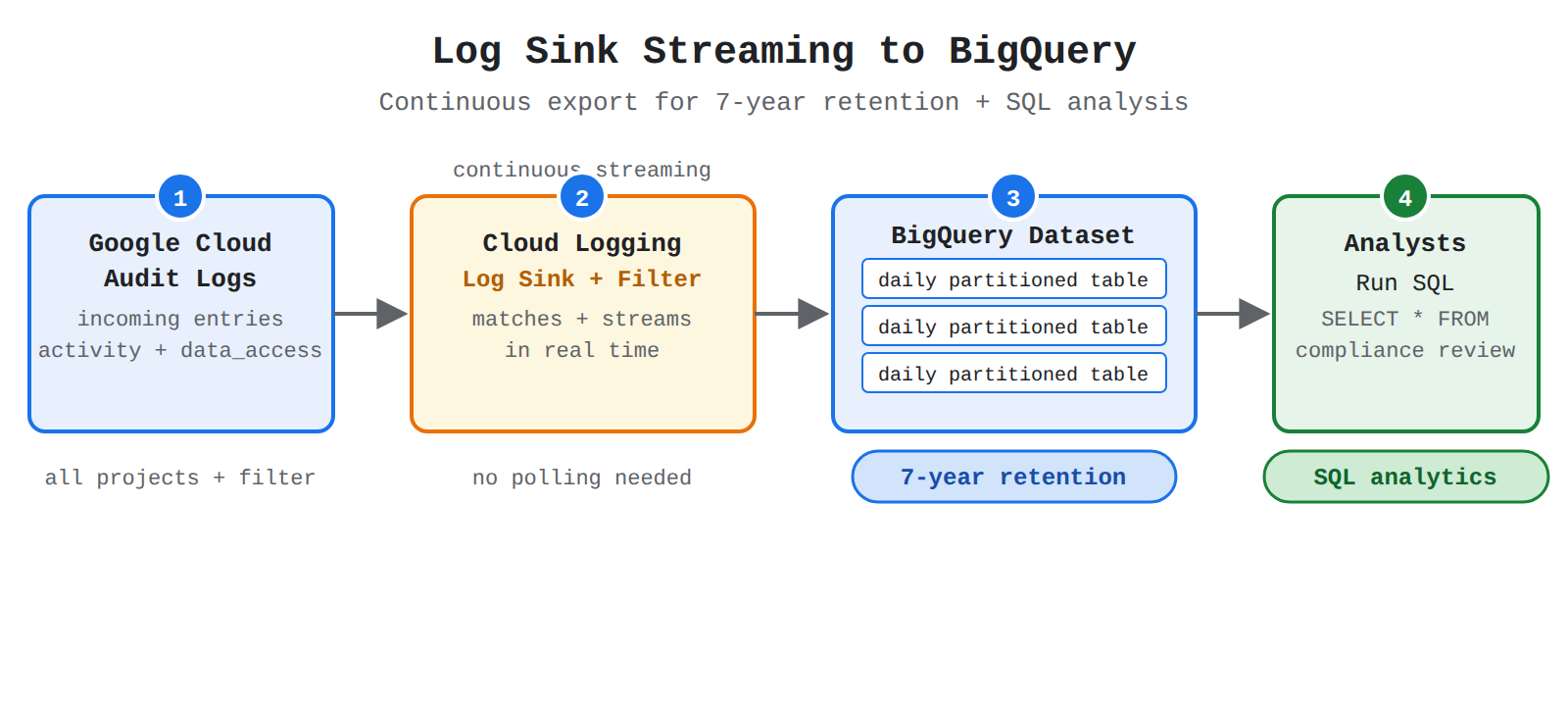
How It Meets the Requirements
- Seven-Year Long-Term Retention: BigQuery datasets can retain partitioned tables indefinitely or apply custom partition expiration rules configured for seven years (or longer), fulfilling strict compliance and regulatory retention mandates.
- SQL-Based Analytical Querying: By routing logs directly to BigQuery, log records are parsed into structured schemas where security analysts can execute standard SQL queries for auditing and forensics.
- Automated Telemetry Export: Cloud Logging sinks stream logs continuously as they arrive, eliminating manual intervention or batch polling scripts.
Key Advantages
- Real-Time Streaming: Logs are streamed directly into destination tables with minimal latency.
- Scalable SQL Analytics: Enables complex queries, cross-table joins, and aggregations across terabytes of historical audit telemetry.
- Centralized Compliance: Can be deployed at the project, folder, or organization level using aggregated sinks to capture all enterprise activity.
- Customizable Ingestion Filters: Sinks allow precise inclusion and exclusion filters to control which log categories are exported.
Why This Is Optimal
Creating a log sink with a BigQuery destination is Google's recommended architecture when log records require immediate SQL searchability, custom retention schedules beyond standard log bucket ceilings, and integration with enterprise analytics dashboards.
Try 10 interactive questions like this one, free
Answer them yourself and get your score the moment you finish. No account needed.
Full access includes
- 2,014 practice questions across all 4 exam domains
- Every answer explained: why it is right, and why the others are not
- Scout, an AI tutor that answers your follow-up questions
- Readiness tracking by domain, so you know when to book the exam
Related free sample questions
Keep the momentum going with these hand-picked practice scenarios
FundamentalAssociate Cloud Engineer
Google Cloud Ops Agent
Provisioning and setting up products in Google Cloud Observability
FundamentalAssociate Cloud Engineer
Cloud Monitoring Dashboard and Uptime Check
Provisioning and setting up products in Google Cloud Observability
FundamentalAssociate Cloud Engineer
Artifact Registry Reader Role for GKE Nodes
Configuring GKE to access Artifact Registry
FundamentalAssociate Cloud Engineer
Gemini Cloud Assist Investigations Remediation
Using Gemini Cloud Assist for Cloud Monitoring
FundamentalAssociate Cloud Engineer
Eventarc Cloud Run Invoker Role
Deploying an application to serverless compute platforms, including for the processing of Google Cloud events (e.g., Pub/Sub events, Cloud Storage object change notification events, Eventarc)
FundamentalAssociate Data Practitioner
Zonal High Availability with Cross-Region Disaster Recovery
Distinguish between primary and secondary data storage location type (e.g., regions, dual-regions, multi-regions, zones) for data redundancy
Last updated