Fundamental
Prepare and test your skills

Fundamental
Prepare and test your skills
Fact-Checking Gemini Investigations Before Remediation
Free sample question with answers and detailed explanation below. The Associate Cloud Engineer practice bank has an additional 2,014 practice questions.Try 10 free realistic questions: instant score, no credit card, and no account required.
An operations engineer is troubleshooting intermittent application crashes detected in Google Cloud Monitoring. To identify the root cause and restore system reliability, the engineer initiates an automated investigation using Gemini Cloud Assist from the Logs Explorer.
Gemini Cloud Assist evaluates logs, metrics, and resource configurations, producing ranked observations, potential root-cause hypotheses, and suggested remediation steps.
Following Google Cloud operational best practices, what should the engineer do to safely validate and apply the proposed remediation?
Explanations
Forward the investigation directly to Cloud Customer Care and avoid testing or applying any remediations internally until Google support replies.
Forward the investigation directly to Cloud Customer Care and avoid testing or applying any remediations internally until Google support replies.
What Cloud Customer Care Escalation Is
Google Cloud provides formal support channels through Cloud Customer Care for organizations holding eligible support packages. Gemini Cloud Assist includes a Request support integration that packages investigation summaries, observations, and relevant log snapshots directly into a Google Cloud support ticket.
Why It Doesn't Meet the Requirement
- Unnecessary Incident Delay: Gemini Cloud Assist Investigations is intended to provide fast, self-service root-cause analysis so that internal operations teams can resolve incidents independently. Halting internal troubleshooting to wait for support response prolongs Mean Time to Resolution (MTTR).
- Customer Responsibility Scope: Under the cloud shared responsibility model, customer application code, workload dependencies, and internal resource configurations are managed by the customer, not Google support engineers.
- Inefficient Use of Support: Support cases are best reserved for unresolved complex issues, suspected platform outages, or infrastructure-level defects after initial internal investigation has taken place.
Key Characteristics and Limitations
- Enriched Support Tickets: Transferring investigation data to support provides engineers with troubleshooting context, eliminating repetitive diagnostic questions.
- Not a Prerequisite: Contacting support is an escalation path, not a required first step for applying guided remediations.
- Operational Self-Sufficiency: Standard incident response workflows encourage teams to evaluate and safely execute validated remediation steps independently whenever possible.
This Answer Would Be Correct If
The team had already completed an internal investigation, ruled out customer-managed application and configuration bugs, and identified an underlying Google Cloud infrastructure degradation that required backend support intervention.
Accept the highest-ranked hypothesis as guaranteed fact and immediately deploy the recommended changes without verifying the underlying telemetry.
Accept the highest-ranked hypothesis as guaranteed fact and immediately deploy the recommended changes without verifying the underlying telemetry.
What Automated Hypothesis Ranking Is
When an investigation is initiated, Gemini Cloud Assist evaluates signals across multiple telemetry sources and synthesizes the findings into hypotheses regarding the probable root cause. Because complex systems can exhibit multiple related failure modes, Gemini ranks these hypotheses based on pattern matching, operational runbooks, and symptom signatures.
Why It Doesn't Meet the Requirement
- Hypotheses Are Probabilistic: A ranked hypothesis represents an informed deduction rather than a guaranteed certainty. In distributed architectures, symptoms like high database latency might mask an underlying network configuration defect.
- Premature Remediation Hazards: Applying configuration fixes without verifying whether the highest-ranked hypothesis actually reflects reality can worsen an incident, waste critical recovery time, or introduce new bugs.
- Ignoring Verifiable Evidence: Gemini Cloud Assist deliberately provides deep links to the underlying metrics, configurations, and logs. Bypassing these links forfeits the opportunity to confirm the diagnosis before altering the infrastructure.
Key Characteristics and Limitations
- Iterative Refinement: When diagnostic uncertainty exists, operators are expected to create investigation revisions to drill deeper rather than blindly accepting the initial output.
- Shared Context: Hypotheses guide where an engineer should direct their attention, functioning as an accelerator rather than a replacement for engineering analysis.
- Verification Necessity: Validating hypotheses against empirical source data is an essential step in modern root-cause analysis.
This Answer Would Be Correct If
Gemini Cloud Assist produced formal mathematical proofs of platform state with 100% causal certainty, eliminating any possibility of ambiguous signals or speculative conclusions.
Review the source data links included with the observations to fact-check the findings, validate the suggested fixes against organizational standards, and apply the remediation.
Review the source data links included with the observations to fact-check the findings, validate the suggested fixes against organizational standards, and apply the remediation.
What Gemini Cloud Assist Investigations and Guided Remediation Are
Gemini Cloud Assist Investigations is an AI-powered root-cause analysis (RCA) feature integrated directly into Google Cloud operational workflows, such as Logs Explorer and Cloud Monitoring. It analyzes telemetry across multiple data sources—including logs, system metrics, and infrastructure configurations—to synthesize key observations, deduce probable root causes, and propose guided remediation steps.
How It Meets Operational Best Practices
- Fact-Checking Telemetry: Each observation produced by Gemini Cloud Assist includes direct links to the underlying source data. This allows operators to inspect the raw log lines and metric graphs, confirming that the AI's conclusions reflect actual system behavior.
- Validating Suggested Fixes: Generative AI tools can occasionally output recommendations that sound plausible but are factually inaccurate or inappropriate for a specific architecture. Google Cloud operational guidance requires operators to validate all recommendations before applying them.
- Controlled Implementation: Evaluating proposed fixes against internal security policies, change control processes, and deployment pipelines ensures system reliability and prevents accidental misconfigurations or configuration drift.
Key Advantages and Capabilities
- Accelerated Incident Triage: Engineers save critical time during an incident by receiving ranked observations rather than manually writing complex log queries.
- Data Traceability: Direct links to source telemetry provide transparency and allow operators to verify the reasoning behind each insight.
- Context-Aware Guidance: The tool cross-references operational signals across multiple services to surface actionable next steps.
- Preventing Recurring Outages: Addressing verified root causes rather than superficial symptoms ensures long-term operational stability.
Why This Workflow Is Optimal
Combining automated AI pattern recognition with human engineering oversight aligns with the core principles of Site Reliability Engineering (SRE) and responsible AI. This approach accelerates time to discovery while ensuring that every change made to production infrastructure is verified, safe, and effective.
Safe Remediation: Fact-Check Then Apply
Process Flow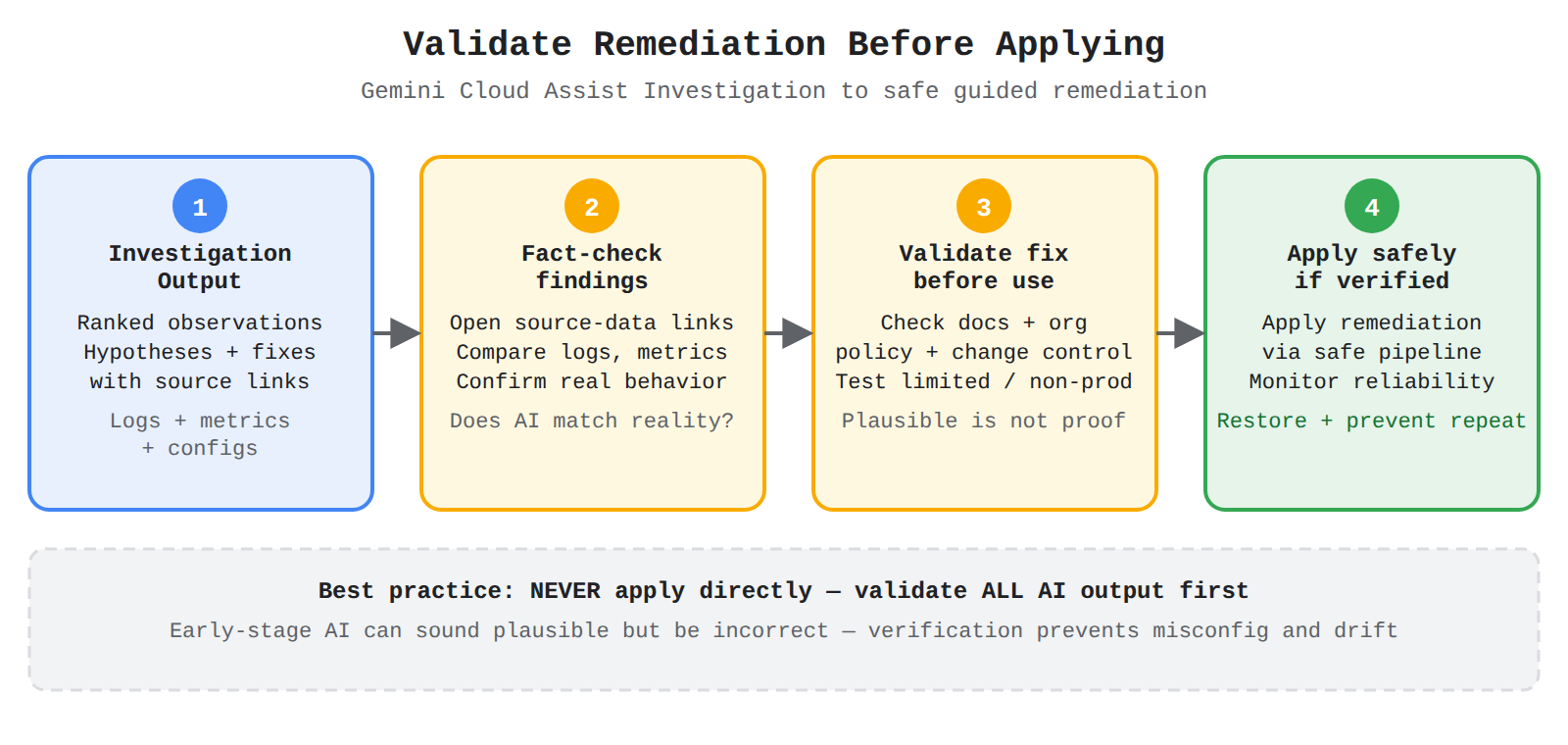
Configure Gemini Cloud Assist to execute autonomous self-healing scripts immediately across all production clusters to prevent human delay.
Configure Gemini Cloud Assist to execute autonomous self-healing scripts immediately across all production clusters to prevent human delay.
What Autonomous Self-Healing and Automated Remediation Are
Autonomous self-healing describes an architecture where monitoring agents or orchestration controllers automatically trigger predefined, deterministic remediation scripts without human involvement. In Google Kubernetes Engine (GKE), native mechanisms like node auto-repair or workload health probes operate autonomously according to explicit platform rules.
Why It Doesn't Meet the Requirement
- Advisory Role: Gemini Cloud Assist is designed as an intelligent collaborator and investigative advisor. It does not have an autonomous background daemon that executes arbitrary write operations or configuration modifications across your production fleet.
- Violation of Responsible AI Best Practices: AI models can generate plausible-sounding recommendations that do not match the specific architectural nuances of an enterprise environment. Granting unmonitored execution authority to AI recommendations creates severe operational risk.
- Risk of Cascading Failures: Automatically applying unverified configuration changes during an active incident can introduce unforeseen side effects, trigger cascading service outages, or violate strict change-management compliance standards.
Key Characteristics and Limitations
- Human Oversight Required: Google Cloud explicitly emphasizes validating all generative AI guidance before deploying updates.
- No Direct Autonomous Execution: Gemini Cloud Assist assists operators with insights and code or command suggestions; it does not replace controlled deployment pipelines.
- Deterministic vs. Generative: Safe autonomous self-healing relies on deterministic scripts and strict health check thresholds, not speculative generative models.
This Answer Would Be Correct If
The scenario focused on native platform features with deterministic criteria—such as enabling GKE node auto-repair or configuring Compute Engine Managed Instance Group (MIG) auto-healing policies based on explicit health check endpoints.
Try 10 interactive questions like this one, free
Answer them yourself and get your score the moment you finish. No account needed.
Full access includes
- 2,014 practice questions across all 4 exam domains
- Every answer explained: why it is right, and why the others are not
- Scout, an AI tutor that answers your follow-up questions
- Readiness tracking by domain, so you know when to book the exam
Related free sample questions
Keep the momentum going with these hand-picked practice scenarios
FundamentalAssociate Cloud Engineer
Gemini Cloud Assist Investigation Data Sources
Using Gemini Cloud Assist for Cloud Monitoring
FundamentalAssociate Cloud Engineer
Predefined vs Basic IAM Roles
Managing IAM permissions of a service account
FundamentalAssociate Cloud Engineer
Kubeconfig Context Switching
Installing and configuring the command-line interface (CLI) for Kubernetes (kubectl)
FundamentalAssociate Cloud Engineer
GKE Cluster Autoscaler Node Pool Scaling
Working with GKE node pools (e.g., add, edit, or remove a node pool; autoscaling node pool)
FundamentalAssociate Cloud Engineer
Rate Quotas vs Allocation Quotas
Assessing quotas and requesting increases
IntermediateProfessional Cloud Database Engineer
Cloud SQL HA with Cross-Region Read Replica
Design for RTO, RPO, and PITR
Last updated