Fundamental
Prepare and test your skills

Fundamental
Prepare and test your skills
Invoking Private Cloud Run with Eventarc
Free sample question with answers and detailed explanation below. The Associate Cloud Engineer practice bank has an additional 2,014 practice questions.Try 10 free realistic questions: instant score, no credit card, and no account required.
An organization is building an event-driven microservices application on Google Cloud. You deploy a containerized order-processing service to Cloud Run and configure it to require authentication so that it cannot be accessed publicly. You want to configure an Eventarc trigger to route new order messages published to a Cloud Pub/Sub topic directly to this Cloud Run service.
You create a dedicated user-managed service account to associate with the Eventarc trigger.
Which Identity and Access Management (IAM) role must you grant to this service account so Eventarc can successfully deliver events to your Cloud Run service?
Explanations
Cloud Run Admin (roles/run.admin)
Cloud Run Admin (roles/run.admin)
What Cloud Run Admin does
The Cloud Run Admin (roles/run.admin) role provides full administrative control over all Cloud Run resources within a project or service boundary. This includes the ability to deploy new container revisions, delete services, update environment variables, and modify IAM policies.
Why it doesn't meet the requirement
Although roles/run.admin technically includes the run.routes.invoke permission necessary to call a Cloud Run service, granting it to a trigger service account violates core Google Cloud security best practices:
- Violates principle of least privilege: A runtime delivery identity only needs invocation access; it should never have rights to modify or delete container services.
- Overly permissive: If the service account is compromised, an attacker would have full administrative access to tamper with production compute resources.
- Certification exams and enterprise standards require choosing the most restrictive role that accomplishes the goal.
Key characteristics and limitations
- Allows creating, updating, and deleting Cloud Run services.
- Allows reading and updating configuration settings, traffic splitting, and revision tags.
- Unnecessarily broad for an automated messaging pipeline delivering events.
This answer would be correct if
The service account belonged to a CI/CD build pipeline or continuous deployment agent responsible for deploying container images and configuring revisions.
Eventarc Admin (roles/eventarc.admin)
Eventarc Admin (roles/eventarc.admin)
What Eventarc Admin does
The Eventarc Admin (roles/eventarc.admin) role is an administrative role granting full control over Eventarc resources across a project. It allows administrators to create, update, list, and delete Eventarc triggers, channels, and enrollments.
Why it doesn't meet the requirement
There is a critical distinction between managing infrastructure and authenticating runtime invocations:
roles/eventarc.adminis used by engineers or provisioning tools to configure triggers.- The service account associated with the trigger is used at runtime to sign authentication tokens when Eventarc forwards an event to the destination endpoint.
- Cloud Run verifies permissions against its own resource model (
run.services.*). Becauseroles/eventarc.admincontains only Eventarc permissions, Cloud Run will deny access when the trigger attempts to deliver an event.
Key characteristics and limitations
- Grants control over Eventarc configuration and triggers.
- Does not grant permissions to invoke or interact with target consumer services.
- Is intended for human operators or automation scripts managing event topologies, not for service account identities invoking targets.
This answer would be correct if
You needed to grant an infrastructure engineer or service account the permissions required to create and delete Eventarc triggers in Google Cloud.
Cloud Run Invoker (roles/run.invoker)
Cloud Run Invoker (roles/run.invoker)
What Cloud Run Invoker is
The Cloud Run Invoker (roles/run.invoker) role is a predefined Identity and Access Management (IAM) role in Google Cloud. It provides the specific permission (run.routes.invoke) required to send HTTP requests to an authenticated Cloud Run service.
How it meets the requirements
When a Cloud Run service is deployed with ingress settings configured to require authentication, all unauthenticated incoming requests receive an HTTP 401 Unauthorized or HTTP 403 Forbidden response. When an Eventarc trigger routes an event from an event provider (such as a Cloud Pub/Sub topic) to a private Cloud Run destination:
- Eventarc uses the trigger's associated user-managed service account to generate an OpenID Connect (OIDC) identity token.
- This token is included in the authorization header of the HTTP push request delivered to the Cloud Run service.
- Cloud Run verifies the token's signature and ensures that the corresponding identity possesses the Cloud Run Invoker (
roles/run.invoker) role on that target service.
Key advantages and capabilities
- Enforces least privilege: Grants strictly the permission required to trigger the application without exposing any management or administrative privileges.
- Granular authorization: Can be bound at the service level rather than project-wide, restricting invocation access exclusively to the specific receiving Cloud Run container.
- Seamless integration: Works natively with Eventarc and Pub/Sub push endpoints to authenticate event deliveries automatically.
- Enhanced security posture: Keeps serverless endpoints completely private while maintaining reliable event ingestion.
Why this is optimal
Granting roles/run.invoker allows the Eventarc delivery pipeline to authenticate itself to the secured Cloud Run service while preventing unauthorized public requests. It provides the exact runtime capability needed for event routing without granting unnecessary permissions.
OIDC Token Check for Eventarc to Cloud Run
Sequence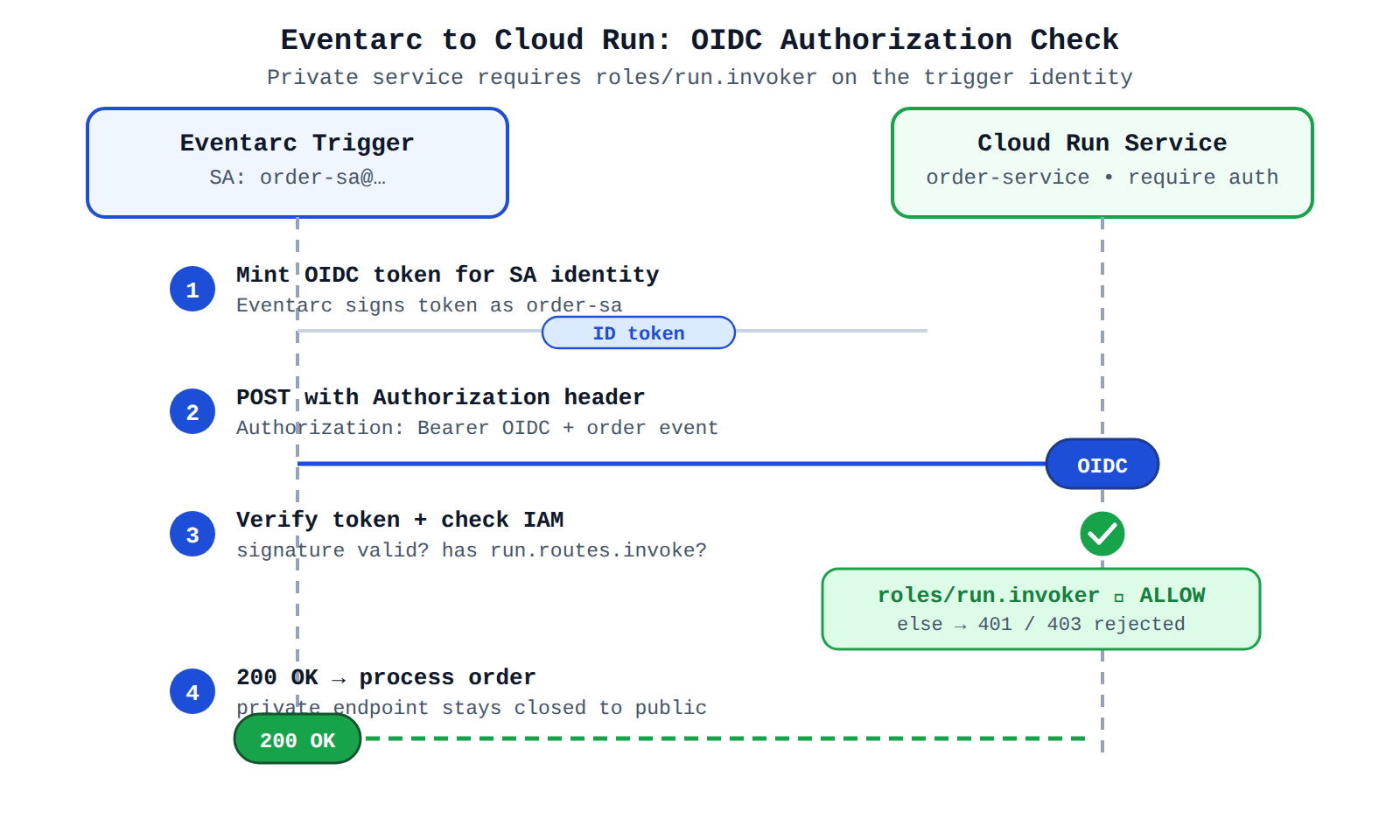
Pub/Sub Publisher (roles/pubsub.publisher)
Pub/Sub Publisher (roles/pubsub.publisher)
What Pub/Sub Publisher does
The Pub/Sub Publisher (roles/pubsub.publisher) role allows an identity to send and publish messages to a Google Cloud Pub/Sub topic. It provides the pubsub.topics.publish permission at the project or topic level.
Why it doesn't meet the requirement
In an event-driven architecture with Eventarc:
- Event producers (such as external applications, Cloud Storage, or user services) publish events to Pub/Sub.
- Eventarc listens for those events and dispatches them downstream to the target destination.
- The trigger's service account acts on the delivery side of the architecture. It is responsible for calling the downstream destination (Cloud Run), not creating or writing new messages to the Pub/Sub topic.
- Granting
roles/pubsub.publisherdoes not grantrun.routes.invoke, meaning Cloud Run will reject incoming requests sent by Eventarc with an authentication error.
Key characteristics and limitations
- Grants permission to write messages to Pub/Sub topics.
- Does not grant permission to read, pull, or acknowledge messages.
- Completely lacks any permissions related to invoking Cloud Run or managing serverless compute resources.
This answer would be correct if
This role would be required if the service account belonged to an event producer application that needed to publish order messages directly to the Pub/Sub topic.
Try 10 interactive questions like this one, free
Answer them yourself and get your score the moment you finish. No account needed.
Full access includes
- 2,014 practice questions across all 4 exam domains
- Every answer explained: why it is right, and why the others are not
- Scout, an AI tutor that answers your follow-up questions
- Readiness tracking by domain, so you know when to book the exam
Related free sample questions
Keep the momentum going with these hand-picked practice scenarios
FundamentalAssociate Cloud Engineer
Eventarc Pub/Sub Trigger for Cloud Run
Deploying an application to serverless compute platforms, including for the processing of Google Cloud events (e.g., Pub/Sub events, Cloud Storage object change notification events, Eventarc)
FundamentalAssociate Cloud Engineer
IAP TCP Forwarding for RDP
Remotely connecting to a Compute Engine instance
FundamentalAssociate Cloud Engineer
Google Cloud Predefined IAM Roles
Granting members Identity and Access Management (IAM) roles within a project
FundamentalAssociate Cloud Engineer
Regional vs Global Quotas
Assessing quotas and requesting increases
FundamentalAssociate Cloud Engineer
Cordon and Drain Node Migration
Working with GKE node pools (e.g., add, edit, or remove a node pool; autoscaling node pool)
FundamentalGenerative AI Leader
Knowledge Cutoff and Data Dependency
Identifying common limitations of foundation models (e.g., data dependency, the knowledge cutoff, bias, fairness, hallucinations, edge cases)
Last updated