Intermediate
Prepare and test your skills
Intermediate
Prepare and test your skills
Keyless Authentication with Workload Identity Federation
Free sample question, answered and explained below. The Professional Cloud Architect practice bank has 2,335 more like it. Try 10 free: instant score, no account.
An enterprise is designing a hybrid cloud architecture where external on-premises applications must access Google Cloud resources securely without using downloadable service account keys. The compliance and security teams establish the following technical requirements:
- External applications must authenticate via Workload Identity Federation using stable, non-reusable identity attributes to prevent unauthorized access via identity spoofing.
- The security operations team must maintain a non-repudiable audit trail capable of tracing all service account impersonation events directly back to the original external principal.
- Attribute mapping configurations must be protected against unauthorized modifications by applying the principle of least privilege.
Which combination of architectural and IAM practices should the cloud architect recommend?
Explanations
Map federation attributes using immutable user identifiers, enable Data Access audit logs for both the Security Token Service API and IAM API, and restrict the IAM Workload Identity Pool Admin role to authorized administrators.
Map federation attributes using immutable user identifiers, enable Data Access audit logs for both the Security Token Service API and IAM API, and restrict the IAM Workload Identity Pool Admin role to authorized administrators.
What Workload Identity Federation Best Practices Entail
Workload Identity Federation allows external workloads (such as on-premises applications or systems hosted in other clouds) to impersonate Google Cloud service accounts using short-lived credentials derived from Security Token Service (STS) tokens, eliminating the risks associated with downloadable service account keys.
How It Meets the Requirements
- Preventing Identity Spoofing: Mapping federation attributes to unique, immutable, and authoritative user IDs (rather than mutable usernames or reusable email addresses) ensures that if an identity profile changes or is recreated in the external provider, unintended permissions are not inherited.
- Non-Repudiable Audit Trail: Enabling Data Access audit logs for both the Security Token Service API and the Identity and Access Management API captures the external caller's subject identity inside the
serviceAccountDelegationInfometadata, providing complete end-to-end traceability for forensic analysis. - Least Privilege Management: Restricting the IAM Workload Identity Pool Admin (
roles/iam.workloadIdentityPoolAdmin) role ensures that only authorized administrators can modify attribute mappings, preventing malicious actors from altering translation rules to gain unauthorized access.
Federated Impersonation Audit Flow
Sequence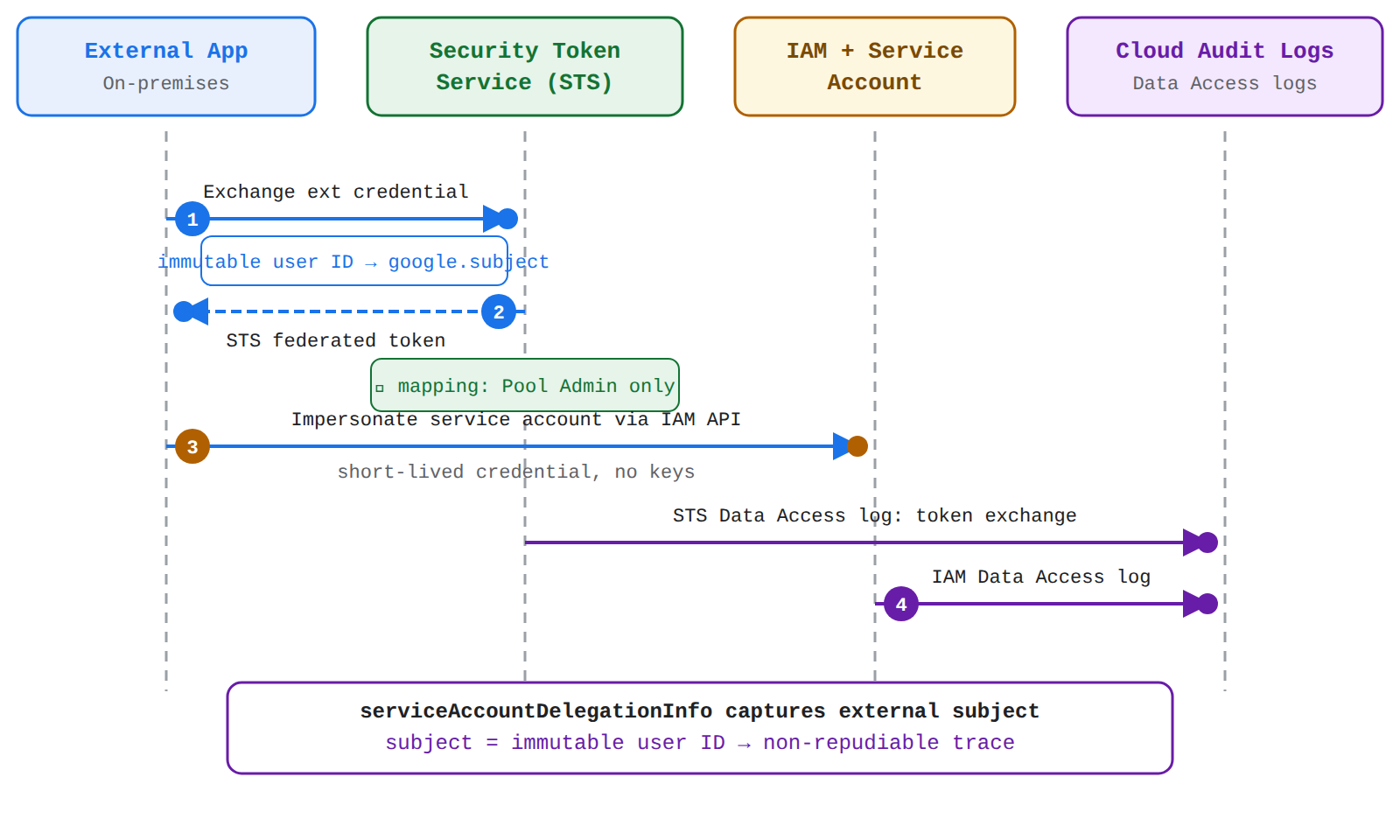
Key Advantages
- Elimination of Long-Lived Secrets: Avoids storing, rotating, and securing service account JSON keys on on-premises infrastructure.
- Authoritative Attribute Mapping: Mitigates impersonation and privilege escalation attacks caused by mutable identity attributes.
- Comprehensive Forensics: Supplies the necessary log fields in Cloud Audit Logs to correlate Google Cloud actions with external identity provider event logs.
- Granular Access Control: Isolates workload pool administrative permissions to dedicated security administrators.
Why This Is Optimal
This architecture establishes zero-trust identity federation while strictly fulfilling organizational compliance, least privilege governance, and end-to-end non-repudiation requirements.
Map federation attributes using external corporate email addresses, rely exclusively on default Admin Activity audit logs, and assign the Owner role to application developers on the workload identity pool project.
Map federation attributes using external corporate email addresses, rely exclusively on default Admin Activity audit logs, and assign the Owner role to application developers on the workload identity pool project.
What This Approach Does
This option configures Workload Identity Federation using user email addresses as identity identifiers, depends solely on default Admin Activity audit logs, and grants full project-level Owner permissions (roles/owner) to application developers.
Why It Doesn't Meet the Requirement
- Vulnerability to Spoofing: Email addresses in many enterprise directories are mutable and can be reassigned when employees depart or change names. Reusing an email attribute allows a new user to inherit previous service account impersonation bindings.
- Incomplete Audit Trail: Default Admin Activity audit logs record configuration changes but do not capture credential generation and impersonation API calls. Capturing external caller metadata requires Data Access audit logs for the Security Token Service API and IAM API.
- Violation of Least Privilege: Granting the Owner role provides excessive permissions across the entire project, enabling developers to modify attribute mappings, rebind service accounts, and bypass intended security boundaries.
Key Limitations
- Fails to prevent privilege escalation via mutable attributes.
- Lacks visibility into runtime token exchanges and service account delegations.
- Exposes identity infrastructure to unintended modifications.
This Answer Would Be Correct If
The identity provider guaranteed that email addresses were permanent and immutable, and the developers were designated as full cloud project administrators in a sandbox environment.
Generate long-lived service account keys, store them securely in Secret Manager for on-premises access, and assign the Service Account Key Admin role to developers.
Generate long-lived service account keys, store them securely in Secret Manager for on-premises access, and assign the Service Account Key Admin role to developers.
What This Approach Does
This design generates static service account private keys, centralizes their storage within Secret Manager, and grants developers the Service Account Key Admin (roles/iam.serviceAccountKeyAdmin) role to manage key lifecycles.
Why It Doesn't Meet the Requirement
- Violates Keyless Architecture: The stated scenario requires workloads to authenticate without using downloadable or long-lived service account keys.
- Key Management Overhead: Long-lived private keys introduce significant exfiltration risks and require complex secret distribution and key rotation pipelines.
- Lack of External Non-Repudiation: When an application authenticates using a downloaded service account key, Cloud Audit Logs only see the service account identity; they cannot link the action to the individual external human or machine requesting the secret.
Key Limitations
- Introduces long-lived credentials into on-premises infrastructure.
- Does not leverage modern identity federation mechanisms.
- Lacks direct attribution to external identity provider subjects.
This Answer Would Be Correct If
The on-premises environment lacked an OIDC or SAML 2.0 compliant identity provider and could not support Workload Identity Federation token exchanges.
Configure Workload Identity Federation using SAML group assertions mapped to primitive Editor roles, disable Data Access logs to optimize cost, and grant all engineers the Workload Identity Pool Admin role.
Configure Workload Identity Federation using SAML group assertions mapped to primitive Editor roles, disable Data Access logs to optimize cost, and grant all engineers the Workload Identity Pool Admin role.
What This Approach Does
This option maps SAML group claims directly to primitive Editor roles (roles/editor), disables Data Access audit logs to avoid logging costs, and assigns the IAM Workload Identity Pool Admin role widely across engineering teams.
Why It Doesn't Meet the Requirement
- Violation of Least Privilege: Granting primitive Editor roles allows broad modification across almost all cloud services instead of granular, least-privilege permissions.
- Missing Auditability: Disabling Data Access audit logs completely breaks the non-repudiation requirement, making it impossible for security operations to determine which external principal obtained credentials.
- Privilege Escalation Risk: Broadly distributing the Workload Identity Pool Admin role permits unauthorized engineers to alter attribute mappings, allowing them to map their own identities to privileged service accounts.
Key Limitations
- Uses broad primitive roles instead of predefined or custom least-privilege roles.
- Eliminates the audit trail necessary for compliance investigation.
- Allows arbitrary modification of security token translation rules.
This Answer Would Be Correct If
The workload only operated in a non-sensitive testing environment with no compliance or auditing requirements.
Try 10 interactive questions like this one, free
Answer them yourself and get your score the moment you finish. No account needed.
Full access includes
- 2,335 practice questions across all 6 exam domains
- Every answer explained: why it is right, and why the others are not
- Scout, an AI tutor that answers your follow-up questions
- Readiness tracking by domain, so you know when to book the exam
Related questions
Keep the momentum going with these hand-picked practice scenarios
IntermediateProfessional Cloud Architect
Intra-Region Synchronous, Inter-Region Asynchronous Replication
Familiarity with the Google Cloud Well-Architected Framework
IntermediateProfessional Cloud Architect
Predictive Autoscaling
Familiarity with the Google Cloud Well-Architected Framework
IntermediateProfessional Cloud Architect
Cloud KMS Admin vs CryptoKey Encrypter/Decrypter
Managing customer-managed encryption keys with Cloud Key Management Service (Cloud KMS)
IntermediateProfessional Cloud Architect
On-Demand Scanning API and Binary Authorization
Software development lifecycle (SDLC)
IntermediateProfessional Cloud Architect
Separation of Duties with Resource Hierarchy and IAM
Separation of duties
AdvancedProfessional Cloud Security Engineer
VPC Service Controls with CMEK and PSC
Determining security requirements for IaaS-hosted and PaaS-hosted training models.
Last updated