Intermediate
Prepare and test your skills
Intermediate
Prepare and test your skills
Predictive Autoscaling for Stateless Compute Engine MIGs
Free sample question, answered and explained below. The Professional Cloud Architect practice bank has 2,335 more like it. Try 10 free: instant score, no account.
An e-commerce company operates a customer-facing stateless web tier hosted on Compute Engine virtual machines across a Managed Instance Group (MIG). The application experiences predictable daily traffic surges every morning, but new VM instances take several minutes to complete initialization and warm local caches, leading to elevated response latency during reactive scale-out events. The company wants to maintain optimal performance during peak hours while minimizing compute costs during low-traffic periods.
Which autoscaling and resource optimization strategy should the company implement?
Explanations
Enable predictive autoscaling on the stateless Managed Instance Group to scale out capacity in advance of forecasted cyclical demand
Enable predictive autoscaling on the stateless Managed Instance Group to scale out capacity in advance of forecasted cyclical demand
What Predictive Autoscaling on Stateless MIGs Is
Predictive autoscaling is an advanced scaling feature in Compute Engine Managed Instance Groups (MIGs) designed to forecast future traffic patterns using machine learning models trained on historical workload metrics. Rather than only reacting to spikes as they happen, predictive autoscaling proactively provisions VM instances ahead of anticipated cyclical surges while maintaining standard autoscaling policies for unexpected demand.
How It Meets the Performance and Cost Requirements
- Eliminating Initialization Latency: By evaluating historical cycles, Compute Engine scales out instances several minutes before the morning surge begins. This ensures VM instances complete initialization and cache warming before end-user requests arrive.
- Balancing Cost and Performance: The workload automatically scales down during off-peak periods, avoiding the unnecessary expense of permanently over-provisioning large static pools of virtual machines.
- Real-Time Responsiveness: Predictive autoscaling works alongside real-time metrics, allowing the cluster to handle both predicted cycles and unexpected spikes without performance degradation.
Predictive Autoscaling: Morning Surge Timeline
Timeline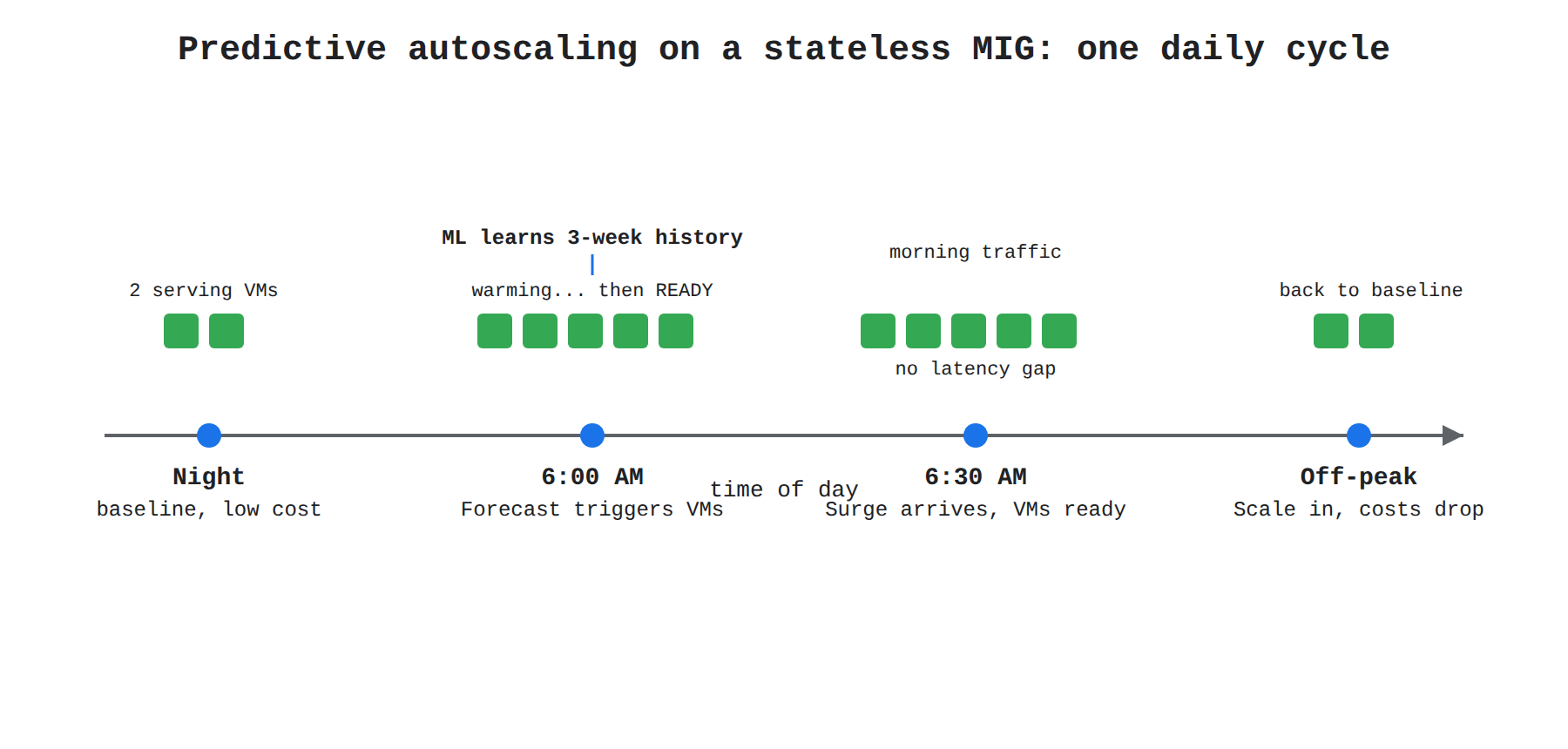
Key Advantages and Capabilities
- Proactive Capacity Management: Provisions VM capacity in advance based on recurring daily or weekly traffic cycles.
- Cost Efficiency: Removes idle over-provisioning by shrinking instance counts to baseline thresholds during non-peak hours.
- Dual-Model Scaling: Integrates historical predictive modeling with real-time reactive metric monitoring (CPU utilization, HTTP load balancing capacity, or custom metrics).
- High Availability: Pairs with stateless regional MIGs to distribute instances across multiple zones for fault tolerance.
Why This Is Optimal
Alternative approaches either require expensive static provisioning around the clock or rely purely on reactive metrics that cause response latency while instances initialize. Predictive autoscaling provides the exact balance of high performance during traffic ramp-up and cost optimization during lulls, fully adhering to the Google Cloud Well-Architected Framework.
Convert the group to a stateful Managed Instance Group and configure scheduled manual resizing via Cloud Scheduler jobs
Convert the group to a stateful Managed Instance Group and configure scheduled manual resizing via Cloud Scheduler jobs
What Stateful MIGs and Scheduled Resizing Are
A stateful Managed Instance Group (Stateful MIG) preserves the unique state of individual VM instances (such as persistent disks, IP addresses, and metadata) across instance restarts or recreations. Scheduled manual resizing uses an orchestrator like Cloud Scheduler to trigger API calls that adjust the target size of a group at specified times.
Why It Doesn't Meet the Requirement
- Autoscaling Incompatibility: Stateful MIGs do not support native dynamic autoscaling. In Google Cloud, autoscaling capabilities are exclusive to stateless MIGs.
- Operational Overhead: Relying on custom Cloud Scheduler scripts and manual resize calls creates brittle maintenance overhead and fails to adapt dynamically when actual daily traffic deviates from hardcoded schedules.
- Incorrect Workload Alignment: The application tier is explicitly stateless; converting it to a stateful group introduces unnecessary state-tracking overhead and impedes rapid rolling updates.
Key Characteristics and Limitations
- No Native Autoscaler: Stateful MIGs cannot scale automatically based on utilization metrics or predictive algorithms.
- State Retention: Retains persistent disks and configurations, which is intended for stateful backend workloads (like databases or Kafka brokers), not web tiers.
- Rigid Scheduling: Fixed Cloud Scheduler scripts cannot adapt to dynamic changes in real-time user traffic.
This Answer Would Be Correct If
The workload were a stateful database or legacy application that required specific disk data and static IP configurations to be preserved across pre-planned maintenance windows.
Additional Context
According to the Google Cloud Well-Architected Framework, stateless workloads should leverage stateless MIGs with automated autoscaling policies to minimize cost and maximize operational agility.
Deploy the application on a single oversized Compute Engine instance configured with a custom machine type and disabled simultaneous multithreading (SMT)
Deploy the application on a single oversized Compute Engine instance configured with a custom machine type and disabled simultaneous multithreading (SMT)
What Oversized Custom Machine Types and Disabled SMT Are
A custom machine type allows administrators to tailor specific vCPU and memory allocations on Compute Engine. Disabling simultaneous multithreading (SMT) ensures each vCPU maps to a dedicated physical CPU core, which can optimize licensing costs for third-party software charged per core.
Why It Doesn't Meet the Requirement
- High Idle Costs: Provisioning a single massive VM sized for peak morning traffic means paying for substantial unused compute capacity during off-peak hours, violating cost optimization principles.
- Single Point of Failure (SPOF): Running a customer-facing production tier on a single VM creates severe reliability risks; if the instance crashes or the host undergoes maintenance, the entire application becomes unavailable.
- Lack of Elasticity: A single instance cannot scale horizontally to accommodate unexpected seasonal spikes beyond its fixed hardware capacity.
Key Characteristics and Limitations
- No Dynamic Scaling: Fixed resource allocation that cannot scale down during low-traffic periods.
- Zero Fault Tolerance: Violates reliability pillars by creating an unmitigated Single Point of Failure.
- Licensing Optimization Mismatch: Disabling SMT is an optimization for per-core third-party software licensing (such as Windows Server or SQL Server), not general web performance.
This Answer Would Be Correct If
The workload were a legacy monolithic single-node application requiring specialized third-party per-core licenses that cannot run across distributed nodes.
Additional Context
The Google Cloud Well-Architected Framework strongly advises eliminating SPOFs by distributing stateless workloads across autoscaled Managed Instance Groups rather than relying on vertical scaling.
Switch the Managed Instance Group to use Spot VMs with reactive CPU utilization target autoscaling
Switch the Managed Instance Group to use Spot VMs with reactive CPU utilization target autoscaling
What Spot VMs and Reactive Scaling Are
Spot VMs are excess Compute Engine capacity offered at steep discounts (60–91% compared to standard on-demand pricing) but are subject to preemption by Google Cloud whenever capacity is reclaimed. Reactive autoscaling adjusts the group size only after observed metrics (like average CPU utilization) cross a defined threshold.
Why It Doesn't Meet the Requirement
- Exacerbated Latency Issues: Reactive autoscaling does not resolve the issue of long VM startup and cache warming times; instances are still only spawned after the spike occurs, causing user latency.
- Risk to User-Facing Traffic: Spot VMs can be reclaimed at any time with only a 30-second preemption notice. For an application with a multi-minute initialization cycle, preemptions during morning peak hours could cause severe service degradation and dropped requests.
- Workload Mismatch: Well-architected principles recommend Spot VMs primarily for fault-tolerant, batch, or non-critical workloads, not latency-sensitive customer-facing production web tiers.
Key Characteristics and Limitations
- Preemptible: Spot VMs can be stopped by the underlying infrastructure at any time.
- Startup Delay: Does not provide advance provisioning for slow-initializing software stacks.
- Reactive Nature: Lags behind rapid incoming request spikes.
This Answer Would Be Correct If
The workload were a non-critical batch processing pipeline, rendering task, or experimental development environment that can tolerate sudden VM interruptions and delays.
Additional Context
While Spot VMs provide outstanding cost savings for stateless asynchronous jobs, using them for high-priority customer-facing web tiers with long initialization overhead introduces unacceptable reliability and performance risks.
Try 10 interactive questions like this one, free
Answer them yourself and get your score the moment you finish. No account needed.
Full access includes
- 2,335 practice questions across all 6 exam domains
- Every answer explained: why it is right, and why the others are not
- Scout, an AI tutor that answers your follow-up questions
- Readiness tracking by domain, so you know when to book the exam
Related questions
Keep the momentum going with these hand-picked practice scenarios
IntermediateProfessional Cloud Architect
Intra-Region Synchronous, Inter-Region Asynchronous Replication
Familiarity with the Google Cloud Well-Architected Framework
IntermediateProfessional Cloud Architect
Workload Identity Federation Best Practices
Familiarity with the Google Cloud Well-Architected Framework
IntermediateProfessional Cloud Architect
BigQuery Table Clones for Test Data Isolation
Testing frameworks (load/unit/integration)
IntermediateProfessional Cloud Architect
Google Cloud Technical Account Advisor Service
Customer success management
IntermediateProfessional Cloud Architect
Workload Identity Federation and VPC Service Controls
Integration patterns with external systems
FundamentalAssociate Data Practitioner
Transfer Appliance vs Storage Transfer Service
Choose the appropriate data transfer tool (e.g., Storage Transfer Service, Transfer Appliance)
Last updated