Intermediate
Prepare and test your skills
Intermediate
Prepare and test your skills
Blocking Vulnerable Images Before GKE Deployment
Free sample question, answered and explained below. The Professional Cloud Architect practice bank has 2,335 more like it. Try 10 free: instant score, no account.
An enterprise is modernizing its continuous integration and continuous delivery (CI/CD) pipeline on Google Cloud. The security team requires a shift-left approach to software delivery with the following constraints:
- Container images must be scanned for operating system and package vulnerabilities early in the build pipeline prior to being uploaded to Artifact Registry.
- Builds that introduce vulnerabilities above a specific severity threshold must be blocked immediately.
- Only verified container images that comply with organizational security policies and have been signed can be deployed to Google Kubernetes Engine (GKE) clusters.
Which solution should you implement to meet these requirements?
Explanations
Use GKE Workload Identity to sign container images upon build completion, and implement Kubernetes Network Policies to isolate pods that run unverified images.
Use GKE Workload Identity to sign container images upon build completion, and implement Kubernetes Network Policies to isolate pods that run unverified images.
What the Option Is
This proposal suggests using GKE Workload Identity to create image signatures during the build phase and configuring Kubernetes Network Policies to isolate non-compliant workloads inside the cluster.
Why It Doesn't Meet the Requirement
- Incorrect Identity Usage: Workload Identity allows Kubernetes service accounts in a GKE cluster to act as IAM service accounts to access Google Cloud APIs securely at runtime. It is not a tool for cryptographically signing container images or performing vulnerability scanning.
- Reactive Runtime Isolation: Kubernetes Network Policies control Layer 3/4 traffic flow between pods and network endpoints. They do not block deployments of vulnerable containers; allowing non-compliant containers to deploy and attempting to isolate them violates the requirement to validate code integrity before deployment.
Key Characteristics and Limitations
- Workload Identity Function: Binds Kubernetes service accounts to IAM roles for workload-level identity federation.
- Network Policies Scope: Manages pod-to-pod and ingress/egress network communication within a cluster.
- Missing Gating Mechanism: Provides no mechanism to inspect container vulnerability scan results during the CI stage or gate admission at the Kubernetes API server.
This Answer Would Be Correct If
The requirement was to allow GKE microservices to securely access Cloud SQL or Cloud Storage using short-lived IAM credentials while restricting east-west network traffic between namespaces.
Enable Artifact Registry automatic scanning for uploaded images, and configure Google Cloud Armor security policies at the ingress load balancer to block requests directed to vulnerable containers.
Enable Artifact Registry automatic scanning for uploaded images, and configure Google Cloud Armor security policies at the ingress load balancer to block requests directed to vulnerable containers.
What the Option Is
This approach relies on Artifact Registry automatic scanning (on-push scanning via Artifact Analysis) and configures Google Cloud Armor web application firewall (WAF) policies at the external HTTP(S) load balancer level.
Why It Doesn't Meet the Requirement
- Fails Shift-Left Pre-Upload Scanning: Automatic registry scanning is an on-push mechanism. The container image must already be pushed and stored in Artifact Registry before the scan executes, failing the requirement to scan locally and block storage of non-compliant images.
- Wrong Enforcement Point: Google Cloud Armor operates at Layer 7 to inspect and filter incoming HTTP/HTTPS traffic (such as SQL injection or DDoS mitigation). It cannot evaluate container image signatures, control Kubernetes pod deployment lifecycles, or enforce container integrity.
Key Characteristics and Limitations
- Cloud Armor Scope: Designed for edge traffic inspection and perimeter defense against web exploits, not workload admission control.
- Automatic Scanning Timing: Vulnerabilities are discovered asynchronously after storage rather than blocking the build stage.
- No Admission Control: Lacks integration with Kubernetes API server admission controllers to prevent unauthorized workloads from running.
This Answer Would Be Correct If
The objective was to protect public-facing web applications running on GKE from Layer 7 OWASP Top 10 web injection attacks while monitoring pushed registry containers for newly disclosed zero-day vulnerabilities.
Incorporate the On-Demand Scanning API within Cloud Build to scan images post-build and block registry upload on policy failure, and configure Binary Authorization on GKE to enforce deployment attestations.
Incorporate the On-Demand Scanning API within Cloud Build to scan images post-build and block registry upload on policy failure, and configure Binary Authorization on GKE to enforce deployment attestations.
What the Solution Is
This architecture combines Cloud Build, the Artifact Analysis On-Demand Scanning API, and Binary Authorization to build a comprehensive end-to-end secure software supply chain on Google Cloud. It directly operationalizes the shift-left security paradigm by testing and enforcing compliance before images are stored in registries or deployed to runtime environments.
How It Meets the Requirements
- Early Vulnerability Scanning & Blocking Uploads: The On-Demand Scanning API allows Cloud Build to scan container images locally right after the
docker buildstep. If the scan identifies CVEs exceeding the defined severity threshold, Cloud Build fails the pipeline and blocks the upload to Artifact Registry. - Attestation & Deployment Gatekeeping: When an image successfully passes scanning and quality gates, an automated signer creates a cryptographic attestation. Binary Authorization is configured as an admission controller on the Google Kubernetes Engine (GKE) cluster to evaluate deployment requests and block any Pod whose container image lacks a valid signature from authorized attestors.
Shift-Left Scan and Deploy Gates
Process Flow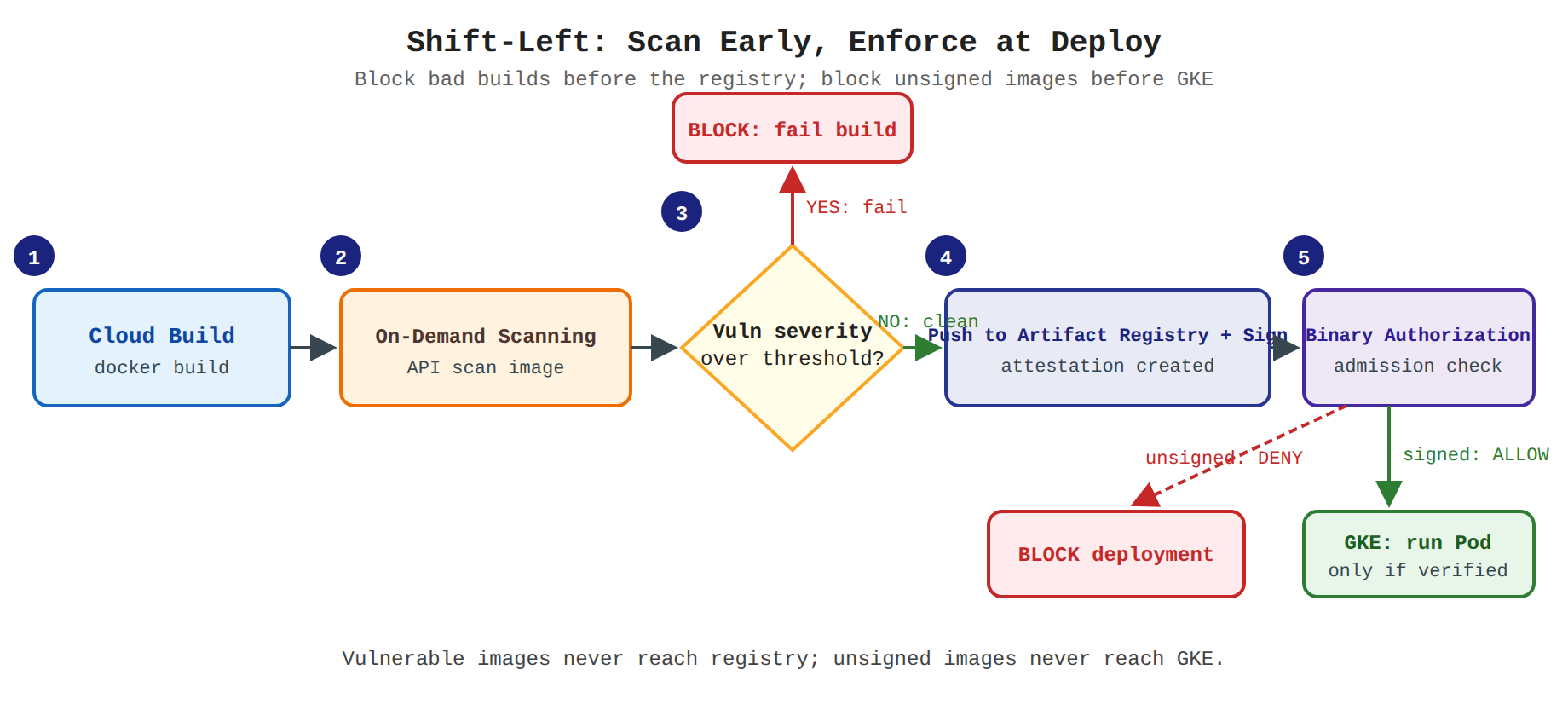
Key Advantages and Capabilities
- Prevents Registry Pollution: Vulnerable artifacts are stopped before they are published to centralized repositories.
- Cryptographic Provenance: Binary Authorization validates that deployed binaries strictly originate from trusted CI/CD pipelines.
- Continuous Compliance: Integrates seamlessly with Artifact Analysis metadata storage to maintain automated audit trails.
- Fail-Closed Security: Clusters enforce policy admission at the Kubernetes API server level regardless of how deployment manifests are applied.
Why This Is Optimal
This solution implements preventive controls across both the build and deployment phases of the SDLC. It prevents defective images from ever entering production environments without relying on manual approvals or post-deployment remediation.
Enable Security Command Center posture monitoring across the environment, and establish Virtual Private Cloud (VPC) Service Controls perimeters to block GKE from pulling unauthorized images.
Enable Security Command Center posture monitoring across the environment, and establish Virtual Private Cloud (VPC) Service Controls perimeters to block GKE from pulling unauthorized images.
What the Option Is
This configuration uses Security Command Center (SCC) to centralize security posture monitoring and deploys VPC Service Controls to establish an isolation boundary around Google Cloud APIs and managed services.
Why It Doesn't Meet the Requirement
- No Build-Time Failure Controls: Security Command Center is an auditing, posture management, and threat detection tool. While it aggregates findings across services, it does not act as an inline build-step scanner that fails CI pipelines based on custom vulnerability thresholds.
- Misapplied Network Perimeters: VPC Service Controls restricts network-level data egress and API access between Google Cloud projects to prevent unauthorized data exfiltration. It cannot parse container metadata, verify software attestations, or enforce deployment integrity policies on GKE.
Key Characteristics and Limitations
- VPC Service Controls Purpose: Enforces network-level perimeters around cloud services rather than verifying code signing or package CVE levels.
- Detection vs. Prevention: Security Command Center provides visibility and reporting after resources exist rather than acting as a gating mechanism within CI/CD pipelines.
This Answer Would Be Correct If
The primary goal was to prevent sensitive container images and data inside an Artifact Registry repository from being exfiltrated to external Google Cloud projects or unauthorized networks.
Try 10 interactive questions like this one, free
Answer them yourself and get your score the moment you finish. No account needed.
Full access includes
- 2,335 practice questions across all 6 exam domains
- Every answer explained: why it is right, and why the others are not
- Scout, an AI tutor that answers your follow-up questions
- Readiness tracking by domain, so you know when to book the exam
Related questions
Keep the momentum going with these hand-picked practice scenarios
IntermediateProfessional Cloud Architect
Cloud Storage vs Filestore vs Persistent Disk
Choosing appropriate storage types (e.g., object, file, and databases)
IntermediateProfessional Cloud Architect
BigQuery Partition Expiration and Cloud Storage Lifecycle
Data growth planning
IntermediateProfessional Cloud Architect
VPC Service Controls Ingress and Egress Rules
Extending to a multicloud environment that may include Google Cloud-to-Google Cloud communication
IntermediateProfessional Cloud Architect
Terraform Workspaces vs Directory Separation
Infrastructure as Code (e.g., IaC and Terraform)
IntermediateProfessional Cloud Architect
Privileged Access Manager Just-in-Time Access and Approval
Separation of duties
AdvancedProfessional Cloud DevOps Engineer
Regional Data Residency with Cloud SQL HA
Data residency
Last updated