Intermediate
Prepare and test your skills
Intermediate
Prepare and test your skills
Active Passive HA VPN Failover with BGP Priorities
Free sample question, answered and explained below. The Professional Cloud Architect practice bank has 2,335 more like it. Try 10 free: instant score, no account.
An enterprise is establishing hybrid connectivity between an on-premises data center and a Google Cloud Virtual Private Cloud (VPC) network using Cloud VPN. The architecture requires dynamic route exchange using the Border Gateway Protocol (BGP) and an automated active/passive failover strategy where outbound Google Cloud traffic strictly prefers the primary tunnel under normal operating conditions.
How should you configure Cloud Router and HA VPN to implement this routing behavior?
Explanations
Deploy an HA VPN gateway with two tunnels, and create untagged policy-based routes configured with skip-policy options to prioritize tunnel traffic.
Deploy an HA VPN gateway with two tunnels, and create untagged policy-based routes configured with skip-policy options to prioritize tunnel traffic.
What Policy-Based Routes and Skip Options Are
Policy-based routes (PBR) in Google Cloud allow packet forwarding based on criteria beyond destination IP addresses, such as protocol, source IP ranges, or network tags. The skip-policy-based-route option is used to bypass PBR evaluation and fall back to standard VPC destination routing, commonly utilized in Network Virtual Appliance (NVA) service chaining topologies.
Why it doesn't meet the requirement
- Incorrect mechanism for BGP failover: Policy-based routes override destination routing rather than managing dynamic BGP path attributes on Cloud Router.
- Misses active/passive BGP control: Active/passive behavior for hybrid links is established via BGP advertised priorities and MED values, not internal VPC PBR skip rules.
- Architectural mismatch: Untagged skip-policy routes are intended for steering traffic through firewall appliances or internal load balancers, not for managing WAN VPN failover priorities.
Key characteristics and limitations
- Evaluated before standard routes: Policy-based routes take precedence over dynamic and static routes in the VPC route evaluation order.
- Targeted use cases: Primarily designed for routing traffic through third-party firewalls and inspection appliances.
- Does not influence remote peer routing: Internal VPC PBRs have no effect on how on-premises routers select ingress paths into Google Cloud.
This answer would be correct if
You were designing an in-line security architecture to route traffic through a pool of third-party firewall NVAs behind an internal load balancer while preventing routing loops.
Deploy an HA VPN gateway with two tunnels connected to separate Cloud Routers, and configure unique local and remote traffic selectors on each tunnel interface.
Deploy an HA VPN gateway with two tunnels connected to separate Cloud Routers, and configure unique local and remote traffic selectors on each tunnel interface.
What Traffic Selectors on VPN Gateways Are
Traffic selectors (often known as encryption domains) define specific IP address ranges (CIDR blocks) used during the Internet Key Exchange (IKE negotiation) to establish an IPsec security association.
Why it doesn't meet the requirement
- Incompatible with HA VPN: HA VPN requires dynamic routing with Cloud Router and mandates universal traffic selectors (always
0.0.0.0/0for IPv4). Custom CIDR traffic selectors are only used in legacy policy-based Classic VPNs. - Unnecessary multi-router architecture: Running multiple Cloud Routers for a single HA VPN gateway adds administrative overhead without delivering path priority control.
- No active/passive steering: Traffic selectors define tunnel encryption scopes, not dynamic path preference or active/passive failover metrics.
Key characteristics and limitations
- HA VPN traffic selector constraint: HA VPN tunnels always configure
0.0.0.0/0as their local and remote traffic selector. - Tunnel renegotiation overhead: Modifying traffic selectors requires destroying and re-creating tunnels.
- Lack of BGP metrics: Traffic selectors do not provide route priority or MED manipulation.
This answer would be correct if
You were configuring a policy-based Classic VPN tunnel to restrict IPsec encryption boundaries between specific subnets without using dynamic BGP routing.
Deploy an HA VPN gateway with two tunnels associated with a Cloud Router, and configure unequal base advertised route priorities on the BGP sessions for the tunnels.
Deploy an HA VPN gateway with two tunnels associated with a Cloud Router, and configure unequal base advertised route priorities on the BGP sessions for the tunnels.
What HA VPN with Cloud Router Advertised Priorities Is
HA VPN (High Availability VPN) combined with Cloud Router enables enterprise-grade site-to-site connectivity using dynamic routing via the Border Gateway Protocol (BGP). To implement deterministic traffic engineering such as an active/passive failover topology, Cloud Router allows network administrators to configure base advertised route priorities (which translate to Multi-Exit Discriminator (MED) values) across distinct BGP sessions.
How it meets the requirements
- Dynamic BGP routing: Cloud Router manages dynamic route propagation and retraction over the two HA VPN tunnels without requiring static route maintenance.
- Active/passive failover: By setting unequal advertised route priorities on the BGP sessions (for example, a lower numerical metric like
10for the primary tunnel and a higher metric like20for the backup tunnel), Google Cloud ensures the on-premises gateway prioritizes the primary path while preserving seamless automated failover if the primary link goes down.
HA VPN Active-Passive MED Failover
System Architecture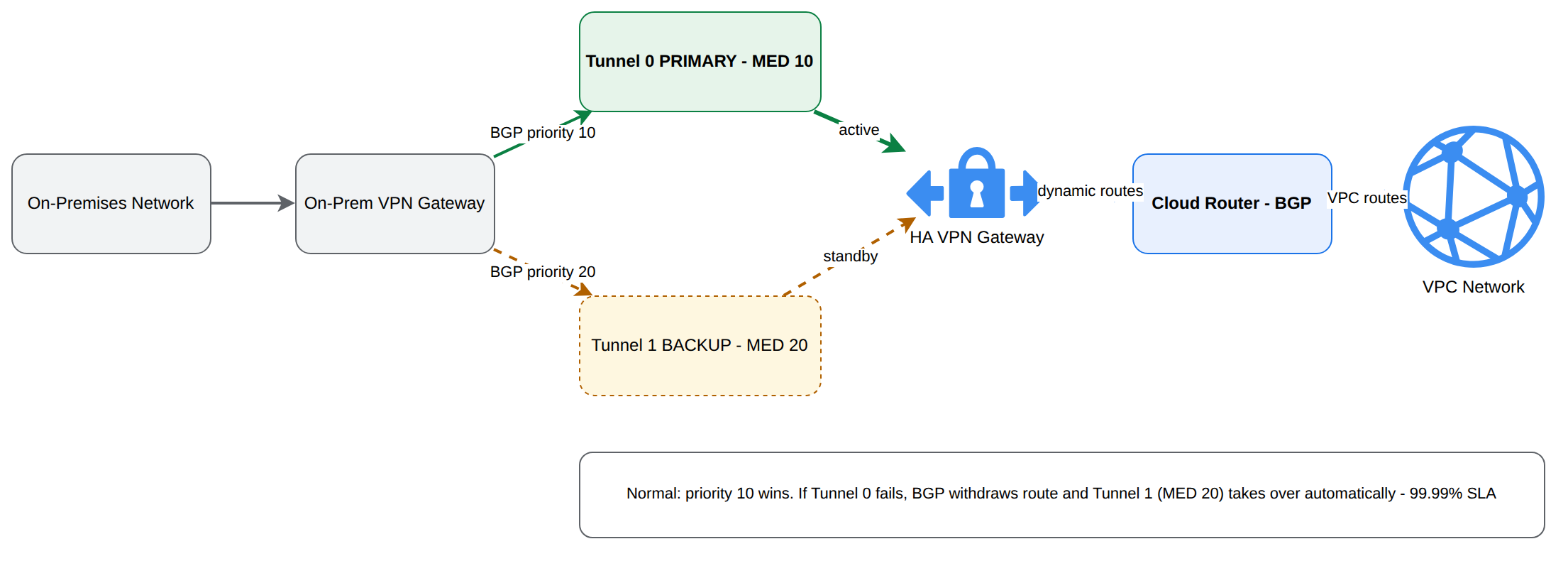
Key advantages and capabilities
- Automated topology updates: Dynamic BGP peering dynamically updates routing tables when routes change or links fail.
- SLA-backed reliability: HA VPN topologies configured with two interfaces and paired tunnels support an industry-standard 99.99% availability SLA.
- Deterministic path selection: Fine-grained control over advertised route priority values guarantees that egress and ingress flows adhere to organizational active/passive routing policies.
- Reduced operational complexity: Eliminates the operational overhead and fragility associated with manual static route configuration.
Why this is optimal
This approach directly aligns with Google Cloud networking best practices for hybrid failover. Setting unequal advertised route priorities on the Cloud Router BGP sessions provides active/passive routing natively over dynamic protocols while maintaining complete topology resiliency and high availability.
Deploy a Classic VPN gateway using route-based static routing, and create two custom static routes with differing priority values pointing to the individual VPN tunnels.
Deploy a Classic VPN gateway using route-based static routing, and create two custom static routes with differing priority values pointing to the individual VPN tunnels.
What Classic VPN with Route-Based Static Routing Is
Classic VPN with route-based static routing uses manually defined custom static routes in Google Cloud to direct traffic toward a remote gateway across IPsec tunnels without exchanging routes via dynamic routing protocols.
Why it doesn't meet the requirement
- Fails dynamic routing requirement: The scenario specifically requires dynamic route exchange via Border Gateway Protocol (BGP). Static routing cannot dynamically learn or propagate prefixes.
- Lack of dynamic failover agility: Static routes cannot automatically adjust to remote network state changes unless combined with complex health checks.
- Deprecation and SLA limitations: Dynamic routing on Classic VPN is deprecated, and Classic VPN topologies do not provide the 99.99% availability SLA supported by HA VPN.
Key characteristics and limitations
- Manual route management: Any subnet addition or modification requires manual updates to static routing tables on both sides.
- No BGP support: Route-based VPN does not leverage Cloud Router or BGP peering.
- Static failover behavior: Route priority is evaluated statically based on route metrics rather than real-time BGP keepalives.
This answer would be correct if
The on-premises legacy hardware did not support BGP and the enterprise specifically mandated a static routing implementation where custom static route priorities govern path selection.
Try 10 interactive questions like this one, free
Answer them yourself and get your score the moment you finish. No account needed.
Full access includes
- 2,335 practice questions across all 6 exam domains
- Every answer explained: why it is right, and why the others are not
- Scout, an AI tutor that answers your follow-up questions
- Readiness tracking by domain, so you know when to book the exam
Related questions
Keep the momentum going with these hand-picked practice scenarios
IntermediateProfessional Cloud Architect
Fleets, Config Sync, Policy Controller, Cloud Service Mesh
Integration with on-premises/multicloud environments
IntermediateProfessional Cloud Architect
BigQuery Omni With Workload Identity Federation
Integration with on-premises/multicloud environments
IntermediateProfessional Cloud Architect
On-Demand Scanning API and Binary Authorization
Software development lifecycle (SDLC)
IntermediateProfessional Cloud Architect
Shared VPC Hierarchical Firewall Policy Scope
Security controls (e.g., auditing, VPC Service Controls, context aware access, organization policy, and hierarchical firewall policy)
IntermediateProfessional Cloud Architect
SOC 2 Type II vs PCI-DSS
Industry certifications (e.g., SOC 2)
AdvancedProfessional Cloud DevOps Engineer
Config Sync RootSync vs RepoSync
Infrastructure-as-code tooling and managed services (e.g., Infrastructure Manager, Cloud Foundation Toolkit, Config Connector, GitOps, Terraform, Helm)
Last updated