Intermediate
Prepare and test your skills
Intermediate
Prepare and test your skills
GKE Fleet Management with GitOps and Service Mesh
Free sample question, answered and explained below. The Professional Cloud Architect practice bank has 2,335 more like it. Try 10 free: instant score, no account.
An enterprise runs microservice workloads across Google Kubernetes Engine (GKE) on Google Cloud, on-premises VMware environments, and AWS. The organization requires a centralized management strategy to achieve the following goals:
- Group and administer distributed clusters across environments as a single logical unit.
- Automatically synchronize declarative configurations and enforce compliance policies across all clusters from a centralized Git repository.
- Implement zero-trust security with mutual TLS (mTLS) encryption and gain deep observability into cross-cluster service communications.
Which combination of GKE Enterprise capabilities should the cloud architect recommend?
Explanations
Deploy Knative serving across all external virtual machines, establish Cloud Interconnect for configuration syncing, use Binary Authorization to enforce runtime policies, and collect telemetry using Container Threat Detection.
Deploy Knative serving across all external virtual machines, establish Cloud Interconnect for configuration syncing, use Binary Authorization to enforce runtime policies, and collect telemetry using Container Threat Detection.
What the Option Is
This proposal relies on Knative serving for serverless abstraction, Cloud Interconnect for physical transport, Binary Authorization for container image deployment validation, and Container Threat Detection for security monitoring.
Why It Doesn't Meet the Requirement
- Misaligned Transport and Sync: While Cloud Interconnect provides dedicated physical hybrid connectivity, it is a physical/data link layer connection, not a GitOps tool for synchronizing Kubernetes manifests across clusters.
- Incomplete Policy and Security Scope: Binary Authorization ensures that only signed and verified container images are deployed; however, it does not manage operational cluster configurations or evaluate programmable cluster compliance policies (which is the role of Policy Controller).
- Missing Service Mesh: Container Threat Detection identifies runtime container threats (like anomalous binaries or memory execution), but it does not provide cross-cluster mTLS encryption, traffic management, or service-to-service distributed telemetry.
Key Limitations
- Does not provide continuous declarative GitOps manifest synchronization.
- Lacks sidecar proxy injection and Layer 7 microservice traffic routing.
- Cannot enforce multi-cluster configuration compliance.
This Answer Would Be Correct If
The primary goal were deploying serverless containers, establishing dedicated hybrid networking circuits, ensuring cryptographic image provenance at deploy time, and monitoring runtime container kernel events.
Connect all clusters using VPC Network Peering, configure Deployment Manager for cluster synchronization, apply IAM custom roles for policy governance, and implement Cloud NAT for mTLS communications.
Connect all clusters using VPC Network Peering, configure Deployment Manager for cluster synchronization, apply IAM custom roles for policy governance, and implement Cloud NAT for mTLS communications.
What the Option Is
This proposal suggests combining VPC Network Peering, Cloud Deployment Manager, Cloud IAM, and Cloud NAT to manage connectivity, deployments, and security across distributed environments.
Why It Doesn't Meet the Requirement
- Networking Scope: VPC Network Peering only functions between Google Cloud Virtual Private Clouds and cannot directly peer on-premises data centers or external cloud providers like AWS.
- No Multi-Cluster GitOps: Deployment Manager is a Google Cloud-specific infrastructure-as-code service; it does not provide continuous GitOps-based configuration synchronization (Config Sync) or Kubernetes-native admission policy control (Policy Controller) for hybrid Kubernetes environments.
- Lacks Service Mesh Capabilities: Cloud NAT provides managed outbound internet connectivity for private instances. It does not operate at Layer 7, cannot enforce service-level mTLS, and does not provide microservice observability or traffic routing.
Key Limitations
- Cannot manage or normalize Kubernetes resources across third-party clouds.
- Lacks container-level service identity and automated mutual TLS encryption.
- Fails to deliver unified telemetry for distributed microservice interactions.
This Answer Would Be Correct If
The workload was strictly deployed across multiple VPCs within Google Cloud needing private IP reachability and outbound internet access, rather than cross-cloud Kubernetes fleet management and microservice mesh capabilities.
Group the clusters into a GKE fleet, use Config Sync and Policy Controller for configuration and compliance, and deploy Cloud Service Mesh for mTLS and telemetry.
Group the clusters into a GKE fleet, use Config Sync and Policy Controller for configuration and compliance, and deploy Cloud Service Mesh for mTLS and telemetry.
What the GKE Enterprise Solution Is
GKE Enterprise (formerly Anthos) provides an integrated hybrid and multicloud application platform. It enables organizations to run, manage, and secure Kubernetes workloads across Google Cloud, on-premises data centers, and third-party clouds such as AWS and Azure through a unified control plane.
How It Meets the Requirements
- Unified Cluster Administration: GKE Fleets logically group heterogeneous Kubernetes clusters across Google Cloud, AWS, and on-premises into a unified management plane, allowing administrators to apply configurations and policies holistically.
- Declarative Configuration and Compliance: Config Sync acts as a managed GitOps engine to automatically deploy and reconcile Kubernetes configurations from a central Git source of truth. Policy Controller enforces programmable security constraints and compliance rules across all registered fleet clusters.
- Zero-Trust Security and Observability: Cloud Service Mesh establishes service-to-service mutual TLS (mTLS) authentication and encryption in transit across hybrid environments without requiring application code changes, while capturing rich telemetry, service graphs, and metrics in Google Cloud Observability.
GKE Fleet Unified Hybrid Governance
System Architecture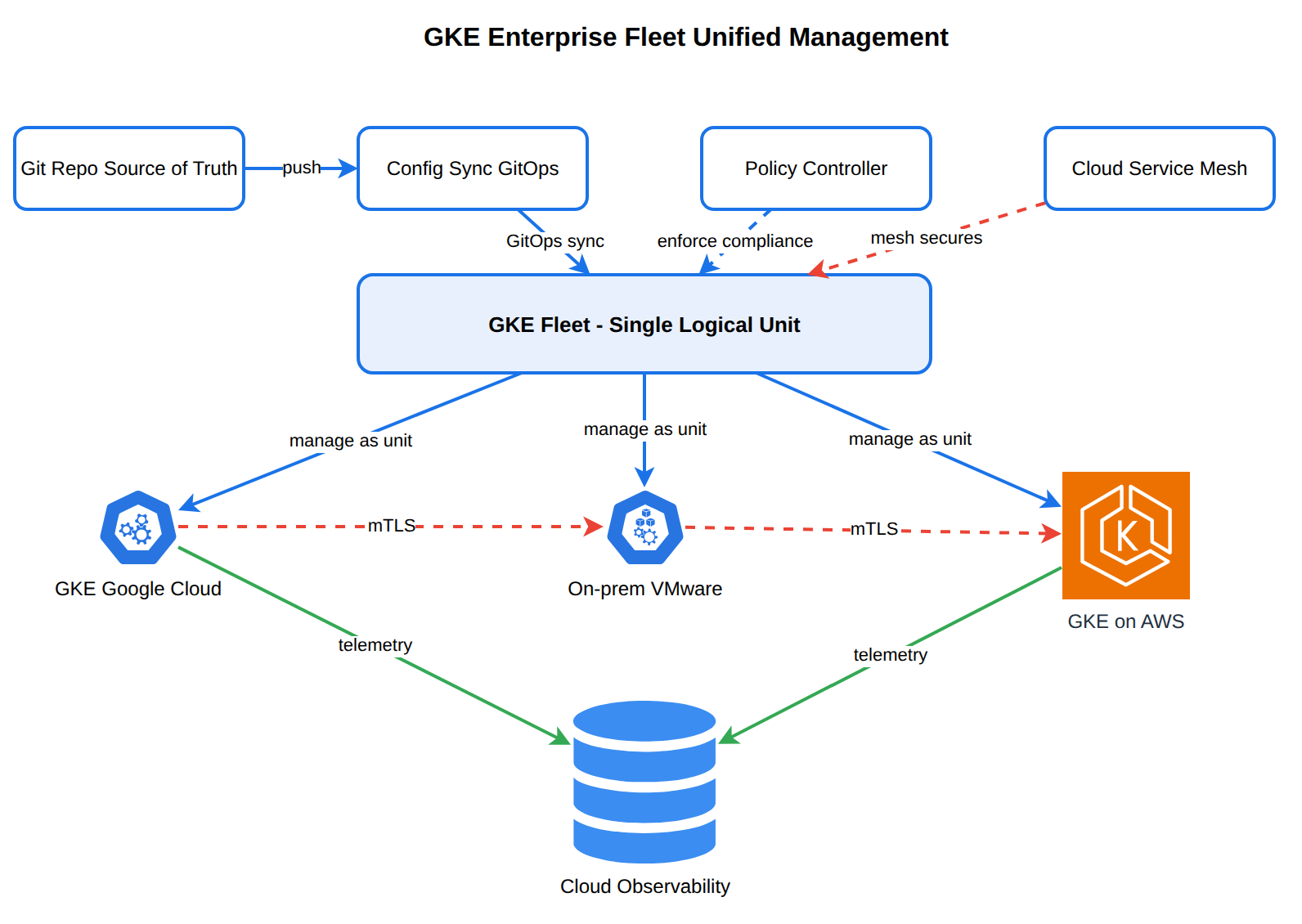
Key Advantages and Capabilities
- Fleet-Wide Normalization: Leverages the concept of sameness across namespaces, identity, and services across all cloud and on-premises clusters.
- GitOps-Driven Automation: Continuously reconciles cluster state against declarative configurations to prevent configuration drift.
- Fine-Grained Traffic Control: Manages Layer 7 routing, canary releases, circuit breakers, and fault injection across distributed clusters.
- Comprehensive Telemetry: Automatically collects metrics, logs, and distributed traces powered by Cloud Monitoring, Cloud Logging, and Cloud Trace.
Why This Is Optimal
This architecture utilizes native GKE Enterprise features specifically built for hybrid and multicloud governance. It avoids custom operational tooling and delivers unified multi-cluster policy enforcement, declarative synchronization, and cross-cluster service mesh security.
Migrate all workloads to Google Cloud VMware Engine, manage cluster manifests using Config Connector, enforce security with Container-Optimized OS, and expose internal services via the Connect gateway with HTTP load balancing.
Migrate all workloads to Google Cloud VMware Engine, manage cluster manifests using Config Connector, enforce security with Container-Optimized OS, and expose internal services via the Connect gateway with HTTP load balancing.
What the Option Is
This approach suggests rehosting environments on Google Cloud VMware Engine (GCVE), using Config Connector to manage Google Cloud resources from Kubernetes, deploying Container-Optimized OS on nodes, and using the Connect gateway for cluster access.
Why It Doesn't Meet the Requirement
- Fails Portability Across Clouds: Migrating all workloads to Google Cloud VMware Engine relocates virtual machines to Google Cloud rather than managing distributed clusters where they currently reside on-premises and in AWS.
- Wrong Configuration Scope: Config Connector allows Kubernetes to manage Google Cloud infrastructure resources (such as Cloud Storage buckets or Cloud SQL instances), but it does not synchronize application configurations across hybrid Kubernetes clusters from Git.
- Inadequate Service-to-Service Security: While the Connect gateway provides centralized administrative API access to fleet clusters, it does not provide in-mesh Layer 7 routing, end-to-end service mTLS, or microservice observability between application pods across clusters.
Key Limitations
- Restricts workloads to a specific VMware hosting environment rather than supporting true multicloud GKE clusters on AWS.
- Does not provide automated policy controller auditing or GitOps configuration synchronization.
- Lacks a managed service mesh for inter-service communication and telemetry.
This Answer Would Be Correct If
The organization wanted to lift-and-shift VMware virtual machines directly into Google Cloud while using Kubernetes custom resources to provision native Google Cloud managed backend dependencies.
Try 10 interactive questions like this one, free
Answer them yourself and get your score the moment you finish. No account needed.
Full access includes
- 2,335 practice questions across all 6 exam domains
- Every answer explained: why it is right, and why the others are not
- Scout, an AI tutor that answers your follow-up questions
- Readiness tracking by domain, so you know when to book the exam
Related questions
Keep the momentum going with these hand-picked practice scenarios
IntermediateProfessional Cloud Architect
BigQuery Omni With Workload Identity Federation
Integration with on-premises/multicloud environments
IntermediateProfessional Cloud Architect
Cloud Router Advertised Route Priority
Integration with on-premises/multicloud environments
IntermediateProfessional Cloud Architect
HA VPN over Cloud Interconnect VPC Service Controls
Movement of data
IntermediateProfessional Cloud Architect
Exponential Backoff with Jitter and Partial Responses
Accessing Google API best practices
IntermediateProfessional Cloud Architect
Cloud Run Scale To Zero
Compute resource provisioning
FundamentalGenerative AI Leader
Gen AI Latency Cost Region Constraints
Identifying the key factors that influence gen AI needs (e.g., business requirements, technical constraints)
Last updated