Intermediate
Prepare and test your skills
Intermediate
Prepare and test your skills
AlloyDB Continuous Backup for Point-in-Time Recovery
Free sample question, answered and explained below. The Professional Cloud Architect practice bank has 2,335 more like it. Try 10 free: instant score, no account.
An enterprise runs a mission-critical financial transaction service on Google Cloud backed by an AlloyDB for PostgreSQL database cluster. The organization's disaster recovery and business continuity policy specifies that the database must achieve a Recovery Point Objective (RPO) of near zero to safeguard against accidental data corruption or malicious table drops, with the ability to restore the database to any specific moment in time over the preceding two weeks.
Which backup and recovery strategy should you configure to meet these requirements?
Explanations
Enable continuous backup and recovery on the AlloyDB cluster with the default 14-day retention window to perform point-in-time recovery (PITR)
Enable continuous backup and recovery on the AlloyDB cluster with the default 14-day retention window to perform point-in-time recovery (PITR)
What Continuous Backup and Recovery Is
AlloyDB continuous backup and recovery is a native data protection mechanism that continuously records incremental storage changes and transaction logs. This capability allows administrators to restore an existing cluster to any precise moment in its recent history with microsecond granularity, eliminating data loss gaps between scheduled backup intervals.
How It Meets the Requirements
- Near-Zero RPO: By continuously logging database state changes, continuous backup enables a Recovery Point Objective (RPO) of zero, allowing restoration up to the exact moment right before a corruption event or accidental deletion.
- Specific Timestamp Restoration: Unlike discrete snapshot schedules that only capture periodic states, Point-in-Time Recovery (PITR) provides granular rewind capability to any selected second.
- Two-Week Window: By default, AlloyDB retains continuous backup data for 14 days (configurable from 1 to 35 days), directly matching the two-week retention mandate.
AlloyDB PITR: 14-Day Recovery Timeline
Timeline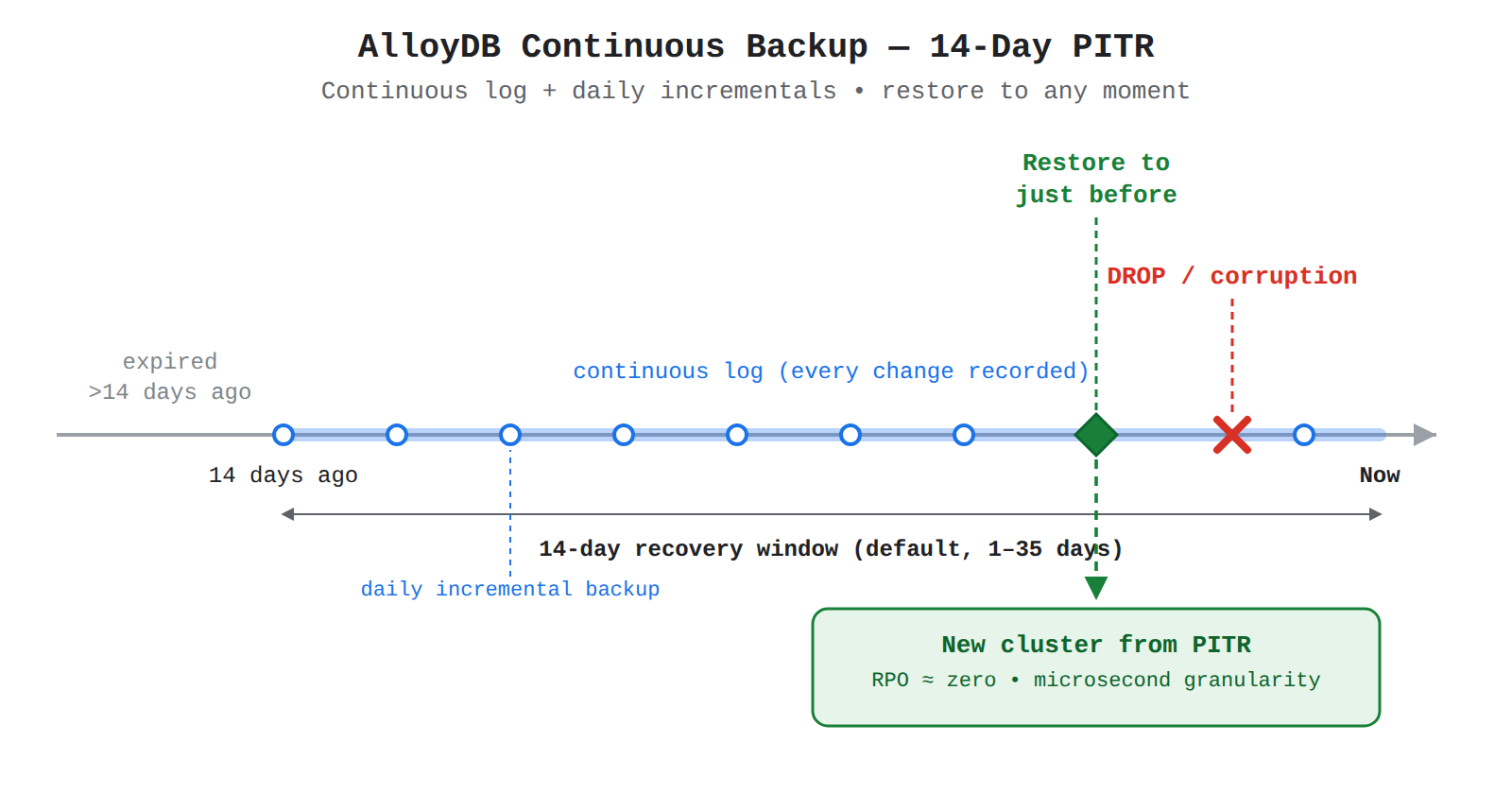
Key Advantages and Capabilities
- Incremental efficiency: Stores only changed blocks relative to previous backups, minimizing storage overhead and cost.
- Automated daily baseline: Automatically captures daily incremental backups alongside continuous write-ahead log data.
- Cluster cloning: Enables rapid creation of independent clones from any timestamp within the retention window without altering the source cluster.
- Immutable retention: Ensures underlying backup files are protected against tampering or unauthorized modification.
Why This Is Optimal
Continuous backup and recovery is the native managed solution specifically designed for relational database point-in-time recovery. It achieves an RPO of zero and provides microsecond-level recovery points without requiring custom scheduling logic, external orchestration, or disruptive full-database lock operations.
Configure automated on-demand full database backups to execute every 24 hours and retain them for 14 days
Configure automated on-demand full database backups to execute every 24 hours and retain them for 14 days
What Daily Full Backups Are
Automated and on-demand backups capture complete, discrete copies of database files at specific scheduled intervals (such as once per day) and store them as independent file-based resources.
Why It Doesn't Meet the Requirement
- High RPO Gap: Executing backups once every 24 hours creates an RPO of up to 24 hours. Any transactions executed between the last daily backup and the corruption event are permanently lost upon restoration.
- Lacks Continuous Point-in-Time Granularity: Daily discrete backups only permit restoring to the single fixed moment when the backup started, failing the requirement to restore to an arbitrary moment moments before an error.
Key Characteristics and Limitations
- High storage consumption: On-demand backups capture full datasets, consuming substantially more storage space compared to continuous incremental tracking.
- Discrete recovery points: Recovery is strictly tied to the predefined execution schedule rather than arbitrary timestamps.
- Coarser recovery resolution: Cannot recover transactions committed after the scheduled backup run completed.
This Answer Would Be Correct If
The workload only required periodic archival snapshots where a 24-hour RPO was acceptable and there was no requirement for microsecond-level point-in-time recovery.
Schedule a daily export of database tables to Cloud Storage Coldline buckets using Cloud Scheduler and Cloud Run
Schedule a daily export of database tables to Cloud Storage Coldline buckets using Cloud Scheduler and Cloud Run
What Scheduled Cloud Storage Table Exports Are
This approach uses custom scripts orchestrated by Cloud Scheduler and Cloud Run to dump database contents into file formats (such as CSV, SQL dumps, or Parquet) and upload them to Cloud Storage for long-term cold retention.
Why It Doesn't Meet the Requirement
- Severe RPO and RTO Deficits: File exports only represent the state at the exact time the batch export ran, resulting in hours of potential data loss (RPO) and requiring long restoration import times (high RTO).
- No Continuous Transaction Rewind: Exporting logical tables cannot reconstruct transactional write-ahead logs or provide granular microsecond point-in-time recovery.
- Operational Overhead: Developing and maintaining custom export scripts introduces maintenance complexity, quota limits, and potential failure points during heavy database load.
Key Characteristics and Limitations
- Intended for Archival: Cloud Storage Coldline is optimized for data accessed at most once a year, making frequent backup restores costly due to retrieval fees.
- Lack of Database State Consistency: Exporting tables individually across large relational datasets can result in referential integrity mismatches unless extensive locks are applied.
This Answer Would Be Correct If
The objective was multi-year regulatory compliance archiving of static historical data where cold storage economics outweigh rapid disaster recovery requirements.
Implement cross-region asynchronous read replicas to handle failover during logical data corruption events
Implement cross-region asynchronous read replicas to handle failover during logical data corruption events
What Read Replicas Are
Read replicas replicate database transactions asynchronously or synchronously to secondary instances in other zones or regions to provide high read throughput and infrastructure failover capability.
Why It Doesn't Meet the Requirement
- Replication of Corrupted State: In the event of human error, malicious deletion, or logical data corruption, the errant SQL statement or dropped table is immediately replicated to the replica, corrupting all read copies simultaneously.
- Not a Backup Mechanism: Replicas maintain current state and do not store a historical timeline of past states for point-in-time recovery.
Key Characteristics and Limitations
- Protects against infrastructure failures, not logical disasters: Replicas guard against zonal or regional hardware outages, not application-level bugs or data deletions.
- No Historical Retention Window: Replicas do not retain a 14-day history of historical write versions.
This Answer Would Be Correct If
The primary requirement was regional disaster recovery to survive a complete Google Cloud regional outage with minimal failover downtime for high-availability read traffic.
Try 10 interactive questions like this one, free
Answer them yourself and get your score the moment you finish. No account needed.
Full access includes
- 2,335 practice questions across all 6 exam domains
- Every answer explained: why it is right, and why the others are not
- Scout, an AI tutor that answers your follow-up questions
- Readiness tracking by domain, so you know when to book the exam
Related questions
Keep the momentum going with these hand-picked practice scenarios
IntermediateProfessional Cloud Architect
Cloud Storage Bucket Lock Retention Policy
Data protection (e.g., backup and recovery)
IntermediateProfessional Cloud Architect
Cloud SQL DR Replica Failover
Data protection (e.g., backup and recovery)
IntermediateProfessional Cloud Architect
Object Lifecycle Management SetStorageClass
Cost optimization
IntermediateProfessional Cloud Architect
Google Cloud Cost Optimization CUDs Spot VMs Rightsizing
Cost optimization/resource optimization (CapEx/OpEx)
IntermediateProfessional Cloud Architect
Dataflow KafkaIO Exactly-Once Semantics
Movement of data
FundamentalAssociate Data Practitioner
BigQuery Dry Run
Create and manage scheduled queries (e.g., BigQuery, Cloud Scheduler, Cloud Composer)
Last updated