Fundamental
Prepare and test your skills
Fundamental
Prepare and test your skills
BigQuery Dry Runs for Cost and Syntax Checks
Free sample question, answered and explained below. The Associate Data Practitioner practice bank has 1,156 more like it. Try 10 free: instant score, no account.
A data analyst is setting up an automated workflow in BigQuery that executes a daily SQL aggregation query to refresh an executive reporting table. Before configuring the scheduled query, the analyst wants to validate the SQL syntax and estimate the number of bytes the query will scan to optimize performance and prevent unexpected billing, without executing the query or incurring on-demand query costs.
Which feature should the analyst use in BigQuery?
Explanations
Perform a query dry run
Perform a query dry run
What a BigQuery dry run is:
A dry run in BigQuery is a query execution simulation mode that evaluates and parses the SQL statement without actually running it against the data engine or scanning table rows. When a query is submitted as a dry run (by setting the dryRun flag to true in API requests, client libraries, or the Google Cloud console), BigQuery validates query syntax, verifies schema and table references, and calculates the exact number of bytes billed and processed if the query were executed.
BigQuery Dry Run Validation Flow
Process Flow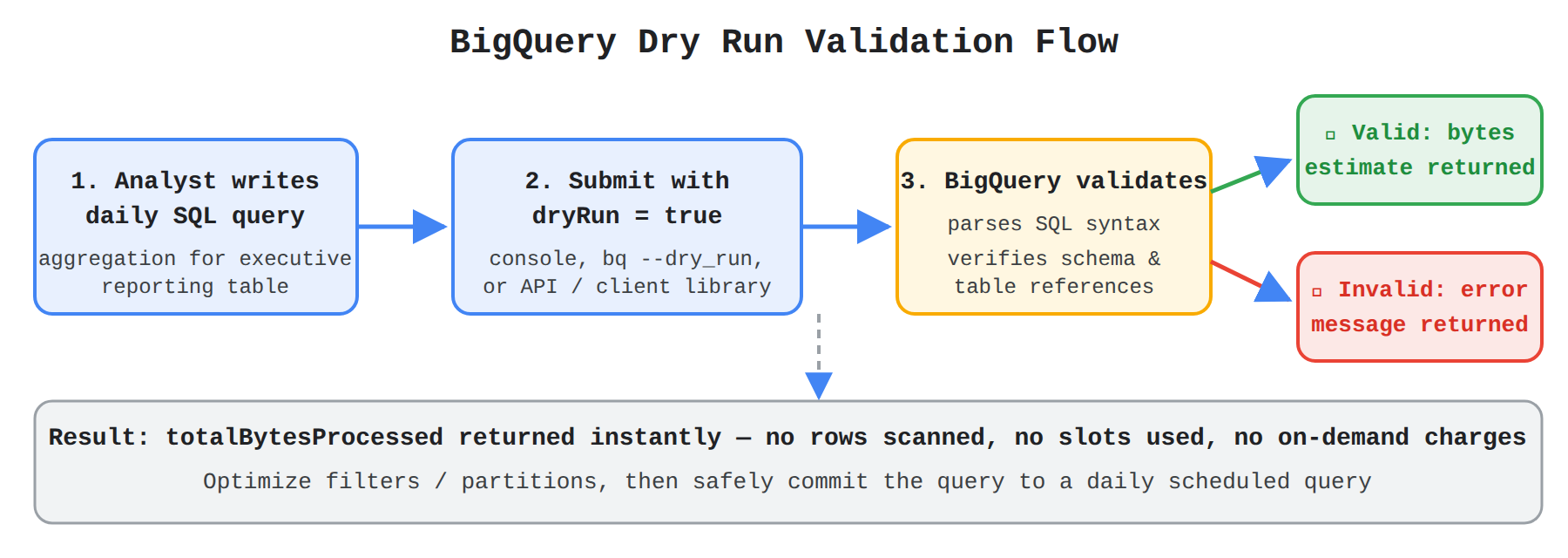
How it meets the requirements:
- Validates SQL syntax (✓): A dry run fully parses the query and returns specific syntax errors or missing column/table notifications before scheduling.
- Estimates processed bytes (✓): Returns the
totalBytesProcessedmetric in the returned job statistics, allowing the analyst to understand resource usage and query cost. - Zero query charges (✓): Dry runs do not scan data, consume slots, or incur processing costs under either on-demand or capacity-based billing.
- Optimizes query design (✓): Enables testing different filtering, partitioning, and clustering strategies to observe how they reduce byte scans prior to automating the workload.
Key advantages:
- Cost governance: Helps data teams prevent expensive full-table scans by testing queries before placing them on recurring schedules.
- Fast feedback loop: Returns validation results and byte estimates almost instantaneously without waiting for long compute tasks.
- Automation integration: Can be embedded into CI/CD pipelines or deployment scripts to test scheduled query definitions automatically.
- Optimization validation: Confirms whether partition filters (such as date or timestamp clauses) are effectively pruning unneeded partitions.
Why this is optimal:
A dry run is the only native BigQuery capability designed specifically to validate query correctness and calculate byte consumption without running the job or incurring execution costs. It provides the exact prerequisite metrics needed before committing queries to automated schedules.
Run the query with batch priority
Run the query with batch priority
What batch query priority is:
Batch query priority is an execution mode in BigQuery that queues a query job and executes it as soon as idle compute resources (slots) become available in the shared resource pool, typically within a few minutes to a few hours.
Why it doesn't meet the requirement:
- Executes the query (✗): Batch priority does not simulate or validate a query; it actively executes the full SQL statement against the underlying tables.
- Incurs billing charges (✗): Running a query in batch mode scans data and charges for the total bytes processed under on-demand billing, failing the requirement to avoid scan costs.
- Does not provide pre-execution estimates (✗): It does not give an upfront byte estimate prior to job submission without executing the job.
Key characteristics and limitations:
- Designed for non-interactive, asynchronous analytical workloads where completion time is flexible.
- Subject to slot availability and may experience scheduling delays during peak regional usage.
- Does not count toward concurrent interactive query limits.
- Still scans data and incurs standard billing rates for processed bytes.
This answer would be correct if:
The scenario required running historical ETL transformations or background reports overnight where execution latency is not critical and jobs should run using idle capacity without competing with interactive user dashboards.
Create a slot reservation for the query
Create a slot reservation for the query
What a slot reservation is:
A slot reservation in BigQuery's capacity-based billing model is a dedicated or autoscaling pool of compute slots allocated to specific projects, folders, or workload types (such as pipeline, interactive, or background queries).
Why it doesn't meet the requirement:
- Compute management, not query analysis (✗): Reservations allocate dedicated compute hardware for workloads but do not validate query syntax or report estimated bytes.
- Requires capacity commitments (✗): Creating a reservation does not estimate the specific byte footprint of an individual SQL query before it is automated.
- Does not eliminate execution (✗): Queries assigned to a reservation still execute and consume slot-hours rather than providing a free validation simulation.
Key characteristics and limitations:
- Used to isolate critical production pipelines from ad-hoc analysis to ensure predictable query execution times.
- Billed based on allocated slot capacity (slot-hours) rather than on-demand data scanned per query.
- Allows configuration of baseline slots and autoscaling upper bounds.
- Requires administrative setup and edition selection (Standard, Enterprise, Enterprise Plus).
This answer would be correct if:
The scenario required guaranteeing predictable execution performance and preventing resource contention for mission-critical scheduled queries by allocating dedicated processing capacity.
Configure a table expiration time on the destination table
Configure a table expiration time on the destination table
What table expiration is:
Table expiration is a lifecycle management configuration applied to BigQuery datasets or individual tables that automatically deletes the table and its associated storage after a specified duration or at a specific timestamp.
Why it doesn't meet the requirement:
- No query validation (✗): Table expiration is a storage lifecycle setting and has no role in validating SQL statements, functions, or schema references.
- No byte estimation (✗): Setting an expiration time does not provide metrics on how many bytes a query will read or process.
- Irrelevant to scheduling setup (✗): It only manages the longevity of data at rest rather than analyzing query performance or execution cost prior to scheduling.
Key characteristics and limitations:
- Helps manage storage costs by automatically cleaning up temporary or staging tables.
- Can be defined at the dataset level as default table expiration or configured on individual tables.
- Deletes both table metadata and underlying physical data upon reaching the expiration window.
- Has no effect on compute slot utilization or query optimization.
This answer would be correct if:
The scenario stated that the daily query writes intermediate staging data to a temporary dataset that must be automatically deleted after 48 hours to minimize long-term storage expenses.
Try 10 interactive questions like this one, free
Answer them yourself and get your score the moment you finish. No account needed.
Full access includes
- 1,156 practice questions across all 4 exam domains
- Every answer explained: why it is right, and why the others are not
- Scout, an AI tutor that answers your follow-up questions
- Readiness tracking by domain, so you know when to book the exam
Related questions
Keep the momentum going with these hand-picked practice scenarios
FundamentalAssociate Data Practitioner
Cloud Scheduler Retry Policy with Exponential Backoff
Create and manage scheduled queries (e.g., BigQuery, Cloud Scheduler, Cloud Composer)
FundamentalAssociate Data Practitioner
Cloud Composer DAG Task Dependencies
Create and manage scheduled queries (e.g., BigQuery, Cloud Scheduler, Cloud Composer)
FundamentalAssociate Data Practitioner
Storage Transfer Service Synchronization Options
Load data into Google Cloud storage systems using the appropriate tool (e.g., gcloud and BQ CLI, Storage Transfer Service, BigQuery Data Transfer Service, client libraries)
FundamentalAssociate Data Practitioner
Transfer Appliance vs Storage Transfer Service
Choose the appropriate data transfer tool (e.g., Storage Transfer Service, Transfer Appliance)
FundamentalAssociate Data Practitioner
Uniform Bucket-Level Access
Compare methods of access control for Cloud Storage (e.g., public or private access, uniform access)
AdvancedProfessional Data Engineer
Spanner INSERT_OR_UPDATE Mutation Idempotency
Processing logic
Last updated