Fundamental
Prepare and test your skills
Fundamental
Prepare and test your skills
Vertex AI Search, Google Search and Commerce Search
External search offerings connect generative AI models to information outside their training data so answers stay current and fact-based. On Google Cloud, Google Search (opens in a new tab) grounding brings live public web results into model responses, while Vertex AI Search brings an organization's own data into retrieval-augmented generation (RAG) applications built on Vertex AI (opens in a new tab). Choose Google Search grounding when answers depend on current public facts, and choose Vertex AI Search with RAG when answers must come from private company data.
What Grounding Means for Gemini Models
Grounding is the process of linking a Gemini model response to real search results before the final answer is returned. An ungrounded model answers only from patterns learned during training, which can lead to outdated or invented facts. A grounded model sends the user prompt to a search system, receives relevant results, and then builds its answer from that evidence. This grounding flow moves from the user prompt to the search tool to the retrieved evidence to the final response, which improves accuracy and customer trust.
How Google Search Grounding Works
Google Search grounding is a tool enabled inside a Vertex AI generation request. The application builds a GenerateContentRequest that names a specific model, such as gemini-2.5-flash, includes the user content, such as "When is the next total solar eclipse in US?", and adds a Tools field containing GoogleSearch. The request is sent through a prediction client to a regional endpoint, such as us-central1-aiplatform.googleapis.com, and the model returns candidates whose text reflects the search results. Setting a low temperature, such as 0.0 in GenerationConfig, makes this output more factual and consistent.
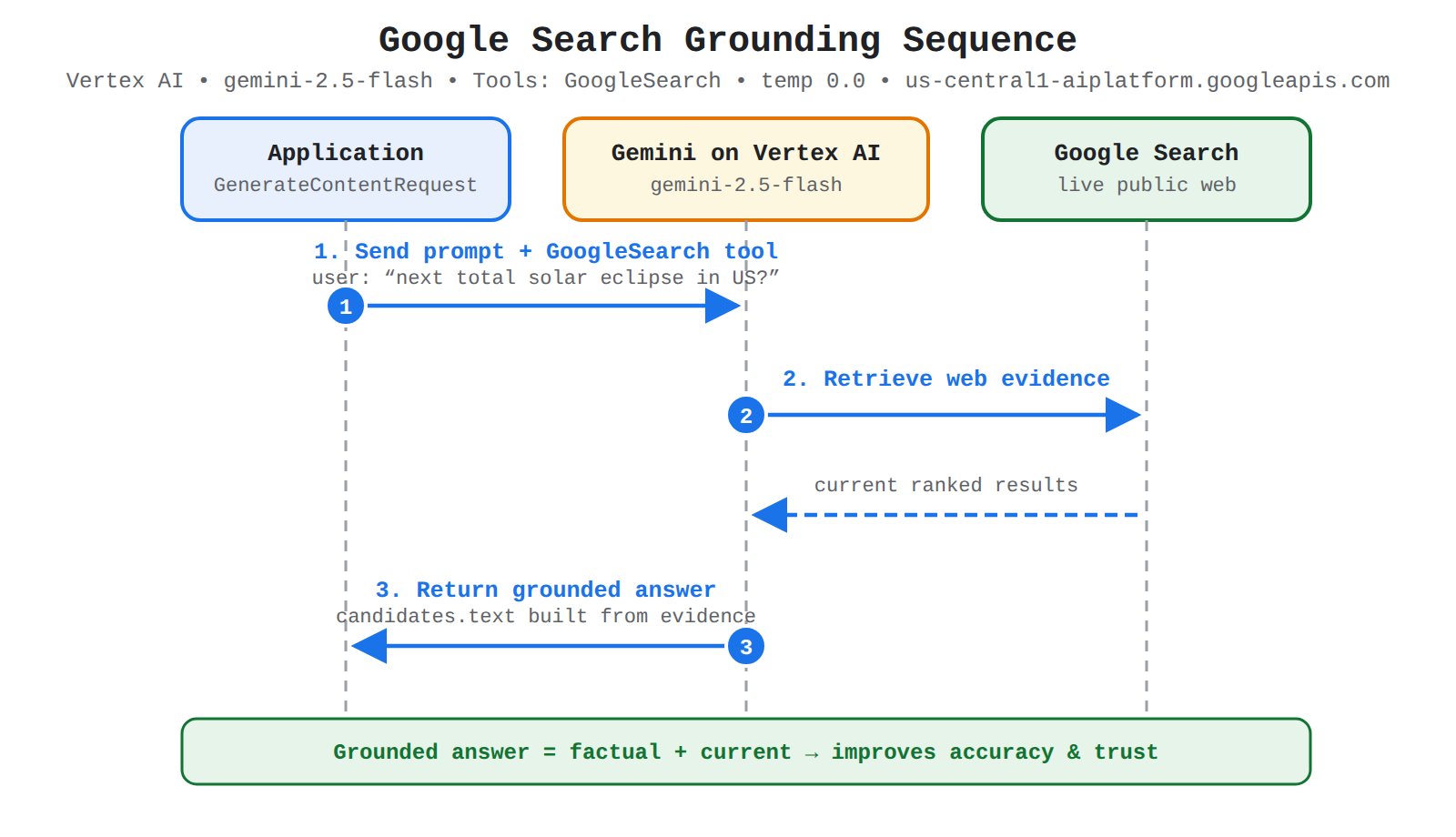
A sequence diagram with Application, Gemini on Vertex AI, and Google Search lifelines showing 1) send prompt with GoogleSearch tool, 2) retrieve live web evidence, 3) return grounded answer.
The grounded generation follows an ordered sequence:
- Send prompt with tool: The application sends user content plus the
GoogleSearchtool to the Gemini model on Vertex AI. - Retrieve web evidence: The model uses the Google Search tool to pull in relevant, current results from Google Search.
- Return grounded answer: The model generates response text in the candidate content that is based on the retrieved results.
Semantic Search Across Business Data with Vertex AI Search
Vertex AI Search is the capability for finding relevant information across business content, including structured, semi-structured, and unstructured data. Instead of matching only exact keywords, semantic retrieval understands meaning so a Gemini model can analyze product catalogs, documents, images, and database records together. This lets one assistant answer questions that span tables, text, and media without the user searching each source separately.
Vertex AI provides the platform for building RAG-capable applications where retrieval flows from business data stores to the model to the user. Supported patterns described for Google Cloud include:
- RAG with Vertex AI Vector Search for similarity search over embeddings
- RAG with AlloyDB for PostgreSQL for combining vector search with operational database data
- RAG with GKE and Cloud SQL plus open-source tools for customizable hosting
In each pattern, the workflow depends on the retriever: the search system first finds relevant company records, then the Gemini model uses those records as context for its answer.
Exam tip: Google Search grounding connects a response to live Google Search results through the GoogleSearch tool, not only to the model's training data.
AI Commerce Search (opens in a new tab) is a Google Cloud search and recommendations offering that uses machine learning models to power personalized search across websites and mobile applications. The business value of AI Commerce Search comes from connecting shopper intent to real catalog data, so customers find relevant products faster and businesses see higher engagement and revenue with less operational work. Data flows from the product catalog and user events into AI models, and the models send ranked search results and recommendations back to the storefront.
More Relevant and Personal Shopping Experiences
AI Commerce Search improves the shopping experience by understanding what shoppers mean, not just what they type. The search engine applies advanced query understanding and personalization to broad queries, long-tail searches, and conversational requests, matching product attributes with website content for relevant product discovery. Guided search refines a broad query through back-and-forth conversation, dynamic filtering, and product image tiles, while autocomplete and semantic search help shoppers narrow choices in real time.
Personalization in AI Commerce Search is driven by nuanced user behavior, including search history, shopping context, and product SKUs. This understanding allows the service to return relevant results and tailored recommendations for similar or complementary items through text and image discovery across channels. Because results reflect actual behavior and catalog information, shoppers encounter fewer dead ends, less search abandonment, and fewer No Results Found pages, which supports higher satisfaction and faster time to the right product.
Stronger Revenue, Conversion, and Insight for the Business
AI Commerce Search delivers measurable business benefits by optimizing product ranking for specific goals such as engagement, revenue, and conversions. The service uses user interaction and ranking models to order results in ways that meet business objectives and increase sales. Insight flows from AI Commerce Search to analytics when product and user event data are exported into BigQuery.
Key commercial outcomes supported for AI Commerce Search include:
- Higher click-through on search results and recommendations
- Higher order value and conversion rates
- Reduced search abandonment by shoppers
- Reduced No Results Found rate through better matching
- Stronger engagement across digital commerce sites and applications
Once the data sits in BigQuery tables, teams can review key performance indicator dashboards in Looker and generate sales forecasts with Vertex AI. This path lets the same interaction data that improves ranking also inform merchandising decisions and demand planning.
Lower Cost and Effort With a Managed and Connected Platform
AI Commerce Search is a fully managed platform that handles data preprocessing, machine learning model training and hyperparameter tuning, load balancing, and infrastructure provisioning. This managed approach removes the need for teams to build and maintain that infrastructure themselves, which reduces burden on development teams and helps manage costs. Teams can start a proof of concept with free credit and free monthly usage of popular products, including AI APIs, and the same ingested catalog and user event data serves both search and recommendations without ingesting the data twice.
The platform connects with existing analytics and marketing workflows to keep data moving efficiently. Data can flow between AI Commerce Search and tools such as:
- Google Analytics 360 for traffic and behavior analysis
- Tag Manager for event collection
- Cloud Storage for data storage and ingestion
- BigQuery for analytics, dashboards, and forecasting
Strong access controls in AI Commerce Search keep customer data isolated between uses, which protects user privacy while still enabling personalization.
Exam tip: Never cache personalized results from one shopper and never return those personalized results to a different shopper.
AI Commerce Search (opens in a new tab) is Google Cloud's external search offering for ecommerce, combining search and recommendations to deliver personalized results on websites and mobile applications. External search offerings can address industry-specific needs such as e-commerce product discovery, internal knowledge management, and customer support portals. AI Commerce Search is the e-commerce-focused option, where product discovery, ranking, and personalization directly affect revenue and customer engagement.
E-Commerce Product Discovery With AI Understanding
AI Commerce Search improves e-commerce product discovery by matching user queries to product attributes and website content. It uses artificial intelligence and machine learning for advanced query understanding and personalization, so even broad queries return relevant results. The service supports text and image search for similar or complementary items in real time. Guided search refines broad queries through back-and-forth conversation, dynamic filtering, and product image tiles. These capabilities can increase click-through, order value, and conversions while reducing search abandonment and No Results Found (NRF).
Personalized Recommendations and Interactive Guided Search
Personalized recommendations in AI Commerce Search are driven by understanding user behavior, context, and SKUs. The service can use search history and cross-channel engagement to return relevant results for long-tail searches that are hard to match with keywords alone. Guided search creates an interactive experience that narrows broad queries through dynamic filtering and product image tiles. The service also supports semantic and back-and-forth conversation to facilitate a real-time ecommerce experience. These features help drive user engagement across channels.
Commerce Analytics and Sales Forecasting Flow
AI Commerce Search turns uploaded product and user event data into business insights. After product and user event data are uploaded, they can be exported to BigQuery for analytics, Key Performance Indicator (KPI) dashboards, and sales forecasts. In BigQuery, the data can feed workflows that produce prebuilt Looker dashboards or sales forecasts using Vertex AI. This helps teams measure click-through rate, search conversion, and NRF rate, and then optimize search results and recommendations.
Choosing AI Commerce Search for Industry Deployments
AI Commerce Search is appropriate when an ecommerce business needs a fully managed platform for search and recommendations. It handles data preprocessing, machine learning model training, hyperparameter tuning, load balancing, and infrastructure provisioning. It integrates with Google Analytics 360, Tag Manager, Cloud Storage, and BigQuery so data can flow into existing analytics and marketing workflows. The same user event and catalog data can be used for both search and recommendations, so teams do not need to ingest the same data twice. A typical migration to A/B testing can take about two to three months, depending on the current search system complexity and speed of execution.
| Use case | What AI Commerce Search does | Business benefit |
|---|---|---|
| Product discovery | Matches queries to product attributes and website content; supports text and image search | Increases click-through, order value, and conversions; reduces search abandonment and NRF |
| Personalized recommendations | Uses user behavior, context, SKUs, and search history | Drives engagement across channels and handles long-tail searches |
| Guided search | Refines broad queries through conversation, dynamic filtering, and product image tiles | Creates an interactive real-time ecommerce experience |
| Commerce analytics | Exports product and user event data to BigQuery; feeds Looker dashboards and Vertex AI forecasts | Provides KPIs and sales forecasts for optimization |
Exam tip: Never cache personalized results from an end user, and never return personalized results to a different end user.
Key Facts
- Grounding links a Gemini model response to real search results, with Google Search grounding for current public facts and Vertex AI Search with RAG for private company data.
- Vertex AI Search uses semantic retrieval to find meaning across structured, semi-structured, and unstructured business data such as catalogs, documents, images, and database records.
- AI Commerce Search connects shopper intent to catalog data to deliver personalized search and recommendations that increase click-through, order value, and conversions.
- Product and user event data from AI Commerce Search can be exported to BigQuery to power Looker dashboards and Vertex AI sales forecasts.
- Personalized results from one shopper must never be cached and returned to a different shopper.
Frequently Asked Questions
When should I use Google Search grounding instead of Vertex AI Search with retrieval-augmented generation (RAG)?
Use Google Search grounding when answers depend on current public facts, and use Vertex AI Search with retrieval-augmented generation (RAG) when answers must come from private company data. Google Search grounding brings live public web results into model responses, while Vertex AI Search brings an organization's own data into retrieval-augmented generation applications built on Vertex AI.
How does Google Search grounding work for Gemini models on Vertex AI?
Google Search grounding works by sending the user prompt with the GoogleSearch tool to a Gemini model on Vertex AI, retrieving current web evidence, and generating the answer from that evidence. The application sends a generation request that names a specific model such as gemini-2.5-flash, includes the user content, and adds a Tools field containing GoogleSearch through a regional endpoint such as us-central1-aiplatform.googleapis.com, and setting a low temperature such as 0.0 makes the output more factual and consistent.
What business benefits does AI Commerce Search provide for ecommerce product discovery?
AI Commerce Search connects shopper intent to real catalog data to deliver personalized search and recommendations that increase click-through, order value, and conversions while reducing search abandonment and No Results Found (NRF) rate. It applies advanced query understanding and personalization with guided search and text and image discovery, and product and user event data can be exported to BigQuery to power Looker dashboards and Vertex AI sales forecasts.
How should businesses handle personalized results from AI Commerce Search to protect shopper privacy?
Businesses must never cache personalized results from one shopper and return those personalized results to a different shopper. AI Commerce Search keeps customer data isolated between uses with strong access controls, which protects user privacy while still enabling personalization.
Sample Question
A company's customer support and operations teams struggle to quickly locate policy documents, troubleshooting guides, and project updates. The relevant information is scattered across multiple enterprise platforms, including Confluence, Jira, Microsoft SharePoint, and ServiceNow. Management wants to deploy a single conversational AI assistant and search interface that connects to these SaaS repositories and provides grounded answers while respecting existing user-level access permissions.
Which Google Cloud offering should the company implement?
Cloud Translation API
Gemini Code Assist
Vertex AI Feature Store
Gemini Enterprise
How learners score on this domain
Last updated