Fundamental
Prepare and test your skills
Fundamental
Prepare and test your skills
Gen AI for Customer Experience on Google Cloud
Recognizing the functionality, use cases, and business benefits of Google Cloud's external search offerings (e.g., Vertex AI Search, Google Search)
Google Cloud's external search offerings connect generative AI models to information outside their training data so answers stay current and fact-based. Google Search grounding supplies live public web facts, Vertex AI Search supplies private company data for retrieval-augmented generation (RAG), and AI Commerce Search (opens in a new tab) supplies personalized product search and recommendations for ecommerce. Choose Google Search grounding when answers depend on current public facts, choose Vertex AI Search with RAG when answers must come from company records, and choose AI Commerce Search when the goal is product discovery and revenue.
How Grounding Connects Gemini Models to Search Results
Grounding is the process of linking a Gemini model response to real search results before the final answer is returned. An ungrounded model answers only from patterns learned during training, which can lead to outdated or invented facts. A grounded model sends the user prompt to a search tool, receives relevant evidence, and then builds its answer from that evidence. This grounding flow moves from the user prompt to the search tool to the retrieved evidence to the final response, which improves accuracy and customer trust.
How Google Search Grounding and Vertex AI Search Differ
Google Search grounding and Vertex AI Search differ in what source they retrieve from and how the retrieval flows to the model. Google Search grounding is a tool enabled inside a Vertex AI generation request. The application builds a GenerateContentRequest that names a model such as gemini-2.5-flash, includes user content such as "When is the next total solar eclipse in US?", and adds a Tools field containing GoogleSearch. The request is sent through a prediction client to a regional endpoint such as us-central1-aiplatform.googleapis.com, and the model returns candidates whose text reflects the search results. Setting a low temperature such as 0.0 in GenerationConfig makes this output more factual and consistent.
The grounded generation follows an ordered sequence:
- Send prompt with tool: The application sends user content plus the
GoogleSearchtool to the Gemini model on Vertex AI. - Retrieve web evidence: The model uses the Google Search tool to pull current results from Google Search.
- Return grounded answer: The model generates response text in the candidate content that is based on the retrieved results.
Vertex AI Search (opens in a new tab) with RAG follows a different path from business data stores to the model to the user. Semantic retrieval understands meaning instead of matching only exact keywords, so one assistant can analyze product catalogs, documents, images, and database records together. Supported patterns include:
- RAG with Vertex AI Vector Search for similarity search over embeddings
- RAG with AlloyDB for PostgreSQL for combining vector search with operational database data
- RAG with GKE and Cloud SQL plus open-source tools for customizable hosting
In each pattern, the search system first finds relevant company records, then the Gemini model uses those records as context for its answer.
Exam tip: Google Search grounding connects a response to live Google Search results through the GoogleSearch tool, not only to the model's training data.
How AI Commerce Search Personalizes Product Discovery
AI Commerce Search is Google Cloud's managed search and recommendations offering for websites and mobile applications. Data flows from the product catalog and user events into AI models, and the models send ranked search results and recommendations back to the storefront. The search engine applies advanced query understanding and personalization to broad queries, long-tail searches, and conversational requests.
Personalization in AI Commerce Search is driven by nuanced user behavior, including search history, shopping context, and product SKUs. Guided search refines a broad query through back-and-forth conversation, dynamic filtering, and product image tiles, while autocomplete and semantic search help shoppers narrow choices in real time. The service supports text and image discovery for similar or complementary items across channels. Because results reflect actual behavior and catalog information, shoppers encounter fewer dead ends, less search abandonment, and fewer No Results Found pages.
How Commerce Data Flows to Analytics and Business Value
Commerce search data creates business value when interaction data flows from the storefront into ranking and then into analytics. AI Commerce Search uses user interaction and ranking models to order results for goals such as engagement, revenue, and conversions. Key commercial outcomes include higher click-through on results and recommendations, higher order value and conversion rates, reduced search abandonment, reduced No Results Found rate, and stronger engagement across digital sites and applications.
The same product and user event data that improves ranking also informs merchandising when it is exported to BigQuery. Once the data sits in BigQuery tables, teams can review key performance indicator dashboards in Looker and generate sales forecasts with Vertex AI. AI Commerce Search is fully managed and handles data preprocessing, model training and hyperparameter tuning, load balancing, and infrastructure provisioning, so teams do not manage that infrastructure themselves. The platform connects with existing workflows, and the same ingested catalog and user event data serves both search and recommendations without ingesting the data twice:
- Google Analytics 360 for traffic and behavior analysis
- Tag Manager for event collection
- Cloud Storage for data storage and ingestion
- BigQuery for analytics, dashboards, and forecasting
A typical migration to A/B testing can take about two to three months, depending on the current search system complexity and speed of execution. Strong access controls keep customer data isolated between uses, and personalized results from one shopper must never be cached and returned to a different shopper.
Recognizing the functionality, use cases, and business value of Google's Customer Engagement Suite (e.g., Conversational Agents, Agent Assist, Conversational Insights, Google Cloud Contact Center as a Service)
Google's Customer Engagement Suite modernizes the contact center by combining automation, human assistance, and analytics in one connected flow. Conversational Agents (opens in a new tab) resolve common requests first, Agent Assist helps human representatives during live conversations, and Conversational Insights analyzes those conversations to improve service. CCAI Platform, the Google Cloud Contact Center as a Service (CCaaS), provides the cloud contact center where voice and digital interactions run.
Contact Center Automation Flow
Process Flow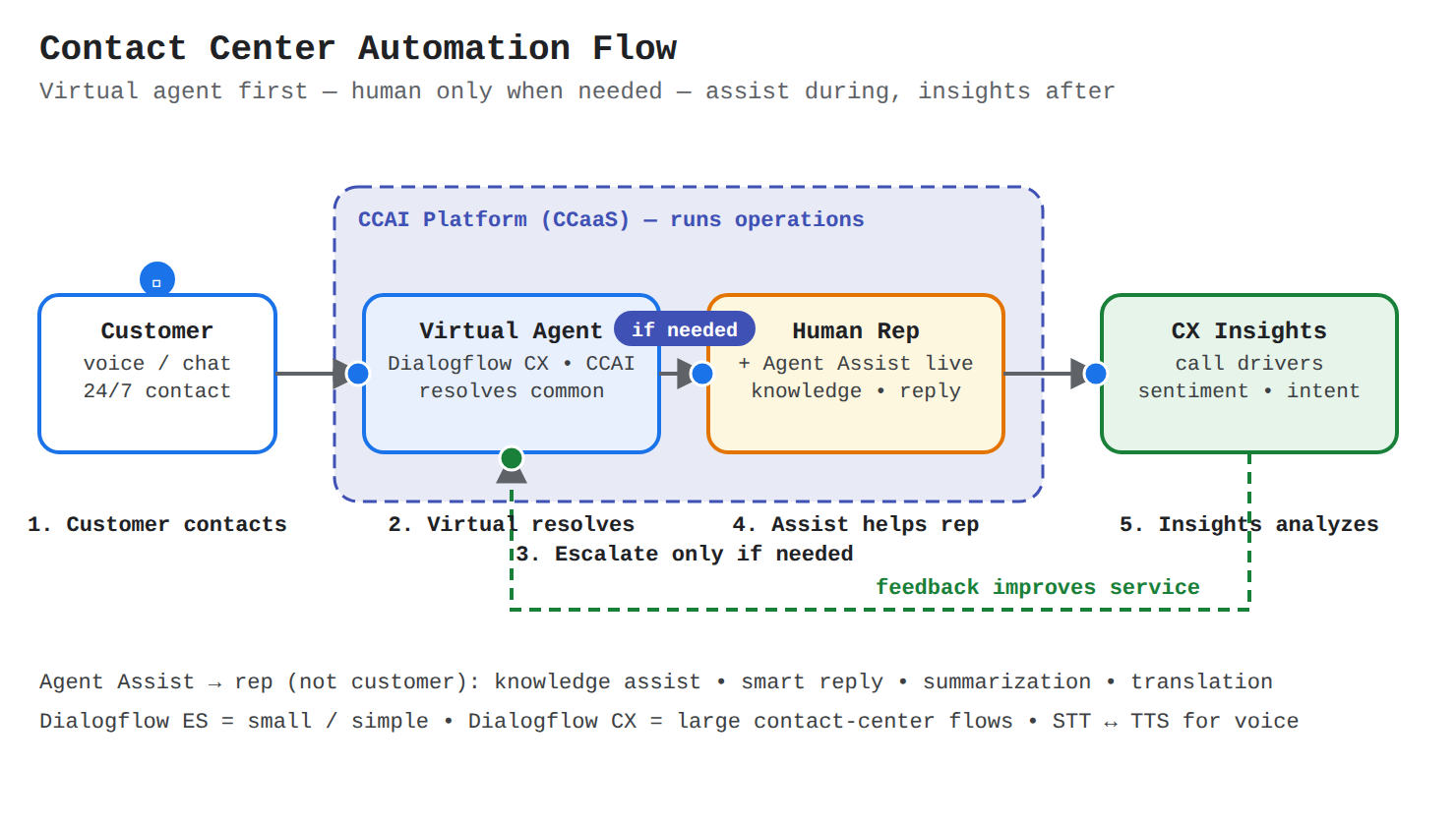
A left-to-right process flow from Customer to Virtual Agent to Human Representative with Agent Assist to Conversational Insights, with forward arrows and a feedback loop back to improve service.
How Conversational Agents Automate Customer Conversations
Conversational Agents are virtual agents that automate customer conversations across digital and voice channels. Agents built with Google Cloud Conversational AI handle complex, multi-turn dialogues by understanding what a customer says, keeping track of conversation context, and responding or taking action without a human agent. This provides immediate, 24/7 support and lets contact centers handle high volumes without adding the same volume of staff.
Dialogflow is the core service for building conversational agents. Designers use a visual console to create agents, while developers use APIs to connect those agents to applications and contact centers:
| Option | Agent size | Complexity |
|---|---|---|
| Dialogflow ES | Small to medium agents | Simple to moderately complex conversations |
| Dialogflow CX | Large agents, including contact center agents | Large and complex conversations |
Choose Dialogflow ES when the use case is a focused chatbot with straightforward questions and answers. Choose Dialogflow CX when the use case requires large, complex flows with many topics, branches, and handoffs, such as a full contact center virtual agent. Traffic flows from the customer to the virtual agent first, and the virtual agent resolves common requests or collects information before routing to a human agent only when needed.
How Voice and Language Services Support Omnichannel Agents
Voice and language processing APIs give conversational agents the ability to hear, speak, understand, and translate. Spoken audio flows from the customer to Speech-to-Text for transcription to text, the agent processes the text meaning, and written responses flow from the agent to Text-to-Speech for synthesis back to human voice. This loop allows the same agent logic to serve both chat and phone channels.
The supporting capabilities work together in one interaction path:
- Speech-to-Text (STT) for transcribing spoken voice to text
- Text-to-Speech (TTS) for synthesizing written text to human voice
- Text-to-Speech Custom Voice for training a custom voice model from studio-quality recordings
- Cloud Natural Language for understanding text meaning and structure
- Cloud Translation for translating text across languages
Together, these APIs let an automated interaction start in voice or text, move through understanding and decision-making, and return an answer in the customer's channel and language.
How Conversational Insights and CCaaS Improve Operations
Conversational Insights and Google Cloud CCaaS play different but connected roles in one feedback loop. Conversational Insights turns raw conversations into structured signals such as call drivers, sentiment, and intent. Google Cloud CCaaS runs contact center operations such as agents, queues, IVR, CRM integration, and digital channels. Those live interactions produce conversational data that insights analyzes, and the analysis shows what customers ask about and how they feel.
Conversational Insights is delivered as Customer Experience Insights (CX Insights), also called CCAI Insights. CX Insights can create and analyze a text or audio conversation through the console or by sending requests to the Contact Center AI Insights API, and it can also list conversations in the console. Custom highlights automatically detect key words or phrases that are important to determine a user's intent. CX Insights depends on several Google Cloud APIs, each supplying a specific capability, including the Cloud Speech-to-Text API for audio uploads, the Cloud Storage API for ingesting conversations, the Contact Center AI Insights API for analysis, the Dialogflow API for runtime integration and topic modeling, and Sensitive Data Protection for redaction. Optionally, CX Insights can be added to a VPC Service Controls perimeter so data stays within the defined boundary.
Google Cloud CCaaS is delivered as CCAI Platform. A typical CCAI Platform setup follows an ordered path where each step depends on the prior one:
- Add agents and teams to establish who will handle contacts.
- Create IVR queues and assign agents to define routing.
- Integrate with a CRM such as Salesforce, Zendesk, Kustomer, Microsoft Dynamics, Freshdesk, HubSpot, ServiceNow, or a custom CRM.
- Test the CRM integration to confirm agent access to customer records.
- Port the support center phone number, possibly running traffic on both the new and existing contact centers while agents ramp up.
- Extend to mobile, web, and SMS with Android and iOS SDKs, the Web SDK, and SMS.
- Use real-time dashboards and monitoring for reporting on operations.
| Area | Conversational Insights | Google Cloud CCaaS |
|---|---|---|
| Primary role | Analyze conversations | Run contact center operations |
| Key inputs | Audio or text conversations, custom highlights, topic modeling | Calls, IVR queues, agents, CRM integration, mobile/web/SMS channels |
| Key outputs | Call drivers, sentiment, intent, business trends | Routing, agent assignment, CRM integration, real-time dashboards |
Exam tip: CCAI Insights analyzes conversations for call drivers and sentiment, while CCAI Platform is the CCaaS that runs agents, queues, IVR, CRM integration, and channels.
How Agent Assist and Supervisor Assist Support Human Teams
Agent Assist is the human productivity tool that helps customer care representatives resolve issues faster and with greater accuracy. During an active chat or voice conversation, assistance flows from Agent Assist to the representative in the moment, not to the customer directly. The representative stays in control while receiving generated responses and real-time coaching that reduce searching, typing, and uncertainty.
Agent Assist is one part of Gemini Enterprise for Customer Experience, which also includes Customer Experience Agent Studio for creating self-service agents, Customer Experience Insights for KPIs and call drivers, and commerce agents that connect chat and voice to backend tools. Customer Experience Agent Studio takes on routine inquiries so representatives can focus on specialized calls, Agent Assist then supports representatives during the calls that still need a person, and Customer Experience Insights learns from those conversations to improve future outcomes. Core productivity features in Agent Assist include generative knowledge assist that surfaces answers from knowledge sources, summarization that creates concise notes for after-call work, smart reply that suggests ready-to-send responses, and live translation that converts messages between languages.
Supervisor assist adds oversight by monitoring live interactions from the virtual agent to the supervisor and escalating conversations for review and intervention. When an end user connects through the bidirectional API to a Dialogflow CX playbook or generative agent, the supervisor gains real-time visibility and can step in before an issue grows. Supervisor oversight creates value by enhancing customer experience, improving containment rates, preventing churn by flagging high-risk conversations, creating revenue opportunities by identifying upsell conversations, and accelerating AI deployment with human oversight. Lower average handle time follows because knowledge surfacing reduces search time, suggested replies reduce pauses and typing, and summarization shortens after-call work, while greater accuracy prevents repeat contacts and escalations.
Key Facts
- Google Search grounding supplies current public facts through the
GoogleSearchtool, while Vertex AI Search with RAG supplies private company data as context for Gemini model answers. - AI Commerce Search connects shopper intent to catalog data to deliver personalized search and recommendations that increase click-through, order value, and conversions.
- Product and user event data from AI Commerce Search can be exported to BigQuery to power Looker dashboards and Vertex AI sales forecasts.
- Dialogflow ES fits small to medium agents with simple to moderately complex conversations, while Dialogflow CX fits large contact center agents with large and complex conversations.
- Agent Assist helps human representatives during live conversations with knowledge assist, summarization, smart reply, and live translation to reduce average handle time.
Frequently Asked Questions
What is the difference between Google Search grounding and Vertex AI Search with retrieval-augmented generation (RAG)?
Google Search grounding retrieves current public web facts to ground Gemini model responses, while Vertex AI Search with retrieval-augmented generation (RAG) retrieves private company records to provide context for answers. Grounding links a response to real search results before the final answer is returned to improve accuracy and customer trust, whereas Vertex AI Search first finds relevant company records using semantic retrieval and then the model uses those records as context.
When should I use Google Search grounding, Vertex AI Search, or AI Commerce Search?
Choose Google Search grounding when answers depend on current public facts, choose Vertex AI Search with retrieval-augmented generation (RAG) when answers must come from company records, and choose AI Commerce Search when the goal is product discovery and revenue. AI Commerce Search supplies personalized product search and recommendations for ecommerce by connecting shopper intent to catalog data.
How does AI Commerce Search personalize product discovery for shoppers?
AI Commerce Search delivers personalized search and recommendations by applying advanced query understanding and personalization to data flowing from the product catalog and user events. Personalization reflects search history, shopping context, and product SKUs and supports guided search, autocomplete, semantic search, and text and image discovery, which reduces dead ends, search abandonment, and No Results Found pages.
How do Conversational Agents, Agent Assist, Conversational Insights, and Google Cloud Contact Center as a Service (CCaaS) work together in Google's Customer Engagement Suite?
Conversational Agents resolve common requests first through automated 24/7 support across digital and voice channels, Agent Assist helps human representatives during live conversations with knowledge assist, summarization, smart reply, and live translation, and Conversational Insights analyzes those conversations for call drivers, sentiment, and intent. Google Cloud Contact Center as a Service (CCaaS), delivered as CCAI Platform, provides the cloud contact center where voice and digital interactions run, including agents, queues, IVR, CRM integration, and mobile, web, and SMS channels.
Subdomains
External search offerings connect generative AI models to information outside their training data so answers stay current and fact-based. On Google Cloud, Google Search grounding brings live public we…
Conversational Agents are virtual agents that automate customer conversations across digital and voice channels. Agents built with Google Cloud Conversational AI handle complex, multi-turn dialogu…
How learners score on this domain
Last updated