Fundamental
Prepare and test your skills
Fundamental
Prepare and test your skills
Prompt Engineering Techniques That Drive Better Results
Defining prompt engineering and describing its significance in interacting with large language models (LLMs)
Defining prompt engineering and its significance means explaining why the words a user types control what a model does. A large language model (LLM) (opens in a new tab) is a foundation model trained on vast amounts of text to predict what is likely to come next. The prompt is the main control over that prediction because the model cannot guess unstated intent. A clear prompt bridges user intent and model capability by stating the task, context, audience, and desired format, while a vague prompt forces the model to fill in missing details on its own.
Why Prompts Control Model Behavior
Why prompts control model behavior is that data flows in one direction from user goal to prompt wording to model response. The user supplies the goal, the LLM supplies broad language and reasoning ability, and the prompt connects them with explicit instructions and background. When the prompt defines the task and adds key context, the model does not have to infer missing details and the output aligns more closely with intent. Well-designed prompts therefore produce answers that are more accurate, relevant, and consistent.
How Prompt Design Reduces Hallucinations and Supports Safety
How prompt design reduces hallucinations and supports safety is by adding guardrails that keep the model grounded. Hallucinations are confident-sounding but false or unsupported statements, and they become more likely when a prompt is open-ended or asks for information the model does not have. Careful prompting constrains the response so the output depends more on supplied context and clear instructions and less on guessing:
- Provide relevant context or source material for the model to use as the basis for its answer.
- Ask for a specific scope, format, and level of detail so the model stays within known bounds.
- Instruct the model to say it does not know or to show its reasoning steps when information is uncertain.
The prompt also acts as a safety boundary where user intent on one side is shaped to stay within respectful and ethical expectations on the other side. Positive constraints such as asking for respectful language, balanced viewpoints, and compliance with policy guide the model toward responsible behavior.
Exam tip: A specific prompt with context and clear limits reduces hallucinations, while a vague prompt increases guessing.
What Prompt Engineering and Preambles Include
What prompt engineering and preambles include is an iterative process of designing, testing, and refining inputs to get specific, high-quality results. Instead of accepting the first answer, the engineer treats each change as an experiment and checks its effect across models and documents. In enterprise summarization tools, the structured input is called a preamble, which combines a task description that sets the role and goal with additional instructions that control how the task is done. For example, the task description might be "You are an enterprise summarization tool," while the instructions add style, format, and accuracy rules.
A complete preamble combines several instruction dimensions, and changing any dimension changes the final response even when the task description stays the same:
- Answer style: tone and audience, such as clear and concise for a non-technical user.
- Output format: structure such as bullets, numbered lists, tables, or code blocks.
- Short answers: limits such as "concise" or less than 200 words.
- Comprehensive answers: key details and points that must not be left out.
- Prohibited topics: rules such as politely refusing political questions.
- Reducing hallucination: rules such as keeping claims verifiable within the given context.
Effective teams refine preambles through iterative testing, user feedback about recurring issues, staying updated as models change, and thorough evaluation across all intended use cases to catch bias.
Why Better Prompts Improve Efficiency and Avoid Larger Models
Why better prompts improve efficiency is that improving the prompt is faster and cheaper than changing the model itself. Content supplies the instructions, examples, and context, while structure uses ordering, labeling, and delimiters to help the model parse that information. Even when all required information is present, better organization improves quality and reduces retries, token use, and latency from prompt submission to complete response. Teams must test the number of examples because too few under-guides the model while too many can cause overfitting to the examples.
Trying prompt improvement first can avoid resource-intensive steps such as supervised tuning (opens in a new tab), reinforcement learning from human feedback (RLHF) tuning, or model distillation, which all require building datasets and selecting methods. It can also avoid moving to a larger model, which can learn more complex patterns but often has higher latency and higher cost. Cost depends on metering by input and output tokens or by node hours, and latency is measured as Time to First Token and Time to Last Token, so keeping the existing model through better prompting controls both.
Identifying prompting techniques and use cases (e.g., zero-shot, one-shot, few-shot, role prompting, prompt chaining)
Identifying prompting techniques and use cases means matching the amount and type of guidance in the prompt to the task. A large language model (LLM) (opens in a new tab) can create coherent new content, and in-context learning controls that output by what is included inside the prompt itself. Zero-shot, one-shot, and few-shot strategies differ mainly in the number of examples, while role prompting and prompt chaining add persona and workflow structure. Choosing the right technique improves format, tone, accuracy, and logical consistency.
How Zero-Shot, One-Shot, and Few-Shot Learning Differ
How zero-shot, one-shot, and few-shot learning differ is in how many input-output examples the prompt provides. Zero-shot prompting, also called direct prompting, provides no examples and relies solely on pre-existing knowledge from training. One-shot prompting provides one example to show the desired pattern, format, or style. Few-shot prompting provides several example pairs so the model can better recognize the pattern and apply it to a new request.
| Strategy | Examples in prompt | Choose when |
|---|---|---|
| Zero-shot | None | The task is straightforward and pre-existing knowledge is enough |
| One-shot | One input-output pair | The task needs a single clear example of format, tone, or style |
| Few-shot | Several input-output pairs | The task is more complex and needs stronger guidance from multiple examples |
Few-shot provides the strongest in-prompt guidance because the model sees the pattern repeated, but examples also help control formatting, phrasing, scope, and overall patterns.
How Role Prompting and Persona Constraints Work
How role prompting and persona constraints work is by telling the model who to act as and what boundaries to respect. Role prompting opens the prompt with a role definition before the request, such as "You are a polite customer service agent" or "You are an expert at Google Search." That persona tells the model which knowledge and style to use, so an agent sounds reassuring while a search expert focuses on concise terms. Persona constraints then create contextual boundaries through explicit limits:
- Only answer questions related to the provided topic, such as a restaurant menu.
- Politely decline when the question is unrelated or when relevant information is missing.
- Stay polite and reassure the user about requests such as speaking with an operator.
- Avoid extra behavior, such as not asking follow-up questions or not offering further help.
These boundaries keep the model from drifting into unrelated topics or inventing answers, and the same persona can handle self-knowledge questions, fixed-reference questions like prices, and dynamic questions backed by a database.
How Prompt Chaining Breaks Complex Work Into Linked Steps
How prompt chaining breaks complex work into linked steps is by replacing one large request with an ordered workflow where each output becomes the next input. Each step handles a narrow piece so the model reasons over already-processed material rather than the raw task, which improves accuracy and keeps reasoning on track:
- Define the first prompt: The starting prompt receives the original task or user input and produces an initial output.
- Pass the output forward: The output is saved and inserted into the next prompt, usually through a placeholder such as
$informationor$last-user-utterance. - Repeat for each step: Each later prompt uses the prior step's output as its input, keeping the reasoning focused.
- Produce the final response: The last prompt generates the deliverable, such as an answer, code, or ticket.
Because each step is smaller and depends on the previous result, the model is less likely to lose track of a sophisticated task.
How Chains Use External Tools and Retrieved Information
How chains use external tools and retrieved information is by letting a step pull in current data or take action between prompts. Data flows from an outside system into a parameter and then into a prompt placeholder, so later steps reason over external, current information rather than only training data. When a step relies only on training data, the answer is not guaranteed to be true or up to date:
- Function calling connects an LLM to external tools such as APIs and functions. The model generates structured data naming the function and parameters, the function runs and returns results, and the model uses those results to build its response for systems like databases and document repositories.
- Dynamic information retrieval connects the generator to a database or search engine. The system retrieves information based on a query, saves it into a parameter, and connects that parameter to a placeholder when the information is too large to paste directly.
- Embeddings and retrieval-augmented generation (RAG) match a user query to relevant knowledge. The query is converted to an embedding, compared against document embeddings through similarity search, and the most relevant information is passed into the prompt.
Common chain patterns combine these mechanisms, such as retrieving customer information from CSV, SQL, JSON, or plain text, generating an optimized search query, answering only from supplied $information, generating code from $problem and $programming-language, and escalating to a human agent from $last-user-utterance when needed.
Exam tip: When the answer must come only from provided information, include an explicit decline rule; without it the model falls back to training knowledge, which may not be true or up to date.
Identifying advanced prompting techniques and when to use them (e.g., chain-of-thought prompting, ReAct prompting)
Identifying advanced prompting techniques means choosing methods that add explicit reasoning or tool use for harder tasks. Chain-of-Thought (CoT) prompting improves logic by showing step-by-step reasoning before the answer, while the ReAct framework adds actions that fetch outside information between reasoning steps. Technique selection matches the method to task complexity, model capability, and required precision. Testing tools and parameters then balance accuracy, cost, and resource use.
How Chain-of-Thought Prompting Improves Reasoning
How Chain-of-Thought prompting improves reasoning is that reasoning flows from the prompt to intermediate steps to the final answer. The prompt provides instructions and examples that demonstrate reasoning first, and the model follows that pattern by generating its own steps before producing structured output. Because models predict what is likely to come next, seeing and generating steps in order keeps the final answer grounded in prior logic. Order matters: first the step-by-step reasoning, then the final answer that depends on it.
Logic decomposition supports this by breaking a large request into smaller cognitive actions that run in sequence. A single prompt that asks the model to summarize, extract entities, translate, and draft an email is trying to do too much and should be split into separate prompts or clearly ordered steps. Explicit reasoning helps most when a task is complex, requires a specific format, or involves nuanced judgment, and it also forces the model to check assumptions for edge cases and incomplete inputs. Built-in Thinking, which is a model capability that generates its own internal reasoning, is distinct from explicit instructions written in the prompt, so both versions should be tested and the more accurate one kept.
Exam tip: In Chain-of-Thought examples, always show step-by-step reasoning before the final structured answer, never the answer before the reasoning.
How the ReAct Framework Combines Reasoning and Acting
How the ReAct framework combines reasoning and acting is by interleaving thought with concrete tool use. ReAct stands for Reasoning and Acting, and it lets the model think through a problem and then request help from another system that runs in its own environment. The result returns across the trust boundary into the model context, where the model handles language and decisions while the tool handles factual lookup and real actions. This pattern supports generative AI applications that need current or specific information the model does not already have.
ReAct Loop: Thought, Action, Observation
Process Flow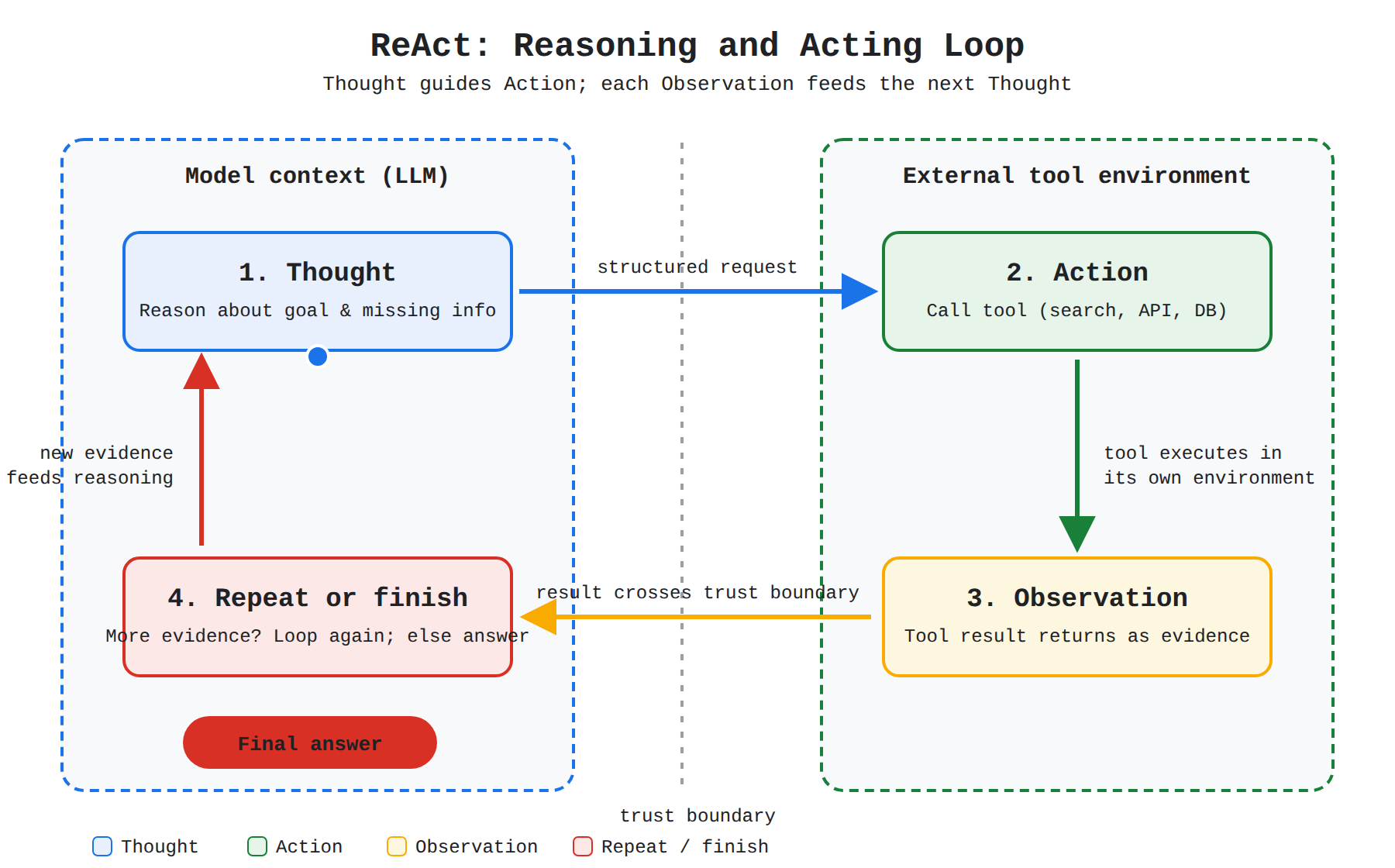
A process-flow diagram of the ReAct framework showing an LLM and an external tool separated by a trust boundary. A moving signal traces the loop: the model produces a Thought, sends an Action to the tool, the tool returns an Observation, and the model repeats or produces the final answer.
The ReAct loop is a repeating cycle where reasoning guides the next action and each action result guides the next reasoning:
- Thought: The model reasons about the goal, what it knows so far, and what information is still missing.
- Action: The model calls an external tool, such as a search function or API, with specific input from its reasoning.
- Observation: Data flows from the external tool back to the model, and the model reads the tool result as new evidence.
- Repeat or finish: The model reasons again with the new evidence, then either takes another action or produces the final answer only after the evidence is sufficient.
This cycle makes task completion autonomous because the model decides the order based on what each observation reveals. Common tools include search engines for current facts, databases for stored records, calculators for precise math, and APIs for actions like checking inventory. Choose ReAct when the answer depends on changing or external data, lightweight tool calling, or dependent lookups, and avoid it when instructions alone are enough because extra calls add time and complexity.
How Technique Selection and Prompt Components Drive Results
How technique selection and prompt components drive results is through a test-driven, iterative workflow. The workflow starts by clearly defining the objective and expected outcome, then systematically testing prompts to find areas for improvement. Content supplies instructions, examples, and context, while structure uses ordering, labeling, and delimiters to help the model parse that information. When one prompt asks for several distinct cognitive actions, it is likely doing too much and should be split.
Prompt components add precision beyond the basic objective and step-by-step instructions:
- System instructions for technical or environmental directives across tasks.
- Few-shot examples showing concrete input-output pairs.
- Output format specification stating how the answer should look.
- Role definition stating when the model must act in a specific role.
Common design failures to check before testing include overt manipulation with flattery or pressure, conflicting instructions and examples, redundant or irrelevant content, missing output format or role definition, underspecified handling of edge cases, tasks outside model capabilities, non-standard machine-readable formats instead of JSON, XML, Markdown, or YAML, fragmented non-linear logic, and prompt injection from untrusted input without safeguards.
How Vertex AI Studio Tools and Parameters Shape Results
How Vertex AI Studio (opens in a new tab) tools and parameters shape results is by helping writers create, refine, and compare prompts while controlling randomness and cost. The built-in AI assistant speeds up writing: to refine, open Vertex AI Studio, enter a prompt and submit, click Refine prompt with feedback such as shorter, longer, more professional, or more casual, then apply and repeat until satisfactory. To generate, use Help me write to describe the goal, generate the prompt, then insert and submit. The Compare feature shows prompts and responses side by side for a new prompt, a saved prompt, or a ground truth preferred answer, with extra evaluation metrics for ground-truth comparison, but it does not support media or multi-exchange chat prompts.
Parameters balance precision and resource use, though safety filters can still block responses:
| Parameter | What it controls | How to choose |
|---|---|---|
| Temperature | Randomness in token selection | Lower for true or correct responses; higher for diverse results |
| Output token limit | Maximum text output, where a token is about four characters | Raise it when the answer needs to be longer |
| Thinking budget | How much the model thinks before answering | Auto for only when needed; Manual to set budget; Off to disable |
| Structured output | Forces machine-readable format such as JSON | Choose when output must be machine-readable |
| Grounding | Connects the model to Google Search, Google Maps, or your own data | Choose Google for public sources or Your data for RAG Engine and search |
Max responses sets the maximum number of responses per prompt, while Top-P changes token selection. Structured output turns off grounding options, so the two cannot be combined.
Key Facts
- The prompt bridges user intent and large language model (LLM) capability by defining task, context, audience, and format, and a preamble combines a task description for role and goal with additional instructions for style, format, length, and accuracy.
- Zero-shot prompting provides no examples, one-shot prompting provides one example, and few-shot prompting provides several examples to guide format and reasoning.
- Prompt chaining breaks complex work into ordered steps where each prompt's output becomes the next prompt's input through placeholders such as
$information. - Chain-of-Thought (CoT) prompting requires step-by-step reasoning before the final structured answer, while the ReAct framework alternates Thought, Action, Observation, and repeat or finish with data flowing from the external tool back to the model.
- Structured output forces machine-readable format such as JSON and turns off grounding options, so structured output and grounding cannot be used together.
Frequently Asked Questions
What is prompt engineering and why does it matter for a large language model (LLM)?
Prompt engineering is the iterative process of designing, testing, and refining inputs to get specific, high-quality results. It matters because the prompt is the main control over what a large language model predicts, bridging user intent and model capability by stating the task, context, audience, and desired format, while a vague prompt forces the model to fill in missing details on its own.
What is the difference between zero-shot, one-shot, and few-shot prompting?
The difference is how many input-output examples the prompt provides. Zero-shot prompting provides no examples and relies solely on pre-existing knowledge from training, one-shot prompting provides one example to show the desired pattern, format, or style, and few-shot prompting provides several example pairs so the model can better recognize the pattern and apply it to a new request.
How does Chain-of-Thought (CoT) prompting improve reasoning compared to giving the answer directly?
Chain-of-Thought prompting improves reasoning by showing step-by-step reasoning before the answer so the model generates its own steps before producing structured output. Because models predict what is likely to come next, seeing and generating steps in order keeps the final answer grounded in prior logic, so order matters with reasoning first and the final answer that depends on it last.
How does the Reasoning and Acting (ReAct) framework combine reasoning and external tools?
The Reasoning and Acting framework interleaves thought with concrete tool use by repeating a cycle of Thought, Action, Observation, and repeat or finish. The model reasons about the goal and what information is still missing, calls an external tool such as a search function or API, reads the tool result as new evidence, and only produces the final answer after the evidence is sufficient.
Subdomains
The ReAct framework is a prompting approach that combines reasoning with acting so a model can solve multi-step tasks. ReAct stands for Reasoning and Acting, and it lets the model think through a …
The significance of prompting in steering model behavior is that the prompt is the main control a user has over what a large language model (LLM) does. An LLM can handle many tasks, but it cannot …
Prompt chaining is the practice of breaking a complex task into a sequence of smaller, linked prompts where the output of one step becomes the input to the next. Instead of asking a model to solve eve…
How learners score on this domain
Last updated