Fundamental
Prepare and test your skills
Fundamental
Prepare and test your skills
Using Prompt Chaining for Reliable Multi-Step Workflows
Free sample question, answered and explained below. The Generative AI Leader practice bank has 2,191 more like it. Try 10 free: instant score, no account.
A customer service team wants to build an automated workflow with a large language model. The process requires several sequential actions:
- Extract key complaint topics and sentiment from an incoming customer email
- Convert the extracted topics into a structured JSON summary
- Compare the summary against internal policy guidelines to determine refund eligibility
- Draft a personalized resolution email based on the policy outcome
When attempting to execute all tasks in a single large prompt, the model frequently misses specific policy rules and produces inconsistent outputs.
Which prompting strategy should the team adopt to decompose this complex workflow into reliable, interdependent steps?
Explanations
Few-shot prompting
Few-shot prompting
What Few-Shot Prompting Is
Few-shot prompting provides the language model with one or more explicit input-output examples (shots) within the prompt context to demonstrate the desired format, style, or reasoning pattern before asking it to handle a new query.
Why It Doesn't Meet the Requirement
- Focuses on pattern matching, not pipeline decomposition: Few-shot prompting guides how a model should format or execute a specific single task, but it does not partition an intricate multi-stage workflow into separate, sequential steps.
- Context window consumption: Providing full end-to-end examples of an entire multi-step workflow (email input, extraction, JSON, policy validation, response) consumes substantial context tokens without guaranteeing proper execution.
- Lacks execution modularity: If the model makes a mistake midway through the generation, few-shot prompting provides no mechanism to isolate or correct the specific intermediate step.
Key Characteristics and Limitations
- In-context demonstration: Excellent for teaching custom schemas, domain-specific terminology, and desired output styles.
- Monolithic processing: Keeps all tasks bundled in one prompt call unless paired with an orchestration mechanism.
- Diminishing returns on compound tasks: As task complexity increases, providing monolithic few-shot examples becomes unwieldy and error-prone.
This Answer Would Be Correct If
- The goal was to teach the model how to output an exact custom JSON structure by providing two or three sample inputs and outputs.
- The scenario focused on standardizing the format of single-step classification tasks.
Additional Context
Few-shot demonstrations are frequently utilized within individual links of a prompt chain (such as formatting the JSON intermediate step), but few-shot prompting itself is not the architectural pattern for task decomposition.
Zero-shot prompting
Zero-shot prompting
What Zero-Shot Prompting Is
Zero-shot prompting involves giving a model a task instruction without providing any demonstration examples or intermediate operational steps. The model must rely solely on its pre-trained knowledge and the immediate instructions to generate a response.
Why It Doesn't Meet the Requirement
- Does not break down multi-step pipelines: Zero-shot prompting refers to the absence of in-context examples, not a method for sequencing or decomposing multi-stage tasks.
- Vulnerable to instruction overload: Applying a zero-shot prompt to an intricate, multi-step problem is precisely why the initial setup failed with missed rules and formatting errors.
- No intermediate verification: A single zero-shot call cannot establish checkpoints between extraction, policy validation, and response drafting.
Key Characteristics and Limitations
- Best suited for simple tasks: Works well for straightforward classification, translation, or basic summarization.
- High variance on complex logic: Fails frequently when multiple interdependent business constraints must be evaluated in order.
- Lacks structural handoffs: Does not provide mechanisms to pass intermediate data between distinct model stages.
This Answer Would Be Correct If
- The scenario asked for the simplest method to classify customer sentiment without providing training examples or previous conversation samples.
- The objective was to test the baseline capabilities of a foundation model on a single, isolated question.
Additional Context
While individual prompts within a chain can utilize zero-shot prompting, zero-shot alone is not the architectural pattern that coordinates sequential, multi-stage workflows.
Prompt chaining
Prompt chaining
What Prompt Chaining Is
Prompt chaining is an advanced prompt engineering technique that breaks down a complex, multi-stage task into a sequence of smaller, discrete prompts. In a prompt chain, the output generated by one prompt serves directly as the context or input for the subsequent prompt in the workflow.
How It Meets the Requirements
- Decomposes multifaceted tasks: Rather than overwhelming the model with extraction, JSON structuring, policy verification, and drafting simultaneously, prompt chaining isolates each step into its own focused prompt.
- Maintains logical consistency: The output of the extraction phase flows directly into the structured formatting step, which then feeds cleanly into the policy verification step.
- Improves accuracy and reliability: By focusing the model's attention on one specific operation at a time, each intermediate output can be validated or parsed before triggering the next phase.
Key Advantages and Capabilities
- Modularity: Individual steps can be debugged, tested, and optimized independently without breaking the entire workflow.
- Error isolation: If the policy evaluation produces an unexpected result, developers can pinpoint the exact stage where the logic failed.
- Intermediate data transformation: Allows deterministic code or validation logic (such as schema checking) to execute between LLM calls.
- Scalability across complex business logic: Enables sophisticated AI-driven pipelines that mimic multi-step human cognitive processes.
Prompt Chain with Validation Gates
Process Flow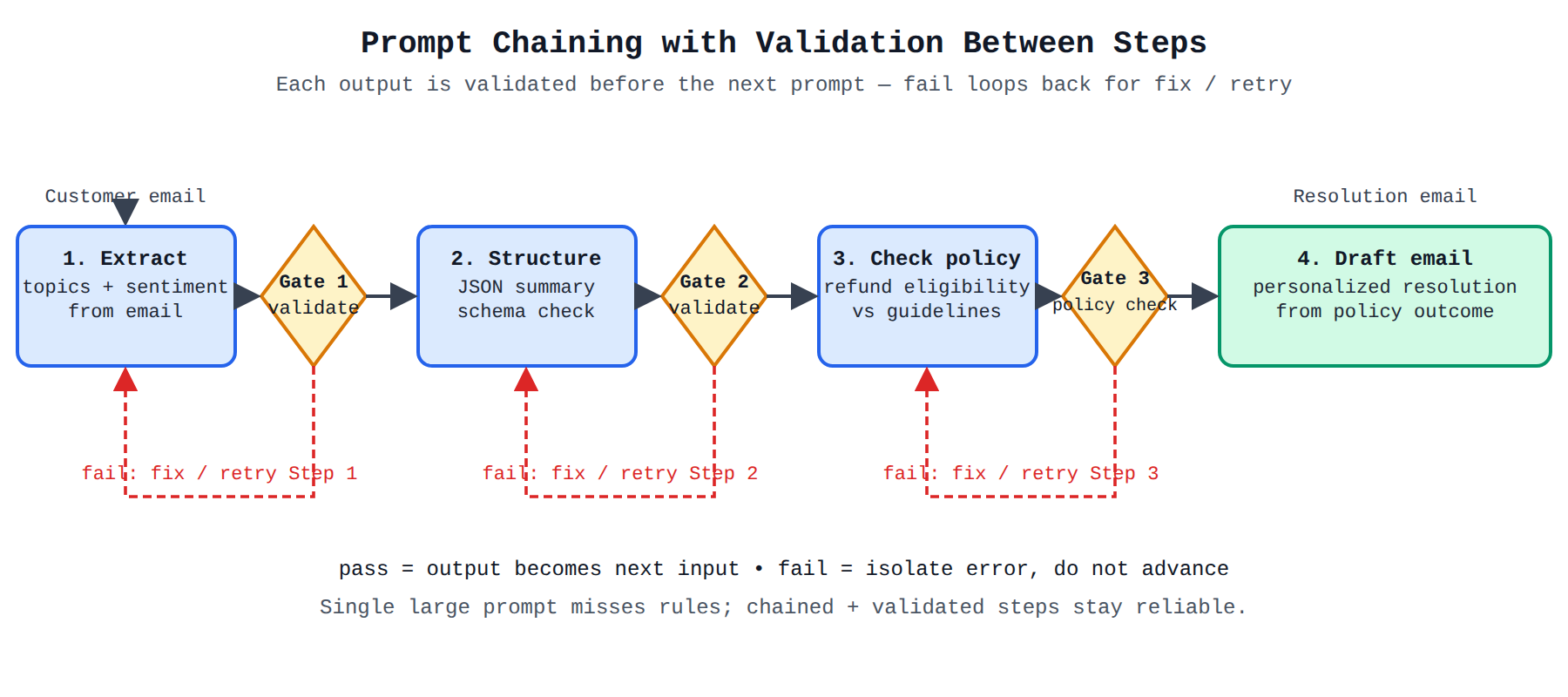
Why This Is Optimal
Attempting to perform extraction, structured formatting, domain verification, and creative text generation in a single prompt introduces cognitive overload for the language model, leading to missed instructions and hallucinations. Prompt chaining directly resolves this by creating deterministic, verifiable handoffs between focused model invocations.
Role prompting
Role prompting
What Role Prompting Is
Role prompting (also known as persona prompting) instructs the generative model to adopt a specific identity, perspective, or professional persona (such as "Act as an experienced customer care specialist" or "Act as a compliance auditor") during response generation.
Why It Doesn't Meet the Requirement
- Addresses tone rather than workflow architecture: Role prompting adjusts the style, perspective, and domain vocabulary of the output, but it does not decompose a workflow into sequential sub-tasks.
- Fails to manage multi-step data flow: Assigning a persona does not prevent the model from dropping rules or hallucinating when multiple complex sub-tasks are combined into one prompt.
- Does not establish pipeline dependencies: It cannot pass structured intermediate results between distinct analytical and drafting stages.
Key Characteristics and Limitations
- Improves stylistic relevance: Helps calibrate the tone, vocabulary, and empathy level of customer-facing responses.
- Single-prompt technique: Typically applied within individual prompts rather than governing the end-to-end orchestration of an application.
- Cannot enforce multi-stage business logic: Cannot guarantee that policy validation occurs strictly before draft generation.
This Answer Would Be Correct If
- The team needed to ensure that the drafted reply sounded empathetic, polite, and aligned with brand guidelines.
- The primary goal was to guide the model's perspective and writing tone.
Additional Context
Role prompting can be incorporated into the final drafting stage of a prompt chain, but on its own, it cannot decompose complex tasks into interdependent steps.
Try 10 interactive questions like this one, free
Answer them yourself and get your score the moment you finish. No account needed.
Full access includes
- 2,191 practice questions across all 4 exam domains
- Every answer explained: why it is right, and why the others are not
- Scout, an AI tutor that answers your follow-up questions
- Readiness tracking by domain, so you know when to book the exam
Related questions
Keep the momentum going with these hand-picked practice scenarios
FundamentalGenerative AI Leader
Role Prompting
Identifying prompting techniques and use cases (e.g., zero-shot, one-shot, few-shot, role prompting, prompt chaining)
FundamentalGenerative AI Leader
Few-Shot Prompting
Identifying prompting techniques and use cases (e.g., zero-shot, one-shot, few-shot, role prompting, prompt chaining)
FundamentalGenerative AI Leader
Business-Centric KPIs vs Technical Metrics
Identifying techniques to measure the impact of gen AI initiatives
FundamentalGenerative AI Leader
Gemini Native Multimodal Architecture
Gemini
FundamentalGenerative AI Leader
Grounded Conversational Search and Multi-Document Summarization
Identifying business use cases where gen AI can create, summarize, discover, and automate (e.g., text generation, image generation, code generation, video generation, data analysis, and personalized user experience)
IntermediateProfessional Cloud Architect
Serverless VPC Access All-Traffic Egress
Cloud-native network configuration for compute resources (e.g., Compute Engine, GKE, serverless networking, and Google Cloud VMware Engine)
Last updated