Fundamental
Prepare and test your skills

Fundamental
Prepare and test your skills
Google Cloud Trust Principles and Compliance
Google Cloud earns customer trust by making Google personnel access visible, limiting that access by default, and proving controls with independent audits. Protection of customer data is a primary design consideration in the Google Cloud security overview (opens in a new tab), and customers own their data completely. Google does not use customer data for advertising or for any purpose other than delivering contracted services. Customers run on the same infrastructure as Search, YouTube, and Gmail, so they benefit from the same large-scale security controls.
Transparency Tools That Show Google Personnel Access
Transparency tools show when Google personnel access Customer Data and prove that security controls work as described. Access Transparency (opens in a new tab) records actions Google personnel take on Customer Data, including the affected resource, action, time, reason, and accessor details such as location and job category. Cloud Audit Logs record actions taken by members of the customer's own organization, so the two logs together cover both Google administrative access and customer actions. Customers can send Access Transparency events to a security information and event management (SIEM) tool such as Google Security Operations to add context to findings and track legal obligations.
Access Approval lets customers approve or deny Google personnel requests to access covered Customer Data before access happens. Approved requests are linked to Access Transparency logs, so the approval and the resulting action stay connected. Key Access Justifications adds control for customers who use customer-managed encryption keys (CMEK), where the customer manages its own keys and controls access to them. Together, approval and key justifications give context for a request and control over data and keys.
Exam tip: Access Transparency logs record Google personnel access to Customer Data, while Cloud Audit Logs record actions by members of your Google Cloud organization.
When and How Google Personnel Can Access Customer Data
Google personnel have no access to Customer Data by default, and any grant is temporary and no greater than necessary. This model of privileged access management (opens in a new tab) enforces least privilege with role-based limits and multi-party approval. To obtain access, personnel must be on relevant access control lists (ACLs), acknowledge data access policies, use a trusted device, sign in with multi-factor authentication (MFA) using a Titan Security Key, provide a justification such as a support ticket, and obtain additional approval when required.
Access is allowed only for limited business reasons after those conditions are met. Customer-initiated support is tied to a support ticket and limited to low-sensitivity data such as a bucket name. Outage or tool failure allows logged access for backup or recovery without bypassing the resource allowlist. Third-party legal requests are rare and only the legal team can create a valid legal justification. Google-initiated reviews are also rare and address safety concerns such as security, fraud, abuse, or compliance.
How Duties Are Shared and Proven With Audits
The shared responsibility model (opens in a new tab) divides security duties between Google Cloud and the customer. The general rule is that customers secure what they bring to the cloud, while Google Cloud protects the cloud itself. Customers are always responsible for their data, while Google Cloud is responsible for the underlying infrastructure.
| Service model | Google Cloud responsibility | Customer responsibility |
|---|---|---|
| Infrastructure as a service (IaaS) | Hardware, storage, and network | Everything above that stack, including data, applications, and access |
| Software as a service (SaaS) | Security of everything except data and its access and usage | Data and its access and usage |
Google Cloud proves its controls through independent third-party audits, certifications, and attestations. Key standards include ISO/IEC 27001 for Information Security Management, ISO/IEC 27017 for Cloud Security, ISO/IEC 27018 for Cloud Privacy, ISO/IEC 27701 for Privacy, and SOC 2 and SOC 3 reports. Regional and industry frameworks include FedRAMP for the United States government, BSI C5 for Germany, and MTCS for Singapore. Assured Workloads helps finance, government, healthcare, and education customers implement requirements with control packages for programs such as FedRAMP, ITAR, and Sovereign Controls for EU.
Discuss how Google Cloud's trust principles are a commitment to our shared responsibility for protecting and managing an organization’s data in the cloud.
Google Cloud trust principles are security, privacy, transparency, and compliance working together to protect organizational data. Security by design shapes Google culture, hiring, data center design, and daily operations at large scale. Privacy means customer data belongs to the customer and is used only to deliver contracted services. Transparency and independent verification make Google operations visible and checkable.
Shared Responsibility Boundary Across Service Models
The shared responsibility boundary divides security duties so each side knows which controls it must provide. In general, the customer secures what it brings to the cloud and Google protects the cloud itself. The exact split changes by service type because Google manages more of the stack as services become more complete. When workloads span multiple service types, the customer must apply the correct split to each part.
Shared Responsibility Stack by Service Model
Layered StackA layered stack diagram comparing responsibility splits for IaaS, PaaS, and SaaS on Google Cloud. Blue layers are Google Cloud responsibilities such as hardware, storage, network, runtime, and platform; orange layers are customer responsibilities, with data and its access and usage always owned by the customer.
| Service model | Google Cloud responsibility | Customer responsibility |
|---|---|---|
| Infrastructure as a service (IaaS) | Hardware, storage, and network | Everything else, including data and workloads |
| Platform as a service (PaaS) | More controls than in IaaS, including runtime and platform layers | Application controls, IAM management, data security, and client protection |
| Software as a service (SaaS) | Security of everything except data and its access and usage | Data and its access and usage |
Google Cloud's shared fate approach treats security as an ongoing partnership beyond this division. Shared fate includes secure landing zones, blueprints for secure starting points, and best-practice guidance. This partnership helps customers start securely and improve over time rather than treating responsibility as a one-time handoff.
Customer Controls for Access, Encryption, and Confidential Computing
Customer controls let organizations see, approve, and limit privileged access to their data. Access Transparency logs administrative access by authorized Google personnel after it occurs, while Access Approval lets customers approve or deny access to certain datasets before it happens. Customers also control encryption with customer-managed encryption keys (CMEK), where the customer manages its own keys and controls access to them. These tools keep the customer as the arbiter of who can decrypt data.
Key Access Justifications provides a justification every time externally hosted keys are used to decrypt data and requires Cloud KMS with Cloud HSM or Cloud EKM. Confidential Computing encrypts data in use and reduces the trust boundary so fewer resources can access confidential data. Options include Confidential VM, Confidential Google Kubernetes Engine (GKE) Nodes, Confidential Dataflow, Confidential Managed Service for Apache Spark, and Confidential Space. Together, logging, approval, key control, and confidential processing limit exposure of sensitive data.
Exam tip: Access Transparency shows privileged access by Google personnel after it occurs, while Access Approval controls that access before it happens for supported datasets.
What Customers and Google Cloud Each Must Do
Customer duties center on data, access, and configuration. Customers must know which data has special compliance or residency needs, place sensitive data inside appropriate Assured Workloads folders or projects, configure Identity and Access Management (IAM) so only appropriate personnel can access resources, and organize folders and projects so personal data is not exposed. Sensitive data includes account information, health information, personal identifiers, cardholder data, and ID numbers. Customers must avoid placing such data in names, IDs, labels, description fields, URIs, timestamps, or firewall rules, because those fields are treated as Service Data or metadata outside the residency boundary.
Google Cloud duties center on infrastructure, enforcement, and oversight under its regulatory, compliance, and privacy needs (opens in a new tab). Google provides default encryption, physical and network security, and enforcement of the IAM and Assured Workloads controls the customer selects. Google assesses third-party suppliers before onboarding, requires security and privacy contract terms, and publishes subprocessors. Google also applies zero trust (opens in a new tab) ideas such as strong authentication, where jobs in production use cryptographic credentials to prove identity.
Policy Enforcement With Organization Hierarchy and IAM
Policy enforcement flows from the resource hierarchy through IAM to each workload. The Organization resource is the apex of the hierarchy and groups all resources that belong to an organization. An Organization can contain folders, each folder can contain projects, and projects contain service resources such as Compute Engine virtual machines (VMs), Pub/Sub topics, Cloud Storage buckets, and Cloud VPN endpoints. Organization policies and Assured Workloads controls set at higher levels flow down to folders and projects.
IAM grants granular access through four connected concepts. A principal is a user, service account, or group that can access a resource. A permission allows a specific operation on a resource. A role is a collection of permissions. An IAM allow policy binds principals to a role on a resource. The customer creates the policy and Google Cloud enforces it, while Policy Intelligence tools give insights on access to accounts and resources.
Describe how sharing transparency reports and undergoing independent third-party audits support customer trust in Google.
Transparency and independent audits support trust by showing what happened to customer data and having outside experts verify that protections work. Customer content in Google Cloud belongs to the customer, and Google does not use it for advertising, sell it, or use it to train models without permission. Transparency shows what actually happened in a specific access event, while audits verify that the controls behind those events are sound. Together, daily evidence from logs and outside confirmation from auditors demonstrate ethical handling and operational integrity.
Limits and Justifications for Privileged Access
Privileged access is access by Google personnel to customer data to provide a contracted service. Most data access happens because the customer accesses its own data or a service acts on the customer's behalf. When administrators must intervene for support or maintenance, Google limits that access through four principles: access is denied by default and temporary when granted, singular access by one person alone is made extremely difficult, all access must have an active business justification, and monitoring processes identify and remediate violations.
Justification reason codes explain why access was requested. Codes include CUSTOMER_INITIATED_SUPPORT for customer support, GOOGLE_INITIATED_SERVICE for system management, THIRD_PARTY_DATA_REQUEST for legal requests, GOOGLE_INITIATED_REVIEW for security or compliance review, and GOOGLE_RESPONSE_TO_PRODUCTION_ALERT for reliability. Access Transparency logs (opens in a new tab) carry these codes so customers can review the purpose of each event. Access Approval builds on this by requiring explicit customer approval before access, with auto approved status used only when strict emergency criteria are met so logging continues without interruption.
Exam tip: Access Transparency gives visibility into Google personnel access after it happens, while Access Approval lets you approve or deny that access before it happens.
How Government Requests and Service Disruptions Are Disclosed
Transparency reports are public disclosures where Google describes government and court requests and how Google responds. As data owner, the customer is primarily responsible for responding to law enforcement, but Google also receives direct requests. A Google team reviews each request to confirm it satisfies legal requirements and Google policies. For Google to comply, the request generally must be made in writing, issued under appropriate law, and signed by an authorized official.
Google policy is to direct the government to request data from the customer and to notify the customer unless prohibited by law or court order. Google was the first company to regularly publish reports about government data requests, with details in its Transparency Report. The report and status dashboard also share service disruptions and regional availability, including temporary outages such as network events and permanent restrictions from government actions. Customers can use this data to analyze availability before committing to a region.
How Independent Audits Verify Google Controls
Independent third-party audits are examinations by outside organizations that verify security controls work as claimed. Because the auditor is independent from the provider, findings are evidence rather than self-reported promises. ISO certifications confirm management systems meet international standards, while SOC reports describe controls over security, availability, and related trust areas. Industry-specific assessments apply sector rules so customers in regulated fields can review documented proof.
Key frameworks that Google Cloud is audited against include:
- ISO/IEC 27001 for information security management, ISO/IEC 27017 for cloud security, ISO/IEC 27018 for cloud privacy, and ISO/IEC 27701 for privacy
- SOC 2 and SOC 3 reports for operational controls
- FedRAMP for the United States government, BSI C5 for Germany, and MTCS for Singapore
- Assured Workloads control packages for finance, government, healthcare, and education folders
Audits verify Google's side of shared responsibility, not the customer's side. In Google Cloud VMware Engine, for example, Google is responsible for VM infrastructure health, vSAN storage, network overlay, ESXi hosts, and default HCX deployment, while the customer is responsible for VM operating systems, applications, NSX overlay networking, and on-premises VPN devices. An audit confirms Google's infrastructure controls, while customers remain accountable for their own configurations. Logging and incident response close the loop: threat indicators from past incidents trigger monitoring and revocation, and separate security teams investigate, remediate, and improve protections.
Describe why data sovereignty and data residency may be requirements and how Google Cloud offers organizations the ability to control where their data is stored.
Data location controls help organizations meet legal, regulatory, and organizational rules about where data lives and which laws govern it. Data residency is the practice of keeping data within specific geographic boundaries, driven by regulations such as GDPR, HIPAA, and PIPEDA where violations can lead to fines. Data sovereignty is the legal and jurisdictional control over data, meaning which country's laws and authorities govern it. Organizations often need both, and residency controls help satisfy sovereignty obligations but do not replace them.
Residency Versus Sovereignty Requirements
Data residency answers where data is stored and processed, while data sovereignty answers which laws and authorities govern the data. Residency is enforced by choosing locations and blocking resources outside approved boundaries. Sovereignty adds licensing and oversight, such as national cybersecurity assessments and support-location rules. Both must be addressed together for regulated workloads.
| Concept | Main question | What it controls | Google Cloud example |
|---|---|---|---|
| Data residency | Where is data stored? | Physical or geographic location | Regional secrets (opens in a new tab) kept in one location at rest, in use, and in transit |
| Data sovereignty | Which laws govern data? | Legal jurisdiction and oversight | Local licensing such as CST Class C in Dammam with NCA ECC and CCC controls |
Secret Manager enforces residency through regional secrets. The creator specifies the storage location, and Secret Manager keeps secret data within that location's infrastructure at rest, in use, and in transit. Only applications in the same location can access the regional secret. Unlike global secrets replicated for high availability, regional secrets are not automatically replicated. Cloud Key Management Service (KMS) and Assured Workloads control packages (opens in a new tab) provide additional regulatory and boundary support.
Exam tip: Data residency answers where data is stored, while data sovereignty answers which laws and authorities govern the data.
Zones, Regions, and Multi-Regions for Data Location
Zones, regions, and multi-regions define how widely data spreads for availability and control. Every general-purpose region is intended to offer at least three physically distinct availability zones. Choosing a smaller scope keeps data tightly bounded, while a larger scope improves resilience but spans more geography. Customers enable residency by selecting a location during provisioning, and that choice cannot be changed later for some services.
| Location type | Where the resource lives | Availability behavior |
|---|---|---|
| Zonal resource | Within a single zone, such as a Compute Engine VM | A zonal outage can affect some or all resources in that zone |
| Regional resource | Redundantly across zones in one region, such as an App Engine app | Higher availability than a single zone because other zones can continue |
| Multi-regional resource | Distributed within and across regions, such as Cloud Storage buckets | Designed to survive loss of a single region, with tradeoffs in latency or consistency |
Cloud Storage and BigQuery apply control through bucket or dataset location. A regional bucket or dataset stores and processes Customer Data within that region's country, keeping data inside one national boundary. A multi-regional bucket or dataset replicates across regions in that multi-region, such as the United States or European Union, which improves resilience but places data in more than one location. Administrators must replicate zonal or regional data elsewhere for disaster recovery. Global functions such as load balancing, networking, and identity still operate across regions to keep the platform running.
Organization Policies and Service Controls That Enforce Boundaries
Governance enforces approved geographies at the policy layer and the service layer. The Organization Policy Service applies constraints so new resources can only be created in allowed places. The constraint gcp.resourceLocations blocks deployment outside approved regions, while gcp.restrictServiceUsage limits which services can be used inside an Assured Workloads folder. Assured Workloads creates a dedicated folder tied to a compliance package that automatically limits selectable regions.
Enforcement follows an ordered workflow:
- Create an Assured Workloads folder and select a control package: The administrator creates the folder and chooses the regime that matches compliance needs.
- Apply location boundaries to the folder: The package sets the Resource Locations constraint so only approved regions can be chosen.
- Create workloads inside the folder: Data flows from the administrator's location choice into each new resource, and requests outside allowed regions are blocked.
Shared duties keep data in place. Google provides default encryption, infrastructure security (opens in a new tab), and enforcement of customer IAM and Assured Workloads controls. The customer must place regulated data in the correct folder, configure IAM, and avoid putting sensitive data in resource names, IDs, labels, or description fields, because those identifiers sit outside the residency boundary.
Try the scenario
Assured Workloads: how folder policy, region choice, and data field shape residency
Change the inputs and watch how the outcome changes.
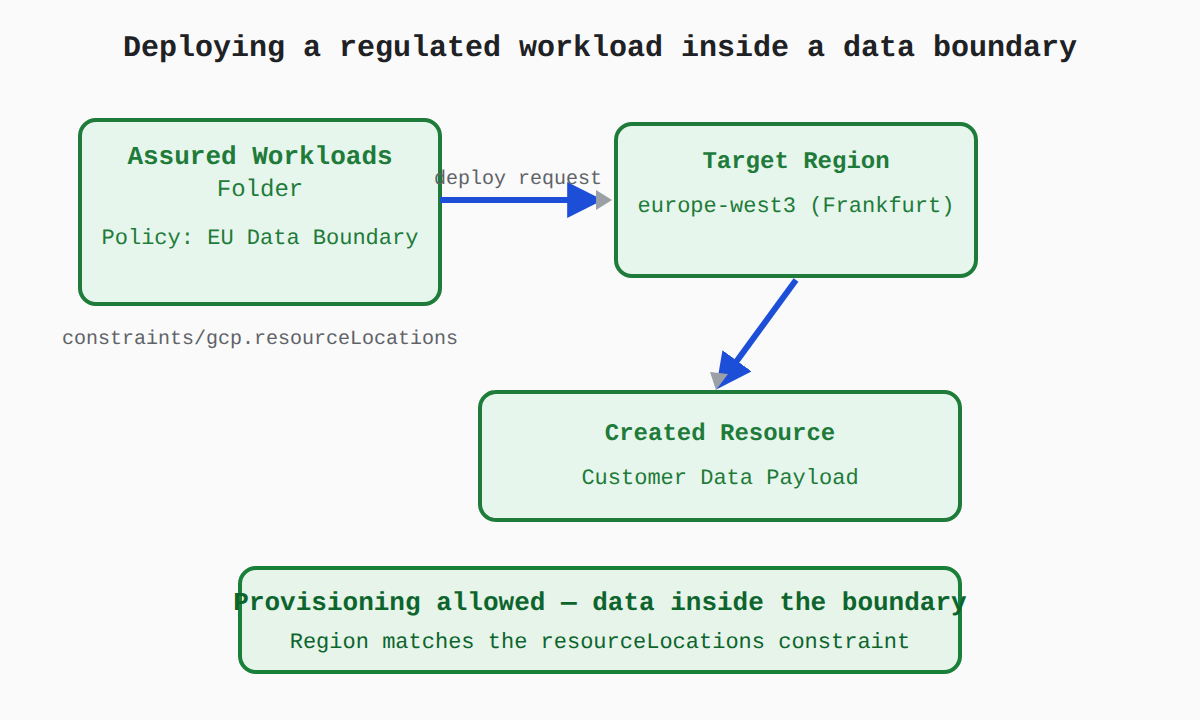
Change the folder policy, target region, and where you put the data to see provisioning succeed, get blocked, or leak.
Describe how Google Cloud compliance resource center and Compliance Reports Manager support industry and regional compliance needs.
Audit readiness means having controls, documentation, and evidence ready for regulatory verification. The Google Cloud Compliance resource center maps regulatory obligations to Google evidence and clarifies shared duties. Compliance Reports Manager provides the downloadable audit reports that prove Google controls were checked. Together they help organizations prepare without searching for proof at the last minute.
What the Compliance Resource Center Provides
The Compliance Resource Center is a central repository for discovering certifications, attestations, audit reports, and compliance offerings. It is used first during assessment to check whether Google Cloud services support a specific regulation and to find current proof. Certifications for a Google Cloud service also apply to Google models included in that service unless documented otherwise.
The center provides:
- Service support for various regulations
- Google Cloud certifications and attestations and letters of attestation
- A complete listing of compliance offerings
- Documentation and third-party audits that support compliance
- Resource documents and mappings where formal certifications do not exist
Regional and industry offerings cover global standards and local regimes. Examples include ISO/IEC 27001 for Information Security Management, ISO/IEC 27017 for Cloud Security, ISO/IEC 27018 for Cloud Privacy, ISO/IEC 27701 for Privacy, SOC 2 and SOC 3 reports, FedRAMP for the US government, BSI C5 for Germany, and MTCS for Singapore. Teams use these listings to match finance, healthcare, government, and education needs to supported services such as GDPR, HIPAA, and PCI DSS workloads.
Exam tip: The Compliance Resource Center is for discovering certifications and offerings; use Assured Workloads when you need to implement regulatory requirements in Google Cloud.
How Compliance Reports Manager Supplies Audit Evidence
Compliance Reports Manager is the library where customers access, download, and manage third-party audit reports and security certifications. It works with the resource center by supplying the actual proof behind the listings. Customers retrieve current certifications and letters of attestation instead of asking Google for evidence separately. Teams share downloaded reports with internal risk teams, external auditors, and regulators.
Reports available include ISO/IEC 27001, ISO/IEC 27017, ISO/IEC 27018, ISO/IEC 27701, and SOC 2 and SOC 3 reports describing privacy controls and infrastructure safeguards. The report flows from the independent auditor to Google Cloud to Compliance Reports Manager, where the customer downloads it for review. This chain gives trusted evidence without auditing Google data centers directly. The evidence covers Google's side of shared responsibility for infrastructure, while customers must still provide evidence for their own data, access rules, and configurations.
Three Stages to Reach and Keep Audit Readiness
Audit readiness moves through assessment, implementation, and continual monitoring, with Google Cloud tools supporting each stage:
- Assess compliance needs: Review regulatory obligations and business practices, then use the Compliance resource center to find service support and current attestations.
- Automate implementation: Use Assured Workloads to select a compliance regime and set data boundaries, and use blueprints with recommended configurations to fix gaps consistently.
- Monitor and verify: Use Audit Manager for adherence assessments, Security Command Center Compliance Manager for custom controls, Cloud Audit Logs for administrative activity, and Access Transparency for Google administrator access, then have controls validated by an external auditor.
The shared responsibility model guides evidence collection at each stage. In IaaS, Google Cloud is responsible only for hardware, storage, and network, while in SaaS Google Cloud is responsible for everything except data and its access and usage. Each party must provide evidence for its own part, so Google certifications plus customer logs and control checks together demonstrate compliance.
Key Facts
- Access Transparency logs record actions by Google personnel on Customer Data, while Cloud Audit Logs record actions by members of the customer's own organization.
- Access Approval lets customers approve or deny Google personnel access before it happens, and approved requests are linked to Access Transparency logs.
- The customer is always responsible for data and its access and usage, while Google Cloud is responsible for hardware, storage, and network in IaaS and for everything except data and its access and usage in SaaS.
- Data residency controls where data is stored and processed, while data sovereignty controls which laws and authorities govern the data.
- The Compliance resource center is for discovering certifications and offerings, while Compliance Reports Manager is the library for downloading third-party audit reports.
Frequently Asked Questions
What is the difference between Access Transparency and Cloud Audit Logs in Google Cloud?
Access Transparency records actions Google personnel take on Customer Data, including the affected resource, action, time, reason, and accessor details, while Cloud Audit Logs record actions taken by members of the customer's own organization. Together the two logs cover both Google administrative access and customer actions.
When should I use Access Approval instead of just relying on Access Transparency in Google Cloud?
Use Access Approval when you want to approve or deny Google personnel requests to access covered Customer Data before access happens, whereas Access Transparency shows that privileged access after it occurs. Approved requests are linked to Access Transparency logs so the approval and the resulting action stay connected.
What is the difference between data residency and data sovereignty in Google Cloud?
Data residency answers where data is stored and processed within specific geographic boundaries, while data sovereignty answers which country's laws and authorities govern the data. Residency controls help satisfy sovereignty obligations but do not replace them.
What is the difference between the Google Cloud Compliance resource center and Compliance Reports Manager?
The Google Cloud Compliance resource center is for discovering certifications, attestations, audit reports, and compliance offerings, while Compliance Reports Manager is the library for accessing, downloading, and managing the actual third-party audit reports. Teams use the resource center first during assessment and retrieve proof from Compliance Reports Manager to share with internal risk teams, external auditors, and regulators.
Subdomains
Transparency mechanisms and operational accountability in Google Cloud show when Google personnel access Customer Data and prove that security controls work as described. The main tools are **Access T…
Transparency and independent audits together strengthen customer confidence by showing what happens to customer data and by having outside experts verify that protections work. Customer content stored…
Governance and policy enforcement mechanisms are the rules and controls that keep Google Cloud resources and data inside approved geographic boundaries. Data residency is the practice of keeping data …
Support audit readiness and shared responsibility means having the right evidence ready to prove cloud workloads meet regulations and knowing which compliance tasks belong to Google Cloud and which be…
Google Cloud trust principles are commitments that shape how Google protects infrastructure while customers keep control of their data. These principles support secure data management through a clear …
How learners score on this domain
Last updated