Fundamental
Prepare and test your skills

Fundamental
Prepare and test your skills
Earning Customer Trust in Google Cloud
Transparency mechanisms and operational accountability in Google Cloud (opens in a new tab) show when Google personnel access Customer Data and prove that security controls work as described. The main tools are Access Transparency (opens in a new tab) logs, Access Approval, Key Access Justifications (opens in a new tab), and Cloud Audit Logs, plus independent audit reports. Together they make administrative access visible, justified, and reviewable.
Access Transparency Logs
Access Transparency is a Google Cloud service that records actions Google personnel take on Customer Data to fulfill contractual obligations. Each log entry includes the affected resource and action, the time of the action, the reason for the action, and details about the accessor such as physical location, employing entity, and job category. The logs help verify that access was for a valid business reason, such as fixing an outage or handling a support ticket, and that access matches the products and data in the support case.
Access Transparency logs differ from Cloud Audit Logs in who is recorded. Cloud Audit Logs record actions that members of your own Google Cloud organization take in your resources, while Access Transparency logs record actions taken by Google personnel. When used together, they provide audit coverage of both customer actions and Google administrative access. Only supported Google Cloud services produce Access Transparency logs, including actions by the Cloud Customer Care team and investigation of an outage.
Customers can collect Access Transparency events in a security information and event management (SIEM) tool such as Google Security Operations. Ingesting the logs into a SIEM can add context to other signals, such as Security Command Center findings, and help track compliance with legal or regulatory obligations.
Exam tip: Access Transparency logs record Google personnel access to Customer Data, while Cloud Audit Logs record actions by members of your Google Cloud organization.
Access Approval and Key Access Justifications
Access Approval is a control that lets customers approve or deny requests from Google personnel to access Customer Data. If you enroll in Access Approval, Google personnel must obtain your approval before they can access your covered resources. Approved access requests are logged with Access Transparency logs that are linked to the approval request, so the approval and the resulting action stay connected.
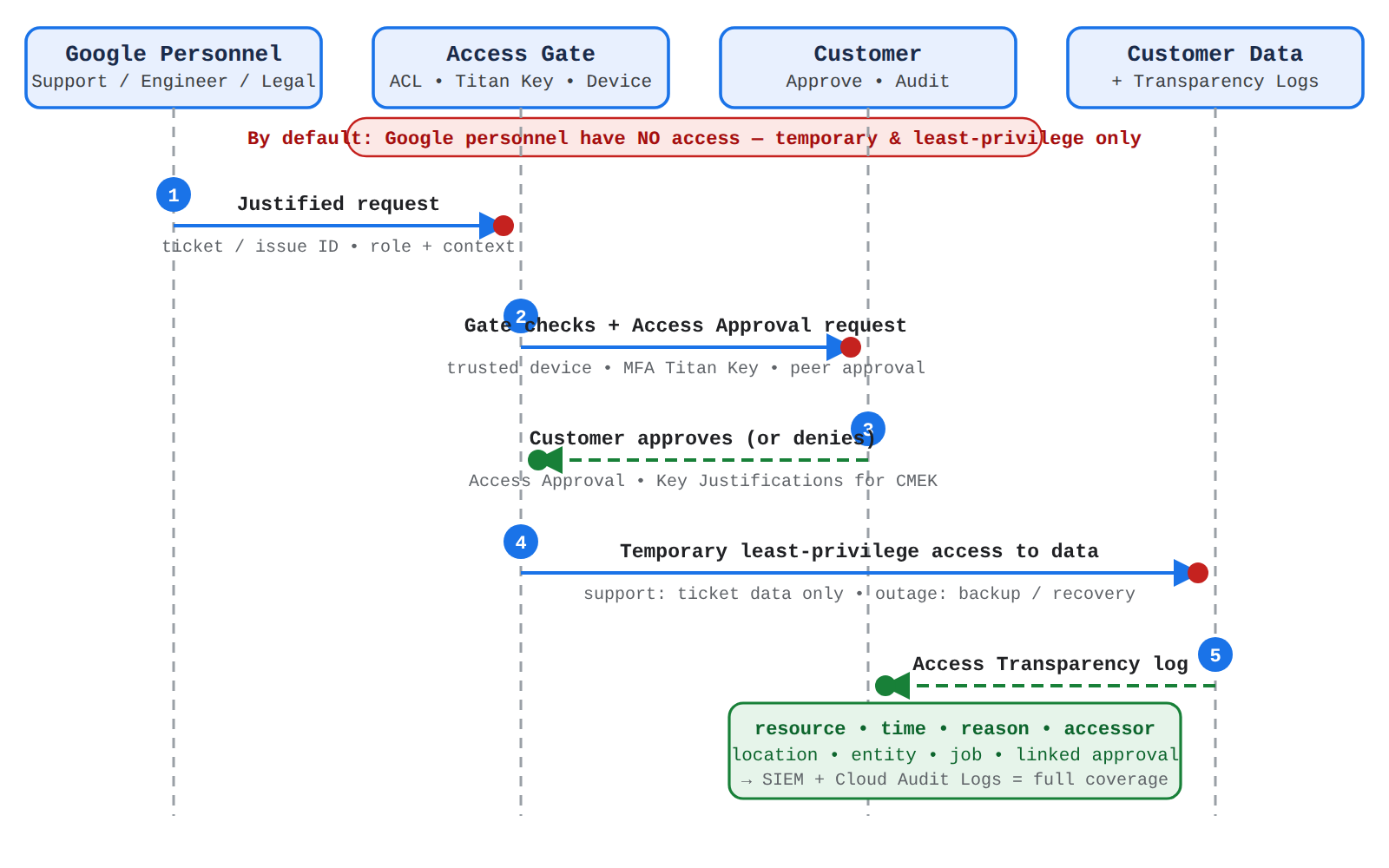
A sequence diagram with four lifelines — Google Personnel, Access Gate, Customer, and Customer Data — showing the ordered steps: justified request, gate checks, Access Approval, temporary access, and Access Transparency logging to SIEM.
Key Access Justifications provides visibility and control over key access requests for customers who use approvals signed with customer-managed encryption keys (CMEK). With customer-managed encryption keys (CMEK), the customer manages its own encryption keys and controls access to them. Together, Access Approval and Key Access Justifications give context for an access request and control over whether access to data and keys is allowed.
Conditions and Reasons for Google Personnel Access
Conditions for Google personnel access are the strict checks that must be met before access to Customer Data is permitted. By default, Google personnel have no access to Customer Data, and any grant is temporary and no greater than necessary. To obtain access, personnel must:
- Be a member of relevant access control lists (ACLs)
- Read and acknowledge Google data access policies regularly
- Use a trusted device
- Sign in with multi-factor authentication (MFA) using a Titan Security Key, which reduces phishing risk
- Provide a justification, such as a support ticket or issue ID, that is evaluated with role and context by access tools
- If required, obtain authorization from another qualified Google employee
- If the customer enrolled in Access Approval, obtain customer approval
Reasons for Google personnel access are the limited business situations that can trigger access after those conditions are met. Support roles have limited access tied to a support ticket, while engineering roles may need broader system privileges for reliability or deployment issues.
| Reason | What triggers it | How access is controlled |
|---|---|---|
| Customer-initiated support | Customer contacts Customer Care | Personnel see only low-sensitivity data related to the ticket, such as a bucket name |
| Outage or tool failure | Service outage or tool failure | Personnel access data for backup or recovery; tools log access and justification; engineers cannot bypass the resource allowlist |
| Third-party legal request | Government or legal request for Customer Data | Rare; only the legal team can create a valid legal justification, reviews requirements and policy, and notifies the customer when permitted |
| Google-initiated review | Security, fraud, abuse, or compliance concern | Rare; used to keep data safe, such as reviewing and removing malware that is exhausting a virtual machine |
Operational Accountability Controls
Operational accountability controls are the privileged access management (opens in a new tab) rules, protections, and oversight that limit what any single Google employee can view or do. Privileged access (opens in a new tab) at Google Cloud follows four guiding principles: access is denied by default and based on roles with multi-party approval, workloads have end-to-end protection, logging and auditing are continuous, and access is transparent with customer controls. End-to-end protection includes encryption in transit, encryption at rest, and Confidential Computing for encryption in use.
Google enforces these principles with infrastructure-wide controls that prevent unauthorized access, continuous detection and remediation, and monitoring with violation alerting. An internal audit team and independent third-party auditors perform regular audits. When a violation is detected, security teams separate from core engineering investigate whether access was intentional, accidental, caused by a bug, or caused by weak controls, then escalate if malicious behavior is suspected and use findings to improve detection.
Suppliers and government requests are handled under the same accountability model. Google assesses third-party suppliers before onboarding, requires security and privacy contract terms, and publishes a list of subprocessors. If Google receives a government request for Customer Data, policy is to direct the government to request the data from the customer and to notify the customer unless prohibited by law, with details published in a Transparency Report.
Compliance frameworks and the shared responsibility model in Google Cloud (opens in a new tab) explain how security work is divided and how protections are proven to meet legal rules. Google Cloud secures the cloud itself and undergoes independent third-party audits, while customers secure what they bring to the cloud, including their data and its use.
A layered stack comparing IaaS and SaaS. Blue layers are Google Cloud's responsibility: hardware, storage, and network in both models, plus OS, middleware, and applications in SaaS. Orange layers are the customer's responsibility: data and its access and usage are always the customer's, and in IaaS the customer owns everything above the infrastructure.
The Shared Responsibility Model
The shared responsibility (opens in a new tab) model is the division of security duties between Google Cloud and the customer. The general rule is that customers secure what they bring to the cloud, while Google Cloud protects the cloud itself. Customers are always responsible for their data, while Google Cloud is responsible for the underlying infrastructure.
The exact split changes with the service type because Google Cloud manages more of the stack as services become more complete:
| Service model | Google Cloud responsibility | Customer responsibility |
|---|---|---|
| Infrastructure as a service (IaaS) | Hardware, storage, and network | Everything above that stack, including data, applications, and access |
| Software as a service (SaaS) | Security of everything except data and its access and usage | Data and its access and usage |
Exam tip: In IaaS only hardware, storage, and network are Google Cloud's responsibility, while in SaaS everything except data and its access and usage is Google Cloud's responsibility — the customer is always responsible for the data.
Independent Audits and Global Certifications
Independent verification is how Google Cloud proves that its security, privacy, and compliance controls work as stated. Google Cloud regularly undergoes independent verification and receives certifications, attestations, and audit reports to demonstrate compliance. These audits include specific controls for customer data privacy that help keep customer data secure.
Key international standards and reports include:
- ISO/IEC 27001 for Information Security Management
- ISO/IEC 27017 for Cloud Security
- ISO/IEC 27018 for Cloud Privacy
- ISO/IEC 27701 for Privacy
- SOC 2 and SOC 3 reports, which are available to customers
Regional, Industry, and Workload Requirements
Regional and industry frameworks (opens in a new tab) are how Google Cloud supports customers with specific government or sector rules. Google Cloud participates in country and sector frameworks, including FedRAMP for the United States government, BSI C5 for Germany, and MTCS for Singapore. Where formal certifications are not required, Google Cloud provides resource documents and mappings to help customers assess controls.
For regulated workloads, Assured Workloads helps implement regulatory requirements in Google Cloud for industries such as finance (opens in a new tab), government, healthcare, and education. Assured Workloads provides a workflow to create and monitor control packages for needs such as dedicated regional support or programs like FedRAMP, ITAR, and Sovereign Controls for EU. Certifications obtained by a Google Cloud service also apply to Google models included in that service unless explicitly documented otherwise, and privileged access (opens in a new tab) controls are part of the audited environment. The complete listing of offerings is published in the Compliance resource center.
Google Cloud's core trust principles are commitments that put customer control first: customers own their data, Google uses that data only to deliver contracted services, and access is restricted, justified, and transparent. Protection of customer data is a primary design consideration for Google Cloud (opens in a new tab) infrastructure, products, and operations. Strong contractual commitments help customers maintain control over their data and how it is processed.
Customer Ownership and Limited Use of Data
Customer ownership means that customer data stored on Google Cloud belongs completely to the customer, not to Google. Google does not use customer data for advertising or for any purpose other than delivering Google Cloud services. This commitment lets customers focus on business and innovation while Google invests in security at a scale few on-premises teams can match. Customers run on the same infrastructure as Search, YouTube, and Gmail, so they benefit directly from those security controls and practices.
Restricted Access by Google Personnel
Restricted access (opens in a new tab) means that by default, Google personnel have no access to Google Cloud customer data. Access that does occur is called privileged access and is granted only temporarily to fulfill a contracted service. Google Cloud enforces least privilege, so access is denied by default and any grant is no greater than absolutely necessary, with role-based limits and multi-party approval making single-person access without checks extremely difficult.
Google personnel access customer data only in limited cases:
- Customer-initiated support, such as viewing low-sensitivity details like a bucket name for a support ticket
- Outage or tool failure, where engineers use logged tools for backup or recovery
- Third-party legal requests, which are rare and only the legal team can justify
- Google-initiated reviews, which are also rare and address safety concerns such as security, fraud, abuse, or compliance audits
To obtain access, personnel must meet strict conditions that connect identity to justification, including membership in access control lists (ACLs), use of a trusted device, sign-in with multi-factor authentication (MFA) using a Titan Security Key, and evaluation of the ticket, role, and context by access tools.
Government Requests and Transparency
Google Cloud's approach to government requests is that governments must follow a strict legal process and do not receive direct or standing access to customer data. When Google receives a request, a dedicated team reviews it to confirm it satisfies legal requirements and Google policies. Generally, Google complies only when the request is made in writing, is issued under an appropriate law, and is signed by an authorized official of the requesting agency.
Transparency flows from Google to the customer and to the public. Google policy is to direct the government to request customer data directly from the customer and to notify the customer unless specifically prohibited by law or court order. Google was the first company to regularly publish reports about government data requests, with details available in its Transparency Report.
Exam tip: Google never uses customer data for advertising, and government access requires a written, lawful, signed request — there is no direct government backdoor.
Customer Visibility and Control Tools
Customer visibility means customers can audit and control Google administrative access to their own data. Access Transparency logs show what Google personnel did, while Cloud Audit Logs show what members of the customer's own organization did in Google Cloud resources. When used together, the two logs provide complete audit coverage of both customer actions and Google administrative access. Access Approval (opens in a new tab) adds control by letting customers approve or deny an access request by Google personnel before access to certain datasets is permitted.
| Log type | Who is recorded | What it shows |
|---|---|---|
| Cloud Audit Logs | Members of the customer organization | Actions the customer team took in its own Google Cloud resources |
| Access Transparency | Authorized Google personnel | Actions Google took on customer data, with resource, time, justification, and accessor details |
Customers can further limit Google access with encryption controls tied to the shared responsibility (opens in a new tab) model. With customer-managed encryption keys (CMEK), customers manage their own keys and control access to them, including using keys stored outside Google infrastructure. This separation of stored data from encryption keys means customers remain the arbiter of who can decrypt their data.
Key Facts
- Access Transparency logs record actions by Google personnel on Customer Data, while Cloud Audit Logs record actions by members of the customer's own Google Cloud organization.
- Access Approval lets customers approve or deny Google personnel requests to access Customer Data, and approved requests are linked to Access Transparency logs.
- Customers always remain responsible for their data, while Google Cloud is responsible for hardware, storage, and network in infrastructure as a service (IaaS) and for everything except data and its access and usage in software as a service (SaaS).
- Google does not use customer data for advertising and provides no direct government backdoor; government requests must be written, lawful, and signed, with customer notification unless prohibited by law.
- Google Cloud proves its controls through independent audits including ISO/IEC 27001, 27017, 27018, 27701 and SOC 2 and SOC 3, plus frameworks such as FedRAMP, BSI C5, and MTCS.
Frequently Asked Questions
What is the difference between Access Transparency logs and Cloud Audit Logs in Google Cloud?
Access Transparency logs record actions taken by Google personnel on Customer Data, including the affected resource and action, the time, the reason, and accessor details such as location, employing entity, and job category. Cloud Audit Logs record actions taken by members of your own Google Cloud organization in your resources. When used together, they provide audit coverage of both customer actions and Google administrative access.
How does Access Approval in Google Cloud control Google personnel access to Customer Data?
Access Approval lets customers approve or deny requests from Google personnel to access Customer Data, and enrolled customers must grant approval before Google personnel can access covered resources. Approved access requests are logged with Access Transparency logs that are linked to the approval request, so the approval and the resulting action stay connected.
How does Google Cloud handle government requests for Customer Data?
Google Cloud does not provide governments with direct or standing access to Customer Data and generally complies only when a request is made in writing, issued under an appropriate law, and signed by an authorized official. Policy is to direct the government to request the data from the customer and to notify the customer unless prohibited by law or court order, with details published in a Transparency Report.
Sample Question
A healthcare enterprise plans to migrate sensitive patient records to Google Cloud. The organization must adhere to strict regional compliance standards and ensure that access to protected health information is tightly controlled.
Under Google Cloud's shared responsibility model, which statement correctly describes the division of responsibilities between Google Cloud and the customer?
Google Cloud secures the underlying infrastructure and enforces platform controls, while the customer classifies their data and configures identity and access policies.
Google Cloud automatically creates and assigns internal user IAM roles, while the customer manages physical server hardware and data center security.
The customer is solely responsible for maintaining hypervisor firmware and network hardware, while Google Cloud decides which business data is sensitive.
Google Cloud assumes full legal and regulatory liability for customer data privacy, removing the customer's need to implement access controls.
How learners score on this domain
Last updated