Fundamental
Prepare and test your skills

Fundamental
Prepare and test your skills
Google Cloud Trust Principles for Data Protection
Google Cloud trust principles are commitments that shape how Google protects infrastructure while customers keep control of their data. These principles support secure data management through a clear responsibility boundary, transparent access controls, limited privileged access, and independently verified compliance. Under this model, the customer is always responsible for securing its data, while Google secures the underlying infrastructure.
Shared Responsibility Boundary and Shared Fate Partnership
The shared responsibility model (opens in a new tab) is the trust boundary that divides security duties between Google Cloud and the customer. In general, the customer secures what it brings to the cloud, and Google protects the cloud itself. The exact split changes by service type, and Google Cloud's shared fate approach treats security as an ongoing partnership with secure landing zones and blueprints to help customers start securely.
| Service model | Google Cloud responsibility | Customer responsibility |
|---|---|---|
| Infrastructure as a service (IaaS) | Hardware, storage, and network | Everything else, including the customer's data and workloads |
| Software as a service (SaaS) | Security of everything except the data and its access and usage | The data and its access and usage |
This boundary tells an organization which controls it must configure, such as access and usage rules, and which controls Google already provides. When workloads span multiple service types, the customer must apply the correct split to each part.
Transparency and Customer Control Over Data Access
Transparency and customer control are trust controls that let organizations see and approve privileged access to their data. Access Transparency (opens in a new tab) logs administrative access by Google authorized personnel when they support an organization or maintain service availability. Access Approval lets a customer approve or deny access requests by Google personnel to certain datasets before access happens.
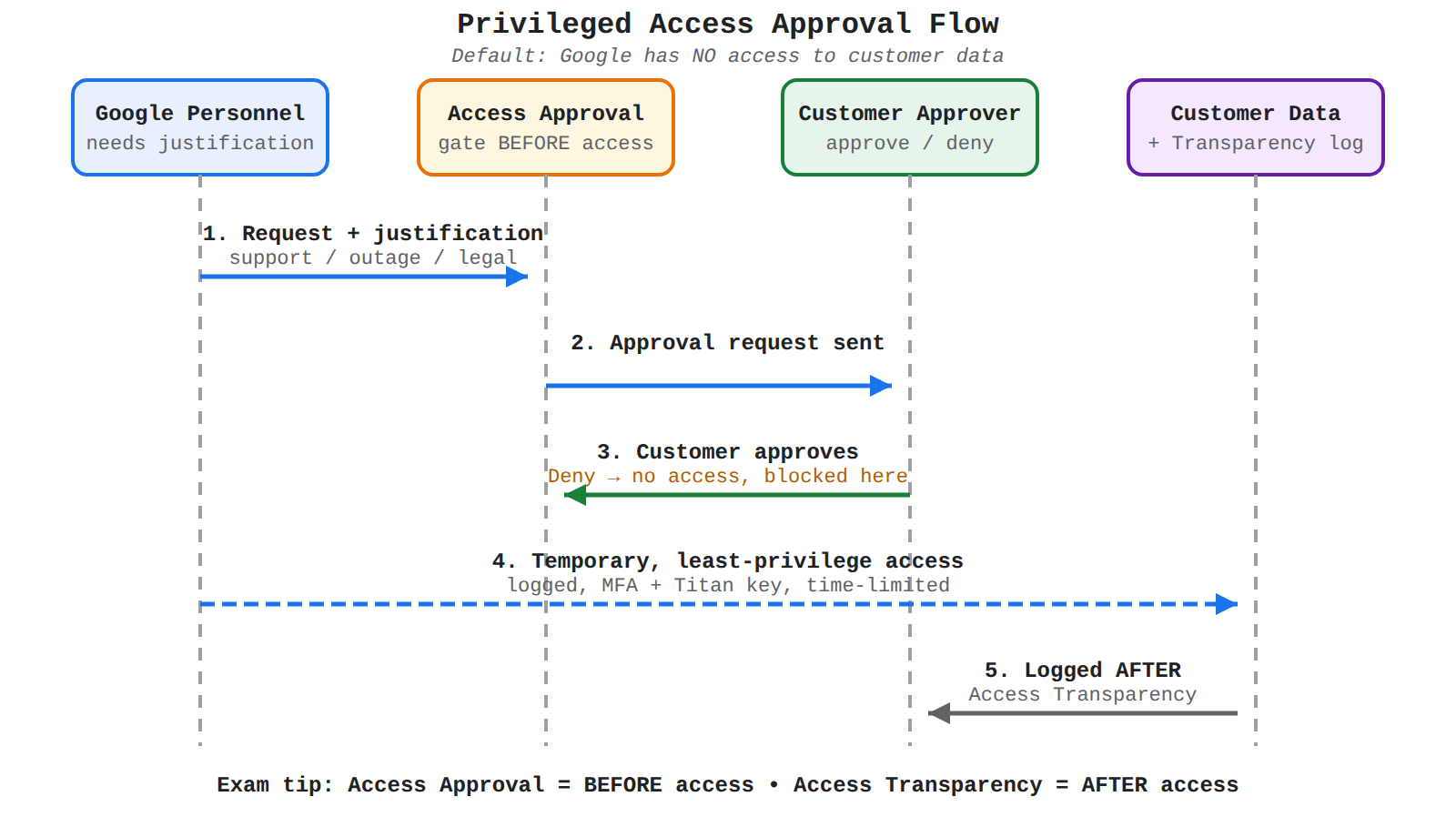
A sequence diagram with Google Personnel, Access Approval, Customer Approver, and Customer Data lifelines showing request, approval, temporary access, and logging in order.
Customers also control encryption and confidential processing. Customer-managed encryption keys (CMEK) let a customer manage its own encryption keys and control access to them. Key Access Justifications provides a justification every time externally hosted keys are used to decrypt data, and it requires Cloud KMS with Cloud HSM or Cloud KMS with Cloud EKM. Confidential Computing encrypts data in use through services such as Confidential VM, Confidential Google Kubernetes Engine (GKE) Nodes, Confidential Dataflow, Confidential Managed Service for Apache Spark, and Confidential Space, which reduces the trust boundary so fewer resources can access confidential data.
Exam tip: Access Transparency logs privileged access by Google personnel after it occurs, while Access Approval lets you approve or deny that access before it happens for supported datasets.
Least Privilege Controls for Google Personnel
Least privilege means Google personnel have no access to customer data by default, and any granted access is temporary, role-based, and no greater than necessary. To obtain access, Google personnel must be on relevant access control lists (ACLs), acknowledge data access policies, use a trusted device, sign in with multi-factor authentication using a Titan Security Key, provide a valid justification, and, if required, obtain approval from another qualified Google person or from the customer. All access is logged and audited continuously, and threat detection systems alert security teams when log entries match threat indicators.
Privileged access (opens in a new tab) by Google personnel is allowed only for specific reasons, including customer-initiated support, outage or tool failure recovery, third-party legal requests, and rare Google-initiated reviews for security, fraud, abuse, or compliance audits. For third-party legal requests, only the legal team can generate a valid legal access justification, and Google reviews the request to ensure it meets legal requirements and policies. Google publishes a Transparency Report and notifies customers unless prohibited by law or court order.
Compliance Programs and Regulatory Support
Compliance programs (opens in a new tab) are independent verifications that prove Google Cloud security, privacy, and compliance controls meet required standards. Key international standards include ISO/IEC 27001 for information security management, ISO/IEC 27017 for cloud security, ISO/IEC 27018 for cloud privacy, and ISO/IEC 27701 for privacy. SOC 2 and SOC 3 reports are available to customers, and Google Cloud also participates in sector and country-specific frameworks such as FedRAMP for the US government, BSI C5 for Germany, and MTCS for Singapore.
Assured Workloads helps organizations implement regulatory requirements by selecting a compliance regime and creating and monitoring control packages, including dedicated regional support, certified programs like FedRAMP or ITAR, and Sovereign Controls for EU. Certifications that a Google Cloud service obtains also apply to Google models included in that service unless explicitly documented otherwise. Before onboarding a third-party supplier, Google assesses its security and privacy practices and requires appropriate contract terms, and Google maintains cyber and privacy liability insurance for events such as unauthorized access and failure to protect confidential information.
A typical compliance journey follows three stages in order:
- Assessment: Review all regulatory obligations and how the business implements them.
- Gap remediation: Automate implementation of compliance requirements using Google Cloud capabilities and blueprints.
- Continual monitoring: Monitor compliance as regulations, markets, and business needs change.
Data Governance, Sovereignty, and Privacy Controls
Data governance features help organizations manage data sovereignty and privacy in Google Cloud. Organizations can control data residency, classify confidential data, lock down access to sensitive data, and manage operational sovereignty and software sovereignty. Privacy regulations define how organizations can obtain, process, store, and manage user data, and the customer owns its data, including data received from users.
Google infrastructure security (opens in a new tab) does not include using customer data for advertising or for any purpose other than delivering Google Cloud services. Many privacy controls, such as cookies, session management, and obtaining user permission, remain the customer's responsibility. Contractual commitments such as the Cloud Data Processing Addendum (CDPA) describe data processing and security commitments and access controls that limit Google support engineers' access to customer environments.
Google Cloud's trust principles are security, privacy, transparency, and compliance working together to protect and manage organizational data. These four principles guide responsible cloud operations by combining strong technology, clear ownership, visible access, and independently verified controls. Together, they give organizations confidence that data is protected by both Google and customer safeguards.
Division of Duties in the Shared Cloud Model
The shared responsibility model (opens in a new tab) is the division of security duties between Google and the customer. The customer is always responsible for securing their data and controlling its access and usage, while Google is responsible for securing the underlying infrastructure. This boundary means Google secures physical hardware, storage, and networks, while the customer secures content, configurations, and identities.
| Service model | Google responsibility | Customer responsibility |
|---|---|---|
| Infrastructure as a service (IaaS) | Hardware, storage, and network | Data, applications, operating systems, and access controls above that layer |
| Software as a service (SaaS) | Security of everything except data and its access and usage | Data and its access and usage |
The exact split shifts as services become more fully managed, because Google manages more of the stack. When a workload uses multiple service types, controls overlap across them. For example, an organization might run virtual machines on Compute Engine, use Google Workspace for email, and analyze data in BigQuery, with a different responsibility split in each service.
Security by Design at Scale
Security by design (opens in a new tab) means security shapes Google culture, hiring, training, data center design, and daily operations. Google operates its own services, such as Search, YouTube, and Gmail, on the same infrastructure that customers use, so customers directly benefit from the same security controls and practices. Large-scale operations and collaboration with the security research community help Google address vulnerabilities quickly and often prevent them entirely. This scale of investment in people, technology, and processes is intended to deliver better security than many on-premises approaches.
Privacy Ownership and Default Denial of Access
Privacy in Google Cloud means customer data belongs to the customer and is used only to deliver Google Cloud services. Google does not use customer data for advertising or for any purpose other than delivering the contracted services. By default, Google personnel have no access to customer data, and any privileged access must have an active, valid business justification, such as resolving a customer support ticket or recovering from an outage.
Privileged access is further limited by strict internal controls that enforce least privilege and accountability:
- Access is denied by default and, when granted, is temporary and no greater than necessary for the role.
- Singular access without another individual involved is made extremely difficult through role-based restrictions and multi-party approval.
- All access must be justified, logged, and continuously monitored, with real-time auditing that alerts security teams to anomalous activity.
- Customers keep control through tools such as customer-managed encryption keys (CMEK), which let customers manage their own keys, and Access Approval, which lets customers approve or deny Google personnel requests to access certain datasets.
Transparency for Administrative and Government Access
Transparency in operations (opens in a new tab) means customers can see when and why their data is accessed, including access by Google personnel and requests from public authorities. Access Transparency provides logs of privileged access by Google personnel with the logged business justification, so data flows from the Google administrator action to a visible log in the customer's project. For third-party suppliers that support services such as customer support, Google assesses their security and privacy practices before onboarding and requires appropriate security, confidentiality, and privacy contract terms.
For government requests, Google reviews each request to confirm it is in writing, issued under appropriate law, and signed by an authorized official before complying. Google was the first company to regularly publish reports about government data requests in its Transparency Report. Its policy is to notify the customer about a request for their data unless notification is specifically prohibited by law or court order.
Exam tip: The customer is always responsible for their data and its access and usage, even in SaaS where Google secures everything else.
Independent Verification for Compliance Confidence
Independent verification (opens in a new tab) demonstrates compliance through regular third-party checks of security, privacy, and compliance controls, resulting in certifications, attestations, and audit reports. These verifications confirm that Google's controls meet international, regional, and industry requirements, which helps customers in regulated industries such as finance, government, healthcare, and education. Assured Workloads builds on Google Cloud controls to help customers implement regulatory requirements with compliant configurations.
Key standards and frameworks that Google Cloud is audited against include:
- ISO/IEC 27001 for information security management
- ISO/IEC 27017 for cloud security
- ISO/IEC 27018 for cloud privacy
- ISO/IEC 27701 for privacy information management
- SOC 2 and SOC 3 reports for operational controls
- FedRAMP for the United States government, BSI C5 for Germany, and MTCS for Singapore
Certifications obtained by a Google Cloud service also apply to the Google models included in that service, unless explicitly documented otherwise. A complete listing is maintained in the Compliance resource center, and Google maintains cyber and privacy liability insurance for risks such as unauthorized network access, failure to protect confidential information, and forensic investigation costs.
The shared responsibility partnership describes which security tasks belong to the customer and which belong to Google Cloud. Google Cloud's trust principles commit to protecting the privacy of customer data as part of secure, transparent, and compliant cloud operations. Responsibilities are not fixed: they change by workload type, by industry and regulatory framework, and by location.
What Customers Must Secure and Configure
Customer responsibilities center on securing data and applications, configuring access control, and managing security services. The customer is the expert on its own security and regulatory requirements and on how its confidential data and resources must be protected. To decide which controls to implement, the customer must consider its regulatory compliance obligations, its organization's security standards and risk management plan, and the security requirements of its customers and vendors.
As a user of any public cloud, the customer is responsible for the following areas:
- Understand which portions of its data have different compliance and security requirements, and place sensitive or regulated data with specific access or residency requirements inside appropriate Assured Workloads folders or projects and keep it there.
- Configure Identity and Access Management (IAM) so that the contents of the organization are accessed and modified only by appropriate personnel.
- Create and organize the organizational hierarchy so that it does not expose personal data.
- Read and follow best practices.
- Share information prudently during technical support and troubleshooting, and do not place or share sensitive or regulated data outside compliant Assured Workloads folders.
Sensitive or regulated data can include account information, health information, personal identifiers for customers or users, cardholder data, and ID numbers. The customer should also avoid placing such data in common fields that may not be protected by technical controls, such as resource names and IDs, project or folder names and IDs, description fields or labels, log-based metrics, VM sizes and similar service configurations, URIs or file paths, timestamps, user IDs, firewall rules, security scanning configurations, and customer IAM policies.
What Google Cloud Secures and Enforces
Google Cloud responsibilities center on securing the underlying infrastructure, including physical security and network security. In the shared partnership, Google Cloud applies default encryption and infrastructure controls and enforces the IAM policies that the customer sets to restrict workload administration and data access. Google Cloud also configures and enforces any customer-selected Assured Workloads controls for the protected data types in the resources the customer has configured, including restrictions on where data is stored and which Google employees can access data during appropriate business activities.
Google Cloud provides the tools customers use to enforce policy at scale. These tools include configurations and controls through Assured Workloads (opens in a new tab) for regulated industries and locationally sensitive data, Organization policies and resource settings that let the customer configure policies throughout its hierarchy of folders and projects, and Policy Intelligence tools that give insights on access to accounts and resources.
How IaaS, PaaS, and SaaS Change the Split
The service category split (opens in a new tab) changes how much security work belongs to the customer and how much belongs to Google Cloud. As services move from infrastructure to platform to software, Google manages more of the stack and owns more security duties, while the customer always keeps responsibility for data and access.
| Cloud service | Examples | What it provides | Responsibility split |
|---|---|---|---|
| Infrastructure as a service (IaaS) | Compute Engine, Cloud Storage, Cloud VPN, Cloud Load Balancing, Cloud DNS | Compute, storage, and network services on demand with pay-as-you-go pricing | The bulk of security responsibilities are the customer's; Google Cloud focuses on the underlying infrastructure and physical security. |
| Platform as a service (PaaS) | App Engine, Google Kubernetes Engine (GKE), BigQuery | A runtime environment for developing and running applications | Google Cloud is responsible for more controls than in IaaS; application-level controls and IAM management are shared; the customer remains responsible for data security and client protection. |
| Software as a service (SaaS) | Google Workspace, Google Security Operations, third-party SaaS in Google Cloud Marketplace | Online applications that customers subscribe to or pay for | Google Cloud owns the bulk of security responsibilities; the customer remains responsible for access controls and the data it chooses to store in the application. |
Exam tip: In IaaS, the customer carries the bulk of security responsibilities; in SaaS, Google Cloud owns the bulk. The customer always remains responsible for access controls and the data it chooses to store.
Enforcing Policy with Hierarchy and IAM
Policy enforcement depends on the resource hierarchy and Identity and Access Management (IAM). The Organization resource is the apex of the hierarchy; all resources that belong to an organization are grouped under the organization node. An Organization can contain one or more folders, and each folder can contain one or more projects. Projects contain service resources such as Compute Engine virtual machines (VMs), Pub/Sub topics, Cloud Storage buckets, Cloud VPN endpoints, and other Google Cloud services.
IAM lets the customer grant granular access to Google Cloud resources. The access model has four core concepts:
- Principal: A Google Account for end users, a service account for Google Cloud products, a Google Group, or a Google Workspace or Cloud Identity account that can access a resource. Principals cannot perform any action they are not permitted to do.
- Role: A collection of permissions.
- Permission: Determines what operations are allowed on a resource. Granting a role to a principal grants all permissions in that role.
- IAM allow policy: Binds a set of principals to a role. To define which principals have access to a resource, the customer creates a policy and attaches it to the resource.
The customer configures IAM policies, and Google Cloud enforces them. Organization policies and resource settings let the customer configure policies throughout the hierarchy of folders and projects, while Policy Intelligence tools provide insights on access to accounts and resources.
When Google Personnel May Access Data
Google Cloud is designed to automate, minimize, or eliminate the need for Google personnel to access customer data, but some cases still require access. These cases include customer-initiated support, outage or tool failure, third-party legal requests, and Google-initiated reviews. For customer-initiated support, Customer Care personnel only obtain access to low-sensitive data, such as a bucket name if the customer lost access to a bucket. During outages or tool failures, Google personnel can access customer data to perform backup or recovery, and they cannot bypass the allowlist for the resource, but they can access the data without customer approval.
Privileged access controls (opens in a new tab) govern these cases with infrastructure-wide controls, continuous detection and remediation of unauthorized access, and monitoring, violation alerting, and regular audits by an internal audit team and independent third-party auditors. Third-party legal requests are rare, and only the legal team can generate a valid legal access justification; the legal team reviews the request, notifies the customer when legally permitted, and considers objections to the extent the law allows. Google-initiated reviews are also rare and occur for security concerns, fraud, abuse, or compliance audits. Google also requires strong authentication for all access, and jobs in production use cryptographic credentials to prove identity when making requests to other services.
Shared Fate Partnership and Location-Based Controls
Shared fate goes beyond shared responsibility by treating the provider-customer relationship as an ongoing partnership to improve security. Shared fate includes building and operating a trusted cloud platform, providing best practice guidance and secured, attested infrastructure code, releasing solutions that combine Google Cloud services, and offering insurance options to help measure and mitigate risk. The Risk Protection Program is a collaboration between Google Cloud and Munich Re and Allianz Global and Corporate Specialty, and its Cyber Insurance Hub provides data-driven insights that customers can share with insurance partners to obtain a quote.
Location can add responsibilities for both sides. If a business has customers in the European Union, it might need to follow the General Data Protection Regulation (GDPR) and keep customer data in the EU; the customer is responsible for ensuring that collected data remains in Google Cloud regions in the EU. Google Cloud provides Assured Workloads for EU Regions or Sovereign Controls for EU, which add controls on top of GDPR assurances, including an EU data boundary, support routing to EU persons in EU locations including subprocessors, visibility into administrative access requests and accesses, policy-driven access approvals for Sovereign Controls only, and custom options for data encryption and key management. Sovereign Controls by Partners (opens in a new tab) is available in certain countries and helps enforce data residency requirements.
Key Facts
- The customer is always responsible for securing its data and controlling its access and usage, while Google Cloud is responsible for securing the underlying infrastructure.
- Access Transparency logs privileged access by Google personnel, while Access Approval lets customers approve or deny that access before it happens for supported datasets.
- In IaaS the customer carries the bulk of security responsibilities, while in SaaS Google Cloud owns the bulk, but the customer always keeps responsibility for access controls and stored data.
- Assured Workloads helps organizations implement regulatory requirements by selecting a compliance regime and creating and monitoring control packages for residency and access.
- The resource hierarchy flows from Organization to folders to projects to service resources, and IAM allow policies bind principals to roles to grant permissions that Google Cloud enforces.
Frequently Asked Questions
What is the difference between Access Transparency and Access Approval in Google Cloud?
Access Transparency logs privileged access by Google authorized personnel after it occurs when they support an organization or maintain service availability, while Access Approval lets a customer approve or deny access requests by Google personnel before access happens for supported datasets. Together they let organizations see and control privileged access to their data.
How does the shared responsibility model in Google Cloud differ for Infrastructure as a Service (IaaS) versus Software as a Service (SaaS)?
In Infrastructure as a Service (IaaS) Google Cloud is responsible for hardware, storage, and network while the customer carries the bulk of other responsibilities including data and workloads, whereas in Software as a Service (SaaS) Google Cloud secures everything except the data and its access and usage. In both models the customer is always responsible for securing its data and controlling its access and usage.
What is Assured Workloads in Google Cloud and how does it support regulatory compliance?
Assured Workloads helps organizations implement regulatory requirements by selecting a compliance regime and creating and monitoring control packages. It provides controls including dedicated regional support, certified programs like FedRAMP or ITAR, and Sovereign Controls for EU to enforce data residency and access restrictions for sensitive or regulated data.
How learners score on this domain
Last updated