Fundamental
Prepare and test your skills

Fundamental
Prepare and test your skills
Enforcing US Data Residency With Location Policies
Free sample question with answers and detailed explanation below. The Cloud Digital Leader practice bank has an additional 3,070 practice questions.Try 10 free realistic questions: instant score, no credit card, and no account required.
A healthcare organization must comply with strict national data residency laws for its cloud workloads. The leadership team has established the following governance requirements:
- Geographic restriction: All new compute and storage resources must be deployed exclusively within approved United States regions.
- Proactive enforcement: Project teams must be automatically prevented from creating new resources in unauthorized geographic locations.
Which Google Cloud governance mechanism should the organization implement to meet these requirements?
Explanations
Enable the Organization Policy Service resource locations constraint to automatically migrate deployed resources into approved United States regions
Enable the Organization Policy Service resource locations constraint to automatically migrate deployed resources into approved United States regions
What Resource Location Constraint Enforcement Does to Existing Resources
When an administrator configures and enforces the resource locations constraint (constraints/gcp.resourceLocations) in the Organization Policy Service, the policy establishes rules governing future resource provisioning. However, the Organization Policy Service is a preventative governance mechanism, not an automated data migration or infrastructure relocation tool.
Why It Doesn't Meet the Requirements
- No automated migration: Enabling the resource locations constraint does not move, modify, or delete resources that were already deployed in unauthorized regions prior to the policy taking effect.
- Forward-looking enforcement only: The constraint only evaluates new resource creation requests. Any existing compute instances or storage buckets in non-compliant regions will continue to exist and operate in their original locations until administrators manually migrate or decommission them.
Key Characteristics and Limitations
- Applies only to newly created resources: Once defined, location restrictions strictly govern resources provisioned after the policy is set.
- Non-disruptive to existing workloads: Pre-existing resources continue to function normally so that applying a new policy does not unexpectedly destroy active production infrastructure.
- Gradual rollout recommendation: Because policies can block services from creating new dependent resources in restricted regions, organizations should test policies in non-production folders or projects before broad enforcement.
This Answer Would Be Correct If
The organization already had data stored in unauthorized regions and used a dedicated data movement tool, such as Storage Transfer Service, to actively transfer objects into compliant regional buckets.
Additional Context
A common misconception among cloud beginners is assuming that applying an organization policy retroactively remediates or relocates non-compliant resources. To maintain strict data residency, organizations should apply gcp.resourceLocations constraints before teams begin deploying workloads.
Configure the Organization Policy Service with the restrict service usage constraint to define which geographic regions can host resources
Configure the Organization Policy Service with the restrict service usage constraint to define which geographic regions can host resources
What the Restrict Service Usage Constraint Does
The restrict service usage constraint (constraints/gcp.restrictServiceUsage) is a managed rule within the Organization Policy Service that governs which Google Cloud products and API endpoints can be used within an organization, folder, or project. It operates by restricting runtime access to service resources based on an allowed or denied list of service APIs (such as compute.googleapis.com or storage.googleapis.com).
Why It Doesn't Meet the Requirements
- Geographic restriction: This constraint evaluates the type of service being called rather than the physical location where a resource is being deployed. It cannot distinguish between a resource created in a United States region and one created in Europe or Asia.
- Proactive enforcement of residency: While it can block an entire unapproved service from being used, any service included on the allowed list can still be deployed in any global region unless a separate location constraint is applied.
Key Characteristics and Limitations
- API-level control: It controls access to specific Google Cloud product APIs and endpoints across the resource hierarchy.
- No location awareness: It does not inspect the
locationproperty of a resource during provisioning. - Complementary compliance role: In regulated boundary configurations, it is used alongside location constraints to ensure teams only use services that support compliance requirements.
This Answer Would Be Correct If
The organization needed to prevent project teams from enabling or using specific Google Cloud products or APIs that have not been approved by the security or compliance team.
Additional Context
A common misconception is confusing gcp.restrictServiceUsage with gcp.resourceLocations because both constraints are applied together by default in compliance control packages like Assured Workloads. In practice, gcp.restrictServiceUsage restricts which services can be used, whereas gcp.resourceLocations restricts where those services can create resources.
Configure the Organization Policy Service with the resource locations constraint to allow resource creation only in approved United States regions
Configure the Organization Policy Service with the resource locations constraint to allow resource creation only in approved United States regions
What the Organization Policy Service Resource Locations Constraint Is
The Organization Policy Service gives administrators centralized, programmatic control over their organization's cloud resources. Within this service, the resource locations constraint (constraints/gcp.resourceLocations) is a governance control designed to limit the physical geographic locations where new Google Cloud resources can be deployed and maintained. For supported data-containing services, restricting the resource location also governs where the underlying data is stored.
How It Meets the Requirements
- Geographic restriction: Administrators can configure the
gcp.resourceLocationsconstraint using an allowed values list (allowed_values) containing specific United States regions (such asus-central1orus-east4) or a curated value group likein:us-locations. - Proactive enforcement: Once the policy is enforced at the organization, folder, or project level, Google Cloud automatically evaluates creation requests against the policy rules and blocks project teams from provisioning new resources in any unauthorized region, multi-region, or zone.
US-Only Enforcement via Resource Locations
Process Flow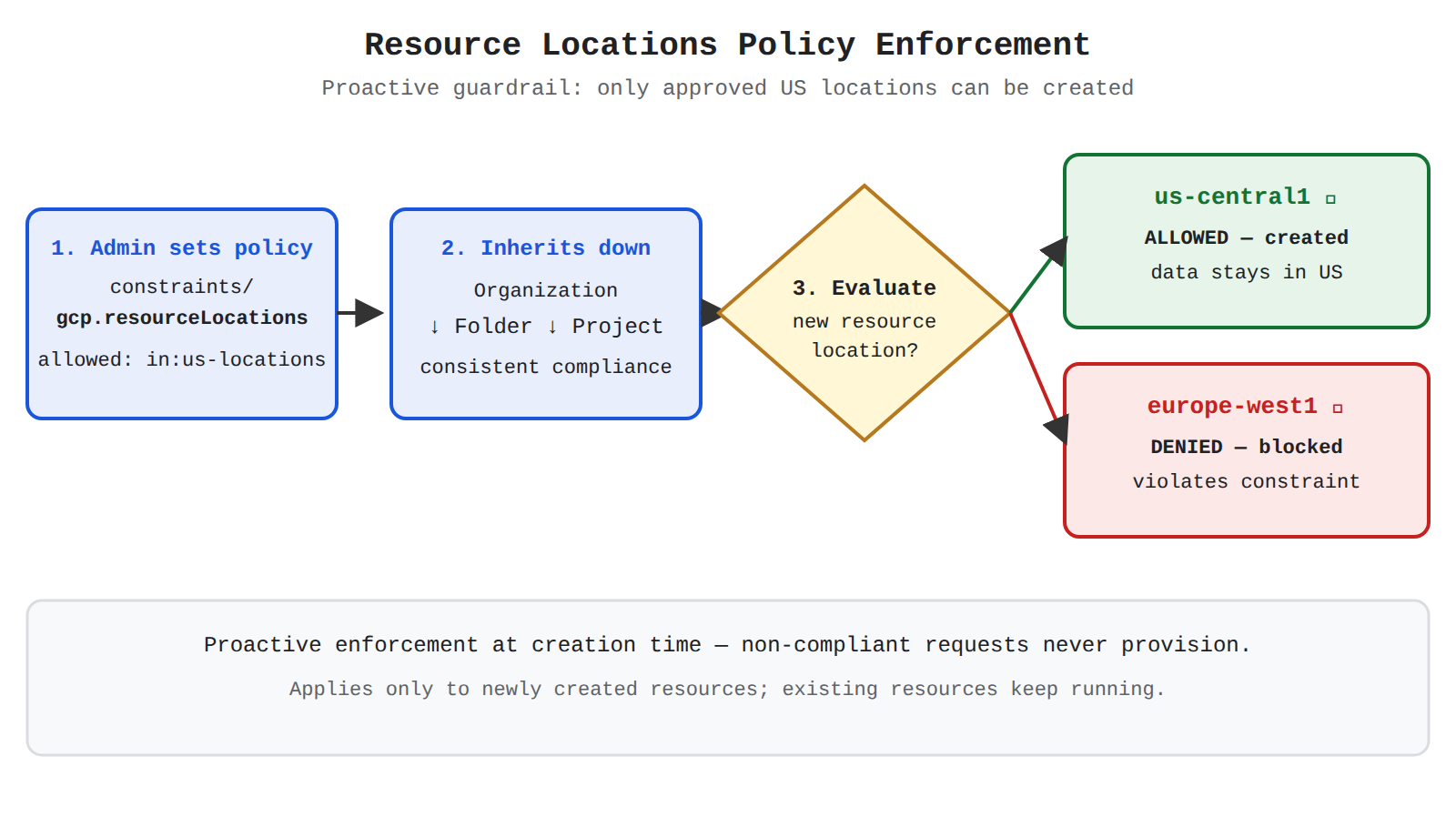
Key Capabilities and Advantages
- Hierarchical inheritance: Policies applied at the organization or folder node automatically flow down to child projects via policy inheritance, ensuring consistent compliance across teams.
- Curated value groups: Using prefixes such as
in:us-locationsallows organizations to define broad geographic boundaries that automatically include current and future regions within that jurisdiction. - Granular location support: Administrators can specify constraints at the multi-region, region, or individual zone level depending on their compliance requirements.
- Defense-in-depth: It serves as a foundational guardrail in regulated environments, such as US Data Boundary workloads, preventing accidental data residency violations before resources are ever created.
Why This Is Optimal
Unlike manual audits or reactive cleanup scripts, enforcing the resource locations constraint through the Organization Policy Service provides preventative, automated governance at the platform layer. It directly blocks non-compliant deployments at the time of creation without requiring manual intervention for every project.
Create a custom organization policy constraint for AI zones to restrict all compute and storage deployments to United States regions
Create a custom organization policy constraint for AI zones to restrict all compute and storage deployments to United States regions
What a Custom Constraint for AI Zones Is
In Google Cloud, AI zones are specialized zonal locations (identified by the -ai string in their name, such as us-west4-ai2b) tailored specifically for artificial intelligence and machine learning workloads. Administrators can create a custom organization policy constraint to explicitly allow or deny the creation of virtual machine (VM) instances within these specialized AI zones.
Why It Doesn't Meet the Requirements
- Geographic restriction across resource types: A custom constraint targeting AI zones only evaluates Compute Engine VM instances and does not apply to other resource types, such as persistent disks, Cloud Storage buckets, or databases.
- Proactive enforcement for general regions: Standard regional and multi-regional deployments do not use the
-aizone naming convention, meaning this custom condition would not properly govern general-purpose United States regions or storage services.
Key Characteristics and Limitations
- VM-only scope: The custom constraint for AI zones applies strictly to VM creation and cannot restrict storage resources or other managed services.
- No value group support: Custom organization policy conditions only evaluate individual resource properties and do not support curated geographic value groups (like
in:us-locations). - Specialized workload focus: It is intended to manage access to specialized AI/ML hardware infrastructure rather than enforcing broad national data residency boundaries.
This Answer Would Be Correct If
The organization specifically wanted to allow or block developers from provisioning Compute Engine virtual machines inside specialized AI zones (such as us-central1-ai1a) while leaving other resource types unaffected.
Additional Context
When enforcing organization-wide data residency across both compute and storage services, administrators should use the managed resource locations constraint (gcp.resourceLocations) rather than a narrow custom constraint built for specialized AI zones.
Try 10 interactive questions like this one, free
Answer them yourself and get your score the moment you finish. No account needed.
Full access includes
- 3,070 practice questions across all 6 exam domains
- Every answer explained: why it is right, and why the others are not
- Scout, an AI tutor that answers your follow-up questions
- Readiness tracking by domain, so you know when to book the exam
Related free sample questions
Keep the momentum going with these hand-picked practice scenarios
FundamentalCloud Digital Leader
Data Residency vs Data Sovereignty
Describe why data sovereignty and data residency may be requirements and how Google Cloud offers organizations the ability to control where their data is stored.
FundamentalCloud Digital Leader
Data Lakehouse Medallion Architecture
Discuss the main data value chain concepts and terms.
FundamentalCloud Digital Leader
Supervised Learning vs Inference
Discuss the main AI and ML concepts, and explain how ML can create business value.
FundamentalCloud Digital Leader
Cloud Text-to-Speech API
Select which Google Cloud pre-trained API best applies to different business use cases, including: Natural Language API, Vision API, Cloud Translation API, Speech-to-Text API, and Text-to-Speech API.
FundamentalCloud Digital Leader
Cloud Trace Distributed Tracing
Define important cloud operations terms.
AdvancedProfessional Cloud DevOps Engineer
Workload Identity Federation Attribute Conditions
Configuration and secret management (e.g., Secret Manager, Certificate Manager, Parameter Manager, Workload Identity Federation)
Last updated