Fundamental
Prepare and test your skills

Fundamental
Prepare and test your skills
Labeled Training and Inference for Fraud Prediction
Free sample question with answers and detailed explanation below. The Cloud Digital Leader practice bank has an additional 3,070 practice questions.Try 10 free realistic questions: instant score, no credit card, and no account required.
A financial services organization is developing a machine learning system to identify fraudulent transactions.
The project team established the following workflow requirements:
- Train the model using historical transaction records where each transaction is already tagged with its verified outcome (ground truth).
- Deploy the trained model into a production service to evaluate incoming, previously unseen transactions and output fraud risk predictions.
Which machine learning paradigm is used during model training, and which lifecycle stage represents generating predictions on new data?
Explanations
Reinforcement learning for model training, and data transformation for generating predictions on new data
Reinforcement learning for model training, and data transformation for generating predictions on new data
What Reinforcement Learning and Data Transformation Are
Reinforcement learning (RL) is a machine learning paradigm where an autonomous software agent learns to make sequential decisions by taking actions in an environment to maximize cumulative numerical rewards. Data transformation is a data engineering step where raw inputs are cleaned, normalized, tokenized, or split into manageable representations before or during model ingestion.
Why It Does Not Meet the Scenario Requirements
- Mismatched learning mechanism: Reinforcement learning relies on an agent interacting dynamically with an environment through trial-and-error feedback loops (rewards and penalties), rather than learning from static historical databases of labeled records.
- Pre-processing rather than prediction: Data transformation formats data for indexing or model consumption; it is not the actual analytical operation of calculating a prediction from a trained model.
Key Characteristics and Limitations
- Agent and environment: RL frameworks require defined state spaces, action spaces, and reward functions (e.g., teaching robotics, game-playing engines, or autonomous navigation).
- Data pipeline step: Data transformation prepares features (such as generating embeddings or scaling numeric values) so models can interpret inputs consistently.
When This Approach Would Be Correct
This combination would be relevant if an autonomous trading agent was learning an optimal trading strategy via simulated market interactions while transforming incoming real-time ticker feeds into structured numerical vectors.
Unsupervised learning for model training, and hyperparameter tuning for generating predictions on new data
Unsupervised learning for model training, and hyperparameter tuning for generating predictions on new data
What Unsupervised Learning and Hyperparameter Tuning Are
Unsupervised learning is a machine learning approach that discovers hidden patterns, groupings, or anomalous structures in datasets that do not contain pre-assigned labels or target outcomes. Hyperparameter tuning is an optimization process conducted during model development where automated trials test different training settings (such as learning rate or network depth) to maximize accuracy.
Why It Does Not Meet the Scenario Requirements
- Ignores labeled ground truth: The organization already has verified target labels for historical transactions; unsupervised learning ignores target labels and is instead used when ground truth is absent.
- Wrong lifecycle stage: Hyperparameter tuning occurs during the training and experimentation phase to find optimal model configurations. It does not generate production predictions for live end users.
Key Characteristics and Limitations
- Clustering and dimensionality reduction: Unsupervised learning algorithms (like k-means or PCA) group similar data points based on feature similarity rather than predicting predefined categories.
- Training parameter governance: Hyperparameters govern the mechanics of the learning algorithm itself and must be set before training runs, unlike standard model parameters which are learned directly from data.
When This Approach Would Be Correct
This option would be appropriate if the organization lacked labeled fraud records and needed an algorithm to cluster customer purchasing behaviors to detect unusual anomalies, and if the team needed to optimize learning rates prior to final deployment.
Generative AI for model training, and early stopping for generating predictions on new data
Generative AI for model training, and early stopping for generating predictions on new data
What Generative AI and Early Stopping Are
Generative AI refers to deep learning models trained on vast corpuses of unstructured content to produce novel outputs (such as natural language text, synthetic code, audio, or images) based on user prompts. Early stopping is a regularization technique applied during the training process that halts training iterations when validation loss begins to increase, preventing the model from overfitting.
Why It Does Not Meet the Scenario Requirements
- Incorrect model objective: The goal is binary classification (flagging fraudulent vs. legitimate transactions based on tabular feature data), which is a standard predictive ML task rather than a generative content creation task.
- Training control versus serving: Early stopping is a mechanism used during model training to safeguard generalization performance; it plays no role in serving predictions on live production traffic.
Key Characteristics and Limitations
- Content generation: Generative models focus on synthesizing original content statistically similar to their training distribution rather than outputting discrete classification decisions.
- Preventing overfitting: Early stopping monitors validation metrics across training epochs to ensure the model retains the ability to generalize to new data.
When This Approach Would Be Correct
This pairing would be applicable if an engineering team was training a large language model to draft automated customer support responses and wanted to stop gradient descent automatically as soon as validation loss stopped improving.
Supervised learning for model training, and inference for generating predictions on new data
Supervised learning for model training, and inference for generating predictions on new data
What Supervised Learning and Inference Are
Supervised learning is a machine learning paradigm where an algorithm learns to map input features to correct target outputs by analyzing labeled training data (known as ground truth). Inference (or model serving) is the operational stage of the machine learning lifecycle where a trained model processes new, unseen live inputs to calculate and generate predictions.
How They Meet the Scenario Requirements
- Labeled historical records: The team utilizes transaction data paired with verified target outcomes. Supervised learning algorithms adjust their internal parameters during training to minimize the error between their predictions and this ground truth.
- Evaluating unseen production transactions: Once training is complete, the model enters the inference phase, where it applies the learned patterns to make real-time inferences on new incoming transaction requests.
Supervised Learning: Error-Minimization Loop
Process Flow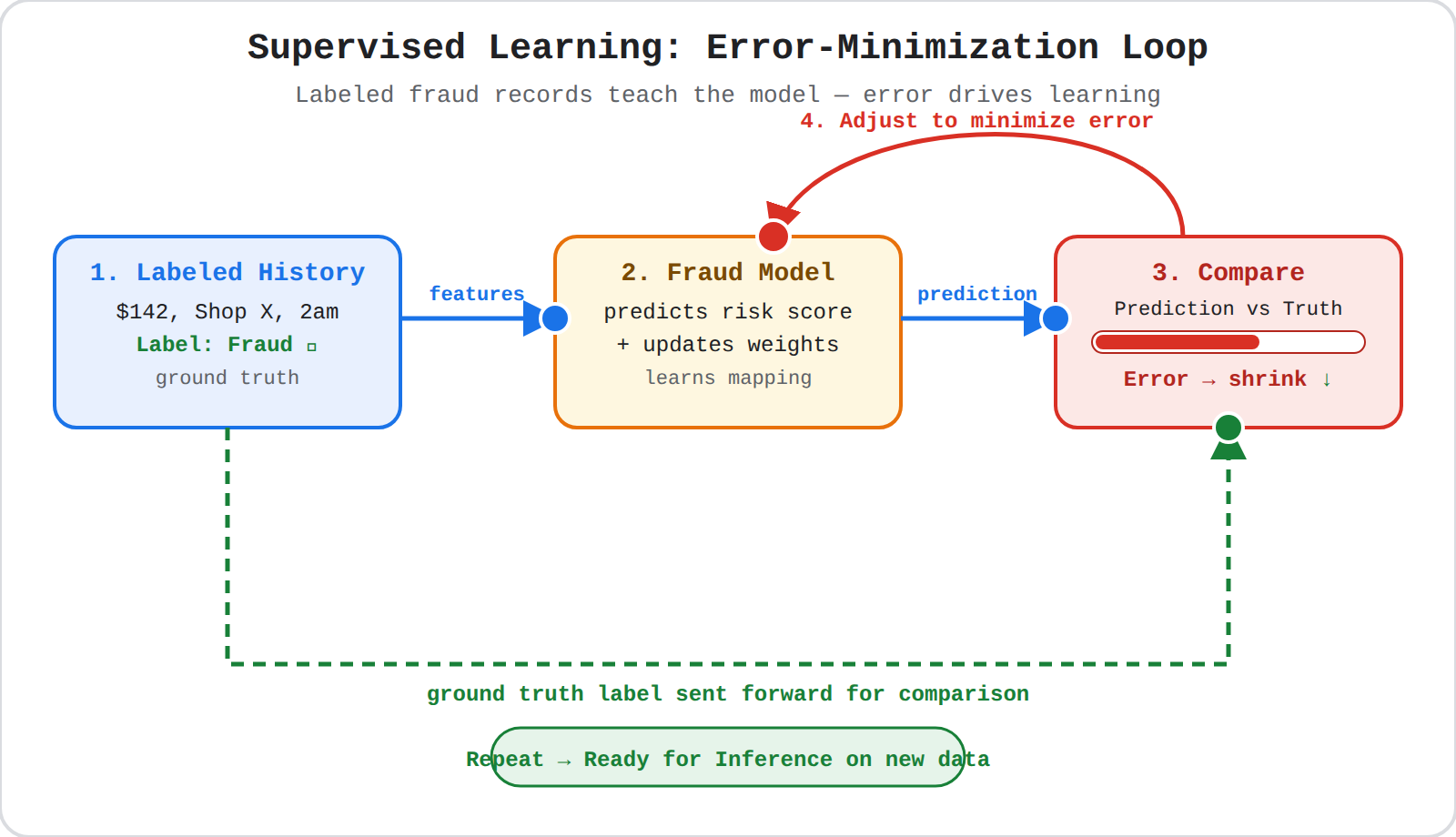
Key Characteristics of Supervised Learning and Inference
- Ground truth dependency: Supervised learning explicitly requires paired input-output examples, such as features (transaction amount, merchant, location) and labels (fraudulent or legitimate).
- Generalization objective: The goal of supervised training is high generalization, meaning the model reliably makes accurate inferences on data it has never encountered before.
- Production serving: Inference can be executed in real time (low-latency online serving) or in batches (processing large collections of records simultaneously).
- Model evaluation: During development, model inference on a separate validation set verifies that the algorithm has not overfitted to the training dataset.
Why This Choice Is Optimal
Because the dataset includes known historical target labels (fraud vs. legitimate) and the production requirement is to calculate predictions on incoming records, supervised learning combined with inference perfectly satisfies both technical stages of the machine learning lifecycle.
Try 10 interactive questions like this one, free
Answer them yourself and get your score the moment you finish. No account needed.
Full access includes
- 3,070 practice questions across all 6 exam domains
- Every answer explained: why it is right, and why the others are not
- Scout, an AI tutor that answers your follow-up questions
- Readiness tracking by domain, so you know when to book the exam
Related free sample questions
Keep the momentum going with these hand-picked practice scenarios
FundamentalCloud Digital Leader
AI Conversational Virtual Agents
Discuss the main AI and ML concepts, and explain how ML can create business value.
FundamentalCloud Digital Leader
Prebuilt Industry AI Solutions vs Custom ML
Explain which decisions and tradeoffs organizations need to consider when selecting Google Cloud AI/ML solutions and products, including: speed; effort; differentiation; required expertise.
FundamentalCloud Digital Leader
24/7 Carbon-Free Energy and CFE%
Discuss how Google Cloud helps organizations meet sustainability goals and reduce environmental impact.
FundamentalCloud Digital Leader
Self-Deployment Custom vLLM Container
Discuss which Google Cloud AI and ML solutions and products might apply given different business use cases, including: pre-trained APIs; AutoML; build custom models.
FundamentalCloud Digital Leader
Container Image Dependency Bundling
Discuss the advantages of using containers in application modernization.
AdvancedProfessional Data Engineer
Dataflow GroupIntoBatches API Quota Management
AI data enrichment
Last updated Validated