Fundamental
Prepare and test your skills

Fundamental
Prepare and test your skills
Lakehouse Medallion Layers From Bronze to Gold
Free sample question with answers and detailed explanation below. The Cloud Digital Leader practice bank has an additional 3,070 practice questions.Try 10 free realistic questions: instant score, no credit card, and no account required.
An enterprise is modernizing its data value chain on Google Cloud to transform raw information into actionable business insights. The organization has the following architectural requirements:
- Cost-effective flexibility: Retain the low-cost storage benefits of a data lake to ingest raw, semi-structured, and unstructured data alongside open formats on Cloud Storage.
- High-performance analytics: Leverage the enterprise governance, fine-grained security controls, and fast SQL query capabilities of a data warehouse in BigQuery.
- Progressive data refinement: Logically organize data into sequential stages—moving from raw ingestion, to cleansed and standardized datasets, and finally to curated, structured business aggregations.
Which architectural approach best satisfies these requirements?
Explanations
Implement a data lakehouse with a medallion architecture that stores raw bronze-layer data on Cloud Storage and serves curated gold-layer structured tables through BigQuery
Implement a data lakehouse with a medallion architecture that stores raw bronze-layer data on Cloud Storage and serves curated gold-layer structured tables through BigQuery
What a Data Lakehouse with Medallion Architecture Is
A data lakehouse is a unified data architecture that combines the cost efficiency and flexible scale of a data lake with the structured data management, governance, and analytical speed of an enterprise data warehouse. Within this architecture, the medallion architecture serves as a logical design pattern that progresses data along the data value chain through three distinct tiers of increasing structure and quality: Bronze (raw), Silver (cleansed), and Gold (curated).
How It Meets the Architectural Requirements
- Cost-effective flexibility: A data lake built on Cloud Storage acts as the foundational storage layer, accommodating unstructured files (such as images, audio, and PDFs), semi-structured data (such as JSON and logs), and open table formats like
Apache IcebergorParquetat a low cost. - High-performance analytics: BigQuery provides the serverless data warehouse engine required to enforce fine-grained security controls, unified governance, and rapid SQL query execution.
- Progressive data refinement: The medallion pattern systematically refines information across the data value chain:
- Bronze (raw) layer: Ingests and preserves raw data in open formats on Cloud Storage.
- Silver (cleansed) layer: Filters, deduplicates, and enriches raw inputs into standardized, schema-enforced tables.
- Gold (curated) layer: Delivers aggregated, highly structured business-level tables served through BigQuery for reporting, dashboards, and high-concurrency analytics.
Medallion Architecture: Bronze to Silver to Gold
Process Flow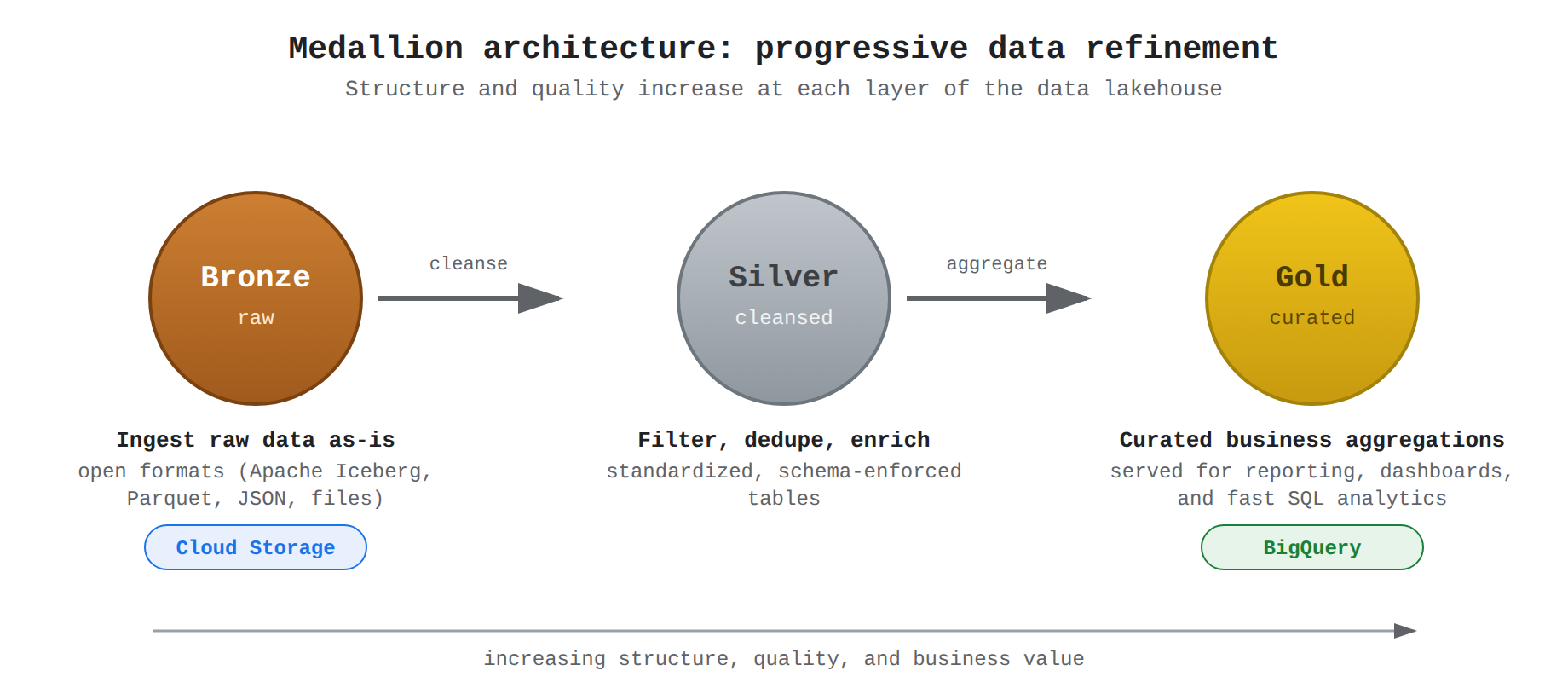
Key Advantages and Capabilities
- Open interoperability: Multiple processing engines—including BigQuery,
Apache Spark, andApache Flink—can operate on a single copy of data without creating isolated data silos. - Support for all data types: Seamlessly handles unstructured, semi-structured, and structured datasets within a unified ecosystem.
- Decoupled storage and compute: Organizations scale storage in Cloud Storage independently from analytical compute in BigQuery.
- Centralized metadata governance: A centralized runtime catalog tracks table schemas, snapshots, and access policies across engines.
Why This Is Optimal
Unlike maintaining separate, disconnected data lakes and data warehouses that require complex duplication pipelines, a data lakehouse using a medallion architecture unifies storage and analytics while clearly structuring the progression from raw data to actionable business insights.
Store all raw and curated datasets strictly as self-managed external tables outside of any metadata catalog so BigQuery can perform automated data compaction and write transformations
Store all raw and curated datasets strictly as self-managed external tables outside of any metadata catalog so BigQuery can perform automated data compaction and write transformations
What External Tables Are
In a cloud analytics architecture, external tables are table definitions that reference data files and metadata residing outside of a managed lakehouse runtime catalog or native data warehouse storage. They allow query engines like BigQuery to read structured or semi-structured files stored directly in Cloud Storage or third-party cloud object stores without importing the data into native warehouse storage.
Why It Doesn't Meet the Requirement
Relying exclusively on self-managed external tables outside of a centralized catalog prevents BigQuery from performing write operations or automated storage optimization. Because BigQuery has read-only access to external tables, it cannot write cleansed silver-layer transformations or curated gold-layer aggregations back to those tables, nor can it execute automated maintenance tasks such as data compaction and garbage collection.
Key Characteristics and Limitations
- Read-only access: BigQuery can query data from external tables but cannot insert, update, or write transformed data into them.
- Self-managed metadata: Both the underlying data files and table metadata must be manually maintained by the user or an external system outside the Lakehouse runtime catalog.
- No automated table management: Automated background optimizations—such as file compaction, storage layout tuning, and garbage collection—are only available for managed lakehouse and native tables.
- Lower query performance: External tables generally do not match the high-concurrency analytical performance of BigQuery native tables or managed
Apache Icebergtables for gold-layer reporting.
This Answer Would Be Correct If
The organization only needed ad-hoc, read-only querying over existing files stored in Cloud Storage or another cloud provider's object storage without requiring BigQuery to write transformations or manage table compaction.
Additional Context
To achieve progressive data refinement across the data value chain, organizations use managed catalog tables (such as Apache Iceberg tables in the Lakehouse runtime catalog) and BigQuery tables, which support full read-write interoperability, schema evolution, and automated storage optimization.
Configure BigQuery native storage as a raw data lake for unstructured bronze-layer ingestion and use Cloud Storage buckets as the gold-layer data warehouse for high-concurrency reporting
Configure BigQuery native storage as a raw data lake for unstructured bronze-layer ingestion and use Cloud Storage buckets as the gold-layer data warehouse for high-concurrency reporting
What BigQuery Native Storage and Cloud Storage Do
BigQuery is Google Cloud's fully managed, serverless enterprise data warehouse designed to store and analyze structured and semi-structured relational data at petabyte scale using standard SQL. Cloud Storage is a scalable object storage service commonly used as the foundation for a data lake, capable of storing any file format—including raw unstructured media, backups, and open analytical file formats (Parquet, Avro, ORC).
Why It Doesn't Meet the Requirement
This option reverses the fundamental architectural roles of a data lake and a data warehouse, as well as the layers of the medallion architecture. Using BigQuery native tables as an object store for raw, unstructured bronze-layer files is architecturally inappropriate because relational warehouse storage requires defined schemas. Conversely, Cloud Storage is an object storage system rather than a SQL query engine, meaning it cannot independently execute high-concurrency analytical queries for the gold consumption layer.
Key Characteristics and Limitations
- Data lake purpose (Cloud Storage): Built for schema-on-read flexibility, low-cost retention of raw bronze-layer data, and storing unstructured objects in their native formats.
- Data warehouse purpose (BigQuery): Built for schema-on-write structure, transactional consistency, and serving gold-layer curated business aggregations with low latency.
- Unstructured data access in BigQuery: When BigQuery analyzes unstructured data, the files remain stored in Cloud Storage and are referenced via object tables and remote functions rather than being loaded into native warehouse tables.
This Answer Would Be Correct If
The architectural mapping were inverted so that Cloud Storage served as the bronze-layer data lake for raw and unstructured data ingestion, while BigQuery served as the gold-layer data warehouse for curated, high-concurrency business reporting.
Additional Context
Understanding the distinction between object storage (data lakes) and relational analytical engines (data warehouses) is critical in the data value chain. Raw data starts in flexible storage and moves toward structured warehouse consumption as business value is extracted.
Replace Cloud Storage with an Apache Hive metastore endpoint to physically store unstructured files and enable full read-write SQL transformations directly from BigQuery
Replace Cloud Storage with an Apache Hive metastore endpoint to physically store unstructured files and enable full read-write SQL transformations directly from BigQuery
What an Apache Hive Metastore Endpoint Is
The Apache Hive metastore (HMS) endpoint is a metadata management interface within the Lakehouse runtime catalog designed for backward compatibility with open-source Apache Spark and Apache Hive workloads. Rather than acting as a physical storage engine, a metastore is a catalog directory that tracks database names, table definitions, partitions, and pointers to where actual data files reside.
Why It Doesn't Meet the Requirement
First, an Apache Hive metastore cannot replace Cloud Storage because a metastore only stores metadata definitions—it still relies on Cloud Storage to physically hold the underlying data files. Second, Hive metastore tables are designed for structured and semi-structured analytical file formats (such as Parquet, ORC, and Avro), not raw unstructured files. Third, for tables managed through the Hive metastore endpoint, BigQuery is restricted to read-only access and cannot perform SQL write transformations.
Key Characteristics and Limitations
- Metadata-only service: Manages logical table schemas and partition definitions while physical data files remain stored in Cloud Storage buckets.
- Read-only BigQuery integration: Open-source engines (
SparkandHive) have read and write access, whereas BigQuery is limited strictly to read-only queries. - Open-source ETL focus: Optimized primarily for migrating legacy
Apache SparkandApache Hiveextract, transform, and load (ETL) pipelines without maintaining a self-hosted metastore. - Limited modern table features: Does not provide the full cross-engine read-write interoperability of the Apache Iceberg REST catalog endpoint.
This Answer Would Be Correct If
The scenario asked how to migrate legacy Apache Spark and Apache Hive workloads to a managed metadata service where open-source engines handle all ETL writes to Cloud Storage and BigQuery only requires read-only access.
Additional Context
For modern lakehouse workloads requiring read and write interoperability between open-source engines and BigQuery, organizations should use Apache Iceberg tables managed through the Apache Iceberg REST catalog endpoint backed by Cloud Storage.
Try 10 interactive questions like this one, free
Answer them yourself and get your score the moment you finish. No account needed.
Full access includes
- 3,070 practice questions across all 6 exam domains
- Every answer explained: why it is right, and why the others are not
- Scout, an AI tutor that answers your follow-up questions
- Readiness tracking by domain, so you know when to book the exam
Related free sample questions
Keep the momentum going with these hand-picked practice scenarios
FundamentalCloud Digital Leader
Business Value-Driven AI Approach
Discuss the main data value chain concepts and terms.
FundamentalCloud Digital Leader
Streaming ETL vs ELT
Discuss the main data value chain concepts and terms.
FundamentalCloud Digital Leader
Digital Transformation Business Drivers
Describe the drivers and challenges that lead organizations to undergo a digital transformation.
FundamentalCloud Digital Leader
Coldline vs Archive Minimum Storage Duration
Differentiate between storage classes in Cloud Storage regarding cost and frequency of access, including: Standard, Nearline, Coldline, and Archive.
FundamentalCloud Digital Leader
Open-Source Compatibility and Standardized Toolchains
Describe the main business transformation benefits of Google Cloud: intelligence, freedom, collaboration, trust, and sustainability.
IntermediateProfessional Cloud Architect
Cloud Monitoring and Active Assist
Customer success management
Last updated