Fundamental
Prepare and test your skills
Fundamental
Prepare and test your skills
Tracing Checkout Latency Across Microservices
Free sample question with answers and detailed explanation below. The Cloud Digital Leader practice bank has an additional 3,070 practice questions.Try 10 free realistic questions: instant score, no credit card, and no account required.
An e-commerce company runs a distributed application on Google Cloud composed of several independent microservices:
- Frontend web interface
- Shopping cart service
- Inventory verification service
- Payment processing service
During a promotional event, customers report slow checkout times. The operations team needs to follow the end-to-end journey of a single checkout transaction across all of these microservices to determine which specific component is causing the latency bottleneck.
Which core observability component should the team analyze to investigate this issue?
Explanations
Logs
Logs
What logs are
Logs (managed in Google Cloud through Cloud Logging) are chronological, time-stamped records of discrete events that occur within an application, operating system, or infrastructure component. Each log entry captures detailed context about a specific event, such as an application error, a configuration change, a security audit trail, or a state transition.
Why logs do not meet the requirement
- Lack of cross-component request flow: While log data provides rich detail about what happened inside one specific part of an application, it does not natively illustrate how an event in one microservice relates to downstream activity in other microservices.
- Inefficient for latency bottleneck tracking: Reconstructing the timing and execution order of a single user request across four separate microservices using raw log entries alone is difficult without distributed trace context.
Key characteristics and limitations
- Event-specific granularity: Records individual occurrences such as failures, warnings, access requests, or state changes.
- Centralized search and filtering: Supports querying and log analysis to inspect specific error messages or audit logs.
- Isolated component context: Focuses on discrete events within a single resource rather than mapping end-to-end latency across distributed paths.
- Storage and retention management: Requires configuring retention policies and exclusion filters on log sinks to manage compliance and storage costs.
This answer would be correct if
The scenario asked how to inspect the detailed error message of a failed payment transaction, review Cloud Storage access logs, or analyze audit trails to determine which administrator modified a system configuration.
Additional context
In a complete observability strategy, logs and traces complement each other. Engineers typically use traces first to isolate which microservice is experiencing a bottleneck or failure, and then examine the logs generated by that specific component to read the detailed error payload.
Metrics
Metrics
What metrics are
Metrics (collected and analyzed in Cloud Monitoring) are numerical measurements of system health, resource utilization, or application activity gathered at regular time intervals. Common examples include CPU utilization, memory consumption, network I/O, request rate, error rate, and business indicators such as orders placed.
Why metrics do not meet the requirement
- Aggregate measurements rather than individual paths: Metric data provides aggregated numerical summaries over time rather than following the step-by-step execution journey of a single user's transaction.
- Inability to map cross-service journeys: While metrics can show that overall application request latency has spiked, they do not trace the causal path of an individual checkout request as it hops between the shopping cart, inventory, and payment services.
Key characteristics and limitations
- Time-series numerical data: Measures quantitative values at fixed intervals to reveal performance trends and usage patterns.
- Service-level indicators (SLIs): Serves as the primary data source for tracking SLIs such as overall availability, throughput, and error rates.
- Resource optimization: Helps identify under-provisioned or over-provisioned compute resources across Compute Engine and Google Kubernetes Engine (GKE).
- No per-request execution graph: Lacks the span-level relationship data needed to follow a single transaction across distributed microservices.
This answer would be correct if
The scenario asked how to track CPU consumption over time to right-size virtual machines, monitor quantitative service-level indicators (SLIs) on a dashboard, or analyze long-term traffic trends for capacity planning.
Additional context
Metrics act as the first line of visibility in observability. An unexpected change in metric data—such as a sudden jump in average checkout latency—signals that a problem exists, prompting engineers to use traces to find where the slowdown is occurring.
Alerting policies
Alerting policies
What alerting policies are
Alerting policies are automated monitoring rules within Google Cloud Observability that evaluate metric thresholds, log events, or statistical anomalies against predefined conditions. When a specified condition is breached, the policy automatically triggers notifications through configured notification channels such as email, SMS, or incident management systems.
Why alerting policies do not meet the requirement
- Notification mechanism rather than telemetry data: Alerting policies are designed to notify operations teams that an issue requires attention; they do not capture or display the end-to-end execution path of a transaction.
- No root cause path analysis: An alert can inform an on-call engineer that checkout latency has exceeded a threshold, but it cannot show which downstream microservice caused the delay during a request's lifecycle.
Key characteristics and limitations
- Proactive issue detection: Monitors critical metrics and log conditions in real time to notify responders before minor issues become major outages.
- Configurable notification routing: Delivers alerts to appropriate teams via email, SMS, paging tools, or ticketing platforms.
- Alert escalation and fatigue prevention: Uses targeted thresholds and escalation procedures to minimize alert fatigue while ensuring timely incident response.
- Dependent on underlying telemetry: Relies on collected metrics and logs to evaluate conditions rather than generating request-path telemetry itself.
This answer would be correct if
The scenario asked how the operations team could automatically send an SMS notification or open an incident ticket whenever the application's checkout error rate exceeds 5% for more than five minutes.
Additional context
In the cloud operations workflow, alerting policies initiate the incident response process by waking up or notifying the team, whereas traces and logs are the diagnostic tools used afterward to investigate and resolve the underlying issue.
Traces
Traces
What traces are
Traces (managed in Google Cloud through Cloud Trace) are a core pillar of observability that represent the complete end-to-end journey of a single user request or transaction as it travels through the components of a distributed application. Each trace is composed of individual spans, where each span records the execution details and duration of a single function, microservice call, or operation.
How traces meet the requirements
- Following an end-to-end transaction: A trace captures the exact execution path of a checkout request as it moves sequentially or in parallel from the frontend web interface to the shopping cart, inventory verification, and payment processing microservices.
- Identifying latency bottlenecks: Because every span within a trace records precise timing and latency data, the operations team can compare how long the request spent in each microservice and immediately pinpoint which component slowed down the transaction.
Key capabilities
- End-to-end request visibility: Tracks how separate microservices interact and depend on one another during a single operation.
- Granular latency breakdown: Measures the exact duration of individual spans to isolate slow database queries, network calls, or service dependencies.
- Root cause identification: Bridges the visibility gap between isolated application components by correlating activity across a distributed architecture.
- Visual topology analysis: Integrates with tools like Trace Explorer and Application Monitoring to visualize request flows and performance bottlenecks.
- Derived performance insights: Helps teams understand how changes in one upstream or downstream service affect the overall user experience.
Why this is optimal
While metrics indicate that overall checkout latency has increased and logs record isolated events within a single service, neither automatically reconstructs the cross-service path of a multi-step request. Traces are specifically designed for distributed systems, making them the optimal telemetry component for diagnosing inter-service latency bottlenecks.
Try the scenario
Which observability pillar answers the question?
Change the inputs and watch how the outcome changes.
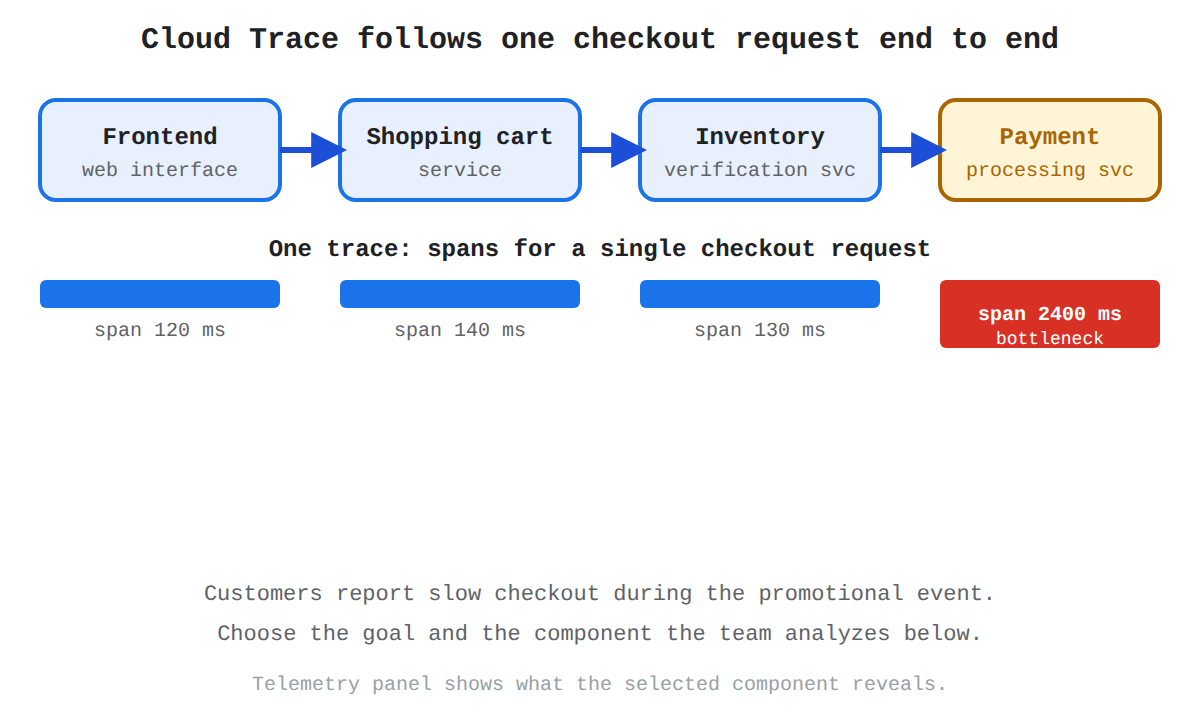
Pick the team's goal and the component they analyze to see what each pillar actually reveals about the checkout application.
Try 10 interactive questions like this one, free
Answer them yourself and get your score the moment you finish. No account needed.
Full access includes
- 3,070 practice questions across all 6 exam domains
- Every answer explained: why it is right, and why the others are not
- Scout, an AI tutor that answers your follow-up questions
- Readiness tracking by domain, so you know when to book the exam
Related free sample questions
Keep the momentum going with these hand-picked practice scenarios
FundamentalCloud Digital Leader
Toil Reduction and Blameless Postmortems
Define important cloud operations terms.
FundamentalCloud Digital Leader
SLI vs SLO vs SLA
Define important cloud operations terms.
FundamentalCloud Digital Leader
Data Lake vs Data Warehouse
Differentiate between basic data management concepts, in particular: databases, data warehouses, and data lakes.
FundamentalCloud Digital Leader
Data Lakehouse Medallion Architecture
Discuss the main data value chain concepts and terms.
FundamentalCloud Digital Leader
MIG Autoscaling and Autohealing
Describe the importance of designing resilient, fault-tolerant, and scalable infrastructure and processes for high availability and disaster recovery.
IntermediateProfessional Cloud Architect
VPC Firewall Rule Priority Ordering
Security protection (e.g. intrusion protection, access control, and firewalls)
Last updated