Fundamental
Prepare and test your skills

Fundamental
Prepare and test your skills
Residency Controls Location and Sovereignty Controls Access
Free sample question with answers and detailed explanation below. The Cloud Digital Leader practice bank has an additional 3,070 practice questions.Try 10 free realistic questions: instant score, no credit card, and no account required.
A multinational healthcare organization is planning to migrate its patient records to Google Cloud. During a regulatory and compliance review, the legal team establishes two strict governance mandates:
- Mandate 1: Patient personally identifiable information (PII) must be physically stored at rest within the borders of the country where it was collected to satisfy national data locality laws and tax regulations.
- Mandate 2: The organization must retain exclusive authority over who can access the data, implementing cryptographic and procedural controls so that the cloud provider cannot access the data without explicit customer approval and justification.
How should the organization categorize these two mandates within its cloud governance framework?
Explanations
Mandate 1 is a data residency requirement, and Mandate 2 is a data sovereignty requirement
Mandate 1 is a data residency requirement, and Mandate 2 is a data sovereignty requirement
What Data Residency and Data Sovereignty Are
In cloud governance, risk, and compliance, data residency and data sovereignty represent two distinct but complementary levels of control over organizational data. Data residency refers to the physical geographic location where data is stored at rest, driven by national laws, industry regulatory concerns, tax implications, system design objectives, and local culture. Data sovereignty extends beyond physical location to address jurisdictional authority and access control, providing technical mechanisms that prevent the cloud provider or unauthorized parties from accessing customer data without explicit approval.
Data Residency vs Data Sovereignty Controls
Comparison Matrix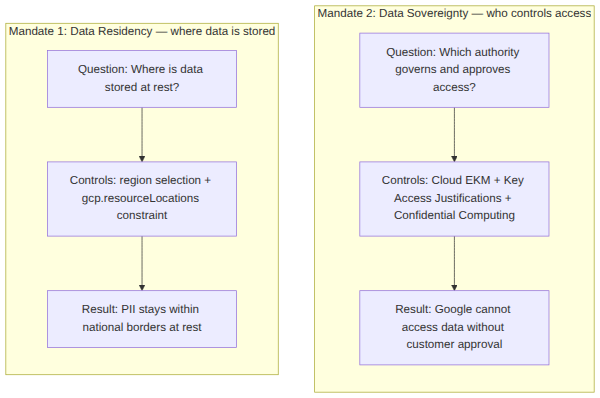
How It Meets Mandate 1 and Mandate 2
- Meeting Mandate 1 (Data Residency): Requiring patient personally identifiable information (PII) to remain physically stored within specific national borders directly defines data residency. In Google Cloud, organizations enforce this by selecting specific regional locations when provisioning resources and applying Organization Policy Service resource location constraints (
constraints/gcp.resourceLocations) to restrict where data can be stored and replicated. - Meeting Mandate 2 (Data Sovereignty): Requiring cryptographic and procedural controls so that Google cannot access the data without explicit customer approval directly defines data sovereignty. Organizations achieve this by managing encryption keys outside the cloud, requiring detailed justifications before granting key access, and encrypting data while it is actively being processed.
Key Capabilities and Governance Controls
- Geographic storage control: Lets administrators select specific regions (such as
us-east1oreurope-west1) so data at rest and backups remain within required national boundaries. - External key management: Allows organizations to store and manage encryption keys outside of Google Cloud using Cloud External Key Manager (EKM).
- Approval workflows: Uses Key Access Justifications to give customers visibility into the exact reason for any encryption key request and the power to approve or deny access.
- In-use data protection: Uses Confidential Computing to keep sensitive workloads encrypted in memory during processing.
- Regulatory compliance: Aligns cloud architectures with strict national data locality laws, privacy frameworks, and geopolitical mandates.
Why This Is Optimal
Distinguishing between data residency and data sovereignty ensures that cloud architects implement the appropriate technical controls for each legal mandate. While regional resource placement satisfies geographic storage laws, maintaining true sovereignty requires additional cryptographic and operational guardrails over data access.
Mandate 1 is a data classification requirement, and Mandate 2 is an advanced data residency requirement
Mandate 1 is a data classification requirement, and Mandate 2 is an advanced data residency requirement
What Data Classification and Advanced Data Residency Are
Data classification is a foundational data security practice where an organization defines, identifies, and labels confidential information—such as credit card numbers, addresses, and personally identifiable information (PII)—so that appropriate security controls can be applied. Advanced data residency refers to strict regulatory requirements that govern the geographic location of data while it is actively being processed (in use) or transmitted (in transit), in addition to when it is stored (at rest).
Why It Doesn't Meet the Requirements
- Why Data Classification fails Mandate 1: Although Mandate 1 references PII, the mandate specifically requires storing that data physically within national borders to satisfy local data locality and tax laws. Categorizing and tagging sensitive fields is data classification, whereas enforcing the physical geographic location where data is stored is data residency.
- Why Advanced Data Residency fails Mandate 2: Advanced data residency ensures that data storage, runtime processing, and network transmission remain confined to a designated region. However, keeping processing and transmission inside a geographic boundary does not by itself prevent the cloud provider from accessing the data or require customer approval for encryption key access, which is a data sovereignty requirement.
Key Characteristics and Limitations
- Sensitive data discovery: Organizations use Sensitive Data Protection to classify, tag, and tokenize confidential data before storing it in Google Cloud.
- Expanded geographic scope: Advanced data residency extends location boundaries beyond data at rest to include data in use and data in transit.
- Jurisdictional access points: Enforcing advanced data residency typically involves provisioning Assured Workloads folders, using a location-based jurisdictional console (such as
console.us.cloud.google.com), and routing API calls through regional endpoints. - Access authority limitation: Neither data classification nor advanced data residency provides the external key management and access justification workflows needed to establish full data sovereignty.
This Answer Would Be Correct If
This option would be correct if Mandate 1 required using Sensitive Data Protection to discover, classify, and tokenize confidential patient records prior to storage, and Mandate 2 required ensuring that API traffic in transit and runtime processing in use remain strictly within a single geographic region.
Mandate 1 is a data sovereignty requirement, and Mandate 2 is a data residency requirement
Mandate 1 is a data sovereignty requirement, and Mandate 2 is a data residency requirement
What This Option Describes
This option reverses the foundational definitions of data sovereignty and data residency. While both concepts are essential components of cloud governance, risk, and compliance, they address different legal, regulatory, and technical requirements and cannot be used interchangeably when designing a compliant cloud architecture.
Why It Doesn't Meet the Requirements
- Misidentifying Mandate 1: Categorizing the physical storage location of personally identifiable information (PII) within national borders as data sovereignty is inaccurate. Controlling the geographic region where data is stored at rest to satisfy local laws and tax regulations is the core definition of data residency.
- Misidentifying Mandate 2: Categorizing cryptographic control and provider access prevention as data residency is incorrect. Specifying which data center region stores your files does not by itself prevent the cloud provider from accessing encryption keys or performing administrative tasks; preventing unauthorized provider access requires data sovereignty controls.
Key Characteristics and Limitations
- Data residency scope: Focuses on configuring where data is stored at rest, including database instances and backups, within designated regions or multi-regions.
- Data residency limitations: Keeping data within a geographic boundary does not automatically grant the customer exclusive control over external encryption keys or provider access approvals.
- Data sovereignty scope: Focuses on mechanisms that prevent the cloud provider from accessing data, ensuring access is approved only for provider behaviors the customer agrees are necessary.
- Layered governance: Organizations often implement data residency first as a baseline geographic boundary and then layer data sovereignty controls on top for highly regulated workloads.
This Answer Would Be Correct If
This option would only be correct if Mandate 1 required implementing Cloud External Key Manager (EKM) and Key Access Justifications to prevent provider access to data, and Mandate 2 required using regional selection and constraints/gcp.resourceLocations to keep stored data within a specific country.
Additional Context
A frequent misconception in cloud compliance is assuming that storing data in a domestic Google Cloud region automatically fulfills all data sovereignty requirements. In practice, regional storage satisfies data residency, whereas sovereignty demands explicit technical controls over who can decrypt and access the data.
Mandate 1 is a software sovereignty requirement, and Mandate 2 is an operational sovereignty requirement
Mandate 1 is a software sovereignty requirement, and Mandate 2 is an operational sovereignty requirement
What Software Sovereignty and Operational Sovereignty Are
Software sovereignty and operational sovereignty are specialized pillars of digital sovereignty in Google Cloud that focus on workload portability and provider personnel oversight. Software sovereignty provides assurances that an organization can control the availability of its workloads and run them wherever it wants without being locked into a single cloud provider. Operational sovereignty provides assurances that cloud provider personnel cannot compromise customer workloads, primarily by restricting support and administrative access based on personnel attributes.
Why It Doesn't Meet the Requirements
- Why Software Sovereignty fails Mandate 1: Mandate 1 focuses on storing personally identifiable information (PII) at rest within a specific country to meet data locality and tax laws (data residency). It does not address avoiding vendor lock-in, surviving connectivity disruptions, or running workloads across multicloud environments.
- Why Operational Sovereignty fails Mandate 2: While operational sovereignty restricts which Google personnel can interact with a workload based on attributes like citizenship or geographic location, Mandate 2 specifically addresses cryptographic and procedural mechanisms that prevent the provider from accessing the data itself without explicit customer approval and justification, which defines data sovereignty.
Key Characteristics and Capabilities
- Avoiding vendor lock-in: Software sovereignty ensures organizations can rapidly change where workloads are deployed and what level of outside network connection is permitted.
- Hybrid and on-premises deployment: Google Cloud supports software sovereignty through hybrid and multicloud architectures as well as Google Distributed Cloud, which brings Google hardware and software into customer data centers.
- Personnel access restrictions: Operational sovereignty limits Google personnel access based on predefined attributes such as citizenship or physical location.
- Resource deployment guardrails: Operational sovereignty also uses regional deployment restrictions alongside personnel controls to protect operational integrity.
This Answer Would Be Correct If
This option would be correct if Mandate 1 required deploying workloads using Google Distributed Cloud or multicloud patterns to avoid cloud provider dependency, and Mandate 2 required restricting cloud support interactions strictly to personnel holding specific citizenship status.
Additional Context
Google Cloud organizes digital sovereignty into three pillars: data sovereignty, operational sovereignty, and software sovereignty. Recognizing how these three pillars differ from foundational data residency helps compliance teams map regulatory requirements to the right cloud controls.
Try 10 interactive questions like this one, free
Answer them yourself and get your score the moment you finish. No account needed.
Full access includes
- 3,070 practice questions across all 6 exam domains
- Every answer explained: why it is right, and why the others are not
- Scout, an AI tutor that answers your follow-up questions
- Readiness tracking by domain, so you know when to book the exam
Related free sample questions
Keep the momentum going with these hand-picked practice scenarios
FundamentalCloud Digital Leader
Organization Policy Resource Locations Constraint
Describe why data sovereignty and data residency may be requirements and how Google Cloud offers organizations the ability to control where their data is stored.
FundamentalCloud Digital Leader
Regional Multi-Zone Deployment with Edge POPs
Define basic network infrastructure terminology, including: IP address; internet service provider (ISP); domain name server (DNS), regions, and zones; fiber optics; subsea cables; network edge data centers, latency; and bandwidth.
FundamentalCloud Digital Leader
AI vs ML Relationship
Define artificial intelligence (AI) and machine learning (ML).
FundamentalCloud Digital Leader
Streaming ETL vs ELT
Discuss the main data value chain concepts and terms.
FundamentalCloud Digital Leader
BigQuery Columnar Storage and Decoupled Compute
Differentiate between basic data management concepts, in particular: databases, data warehouses, and data lakes.
IntermediateProfessional Cloud Architect
BigQuery Data Owner, Data Viewer, and Job User
Legislation and regulation (e.g., health record privacy, children's privacy, data privacy, ownership, and data sovereignty)
Last updated