Intermediate
Prepare and test your skills
Intermediate
Prepare and test your skills
Ordering VPC Egress Rules for Restricted API Access
Free sample question, answered and explained below. The Professional Cloud Architect practice bank has 2,335 more like it. Try 10 free: instant score, no account.
An enterprise is designing network security controls in Google Cloud to prevent data exfiltration from resources within a Virtual Private Cloud (VPC) network. Workloads in the VPC must communicate with Google APIs exclusively through the restricted virtual IP (VIP) range 199.36.153.4/30 on TCP port 443.
The security architect must enforce strict egress controls to ensure that all general outbound internet traffic is blocked while outbound access to Google services via the restricted VIP is permitted without disrupting internal traffic flows or connector communication.
How should the VPC egress firewall rules and priority levels be configured?
Explanations
Create an allow egress rule for destination range 199.36.153.4/30 filtered by source network tags, and rely on the implied default allow egress rule at priority 65535.
Create an allow egress rule for destination range 199.36.153.4/30 filtered by source network tags, and rely on the implied default allow egress rule at priority 65535.
What Network Tags And Implied Rules Do
Network tags are metadata strings assigned to Compute Engine VM instances used to apply firewall rules to specific VMs. The implied default allow egress rule in Google Cloud operates at priority 65535 and permits all outbound traffic to 0.0.0.0/0 unless explicitly overridden by higher-priority deny rules.
Why It Fails The Requirement
- No Exfiltration Protection: Relying on the implied default allow egress rule allows instances to communicate freely with any internet IP destination, failing the requirement to block general outbound internet traffic.
- Tag Incompatibility: Network tags are not supported for serverless environments using Direct VPC egress; source IP ranges or service accounts must be used instead.
Key Limitations
- Permissive Outbound Access: Leaving the default implied allow egress rule in place permits data exfiltration to unauthorized public endpoints.
- Limited Scope: Tags cannot be evaluated on serverless requests routed through Direct VPC egress.
This Answer Would Be Correct If
The network allowed open outbound internet access and only required tagging specific VMs for specialized monitoring or routing policies.
Create a deny egress rule for destination 0.0.0.0/0 with a priority before 1000 (such as 900), and create an allow egress rule for destination range 199.36.153.4/30 on TCP port 443 with a priority after 1000 (such as 1100).
Create a deny egress rule for destination 0.0.0.0/0 with a priority before 1000 (such as 900), and create an allow egress rule for destination range 199.36.153.4/30 on TCP port 443 with a priority after 1000 (such as 1100).
What This Option Does
This configuration assigns a higher evaluation precedence (priority 900) to the broad deny 0.0.0.0/0 egress rule and a lower precedence (priority 1100) to the specific allow rule for 199.36.153.4/30.
Why It Fails The Requirement
- Rule Shadowing: Because
199.36.153.4/30falls within0.0.0.0/0, all outbound traffic—including traffic aimed at the restricted Google VIP—matches the priority900deny rule first and is dropped. - Infrastructure Outage: Setting a deny-all egress rule with a priority before 1000 breaks required internal communication paths, including Serverless VPC Access connector traffic and Direct VPC egress routing.
Key Limitations
- No API Connectivity: Completely prevents workloads from accessing Google APIs via the restricted VIP.
- High Precedence Disruption: Fails the best practice requirement that deny-all egress rules must be configured after priority 1000.
This Answer Would Be Correct If
The objective were to achieve a total network isolation sandbox where no outbound connectivity to any endpoint, including Google Cloud APIs, was permitted under any condition.
Create an allow ingress rule for 199.36.153.4/30 on TCP port 443 at priority 1000, and rely on the default implied deny ingress rule at priority 65535 to block outbound internet traffic.
Create an allow ingress rule for 199.36.153.4/30 on TCP port 443 at priority 1000, and rely on the default implied deny ingress rule at priority 65535 to block outbound internet traffic.
What Ingress Rules Control
Ingress firewall rules control incoming connections initiated from external sources toward instances in the VPC. The implied deny ingress rule (priority 65535) blocks incoming connection attempts from outside the VPC.
Why It Fails The Requirement
- Wrong Directionality: Exfiltration prevention and API access are egress concerns (traffic initiated from inside the VPC outbound to an external IP), not ingress.
- Default Egress Still Active: Ingress rules do not restrict outbound connections. Workloads could still initiate outbound connections to arbitrary public internet IP addresses because Google Cloud's implied egress rule allows all outbound traffic by default.
Key Limitations
- Direction Mismatch: Ingress firewall rules have zero effect on outbound data flows initiated by local workloads.
- Misplaced Google API Rule: Google APIs do not initiate inbound TCP handshakes to VPC workloads over port 443; the VPC instances initiate outbound egress connections.
This Answer Would Be Correct If
The workload was hosting an inbound web service and needed to accept external HTTPS connections while blocking all other unsolicited inbound traffic.
Create an allow egress rule for destination range 199.36.153.4/30 on TCP port 443 with a priority before 1000 (such as 900), and create a deny egress rule for destination 0.0.0.0/0 with a priority after 1000 (such as 1100).
Create an allow egress rule for destination range 199.36.153.4/30 on TCP port 443 with a priority before 1000 (such as 900), and create a deny egress rule for destination 0.0.0.0/0 with a priority after 1000 (such as 1100).
What Egress Firewall Rule Priority Is
In Google Cloud VPC networks, firewall rules are evaluated sequentially based on their numerical priority (from 0 to 65535), where lower numerical values represent higher precedence. When traffic matches a rule with higher precedence, that rule is applied immediately, and subsequent lower-priority rules are ignored.
How It Meets The Requirements
- Exfiltration Prevention: Creating a custom deny egress rule for
0.0.0.0/0ensures that all outbound traffic destined for external internet endpoints is blocked. - Restricted VIP Access: Creating an allow egress rule targeting
199.36.153.4/30on TCP port 443 explicitly permits communication with Google APIs. - Priority Evaluation Order: Placing the allow rule at a priority before 1000 (e.g.,
900) and the broad deny rule at a priority after 1000 (e.g.,1100) ensures that traffic to the restricted VIP is evaluated and allowed before the broad deny rule is reached. - Connector and Internal Service Compatibility: Keeping the deny-all rule at a priority after 1000 prevents blocking internal infrastructure flows (such as Serverless VPC Access connectors or Direct VPC egress mechanisms) that rely on default priority ranges.
Firewall Priority Order: Allow VIP First
Process Flow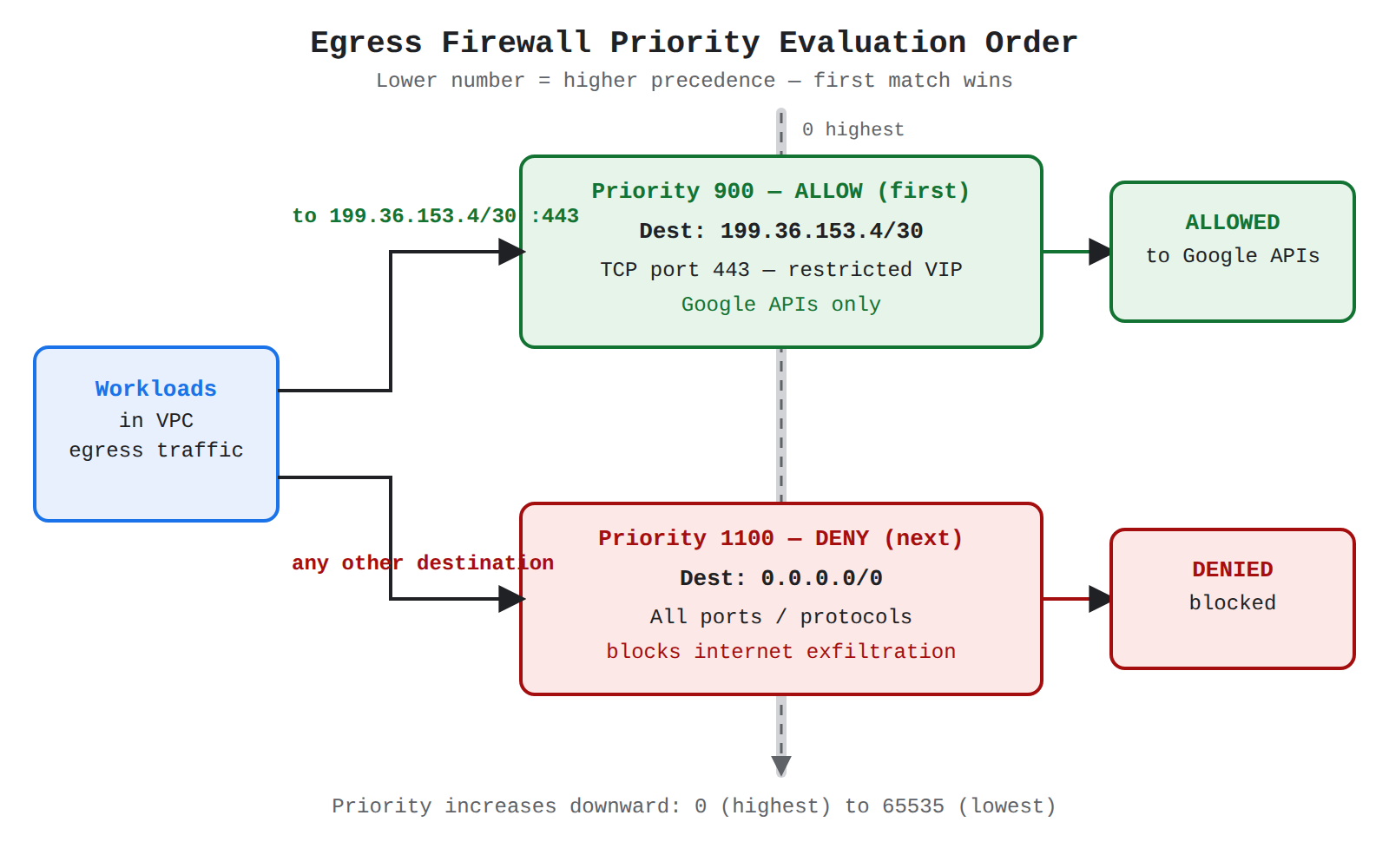
Key Advantages
- Granular Perimeter Security: Restricts outbound VPC communication strictly to validated Google services.
- Deterministic Rule Evaluation: Prevents accidental shadowing of specific allow rules by global deny rules.
- Operational Stability: Protects internal VPC management and serverless routing paths from unintended disruption.
Why This Is Optimal
This configuration ensures that traffic destined for 199.36.153.4/30 is processed and allowed first, while all other egress is systematically dropped without interfering with default VPC internal routing.
Try 10 interactive questions like this one, free
Answer them yourself and get your score the moment you finish. No account needed.
Full access includes
- 2,335 practice questions across all 6 exam domains
- Every answer explained: why it is right, and why the others are not
- Scout, an AI tutor that answers your follow-up questions
- Readiness tracking by domain, so you know when to book the exam
Related questions
Keep the momentum going with these hand-picked practice scenarios
IntermediateProfessional Cloud Architect
Cloud Armor vs Cloud NGFW
Security protection (e.g. intrusion protection, access control, and firewalls)
IntermediateProfessional Cloud Architect
IAP TCP Forwarding
Security protection (e.g. intrusion protection, access control, and firewalls)
IntermediateProfessional Cloud Architect
Vertex AI Pipelines Service Account and VPC SC
Using Vertex AI pipelines to automate and orchestrate the ML lifecycle
IntermediateProfessional Cloud Architect
BigQuery to Vertex AI Dataset Import
Preparing for Vertex AI data integration
IntermediateProfessional Cloud Architect
Cloud DLP De-Identification Transformations
Commercial (e.g., sensitive data such as credit card information handling and personally identifiable information [PII])
AdvancedProfessional Data Engineer
BigQuery ELT vs Dataproc ETL
Defining data transformation and orchestration logic
Last updated