Fundamental
Prepare and test your skills

Fundamental
Prepare and test your skills
Self-Healing Scaling for Stateless Web Apps
Free sample question with answers and detailed explanation below. The Cloud Digital Leader practice bank has an additional 3,070 practice questions.Try 10 free realistic questions: instant score, no credit card, and no account required.
An e-commerce company runs a stateless web application on Compute Engine virtual machines (VMs). Recently, unpredictable traffic surges caused high CPU utilization and slow response times, while quiet periods left extra VMs sitting idle. Additionally, during a recent traffic spike, the application software crashed on several VMs even though the VMs remained running, resulting in failed customer requests.
The company wants to update its architecture to meet the following requirements:
- Dynamically add or remove VMs based on real-time CPU utilization to maintain performance and optimize costs
- Route user traffic only to responsive application instances
- Automatically delete and recreate VMs if the application software becomes unresponsive
Which Google Cloud solution should the company implement?
Explanations
Purchase Committed Use Discounts (CUDs) for the VMs and configure API rate quotas to restrict incoming requests during traffic spikes
Purchase Committed Use Discounts (CUDs) for the VMs and configure API rate quotas to restrict incoming requests during traffic spikes
What Committed Use Discounts and Rate Quotas Are
Committed Use Discounts (CUDs) are a billing cost-optimization mechanism that provides discounted prices in exchange for committing to a consistent level of resource usage (such as vCPUs and memory) for a one-year or three-year term. Rate quotas are per-project service limits that restrict the number of API requests a system can receive within a specific period to control resource consumption and protect against excessive load.
Why It Doesn't Meet the Requirements
- No dynamic capacity scaling: Purchasing CUDs only changes how VM usage is billed; it does not dynamically add or remove VMs in response to real-time CPU utilization.
- Blocks traffic instead of scaling: Applying rate quotas or rate-limiting during legitimate customer traffic surges rejects incoming requests rather than scaling out infrastructure to serve those users smoothly.
- No traffic routing or autohealing: Neither CUDs nor API rate quotas inspect the health of running application software, reroute traffic away from crashed nodes, or automatically recreate unresponsive VMs.
Key Characteristics and Limitations
- Best for predictable baselines: CUDs optimize spending for steady, predictable workloads rather than highly variable or spiky traffic patterns where extra capacity needs to scale down during quiet periods.
- Protective throttling: Rate limiting and rate quotas are designed to prevent system failure during malicious Distributed Denial-of-Service (DDoS) attacks or client configuration errors.
- No infrastructure automation: Financial commitments and project quotas do not manage VM lifecycles or application health.
This Answer Would Be Correct If
This approach would be appropriate if the company ran a predictable, steady-state workload where it wanted to lower long-term compute bills using Committed Use Discounts, and needed to protect backend APIs from abusive request floods or runaway client scripts using rate quotas.
Additional Context
A common misconception is equating cost optimization through billing discounts with resource optimization through elasticity. While CUDs reduce the unit price of compute resources, autoscaling optimizes actual resource consumption by dynamically removing idle instances when demand is low.
Migrate the workload to Spot VMs and configure Cloud Billing budgets and alerts to notify administrators when traffic increases
Migrate the workload to Spot VMs and configure Cloud Billing budgets and alerts to notify administrators when traffic increases
What Spot VMs and Cloud Billing Budgets Are
Spot VMs are Compute Engine virtual machines that provide access to unused Google Cloud compute capacity at a steep discount compared to standard VMs, with the trade-off that Google Cloud can preempt (terminate) them at any time if the capacity is needed elsewhere. Cloud Billing budgets and alerts are Cost Management tools that track cloud spending against defined financial thresholds and send notifications to administrators when costs approach or exceed the budget.
Why It Doesn't Meet the Requirements
- Reduces availability instead of improving it: Running a customer-facing e-commerce web application purely on Spot VMs introduces the risk of sudden VM preemption during peak demand, worsening reliability rather than ensuring continuous performance.
- No automated scaling: Cloud Billing budgets and alerts only notify administrators about spending trends; they do not dynamically provision or remove VMs based on real-time CPU utilization.
- No health checking or self-healing: Neither Spot VMs nor billing alerts detect crashed application software on running VMs, stop routing customer traffic to failed nodes, or recreate unresponsive instances.
Key Characteristics and Limitations
- Preemptible lifecycle: Spot VMs can be reclaimed by Google Cloud at any moment, making them unsuitable as the sole infrastructure for availability-critical, user-facing web applications.
- Financial governance focus: Budgets and alerts help organizations monitor IT spending and prevent unexpected billing overruns, but they do not control infrastructure scaling or traffic routing.
- Requires manual action: Alert notifications inform human operators of threshold breaches rather than executing automated horizontal scaling or instance autohealing.
This Answer Would Be Correct If
This strategy would be appropriate if the company wanted to run fault-tolerant, non-urgent batch processing jobs at the lowest possible compute price using Spot VMs, while keeping finance teams informed of monthly project expenditures using Cloud Billing budgets and alerts.
Additional Context
Students often confuse financial alerting with operational autoscaling. While budgets notify teams about cost increases, maintaining performance continuity under variable load requires elastic infrastructure—such as a Managed Instance Group (MIG) with an autoscaling policy—that acts immediately without human intervention.
Create Compute Engine capacity reservations and use Recommender to manually resize the VMs after each traffic spike
Create Compute Engine capacity reservations and use Recommender to manually resize the VMs after each traffic spike
What Capacity Reservations and Recommender Are
Compute Engine capacity reservations provide assured hardware capacity in a specific zone for a designated number of VMs of a chosen machine type, ensuring resources are available when needed. Recommender (part of Active Assist) is an analytical tool that evaluates historical resource utilization data to generate intelligent recommendations for right-sizing underutilized or over-provisioned cloud resources.
Why It Doesn't Meet the Requirements
- Lacks real-time elasticity: Capacity reservations guarantee that VM hardware is available to be provisioned in a zone, but they do not automatically launch or terminate VMs when CPU utilization fluctuates.
- Reactive manual resizing: Using Recommender to manually resize VMs after a traffic spike is a slow, reactive governance process. It cannot prevent slow response times during sudden, unpredictable surges.
- No application recovery: Neither reservations nor right-sizing recommendations monitor real-time application responsiveness, isolate crashed software instances from user traffic, or automatically recreate unhealthy VMs.
Key Characteristics and Limitations
- Assured zonal capacity: Reservations ensure that when you or an autoscaler attempt to create VMs during peak events or disaster recovery failovers, Google Cloud has the physical capacity set aside.
- Historical analysis: Recommender analyzes usage trends over days or weeks to suggest optimal machine types, helping teams balance baseline performance and cost.
- Manual or scheduled intervention: Right-sizing existing individual VMs typically requires administrative action or vertical scaling restarts rather than seamless horizontal scaling.
This Answer Would Be Correct If
This solution would be ideal if the company needed guaranteed zonal hardware availability ahead of a planned product launch using capacity reservations, and wanted to review historical utilization trends to right-size baseline VM machine types using Recommender.
Additional Context
While Recommender and Cloud Monitoring are essential for ongoing capacity planning and baseline right-sizing, they complement—rather than replace—automated runtime mechanisms like Managed Instance Groups (MIGs), autoscaling, and autohealing.
Deploy the VMs in a Managed Instance Group (MIG) with an autoscaling policy, load-balancing health checks, and autohealing
Deploy the VMs in a Managed Instance Group (MIG) with an autoscaling policy, load-balancing health checks, and autohealing
What Managed Instance Groups with Autoscaling and Autohealing Are
A Compute Engine Managed Instance Group (MIG) is a collection of identical virtual machine (VM) instances that you control and scale as a single entity using an instance template. When combined with autoscaling policies, Cloud Load Balancing health checks, and autohealing, a MIG provides an elastic, resilient, and self-healing infrastructure architecture that automatically adapts to changing workload demands and recovers from software disruptions.
How It Meets the Requirements
- Dynamic Scaling and Cost Optimization: By defining an autoscaling policy based on CPU utilization, the MIG automatically scales out horizontally by creating new VM instances when traffic surges push CPU usage past a defined threshold. When demand drops, the autoscaler removes unneeded VMs so the company avoids paying for idle capacity.
- Intelligent Traffic Routing: Load-balancing health checks continuously probe the application software on each VM. Even if a VM is in the
RUNNINGstate, the load balancer stops sending user requests to any backend instance where the application has crashed. - Automated Instance Recovery: Configuring an application-based health check for autohealing ensures that when the application software on a VM becomes unresponsive, the MIG proactively deletes the faulty VM and recreates a fresh, working instance automatically.
MIG Autoscaling and Autohealing
System Architecture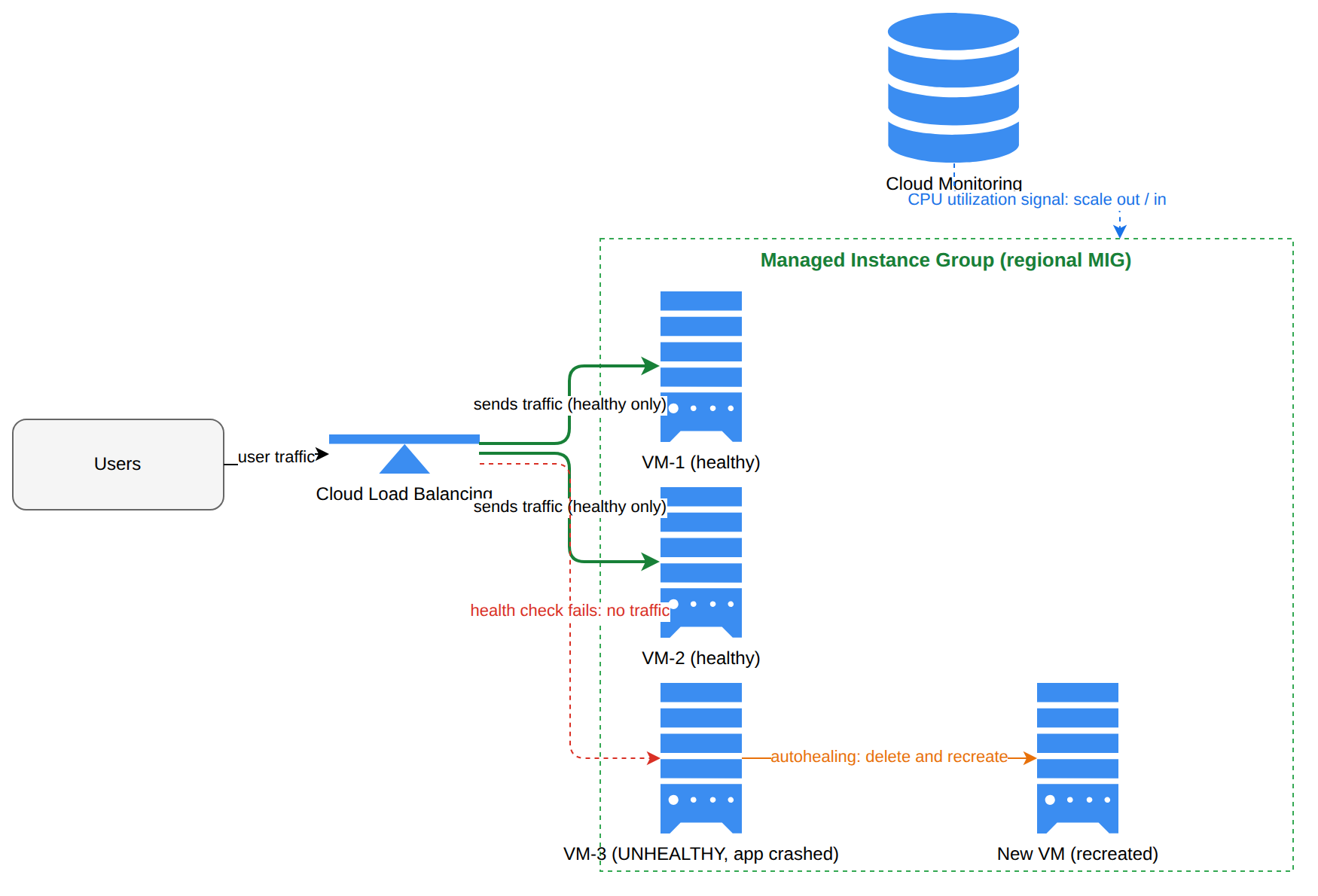
Key Advantages and Capabilities
- Elasticity on demand: Adjusts compute capacity dynamically in response to real-time metrics such as CPU utilization, load balancing serving capacity, or custom metrics in Cloud Monitoring.
- High availability: Distributes traffic across healthy instances to prevent any single VM from becoming overloaded during system stress.
- Proactive fault tolerance: Replaces crashed or frozen application nodes without requiring manual administrator intervention.
- Operational efficiency: Eliminates the overhead of manually provisioning redundant hardware for peak load and manually tearing it down afterward.
- Predictable performance: Maintains consistent response times and helps meet strict Service Level Objectives (SLOs) under fluctuating loads.
Why This Is Optimal
Unlike static provisioning or manual resizing strategies, combining MIG autoscaling, load-balancing health checks, and autohealing addresses both capacity fluctuations and application-level reliability simultaneously. It ensures continuous performance during unexpected surges while keeping operational costs aligned with actual consumption.
Try 10 interactive questions like this one, free
Answer them yourself and get your score the moment you finish. No account needed.
Full access includes
- 3,070 practice questions across all 6 exam domains
- Every answer explained: why it is right, and why the others are not
- Scout, an AI tutor that answers your follow-up questions
- Readiness tracking by domain, so you know when to book the exam
Related free sample questions
Keep the momentum going with these hand-picked practice scenarios
FundamentalCloud Digital Leader
Cold DR Backup and Restore
Describe the importance of designing resilient, fault-tolerant, and scalable infrastructure and processes for high availability and disaster recovery.
FundamentalCloud Digital Leader
Multi-Zone High Availability Architecture
Describe the importance of designing resilient, fault-tolerant, and scalable infrastructure and processes for high availability and disaster recovery.
FundamentalCloud Digital Leader
Real-Time Visibility Business Value
Describe how streaming analytics in real-time makes data more useful and generates business value.
FundamentalCloud Digital Leader
Container Image Dependency Bundling
Discuss the advantages of using containers in application modernization.
FundamentalCloud Digital Leader
Zero Trust vs Perimeter Security
Differentiate between cloud security and traditional on-premises security.
AdvancedProfessional Data Engineer
Bigtable Row Key vs BigQuery Partitioning Clustering
Analyzing data access patterns
Last updated