Fundamental
Prepare and test your skills

Fundamental
Prepare and test your skills
Data Lakes Store Raw Data for Machine Learning
Free sample question with answers and detailed explanation below. The Cloud Digital Leader practice bank has an additional 3,070 practice questions.Try 10 free realistic questions: instant score, no credit card, and no account required.
A retail organization is designing a cloud storage architecture to collect massive volumes of raw data from diverse sources. The solution must support the following requirements:
- Store unstructured product review images, semistructured
JSONclickstream logs, and raw open-format files (ParquetandAvro) at scale - Enable flexible ingestion without enforcing a predefined table schema upfront
- Support schema-on-read so data scientists can run custom machine learning workflows and open-source processing engines
Which storage paradigm and Google Cloud service should the organization implement?
Explanations
A data lake built on Cloud Storage
A data lake built on Cloud Storage
What a Data Lake on Cloud Storage Is
A data lake is a centralized repository designed to ingest, store, and protect massive volumes of raw data in its native format at any scale. On Google Cloud, Cloud Storage serves as the foundational object storage layer for building data lakes. Unlike structured repositories that require data to be cleaned and formatted before storage, a data lake accepts structured, semistructured, and unstructured data directly from source systems.
Data Lake Stores Raw Data in Cloud Storage
System Architecture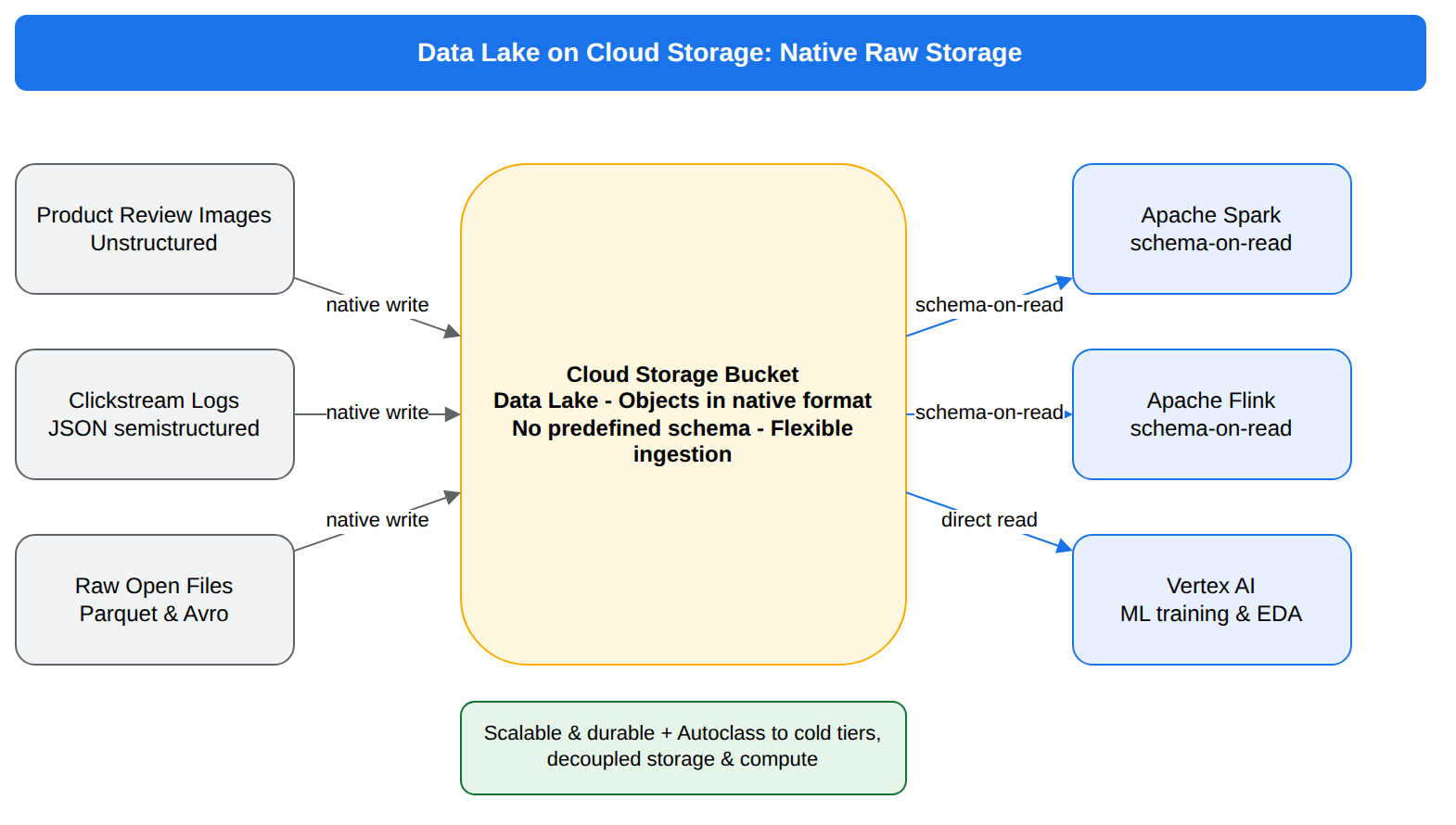
How It Meets the Requirements
- Raw, semistructured, and unstructured storage: Cloud Storage natively stores binary objects of any type, including unstructured image files, semistructured
JSONorCSVlogs, and open analytical formats likeParquet,ORC, andAvro. - Flexible ingestion and schema-on-read: Data is written directly to storage buckets without enforcing a strict table structure during ingestion. Instead, processing engines apply schema-on-read, interpreting the structure of the data only when it is queried or processed.
- Machine learning and open-source workflows: Data scientists can connect diverse engines—such as Apache Spark, Apache Flink, or Vertex AI—directly to the raw files in Cloud Storage for feature engineering, exploratory data analysis, and model training.
Key Advantages and Capabilities
- Infinite scalability and durability: Cloud Storage scales automatically to petabytes or exabytes while maintaining high durability across regions.
- Cost optimization: Features like Autoclass automatically transition infrequently accessed raw data to colder storage tiers to reduce long-term storage costs.
- Decoupled storage and compute: Organizations pay for object storage independently from compute resources, allowing multiple engines to process data without duplicating files.
- Foundation for a lakehouse: Raw data in Cloud Storage can serves as the bronze ingestion layer in a medallion architecture or be organized with open table formats like
Apache Iceberg.
Why This Is Optimal
Compared to databases and data warehouses, which enforce schema-on-write and are optimized for structured records, a data lake on Cloud Storage is the only paradigm that natively handles raw unstructured media alongside semistructured logs with maximum ingestion flexibility for machine learning workloads.
A metadata repository built on the Lakehouse runtime catalog
A metadata repository built on the Lakehouse runtime catalog
What the Lakehouse Runtime Catalog Is
The Lakehouse runtime catalog (formerly known as BigLake metastore) is a fully managed, serverless metadata service on Google Cloud. It acts as a centralized metastore that tracks namespaces, table schemas, partition specifications, and file locations—implementing open standards such as the Apache Iceberg REST Catalog API—so multiple query engines can discover and share tables.
Why It Doesn't Meet the Requirements
- Stores metadata, not raw data files: The Lakehouse runtime catalog is a catalog layer service, not a physical bulk storage repository. It maintains pointers to
metadata.jsonfiles and table snapshots rather than storing the underlying images,JSONlogs, orParquetfiles. - Requires an underlying storage layer: The catalog relies entirely on Cloud Storage to hold the actual physical data files and metadata files.
- Does not replace a data lake: Because it only governs table metadata and access delegation, it cannot function on its own as the storage foundation for unstructured media and raw data ingestion.
Key Characteristics and Limitations
- Centralized metadata discovery: Provides a single source of truth for table state across engines like Apache Spark, Apache Flink, Trino, and BigQuery.
- Credential vending: Generates short-lived tokens with reduced scope to delegate secure access to underlying storage buckets.
- ACID transaction coordination: Manages pointer updates and transaction commits for open table formats like
Apache Iceberg. - No raw object storage capacity: Cannot independently store raw unstructured objects such as product review photographs.
This Answer Would Be Correct If
This option would be the right choice if the organization already had a data lake on Cloud Storage and needed a serverless metastore to centralize Apache Iceberg table metadata and coordinate concurrent reads and writes across BigQuery and Apache Spark.
Additional Context
When transitioning from a basic data lake to a data lakehouse, organizations combine Cloud Storage (the data layer where raw Parquet, ORC, or Avro files reside) with the Lakehouse runtime catalog (the catalog layer that organizes those files into logical namespaces and tables).
A transactional database built on AlloyDB for PostgreSQL
A transactional database built on AlloyDB for PostgreSQL
What a Transactional Database on AlloyDB for PostgreSQL Is
A transactional database—often referred to as an Online Transaction Processing (OLTP) system—is designed to manage real-time operational data using strict relational schemas. AlloyDB for PostgreSQL is a fully managed, PostgreSQL-compatible relational database service on Google Cloud engineered for demanding enterprise transactional workloads.
Why It Doesn't Meet the Requirements
- Requires strict schema-on-write: Relational databases organize data into normalized tables with predefined columns, data types, and relational constraints. They do not support schema-on-read or flexible, schema-free raw ingestion.
- Unsuitable for massive unstructured data: Storing millions of raw product review images and raw
ParquetorAvrofiles inside a relational database degrades performance and drives up storage costs significantly. - Optimized for row-level operations: AlloyDB for PostgreSQL is built for fast, concurrent row-level inserts, updates, and deletes rather than serving as a raw file repository for diverse open-source batch processing engines.
Key Characteristics and Limitations
- ACID compliance: Guarantees Atomicity, Consistency, Isolation, and Durability so that concurrent operational transactions never corrupt business records.
- Relational data modeling: Enforces referential integrity through primary keys, foreign keys, and strict table schemas.
- Operational focus: Excels at powering live applications such as e-commerce shopping carts, inventory tracking, and financial ledgers.
- Storage paradigm mismatch: Relational databases are not intended to replace object storage for raw, multi-format data lakes.
This Answer Would Be Correct If
This option would be correct if the retail organization needed a highly available, PostgreSQL-compatible relational database to process real-time customer orders, manage live inventory updates, or combine operational transactions with analytical views.
Additional Context
In a modern cloud data ecosystem, operational databases like AlloyDB for PostgreSQL often act as upstream data sources. Change data capture (CDC) tools like Datastream replicate operational records from the database into a Cloud Storage data lake or BigQuery data warehouse for downstream analysis.
A data warehouse built on BigQuery native tables
A data warehouse built on BigQuery native tables
What a Data Warehouse on BigQuery Is
A data warehouse is an enterprise analytical repository designed to store, organize, and query large volumes of structured and semistructured data for business intelligence and reporting. BigQuery is Google Cloud's serverless, highly scalable enterprise data warehouse, and BigQuery native tables store cleansed, structured data in Google-managed columnar storage.
Why It Doesn't Meet the Requirements
- Enforces schema-on-write: Loading data into BigQuery native tables requires defining a table schema upfront (schema-on-write). It does not allow arbitrary unstructured files to be dumped without a defined table structure.
- Not designed for raw unstructured blobs: Native tables in a data warehouse are built for tabular rows and columns rather than storing raw unstructured media files like product review images.
- Targeted at curated analytics: In a standard medallion architecture, BigQuery serves best as the curated gold consumption layer for high-concurrency
SQLanalytics rather than the raw, schema-free landing zone.
Key Characteristics and Limitations
- High-performance SQL engine: Optimized for running complex analytical queries, aggregations, and joins over petabytes of structured data in seconds.
- Schema enforcement: Ensures high data quality and consistency for business reporting by validating data types upon ingestion.
- Serverless compute: Automatically provisions and scales query slots without requiring database administrators to manage infrastructure.
- Format constraints: Cannot act as a general-purpose object store for raw binary assets such as images, audio, or arbitrary application files.
This Answer Would Be Correct If
This option would be the right choice if the organization needed to store cleansed, conformed, and structured business data in a gold consumption layer to power high-concurrency SQL dashboards, Looker visualizations, and ad hoc business intelligence queries.
Additional Context
While BigQuery can query unstructured or open-format data sitting in a data lake by using external tables or Apache Iceberg tables, the underlying raw files themselves must still reside in Cloud Storage, making a data lake the required storage foundation.
Try 10 interactive questions like this one, free
Answer them yourself and get your score the moment you finish. No account needed.
Full access includes
- 3,070 practice questions across all 6 exam domains
- Every answer explained: why it is right, and why the others are not
- Scout, an AI tutor that answers your follow-up questions
- Readiness tracking by domain, so you know when to book the exam
Related free sample questions
Keep the momentum going with these hand-picked practice scenarios
FundamentalCloud Digital Leader
Cloud SQL Managed Relational OLTP
Differentiate between basic data management concepts, in particular: databases, data warehouses, and data lakes.
FundamentalCloud Digital Leader
BigQuery Columnar Storage and Decoupled Compute
Differentiate between basic data management concepts, in particular: databases, data warehouses, and data lakes.
FundamentalCloud Digital Leader
IAM Allow Policy on Bucket
Differentiate between authentication, authorization, and auditing.
FundamentalCloud Digital Leader
Streaming ETL vs ELT
Discuss the main data value chain concepts and terms.
FundamentalCloud Digital Leader
Cloud Run vs GKE Containerization
Discuss benefits of infrastructure modernization and application modernization by using Google Cloud.
AdvancedProfessional Cloud Security Engineer
Private Service Connect vs VPC Peering
Configuring network isolation and data encapsulation for N-tier applications.
Last updated