Fundamental
Prepare and test your skills

Fundamental
Prepare and test your skills
Time-Bound SSH Keys Using google-ssh Metadata
Free sample question with answers and detailed explanation below. The Associate Cloud Engineer practice bank has an additional 2,014 practice questions.Try 10 free realistic questions: instant score, no credit card, and no account required.
An administrator needs to provide a temporary contractor with access to several Linux Compute Engine instances. Company policy mandates that temporary SSH keys must automatically expire after a specific timestamp without requiring manual administrative cleanup.
How should the administrator format the SSH key entry when adding it to the project or instance metadata?
Explanations
Append the public SSH key to the ~/.ssh/authorized_keys file and schedule a local cron job inside the guest OS to delete the line
Append the public SSH key to the ~/.ssh/authorized_keys file and schedule a local cron job inside the guest OS to delete the line
What In-Guest Key Management and Cron Jobs Do
Linux systems traditionally manage SSH public keys via the ~/.ssh/authorized_keys file located in each user's home directory. A local cron job can be configured within the guest operating system to run scheduled shell scripts that edit system files.
Why It Does Not Meet the Requirement
- Overwritten by Guest Environment: Compute Engine instances run guest environment daemons that actively synchronize users and keys defined in Cloud project and instance metadata. Manually editing
~/.ssh/authorized_keyscan result in changes being overwritten when metadata syncs. - High Operational Burden: Configuring individual cron jobs on multiple virtual machines introduces unnecessary configuration overhead, requires in-guest administrative privileges, and is prone to synchronization errors.
- Lacks Centralized Control: In-guest scheduled scripts cannot be centrally tracked or managed through Google Cloud IAM, metadata APIs, or infrastructure-as-code tools.
Key Characteristics and Limitations
- Decentralized Management: Requires per-instance maintenance and root/sudo permissions inside each Linux OS.
- Conflict with Metadata Daemon: Compute Engine's metadata agent manages authorized keys based on cloud metadata entries, potentially re-adding deleted keys if they still exist in metadata.
This Answer Would Be Correct If
This approach would be appropriate in unmanaged, standalone on-premises Linux servers that do not possess a cloud metadata service or guest management agent.
Add the standard SSH key string and pass a --ttl flag during VM creation with the gcloud compute instances create command
Add the standard SSH key string and pass a --ttl flag during VM creation with the gcloud compute instances create command
What the Compute Instance Creation Command Does
The gcloud compute instances create command is used to provision new virtual machine instances in Compute Engine. It allows configuration of machine types, boot disks, network interfaces, and metadata values.
Why It Does Not Meet the Requirement
- Non-Existent Parameter: The
gcloud compute instances createcommand does not have a native--ttl(time-to-live) flag for automatically expiring individual SSH keys added to metadata. - Instance Lifecycle vs. Key Lifecycle: Setting an instance lifetime or schedule controls the VM's operational state (running vs. stopped/terminated), rather than managing individual SSH key lifecycles for external users.
- No Key-Level Control: Even if an instance has automated shutdown policies, any SSH keys embedded in metadata without expiration attributes remain valid for as long as the VM exists.
Key Characteristics and Limitations
- Instance Flags: VM creation flags manage hardware, disks, service accounts, and metadata key-value pairs.
- Metadata Delivery: SSH keys are ingested through the
ssh-keysmetadata attribute, which requires specific internal formatting for expiration rather than top-level CLI flags.
This Answer Would Be Correct If
This option would be correct if the requirement was to automatically terminate or delete the entire virtual machine instance after a fixed duration using an instance scheduling policy or script.
Provide the SSH key value followed by google-ssh JSON metadata specifying the userName and an expireOn timestamp in ISO 8601 format
Provide the SSH key value followed by google-ssh JSON metadata specifying the userName and an expireOn timestamp in ISO 8601 format
What SSH Key Expiration Metadata Is
Google Cloud Compute Engine supports automated lifecycle management for standard metadata SSH keys by allowing JSON-structured metadata attributes to be appended to the public key string. This structured format contains parameters including the target username and an explicit expiration timestamp (expireOn).
How It Meets the Temporary Access Requirement
- Automated Key Expiration: When the key format
KEY_VALUE google-ssh {"userName":"USERNAME","expireOn":"EXPIRE_TIME"}is stored in metadata, the guest environment running inside the Compute Engine Linux VM inspects theexpireOnvalue. - ISO 8601 Compliance: The
EXPIRE_TIMEis specified in standard ISO 8601 format (for example,2024-12-04T20:12:00+0000). Once the current system time passes this timestamp, the VM guest agent automatically invalidates the key and prevents further SSH authentication. - Zero Administrative Teardown: The administrator does not need to execute follow-up API calls, run custom scripts, or manually delete keys from project or instance metadata when the contractor's engagement ends.
Expiring SSH Key Structure for Compute Engine
Annotated Structure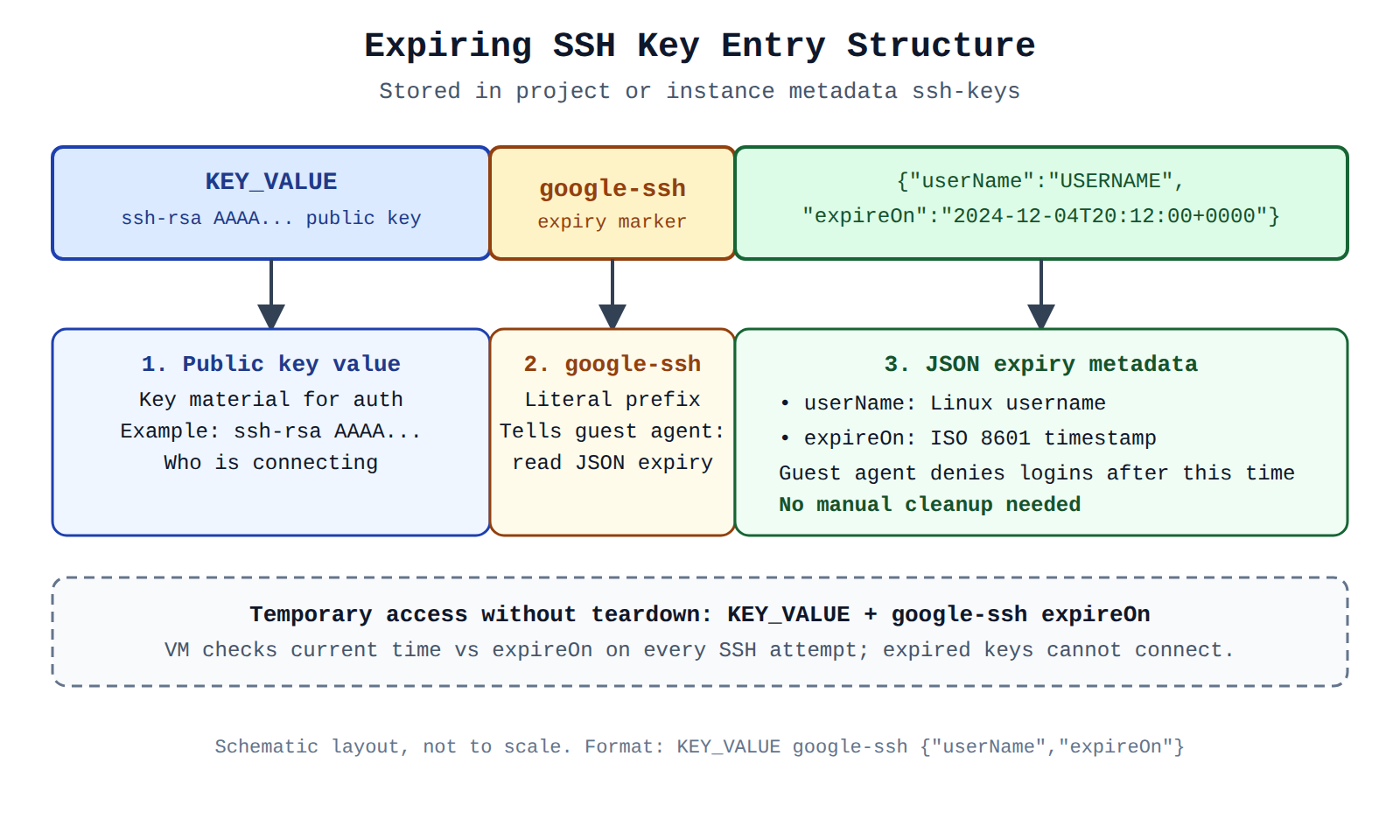
Key Advantages and Capabilities
- Declarative Expiration: Provides built-in support for time-bound credentials natively handled by the Compute Engine guest environment.
- Project and Instance Scope: Can be applied at either the project metadata level (granting access to all instances in the project) or the instance metadata level (restricting access to specific VMs).
- Auditability: Key metadata and expiration times remain visible in Google Cloud metadata configurations and Cloud Audit Logs for compliance review.
- Compatibility: Works seamlessly across standard Compute Engine public Linux images without requiring custom SSH daemon modifications.
Why This Is Optimal
Using native google-ssh metadata with an expireOn property is the standardized, platform-supported mechanism for defining expiring SSH keys in Compute Engine metadata. It eliminates the risk of orphaned credentials and avoids the operational complexity of custom in-guest cleanup scripts.
Apply an IAM condition to the Compute Instance Admin role that automatically revokes metadata write permissions at the target timestamp
Apply an IAM condition to the Compute Instance Admin role that automatically revokes metadata write permissions at the target timestamp
What IAM Conditions on Compute Roles Do
Identity and Access Management (IAM) Conditions allow administrators to define conditional access policies based on resource attributes, request time/date, or access levels. A time-based condition can grant or revoke specific Google Cloud IAM roles (such as Compute Instance Admin) at a designated timestamp.
Why It Does Not Meet the Requirement
- Does Not Expire Existing SSH Keys: Revoking the administrator's or user's IAM permissions to write metadata does not remove or invalidate SSH keys that have already been written to the VM's metadata.
- Controls Control Plane Access, Not SSH Authentication: IAM conditions govern interactions with Google Cloud APIs (like creating VMs or editing metadata). Once an SSH key is in metadata and processed by the Linux VM's guest agent, SSH access occurs directly over the network via SSH protocol, bypassing IAM control-plane checks unless OS Login is used.
Key Characteristics and Limitations
- Scope of IAM: IAM regulates Google Cloud resource management APIs, not in-guest POSIX authentication for legacy metadata-based keys.
- Static Metadata Persistence: Metadata entries remain completely static and active until explicitly altered or expired via metadata formatting rules.
This Answer Would Be Correct If
This answer would be correct if the goal was to restrict when an administrator has permission to execute Google Cloud CLI management commands against Compute Engine API endpoints.
Try 10 interactive questions like this one, free
Answer them yourself and get your score the moment you finish. No account needed.
Full access includes
- 2,014 practice questions across all 4 exam domains
- Every answer explained: why it is right, and why the others are not
- Scout, an AI tutor that answers your follow-up questions
- Readiness tracking by domain, so you know when to book the exam
Related free sample questions
Keep the momentum going with these hand-picked practice scenarios
FundamentalAssociate Cloud Engineer
OS Login Ignores Metadata SSH Keys
Configuring OS Login
FundamentalAssociate Cloud Engineer
Compute OS Login vs OS Admin Login
Configuring OS Login
FundamentalAssociate Cloud Engineer
StatefulSet with volumeClaimTemplates
Working with Kubernetes resources (e.g., Pods, Services, StatefulSets)
FundamentalAssociate Cloud Engineer
Google Cloud Regional Service Availability
Confirming availability of products in geographical locations (e.g., regional, global)
FundamentalAssociate Cloud Engineer
IAM Roles at Project vs Bucket Level
Managing and securing objects in Cloud Storage buckets
IntermediateProfessional Cloud Database Engineer
Striped SQL Server Backups to Cloud Storage
Develop and execute migration strategies and plans, including zero/near-zero downtime, extended outage, and fallback
Last updated