Fundamental
Prepare and test your skills

Fundamental
Prepare and test your skills
Persistent Disk Billing for Provisioned Capacity
Free sample question with answers and detailed explanation below. The Associate Cloud Engineer practice bank has an additional 2,014 practice questions.Try 10 free realistic questions: instant score, no credit card, and no account required.
An organization is designing a high-availability database architecture on Google Cloud using Compute Engine virtual machines and managed database services. The engineering team is preparing a monthly budget estimate and evaluating how storage pricing is calculated for standard and SSD Persistent Disks, as well as multi-zone configurations. They need to ensure that their financial projections account for idle periods and disaster recovery replication.
Which principle should the team use to accurately estimate their Persistent Disk storage costs?
Explanations
Storage is billed strictly on the actual volume of data written, and all disk capacity charges stop accumulating whenever the associated virtual machine instance is stopped.
Storage is billed strictly on the actual volume of data written, and all disk capacity charges stop accumulating whenever the associated virtual machine instance is stopped.
What Consumption-Based Billing Is
Consumption-based or pay-as-you-go data billing charges users exclusively for the exact volume of data stored (such as raw bytes written), which is standard for object storage solutions like Cloud Storage or query storage in BigQuery. In those services, an empty bucket or table incurs zero storage fees, and costs increase dynamically only as files or rows are uploaded.
Why It Doesn't Meet the Requirement
- Fails on block storage mechanics: Persistent Disks are pre-allocated block devices, not dynamic object buckets. Compute Engine reserves physical storage blocks on Google's distributed file system when the disk is provisioned, meaning you are billed for the full provisioned capacity regardless of how much space remains empty.
- Misunderstands VM state transitions: Stopping a Compute Engine instance halts billing for compute resources (vCPU cores and system memory). However, stopping a VM does not de-allocate or release the attached Persistent Disk. The disk retains all stored operating system files, database records, and logs so that the VM can cleanly reboot later. Consequently, disk capacity billing continues at 100% of the provisioned rate while the VM is stopped.
Key Characteristics and Limitations of Block Storage Billing
- No auto-scaling down by default: Unused disk space inside a file system still counts as provisioned capacity and is billed in full.
- Continuous billing lifecycle: Disks attached to stopped or suspended VMs, unattached standalone disks, and boot disks all incur ongoing storage fees until deleted.
- Pre-allocation overhead: Operating systems format the entire provisioned block range, reserving storage infrastructure regardless of active application write operations.
This Answer Would Be Correct If
This pricing model would be accurate if the workload used Cloud Storage object buckets to hold backup files or export archives, where customers are billed solely for the gigabytes of data actually stored and where inactive compute infrastructure incurs no ongoing storage overhead.
Storage is billed based on total provisioned capacity rather than used space, charges persist while instances are stopped, and regional redundancy increases storage costs because data is replicated across two zones.
Storage is billed based on total provisioned capacity rather than used space, charges persist while instances are stopped, and regional redundancy increases storage costs because data is replicated across two zones.
What Persistent Disk Provisioning and Billing Entails
Google Cloud Persistent Disk provides durable, network-attached block storage designed for virtual machines on Compute Engine and managed services such as Cloud SQL. Unlike object storage, block storage reserves a dedicated partition of virtualized disk space that is formatted and managed directly by the operating system or database engine. Pricing for Persistent Disk is calculated per gigabyte-month (GiB/month) based strictly on the provisioned capacity allocated at disk creation, rather than the volume of data actually written to the file system.
How It Meets the Cost Estimation Requirements
- Provisioned capacity vs. consumed space: When an administrator creates a 500 GiB disk, Google Cloud allocates and reserves that block storage immediately. The organization is billed for the entire 500 GiB regardless of whether only 20 GiB or 400 GiB of application data exists.
- Billing during VM stop states: Block storage volumes persist independently of compute instances. When a VM is stopped or suspended, compute charges (vCPU and RAM) halt, but storage capacity charges continue because the underlying blocks remain reserved and durable on Google's storage infrastructure.
- Regional redundancy impact: A standard Zonal Persistent Disk resides in a single zone. In contrast, a Regional Persistent Disk provides active, synchronous replication between two zones in the same region to ensure high availability and disaster recovery. Because Google Cloud maintains twice as many physical disk replicas across two independent zones, storage costs for Regional Persistent Disks are roughly double that of their zonal counterparts.
Regional Persistent Disk Replication Cost
System Architecture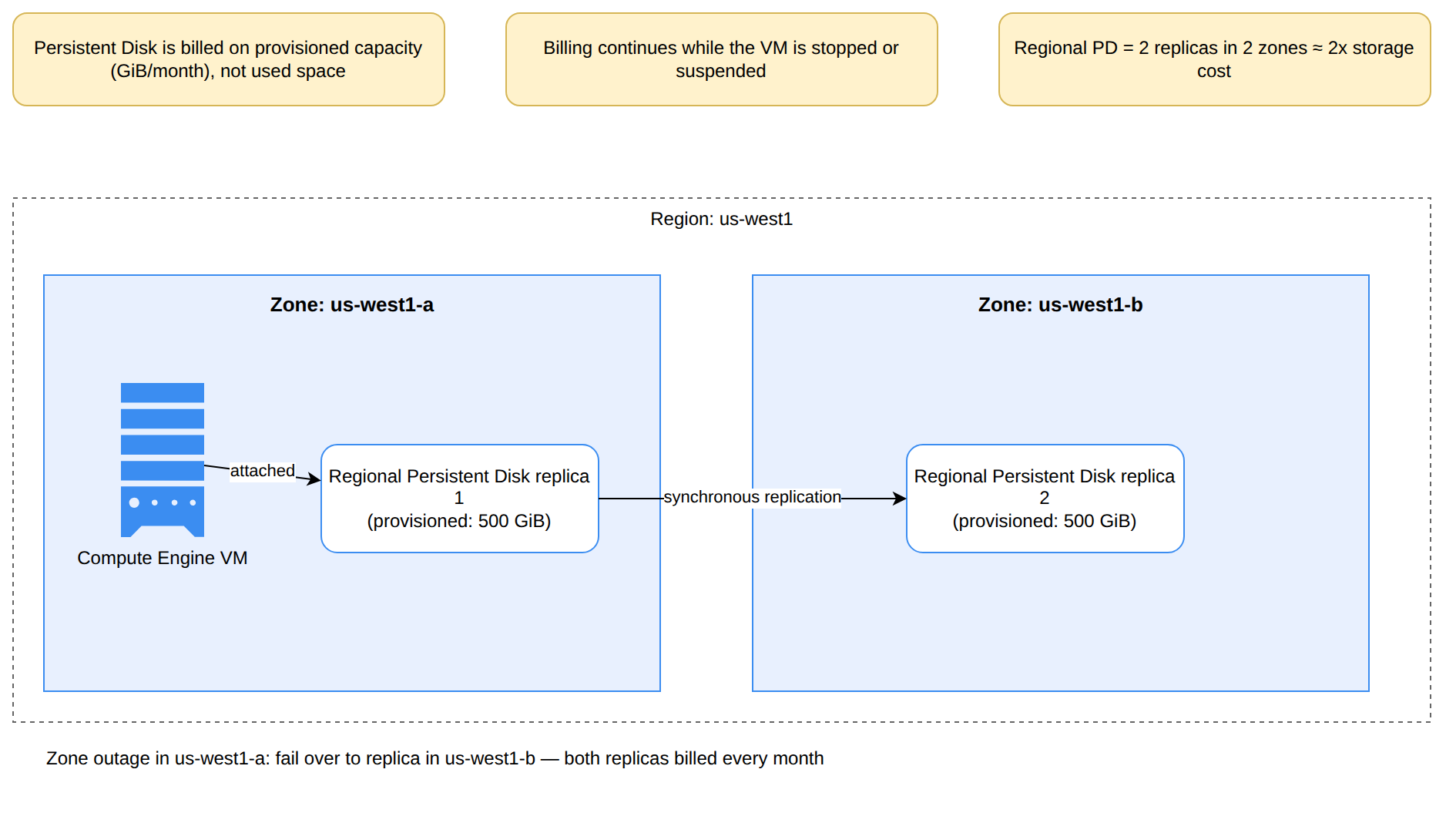
Key Cost and Architecture Considerations
- Capacity drives performance: In standard, balanced, and SSD Persistent Disks, baseline IOPS and throughput scale linearly with provisioned capacity. Achieving higher I/O performance often requires over-provisioning disk size.
- Persistent lifecycle: Storage billing starts when the volume is created and continues uninterrupted until the disk is explicitly deleted, even if unattached.
- Differentiation across tiers: Disk performance tiers (pd-standard, pd-balanced, pd-ssd, and pd-extreme) feature distinct base pricing per GiB to reflect underlying hardware media (HDDs vs. solid-state drives).
- Snapshot costs: Point-in-time incremental snapshots incur additional storage costs based on delta changes stored in Cloud Storage.
Why This Is Optimal
Understanding that Persistent Disk charges depend on provisioned capacity, persistent reservation, and cross-zone replication allows architects to forecast storage expenditures accurately, avoid surprise bills from idle stopped instances, and properly balance database availability against budget constraints.
Storage capacity is billed at an identical flat rate across all Persistent Disk tiers, with pricing differences determined solely by the number of read and write I/O operations.
Storage capacity is billed at an identical flat rate across all Persistent Disk tiers, with pricing differences determined solely by the number of read and write I/O operations.
What Disk Performance Tiers and I/O Operations Are
Google Cloud offers multiple Persistent Disk types suited for different workload profiles, including Standard Persistent Disk (pd-standard using HDD), Balanced Persistent Disk (pd-balanced using SSD), and SSD Persistent Disk (pd-ssd). Each tier delivers distinct input/output operations per second (IOPS) and throughput limits, with higher tiers offering substantially lower latency for random read and write operations.
Why It Doesn't Meet the Requirement
- Incorrect pricing structure: Persistent Disk types do not share an identical flat rate per GiB. Solid-state disk tiers (
pd-balancedandpd-ssd) carry higher unit costs per provisioned gigabyte than magnetic hard disk drives (pd-standard) due to the higher underlying hardware and infrastructure expenses. - No per-operation I/O billing: Unlike services that charge for API operations (such as Class A and Class B operations in Cloud Storage), standard and SSD Persistent Disks do not bill for individual read or write I/O requests. Instead, a customer pays exclusively for the provisioned capacity per month, and the allowable IOPS and throughput scale automatically based on that provisioned size.
Key Characteristics of Persistent Disk Tiers
- Linear performance scaling: For
pd-standard,pd-balanced, andpd-ssd, maximum IOPS and throughput increase proportionally with every gigabyte provisioned until instance vCPU limits are reached. - Tiered per-GiB pricing:
pd-ssdoffers high IOPS at a higher per-GiB price point,pd-standardoffers budget sequential storage at the lowest per-GiB price, andpd-balancedprovides an intermediate cost-to-performance compromise. - Dedicated performance billing exceptions: Only specialized block storage types, such as Hyperdisk or Extreme Persistent Disk (
pd-extreme), allow customers to provision and pay separately for target IOPS and throughput independent of disk volume.
This Answer Would Be Correct If
This logic would apply if the team were evaluating transactional NoSQL databases like Firestore in Datastore mode, or object storage retrieval APIs in Cloud Storage, where pricing incorporates discrete charges for read, write, and delete operations rather than relying purely on provisioned capacity scaling.
Regional Persistent Disks cost the exact same per gigabyte as zonal disks, because Google Cloud provides multi-zone synchronous replication as a built-in feature without additional storage charges.
Regional Persistent Disks cost the exact same per gigabyte as zonal disks, because Google Cloud provides multi-zone synchronous replication as a built-in feature without additional storage charges.
What Regional Persistent Disks Are
A Regional Persistent Disk is a durable block storage device that provides synchronous replication of data between two zones located within the same Google Cloud region. If an unexpected zonal failure or scheduled maintenance occurs in one zone, the attached workload or virtual machine can rapidly fail over to the secondary zone using the standby disk replica.
Why It Doesn't Meet the Requirement
- Underestimates replication costs: Regional replication is not provided at the same price as a single-zone disk. To provide synchronous replication, Google Cloud provisions and maintains two independent copies of the disk volume across separate data center facilities. As a result, the storage price per provisioned GiB for a Regional Persistent Disk is roughly double the price of a standard Zonal Persistent Disk of the same type.
- Miscalculates high availability budgeting: Assuming that regional disaster recovery carries zero additional storage expenditure will lead to severe budget underestimations. When planning high-availability architectures for database servers or Cloud SQL regional instances, engineers must account for the doubled storage unit cost required to maintain two synchronized disk replicas.
Key Characteristics of Regional Persistent Disks
- Dual-zone replication: Synchronously writes data to two zones before confirming the write operation, ensuring zero Recovery Point Objective (RPO) across zones.
- Direct 2x cost impact: Storage capacity pricing reflects the underlying physical infrastructure, effectively doubling the monthly cost per provisioned GiB compared to zonal disks.
- Failover mechanism: Only the storage layer is replicated; compute instances must be started or managed in the secondary zone to attach the surviving replica upon a zonal outage.
This Answer Would Be Correct If
This assumption would only be valid if Google Cloud included multi-zone physical block replication at no additional cost as part of a basic zonal storage SLA, or if the workload relied on an application-level logical replication framework that handled cross-zone syncing across separate, independently billed compute and storage resources.
Try 10 interactive questions like this one, free
Answer them yourself and get your score the moment you finish. No account needed.
Full access includes
- 2,014 practice questions across all 4 exam domains
- Every answer explained: why it is right, and why the others are not
- Scout, an AI tutor that answers your follow-up questions
- Readiness tracking by domain, so you know when to book the exam
Related free sample questions
Keep the momentum going with these hand-picked practice scenarios
FundamentalAssociate Cloud Engineer
Coldline Storage Access Frequency
Estimating costs of data storage resources
FundamentalAssociate Cloud Engineer
Cloud Storage Retrieval, Egress, and API Request Costs
Estimating costs of data storage resources
FundamentalAssociate Cloud Engineer
Organization Policy List vs Boolean Constraints
Applying organizational policies to the resource hierarchy
FundamentalAssociate Cloud Engineer
kubectl describe vs kubectl get
Viewing current running GKE cluster inventory (e.g., nodes, Pods, Services)
FundamentalAssociate Cloud Engineer
Workload Identity Federation for External Workloads
Creating and managing short-lived service account credentials
AdvancedProfessional Data Engineer
BigQuery Fine-Grained Access Control
Defining rules to share data
Last updated