Fundamental
Prepare and test your skills

Fundamental
Prepare and test your skills
Safe GKE Node Pool Migration With Cordon and Drain
Free sample question with answers and detailed explanation below. The Associate Cloud Engineer practice bank has an additional 2,014 practice questions.Try 10 free realistic questions: instant score, no credit card, and no account required.
Your company runs a production application on a Google Kubernetes Engine (GKE) cluster in a node pool named pool-1. You create a new node pool named pool-2 with upgraded machine types and need to migrate your existing workloads to pool-2 before retiring pool-1.
You want to ensure that all workloads are safely rescheduled onto pool-2 with zero unexpected downtime before removing the old nodes.
Which sequence of actions should you take?
Explanations
Update the cluster autoscaler to set the maximum nodes of pool-1 to 0 and let GKE remove the nodes automatically.
Update the cluster autoscaler to set the maximum nodes of pool-1 to 0 and let GKE remove the nodes automatically.
What Modifying Autoscaler Limits Does
Adjusting the cluster autoscaler's maximum node boundary (--max-nodes) restricts the upper ceiling of nodes that the autoscaler can provision during high traffic or resource contention.
Why It Doesn't Meet the Requirement
- Fails to remove existing nodes: Setting
--max-nodesto0does not automatically scale down running instances if--min-nodesor current demand keeps nodes active; in fact, setting max nodes below current size is invalid or ineffective for draining. - Does not migrate workloads: The autoscaler only scales down nodes when they are unneeded and underutilized over a prolonged period. It does not actively initiate a safe migration of active, healthy pods to
pool-2.
Key Limitations
- The autoscaler is designed for demand-based elasticity, not manual workload migration.
- Does not cordon nodes against new scheduling events.
- Leaves the node pool intact rather than decommissioned.
This Answer Would Be Correct If
You wanted to prevent a node pool from expanding further during an autoscaling event while allowing existing nodes to handle current traffic.
Additional Context
To decommission a node pool permanently, administrators must explicitly drain workloads and delete the node pool object rather than manipulating autoscaling limits.
Cordon and drain the nodes in pool-1, verify pods are running on pool-2, and then delete pool-1.
Cordon and drain the nodes in pool-1, verify pods are running on pool-2, and then delete pool-1.
What Cordoning and Draining Is
In Kubernetes and Google Kubernetes Engine (GKE), cordoning marks a node as unschedulable to prevent new Pods from being placed on it, while draining gracefully evicts and terminates existing running Pods so that the Kubernetes control plane reschedules them onto other eligible nodes in the cluster.
How It Meets the Requirements
- Zero unexpected downtime: Running
kubectl cordonensures no new incoming workloads land onpool-1. Runningkubectl drainrespects Pod Disruption Budgets (PDBs) and graceful termination periods, cleanly evicting Pods so they get scheduled onto available nodes inpool-2. - Safe node pool retirement: Once all Pods have successfully migrated to
pool-2and the old nodes are confirmed empty, deletingpool-1withgcloud container node-pools deletesafely removes the underlying Compute Engine instances without data loss or interrupted requests.
Key Advantages and Capabilities
- Graceful Pod termination: Gives containers time to complete inflight requests and execute pre-stop lifecycle hooks.
- Controlled rescheduling: Directs the scheduler to place workloads exclusively onto active nodes in
pool-2. - Validation before destruction: Allows cluster operators to verify workload health and resource capacity on the new pool prior to permanent deletion.
- Disruption budget enforcement: Prevents violating minimum availability guarantees defined in PodDisruptionBudget objects.
Cordon, Drain, Reschedule, Delete in Order
Sequence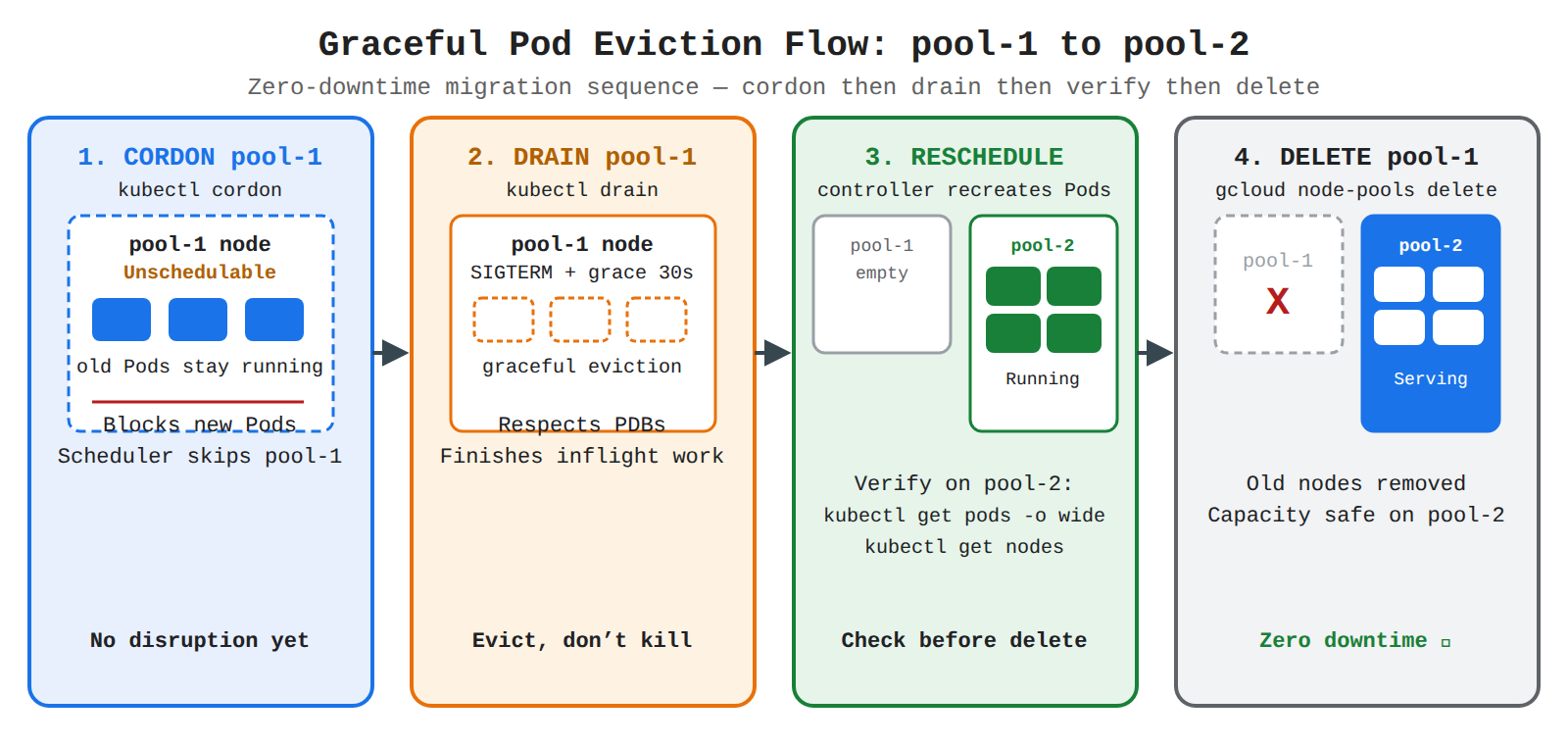
Edit the machine type of pool-1 directly using gcloud container node-pools update to match pool-2.
Edit the machine type of pool-1 directly using gcloud container node-pools update to match pool-2.
What Node Pool In-Place Updating Is
In GKE, certain node pool properties (such as node auto-upgrade, auto-repair, and autoscaling boundaries) can be modified in-place on an existing node pool using the CLI or Google Cloud Console.
Why It Doesn't Meet the Requirement
- Immutable hardware specifications: Fundamental hardware attributes such as machine type, boot disk type, and disk size cannot be changed on an existing node pool after creation.
- Requires replacement: To change machine types, operators must create a brand-new node pool with the desired specifications, migrate the workloads, and delete the original node pool.
Key Limitations
- Machine type and hypervisor architectures are immutable after node pool provisioning.
- Attempting to update the machine type directly on an existing pool will result in a command validation error.
This Answer Would Be Correct If
The operator were updating mutable pool properties such as enabling cluster autoscaling, updating node labels, or changing maintenance windows.
Additional Context
Because machine types are immutable, creating a new node pool and executing a cordon-and-drain migration is the standard method for resizing cluster nodes.
Delete pool-1 immediately using gcloud container node-pools delete so that GKE automatically moves all pods to pool-2.
Delete pool-1 immediately using gcloud container node-pools delete so that GKE automatically moves all pods to pool-2.
What Immediate Node Pool Deletion Does
Deleting a node pool directly via the Google Cloud CLI immediately signals GKE to tear down the managed instance groups and delete the virtual machine instances associated with that specific pool.
Why It Doesn't Meet the Requirement
- Risk of abrupt service interruption: Deleting a node pool directly bypasses the operator's opportunity to verify capacity and workload placement in advance, potentially causing sudden container termination and downtime if workloads take time to restart.
- Lack of verification: If
pool-2lacks sufficient CPU, memory, or compatible taints/tolerations, evicting pods via direct deletion can leave critical workloads in an unschedulablePendingstate.
Key Limitations
- Does not allow controlled, phased workload verification across pools.
- Can terminate active connections and state before new replicas are healthy.
- Eliminates the fallback path if
pool-2encounters unexpected configuration issues.
This Answer Would Be Correct If
The cluster were running purely non-critical, fault-tolerant batch workloads or a disposable development environment where sudden termination and downtime carry no operational impact.
Additional Context
Always perform explicit node cordon and drain operations in production environments to maintain visibility and control over workload redistribution.
Try 10 interactive questions like this one, free
Answer them yourself and get your score the moment you finish. No account needed.
Full access includes
- 2,014 practice questions across all 4 exam domains
- Every answer explained: why it is right, and why the others are not
- Scout, an AI tutor that answers your follow-up questions
- Readiness tracking by domain, so you know when to book the exam
Related free sample questions
Keep the momentum going with these hand-picked practice scenarios
FundamentalAssociate Cloud Engineer
Kubernetes Node Taints and Tolerations
Working with GKE node pools (e.g., add, edit, or remove a node pool; autoscaling node pool)
FundamentalAssociate Cloud Engineer
GKE Cluster Autoscaler Node Pool Scaling
Working with GKE node pools (e.g., add, edit, or remove a node pool; autoscaling node pool)
FundamentalAssociate Cloud Engineer
Helm Templates and Values Files
Infrastructure as code tooling (e.g., Fabric FAST, Config Connector, Terraform, Helm)
FundamentalAssociate Cloud Engineer
GKE Gateway API HTTPRoute Weighted Traffic Splitting
Adjusting application traffic splitting parameters (e.g., Cloud Run, Cloud Run functions, GKE)
FundamentalAssociate Cloud Engineer
Static Internal IP Primary CIDR Requirement
Reserving static external or internal IP addresses
FundamentalGenerative AI Leader
Open Standards Prevent Vendor Lock-In
Describing the benefits of Google Cloud's open approach
Last updated