Fundamental
Prepare and test your skills

Fundamental
Prepare and test your skills
Using GKE Node Taints for Workload Isolation
Free sample question with answers and detailed explanation below. The Associate Cloud Engineer practice bank has an additional 2,014 practice questions.Try 10 free realistic questions: instant score, no credit card, and no account required.
You are creating a new node pool in an existing Google Kubernetes Engine (GKE) cluster to host dedicated, high-priority workloads. You need to ensure that general application pods are not scheduled on these specific nodes, while allowing only dedicated pods configured with matching tolerations to run on them.
Which configuration should you apply to the node pool?
Explanations
Configure a maintenance window on the cluster
Configure a maintenance window on the cluster
What Maintenance Windows Are
Maintenance windows and maintenance exclusions in GKE allow administrators to control the timing of automated control plane and node pool upgrades. By setting a maintenance window, you define recurring time periods during which GKE is permitted to perform automatic updates and repairs, helping prevent disruptions during peak business hours.
Why It Doesn't Meet the Requirement
- Workload placement control: Maintenance windows manage the schedule of administrative lifecycle events (such as Kubernetes version upgrades and OS patch rollouts). They do not govern where pods are scheduled or which workloads can run on specific nodes.
- Preventing general pods: Standard workloads will still be scheduled on the node pool regardless of whether a maintenance window is active or configured.
Key Characteristics and Limitations
- Upgrade scheduling: Restricts automated version upgrades and node recreation to designated off-peak windows.
- Cluster stability: Helps ensure high availability by avoiding unplanned reboots or node drains during critical operations.
- No pod-level filtering: Does not affect Kubernetes scheduler behavior or pod assignment.
This Answer Would Be Correct If
The requirement was to limit automated GKE node pool updates and version upgrades to specific hours during the weekend or night to minimize production disruption.
Configure node taints on the node pool
Configure node taints on the node pool
What Node Taints Are
Node taints are a core Kubernetes scheduling primitive applied to nodes or entire GKE node pools to repel certain sets of pods. A taint consists of a key, value, and an effect (such as NoSchedule, PreferNoSchedule, or NoExecute). Nodes configured with a taint will reject any pod that does not possess a matching toleration in its pod specification.
Taint Filter Allows Only Tolerating Pods
Decision Tree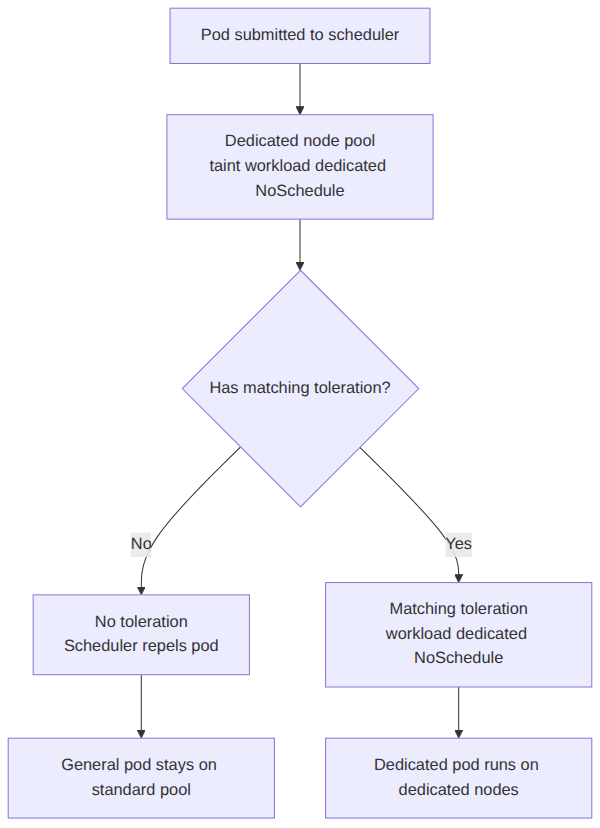
How It Meets the Requirements
- Preventing general workloads: Applying a taint (such as
workload=dedicated:NoSchedule) ensures that standard pods lacking a matching toleration cannot be scheduled on the nodes within this node pool. - Allowing dedicated workloads: High-priority or specialized pods configured with a matching toleration (
tolerations: [{key: "workload", operator: "Equal", value: "dedicated", effect: "NoSchedule"}]) are permitted to schedule onto these tainted nodes. - Node pool management: Taints can be configured directly during node pool creation using
gcloud container node-pools create --node-taintsor via the Google Cloud console, applying uniformly across all worker nodes in the pool.
Key Advantages and Capabilities
- Granular workload isolation: Enforces node dedication for specific workloads such as GPU tasks, batch processing, or sensitive multi-tenant services.
- Flexible scheduling control: Works seamlessly alongside node labels and nodeSelectors or nodeAffinity to ensure pods both repel unwanted workloads and attract the desired ones.
- Lifecycle consistency: Automatically applies the configured taints to any newly provisioned nodes when the node pool scales out.
- Non-disruptive placement control: Protects specialized compute resources without requiring separate GKE clusters.
Why This Is Optimal
Configuring node taints at the node pool level directly solves the requirement of restricting pod placement. Other features like network tags or maintenance windows govern network routing and upgrade schedules respectively, but only taints prevent the Kubernetes scheduler from placing standard pods on dedicated nodes.
Enable GKE node auto-repair on the node pool
Enable GKE node auto-repair on the node pool
What Node Auto-Repair Is
Node auto-repair is a GKE management feature that continuously monitors the health of worker nodes in a node pool. If a node fails health checks consistently (for example, reporting a NotReady status for an extended period), GKE automatically initiates a drain and recreation process to restore node health.
Why It Doesn't Meet the Requirement
- Workload placement control: Node auto-repair is a node availability and self-healing mechanism. It does not control pod scheduling, nor does it enforce workload isolation.
- Preventing general pods: Enabling auto-repair does nothing to block non-dedicated workloads from being scheduled onto the node pool.
Key Characteristics and Limitations
- Automated remediation: Automatically recreates failed or unhealthy VMs to maintain desired pool capacity.
- Works with auto-upgrades: Commonly paired with node auto-upgrades to maintain cluster reliability and consistency.
- No scheduler integration: Does not modify Kubernetes node taints, labels, or pod tolerations.
This Answer Would Be Correct If
The objective was to ensure that unhealthy or unresponsive nodes in the node pool are automatically detected and replaced without manual administrator intervention.
Apply Compute Engine network tags to the node pool
Apply Compute Engine network tags to the node pool
What Network Tags Are
Compute Engine network tags are metadata strings assigned to the underlying virtual machine (VM) instances that comprise GKE nodes. They are primarily used in Virtual Private Cloud (VPC) firewall rules and route configurations to identify which VM instances a firewall rule or route should apply to.
Why It Doesn't Meet the Requirement
- Workload placement control: Network tags operate at the infrastructure and network layer (Layer 3/4 routing and firewall policies). They have no awareness of Kubernetes pods, the kube-scheduler, or workload placement logic.
- Preventing pod scheduling: Applying network tags to a node pool does not prevent general pods from being scheduled on the nodes. Standard pods will continue to be scheduled onto these nodes by Kubernetes based solely on resource availability.
Key Characteristics and Limitations
- Security and routing focus: Useful for attaching firewall rules to restrict network traffic entering or leaving specific node pools.
- Infrastructure level: Network tags apply to Compute Engine VM instances, not directly to Kubernetes scheduling objects.
- No toleration mechanism: Network tags do not interact with Kubernetes pod specifications, tolerations, or scheduling constraints.
This Answer Would Be Correct If
The scenario required applying specific VPC firewall rules or routing policies to allow or deny network traffic to and from the nodes in a specific node pool.
Try 10 interactive questions like this one, free
Answer them yourself and get your score the moment you finish. No account needed.
Full access includes
- 2,014 practice questions across all 4 exam domains
- Every answer explained: why it is right, and why the others are not
- Scout, an AI tutor that answers your follow-up questions
- Readiness tracking by domain, so you know when to book the exam
Related free sample questions
Keep the momentum going with these hand-picked practice scenarios
FundamentalAssociate Cloud Engineer
GKE Cluster Autoscaler Node Pool Scaling
Working with GKE node pools (e.g., add, edit, or remove a node pool; autoscaling node pool)
FundamentalAssociate Cloud Engineer
Cordon and Drain Node Migration
Working with GKE node pools (e.g., add, edit, or remove a node pool; autoscaling node pool)
FundamentalAssociate Cloud Engineer
Custom Machine Type Memory Constraints
Using Spot VM instances and custom machine types
FundamentalAssociate Cloud Engineer
Standard vs Premium Network Service Tiers
Differentiating Network Service Tiers
FundamentalAssociate Cloud Engineer
Dedicated vs Partner Interconnect
Establishing network connectivity (e.g., Cloud VPN, VPC Network Peering, Cloud Interconnect)
IntermediateProfessional Cloud Database Engineer
Index Defragmentation vs Spanner Compaction
Perform database maintenance (e.g., rebuilding indexes, data exports)
Last updated