Fundamental
Prepare and test your skills

Fundamental
Prepare and test your skills
Static Internal IP Addresses Use Primary Ranges
Free sample question with answers and detailed explanation below. The Associate Cloud Engineer practice bank has an additional 2,014 practice questions.Try 10 free realistic questions: instant score, no credit card, and no account required.
Your team is deploying an internal database workload on a Compute Engine virtual machine (VM) in a custom VPC network. The database must maintain a consistent, persistent private IP address so that other microservices within the VPC can reliably reach it across restarts, maintenance events, and redeployments. The target subnet has a primary IPv4 CIDR range as well as configured secondary CIDR ranges.
Which requirement must be met when reserving and assigning a static internal IP address for the VM instance's primary network interface?
Explanations
The static internal IP address must be reserved globally at the VPC network level rather than within a regional subnet.
The static internal IP address must be reserved globally at the VPC network level rather than within a regional subnet.
What Global IP Reservations Are
Global IP reservations in Google Cloud apply exclusively to external (public) IPv4 and IPv6 addresses used with global load balancers, such as the Global External Application Load Balancer. Global IP addresses do not belong to any individual subnet or region.
Why It Doesn't Meet the Requirement
- Subnet Scope: Internal IP addresses in Google Cloud are strictly regional and subnet-bound. A static internal IP must always be allocated from an IP range defined within a specific subnet in a specific region.
- VPC Routing: Because VPC subnets are regional resources, private internal communication relies on subnet-level routing tables, making global internal IP allocation impossible.
Key Characteristics
- Regional Resource Boundary: Static internal IP address resources are created within a designated region and associated with a specific VPC subnet.
- External vs. Internal Scope: Only external IP addresses supporting global Anycast frontends can have a global scope.
- Subnet Isolation: Internal IP addresses cannot float across different subnets or regions freely.
This Answer Would Be Correct If
You were reserving a static public IP address for a global frontend service, such as configuring a Global External Application Load Balancer to accept worldwide public internet traffic.
The static internal IP address can be reserved from either the primary range or any secondary CIDR range configured on the subnet.
The static internal IP address can be reserved from either the primary range or any secondary CIDR range configured on the subnet.
What Secondary CIDR Ranges Are
Secondary CIDR ranges are additional IP address ranges attached to an existing VPC subnet. They are primarily designed for allocating alias IP ranges to virtual machines, which is standard practice in containerized environments like Google Kubernetes Engine (GKE) where pods require separate IP addresses on the same host network interface.
Why It Doesn't Meet the Requirement
- No Reservations from Secondary Ranges: Google Cloud explicitly restricts internal IP address reservations to the primary subnet range. You cannot reserve a standalone static internal IP address from a secondary CIDR range.
- Primary Interface Constraint: The primary network interface's main IP must always reside within the primary CIDR block of the subnet.
Key Limitations
- Secondary Range Use Cases: Secondary ranges are strictly reserved for alias IP allocations or multi-IP container architectures.
- Reservation Failure: Attempting to reserve an internal IP address specifying an address inside a secondary range will result in an API validation error.
- Gateway Association: All alias and secondary IPs rely on the default gateway established by the primary subnet range.
This Answer Would Be Correct If
You were assigning an unreserved, dynamically allocated alias IP range to a VM interface or provisioning pod address spaces in a GKE cluster rather than creating a reserved static internal IP address for a VM's primary interface.
The static internal IP address must be reserved from the subnet's primary CIDR range.
The static internal IP address must be reserved from the subnet's primary CIDR range.
What Static Internal IP Address Reservation Is
A static internal IP address is a private IPv4 address reserved from a specific subnet in a Virtual Private Cloud (VPC) network. Unlike ephemeral internal IP addresses, which can change when a VM instance is stopped and restarted or deleted and recreated, a reserved static internal IP address remains assigned to your project and bound to your specified resource until explicitly released.
How It Meets the Requirements
- Consistent Private Addressing: Reserving a static internal IP address ensures that the internal database VM maintains the exact same private IPv4 address across reboots, maintenance disruptions, and VM instance replacements.
- Primary Interface Allocation: Google Cloud requires that the primary internal IPv4 address of any network interface (
nic0) must be drawn from the subnet's primary CIDR range. - Subnet Reservation Support: While secondary CIDR ranges exist for alias IP allocation (such as container pods in GKE), standalone static internal IP address reservations must be allocated from the subnet's primary range.
Primary Range Supplies Static Internal IP
Set Relationship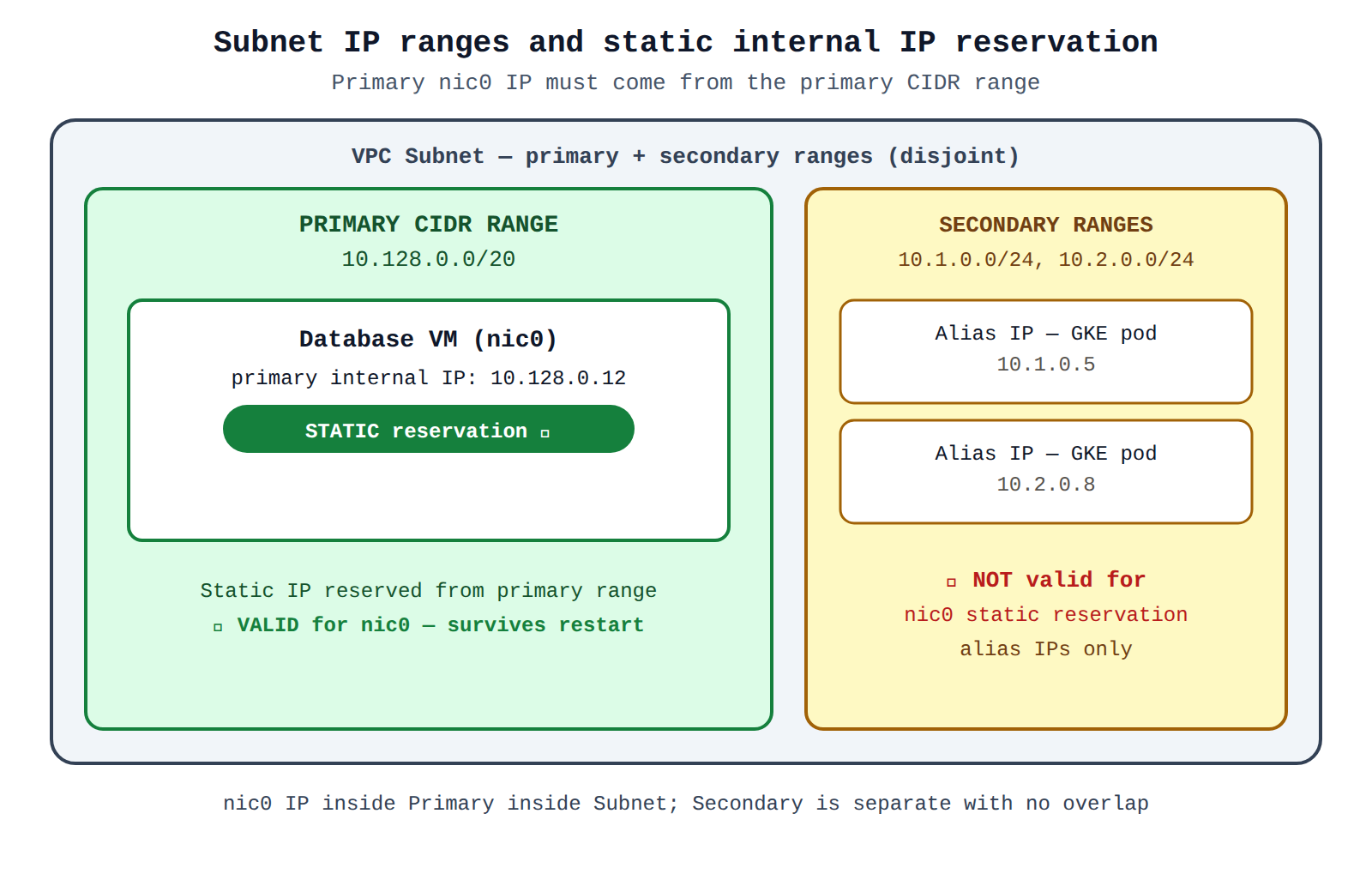
Key Advantages and Capabilities
- Reliable Service Discovery: Internal microservices and configuration files can target a fixed internal IP address without fear of unexpected IP shifts.
- High Availability and Failover: You can reassign a reserved static internal IP from a failed VM instance to a standby replacement VM in the same subnet with minimal downtime.
- Non-Disruptive Lifecycle: The reserved address remains securely allocated within the VPC even when the attached VM is stopped.
- Automated Internal DNS: Google Cloud automatically registers the instance hostname with the primary static internal IP address on the primary interface.
Why This Is Optimal
Reserving the internal IP directly from the primary subnet CIDR block aligns with Google Cloud networking architecture, guarantees predictable routing across the VPC, and satisfies the requirement for persistent communication across application services.
The static internal IP address must be assigned as an ephemeral address first and cannot be reserved prior to instance creation.
The static internal IP address must be assigned as an ephemeral address first and cannot be reserved prior to instance creation.
How Internal IP Address Reservation Methods Work
Google Cloud provides two distinct ways to obtain a static internal IP address: reserving a new address in advance (standalone reservation) or promoting an existing ephemeral internal IP address to static.
Why It Doesn't Meet the Requirement
- Pre-Reservation Is Supported: You do not have to create an ephemeral VM first. You can reserve an internal IP address explicitly before provisioning any compute resource by specifying the target subnet and IP address.
- Infrastructure as Code Compatibility: Modern deployment workflows using Terraform, Deployment Manager, or automation scripts routinely reserve IP addresses prior to launching VM instances to maintain clean resource dependencies.
Key Characteristics
- Standalone Reservations: Static internal IPs can exist independently of any VM and wait in a reserved state until attached.
- Promotion Capability: If an existing VM already runs with an ephemeral IP, you have the option to promote it in place to avoid address reassignment.
- Flexible Workflow: Administrators can choose either pre-allocation or post-creation promotion depending on their operational preferences.
This Answer Would Be Correct If
Google Cloud enforced mandatory post-provisioning promotion, preventing pre-allocation in CI/CD and orchestration pipelines, which is not how Google Cloud VPC IP management functions.
Try 10 interactive questions like this one, free
Answer them yourself and get your score the moment you finish. No account needed.
Full access includes
- 2,014 practice questions across all 4 exam domains
- Every answer explained: why it is right, and why the others are not
- Scout, an AI tutor that answers your follow-up questions
- Readiness tracking by domain, so you know when to book the exam
Related free sample questions
Keep the momentum going with these hand-picked practice scenarios
FundamentalAssociate Cloud Engineer
Promoting Ephemeral IP to Static
Reserving static external or internal IP addresses
FundamentalAssociate Cloud Engineer
Regional vs Global Static External IP
Reserving static external or internal IP addresses
FundamentalAssociate Cloud Engineer
Compute OS Login vs OS Admin Login
Configuring OS Login
FundamentalAssociate Cloud Engineer
Cloud DNS Managed Private Zones
Working with Cloud DNS and Cloud NAT
FundamentalAssociate Cloud Engineer
Regional vs Global Quotas
Assessing quotas and requesting increases
FundamentalGenerative AI Leader
Custom Gems Enterprise Data Grounding
Recognizing the functionality, use cases, and business value of the Gemini app and Gemini Advanced (e.g., Gems)
Last updated