Fundamental
Prepare and test your skills

Fundamental
Prepare and test your skills
Weighted Canary Splits With GKE HTTPRoute
Free sample question with answers and detailed explanation below. The Associate Cloud Engineer practice bank has an additional 2,014 practice questions.Try 10 free realistic questions: instant score, no credit card, and no account required.
Your company runs a web service on Google Kubernetes Engine (GKE) and is rolling out an updated version of the application. You want to execute a canary release by routing 90% of incoming HTTP user traffic to the stable production Service (v1-service) and 10% to the new release Service (v2-service).
Which GKE traffic management resource should you configure to implement this traffic split?
Explanations
A NetworkPolicy resource, defining egress traffic filters with percentage allocations between the two deployment pods
A NetworkPolicy resource, defining egress traffic filters with percentage allocations between the two deployment pods
What a Kubernetes NetworkPolicy Is
A NetworkPolicy is a Kubernetes security specification that controls network communication between pod groups and network endpoints. It acts as a distributed packet firewall at Layers 3 and 4, allowing administrators to define which pods can send (egress) or receive (ingress) network packets.
Why It Doesn't Meet the Requirement
- Security mechanism, not load balancer: NetworkPolicies allow or deny network packets based on IP addresses, pod selectors, and port numbers; they cannot route, forward, or split client requests.
- No percentage-based routing: NetworkPolicy rules are binary evaluations (allow or block). They do not have mechanisms to distribute percentages of traffic between competing destinations.
- Cannot manage incoming public traffic: External client traffic entering the cluster via an ingress controller or load balancer cannot be weighted or dynamically balanced using pod firewall policies.
Key Characteristics and Limitations
- Firewall focus: Enforces zero-trust isolation and prevents unauthorized lateral movement between microservices.
- Operates at L3/L4: Evaluates IP CIDRs, protocols (TCP/UDP/SCTP), and port numbers, with no understanding of HTTP requests, URLs, or application-layer weights.
- All-or-nothing traffic rules: Packets matching an egress rule are permitted; packets not matching are dropped.
This Answer Would Be Correct If
You needed to enforce network security boundaries, such as blocking the v2 canary pods from communicating with an unapproved backend database or restricting access to specific namespaces.
Additional Context
Network policies must be enabled via the GKE Network Policy engine or Dataplane V2. They complement traffic routing resources by securing pod-to-pod communication but play no role in external load balancing or traffic splitting.
A standard Kubernetes Service of type LoadBalancer, configuring weighted targetPort definitions for each deployment
A standard Kubernetes Service of type LoadBalancer, configuring weighted targetPort definitions for each deployment
What a Service of Type LoadBalancer Is
A Kubernetes Service of type LoadBalancer creates an external Layer 4 (TCP/UDP) network load balancer in Google Cloud. It provides a single stable IP address and balances network traffic evenly across all pods that match its selector labels.
Why It Doesn't Meet the Requirement
- Lack of weighted traffic controls: Standard Kubernetes Services distribute connections round-robin or randomly across matching pod endpoints; they do not have a native
weightfield for splitting percentages between different Services. - No multi-Service traffic splitting: A Service selects pods using label selectors. You cannot point a single standard Service definition to multiple other Services to divide traffic by percentage.
- Layer 4 limitation: Type
LoadBalanceroperates at Layer 4 (transport layer) rather than Layer 7 (HTTP layer), making it unsuitable for advanced HTTP request routing and fine-grained canary percentages.
Key Characteristics and Limitations
- Equal distribution per pod: Traffic is distributed uniformly across all healthy target endpoints rather than allocated by specified percentages.
- No L7 awareness: Cannot inspect HTTP paths, request headers, cookies, or hostnames to direct traffic.
- Coarse canary only: Achieving a 90/10 split using standard Services would require running 9 pods of
v1and 1 pod ofv2under the same selector, which wastes compute resources and lacks operational flexibility.
This Answer Would Be Correct If
Your requirement was simply to expose a single TCP-based containerized workload directly to the internet with basic Layer 4 load balancing across all backend instances.
Additional Context
While pod-ratio scaling was an early workaround for canary testing in Kubernetes, modern GKE architectures use Layer 7 solutions like the Gateway API or Service Mesh to control traffic weights independently of pod replica counts.
An HTTPRoute resource attached to a Gateway, configuring backendRefs with weight parameters for each Service
An HTTPRoute resource attached to a Gateway, configuring backendRefs with weight parameters for each Service
What the Gateway API HTTPRoute Is
The Gateway API in Google Kubernetes Engine (GKE) is a modern, standards-based specification for service networking and ingress. Within this API, the HTTPRoute resource defines routing rules for HTTP and HTTPS traffic, allowing advanced traffic management capabilities such as header matching, URL rewrites, and weighted traffic distribution across multiple backend Kubernetes services.
How It Meets the Canary Release Requirement
- Precise percentage splitting: Under
rules.backendRefs, theHTTPRoutemanifest accepts multiple target Services and assigns an integerweightto each. - Weight distribution: By assigning a weight of
90tov1-serviceand a weight of10tov2-service, the underlying Google Cloud Load Balancer distributes 90% of requests to the stable version and 10% to the canary deployment. - Dynamic updates: You can adjust traffic percentages seamlessly over time (e.g., from 90/10 to 50/50, and eventually 0/100) by updating the
HTTPRoutemanifest without modifying application pods or recreating network load balancers.
Key Advantages and Capabilities
- Declarative traffic splitting: Enables Canary and Blue/Green deployment strategies natively through standard Kubernetes resources.
- Role-oriented architecture: Separates infrastructure provisioning (managed by cluster administrators via
Gatewayresources) from application routing rules (managed by application developers viaHTTPRouteresources). - Advanced routing policies: Supports header-based routing, path matching, query parameter inspection, and traffic mirroring alongside weighted splits.
- Native GCP Load Balancer integration: GKE automatically programs Google Cloud external or internal Application Load Balancers based on Gateway API definitions.
Why This Is Optimal
The GKE Gateway API is Google Cloud's recommended next-generation solution for L7 ingress and advanced traffic routing. Unlike traditional Ingress objects that require vendor-specific annotations for basic traffic splits, HTTPRoute natively defines weighted multi-backend routing as part of the core specification.
A standard Kubernetes Ingress resource, specifying multiple path rules pointing to different backend Services
A standard Kubernetes Ingress resource, specifying multiple path rules pointing to different backend Services
What a Standard Kubernetes Ingress Is
A standard Kubernetes Ingress resource manages external HTTP/HTTPS access to services within a cluster. It defines rules based on request hostnames and URL paths (such as routing /api to one Service and /static to another).
Why It Doesn't Meet the Requirement
- No native percentage weighting: The core Kubernetes
Ingressspecification only supports path-based and host-based routing. It does not provide native syntax to split traffic dynamically across multiple backends for the same URL path. - Separate path mapping: Defining multiple
pathentries routes distinct URL endpoints to distinct Services (e.g.,/v1vs/v2), which requires clients to explicitly call different URLs rather than transparently receiving the 90/10 canary split on the main application endpoint.
Key Characteristics and Limitations
- Path and host bound: Directs traffic according to request URLs (e.g.,
example.com/app) rather than distributing identical requests probabilistically. - Monolithic resource model: Combines load balancer configuration and route definitions into a single object, leading to management bottlenecks across large development teams.
- Superceded by Gateway API: The Kubernetes community designed the Gateway API specifically to overcome Ingress limitations like lack of weighted multi-backend routing.
This Answer Would Be Correct If
The objective was to route users to different microservices based on distinct URL prefixes (e.g., /orders and /catalog) rather than performing a percentage-based canary release across identical endpoints.
Additional Context
Although some third-party Ingress controllers offer custom vendor annotations for canary routing, standard GKE Ingress does not offer native declarative traffic splitting, making the Gateway API the recommended mechanism in GKE.
Try the scenario
GKE Canary Release: pick the traffic-splitting resource
Change the inputs and watch how the outcome changes.
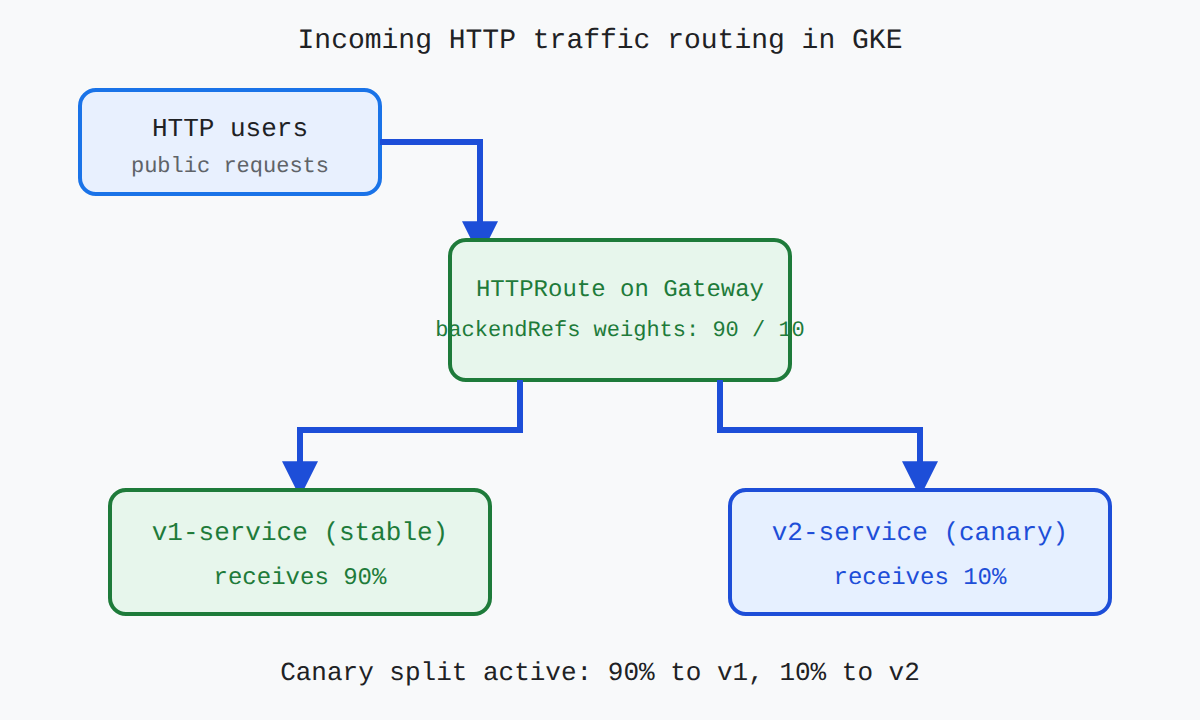
Choose which resource routes incoming HTTP traffic and what objective it should serve, then watch how requests flow.
Try 10 interactive questions like this one, free
Answer them yourself and get your score the moment you finish. No account needed.
Full access includes
- 2,014 practice questions across all 4 exam domains
- Every answer explained: why it is right, and why the others are not
- Scout, an AI tutor that answers your follow-up questions
- Readiness tracking by domain, so you know when to book the exam
Related free sample questions
Keep the momentum going with these hand-picked practice scenarios
FundamentalAssociate Cloud Engineer
Cloud Run Revision Tags and Traffic Splitting
Adjusting application traffic splitting parameters (e.g., Cloud Run, Cloud Run functions, GKE)
FundamentalAssociate Cloud Engineer
Personalized Service Health Relevance Status
Viewing the Personalized Service Health dashboard
FundamentalAssociate Cloud Engineer
VPC Longest Prefix Match vs Priority
Adding custom static routes in a VPC
FundamentalAssociate Cloud Engineer
Regional vs Global Quotas
Assessing quotas and requesting increases
FundamentalAssociate Cloud Engineer
Cloud Run Internal Ingress Setting
Creating and applying Cloud Next Generation Firewall (Cloud NGFW) policies with ingress and egress rules and attributes (e.g., action, source, destination, targets, protocols, ports)
AdvancedProfessional Cloud DevOps Engineer
GMP ClusterPodMonitoring Metric Relabeling Drop
Collecting metrics (e.g., from applications, platforms, networking, Cloud Service Mesh, Google Cloud Managed Service for Prometheus, hybrid/multi-cloud environments)
Last updated