Fundamental
Prepare and test your skills

Fundamental
Prepare and test your skills
Canary Rollouts With Revision Tags and Traffic Weights
Free sample question with answers and detailed explanation below. The Associate Cloud Engineer practice bank has an additional 2,014 practice questions.Try 10 free realistic questions: instant score, no credit card, and no account required.
Your team has deployed a new revision (orders-v2) of an internal microservice running on Cloud Run. Before directing any live user traffic to orders-v2, quality assurance engineers need to perform isolated smoke testing using a dedicated URL.
After testing is successful, you need to route 10% of incoming production requests to orders-v2 and keep 90% of traffic directed to the existing stable revision (orders-v1).
Which configuration approach should you use?
Explanations
Set the concurrency of orders-v2 to 10 and orders-v1 to 90 so that instances automatically distribute requests proportionally.
Set the concurrency of orders-v2 to 10 and orders-v1 to 90 so that instances automatically distribute requests proportionally.
What Concurrency in Cloud Run Is
Concurrency defines the maximum number of concurrent requests that a single container instance can process simultaneously before Cloud Run spins up additional container instances to handle incoming load.
Why It Doesn't Meet the Requirement
- Misunderstanding of Concurrency: Concurrency controls instance-level capacity and autoscaling thresholds, not the percentage of total incoming traffic routed to a revision.
- No Dedicated Testing URL: Adjusting concurrency does not provide a dedicated, isolated test URL for QA verification prior to rollout.
- Unpredictable Routing: Both revisions would still receive requests according to the service's traffic configuration, regardless of their individual instance concurrency limits.
Key Characteristics and Limitations
- Controls Instance Capacity: Concurrency ranges from 1 to 1000 requests per container instance.
- Autoscaling Impact: Lower concurrency causes Cloud Run to scale up more instances faster under load.
- Does Not Split Traffic: Traffic distribution percentages are managed explicitly via traffic allocation rules, not concurrency settings.
This Answer Would Be Correct If
You wanted to optimize memory and CPU performance by tuning how many simultaneous requests an individual container handles.
Assign a revision tag to orders-v2 for isolated URL testing, then adjust traffic splitting on the service to assign 10% to orders-v2 and 90% to orders-v1.
Assign a revision tag to orders-v2 for isolated URL testing, then adjust traffic splitting on the service to assign 10% to orders-v2 and 90% to orders-v1.
What Cloud Run Revision Tags and Traffic Splitting Are
Cloud Run uses an immutable revision model where every deployment creates a new revision. Revision tags provide a direct, dedicated URL scheme (for example, https://TAG---SERVICE-IDENTIFIER.run.app) to access a specific revision without exposing it to the main service endpoint. Traffic splitting allows administrators to distribute incoming requests across two or more revisions by defining specific percentage weights.
How it Meets the Scenario Requirements
- Isolated Testing: Assigning a tag (such as
testorstage) directly toorders-v2creates a unique URL that routes 100% of traffic hitting that URL specifically toorders-v2, while keeping main service traffic at 0% for that revision. - Gradual Rollout (10/90 Split): Adjusting the service's traffic parameters assigns 10% of production traffic to
orders-v2and 90% toorders-v1via the root service URL.
Key Advantages and Capabilities
- Zero-Downtime Canary Deployments: Enables gradual shift of live user requests to validate performance under real production load.
- Targeted Validation: Internal testers can send requests directly to tagged URLs without altering production user experiences.
- Instant Rollback: If issues occur during canary testing, shifting 100% of traffic back to
orders-v1takes effect immediately with no redeployment needed. - Declarative Control: Can be managed using
gcloud run services update-trafficor through the Google Cloud console.
Why This Is Optimal
This approach leverages native Cloud Run traffic management capabilities within the same service boundary. It eliminates the operational overhead of creating external load balancers, duplicate projects, or separate DNS records.
Execute orders-v2 as an asynchronous Cloud Run Job, then replace the container image of orders-v1 once testing completes.
Execute orders-v2 as an asynchronous Cloud Run Job, then replace the container image of orders-v1 once testing completes.
What Cloud Run Jobs Are
Cloud Run jobs are designed for running containerized tasks to completion asynchronously (such as batch data processing, backups, or database migrations) rather than serving continuous HTTP web traffic.
Why It Doesn't Meet the Requirement
- Incompatible Service Type: Interactive HTTP microservices require synchronous request-response handling provided by Cloud Run services, not Cloud Run jobs.
- No Traffic Splitting: Cloud Run jobs do not support HTTP endpoints, revision tags, or fractional percentage traffic splitting.
- All-or-Nothing Rollout: Overwriting the container image directly on
orders-v1immediately exposes all users to the new code without a canary phase (10/90 split).
Key Characteristics and Limitations
- Batch-Oriented: Jobs run until they finish or time out without listening on an HTTP port.
- Immutable Revisions Bypassed: In Cloud Run, updating configurations or images automatically generates a new revision rather than modifying existing revisions in place.
This Answer Would Be Correct If
The workload was a scheduled data transformation script or nightly batch job that did not process interactive HTTP web requests.
Deploy orders-v2 into a separate Google Cloud project, and configure Cloud DNS round-robin weighted records between both service endpoints.
Deploy orders-v2 into a separate Google Cloud project, and configure Cloud DNS round-robin weighted records between both service endpoints.
What Cloud DNS Weighted Routing Is
Cloud DNS is an enterprise DNS hosting service that resolves domain names to IP addresses or endpoints and can use routing policies such as weighted round-robin to distribute traffic across distinct IP targets.
Why It Doesn't Meet the Requirement
- Lacks Revision-Level Control: Deploying the revision into a separate project treats it as a distinct infrastructure resource rather than managing revisions within the existing Cloud Run service lifecycle.
- DNS Caching Limitations: DNS-based routing cannot achieve precise or instant percentage splits (such as 10/90) because client-side resolvers and intermediate ISP DNS servers cache responses based on Time-to-Live (TTL) values.
- Operational Complexity: Managing multi-project deployments creates unnecessary administrative overhead for testing and deployment pipelines.
Key Characteristics and Limitations
- Coarse Traffic Management: DNS queries, not individual HTTP requests, are distributed.
- No Integrated Tag URLs: Does not provide native revision URLs managed by Cloud Run.
- Slower Rollbacks: Propagation delays make quick rollbacks difficult if bugs are discovered.
This Answer Would Be Correct If
You needed to distribute global incoming traffic across entirely separate, multi-region backends or separate independent architectures during a complex multi-cloud or multi-project infrastructure migration.
Try the scenario
Cloud Run revision tags and traffic splitting for safe rollouts
Change the inputs and watch how the outcome changes.
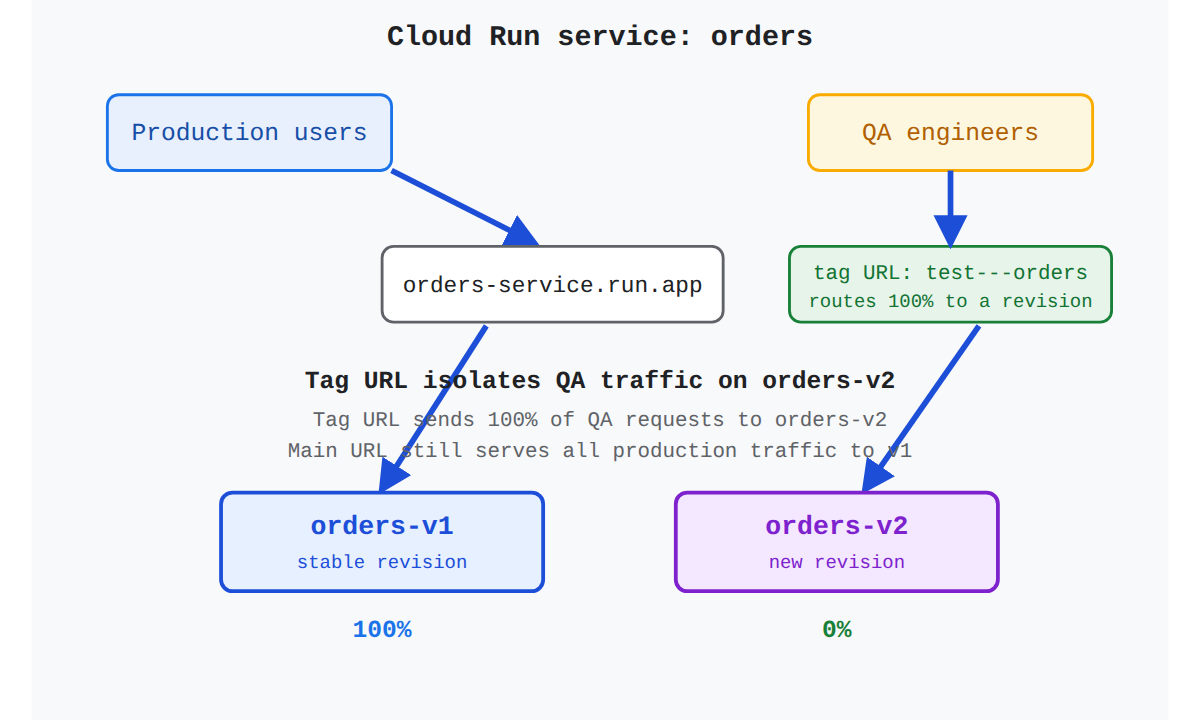
Switch the approach and rollout stage to see how each configuration routes QA and production requests.
Try 10 interactive questions like this one, free
Answer them yourself and get your score the moment you finish. No account needed.
Full access includes
- 2,014 practice questions across all 4 exam domains
- Every answer explained: why it is right, and why the others are not
- Scout, an AI tutor that answers your follow-up questions
- Readiness tracking by domain, so you know when to book the exam
Related free sample questions
Keep the momentum going with these hand-picked practice scenarios
FundamentalAssociate Cloud Engineer
GKE Gateway API HTTPRoute Weighted Traffic Splitting
Adjusting application traffic splitting parameters (e.g., Cloud Run, Cloud Run functions, GKE)
FundamentalAssociate Cloud Engineer
GKE Cluster Autoscaler Node Pool Scaling
Working with GKE node pools (e.g., add, edit, or remove a node pool; autoscaling node pool)
FundamentalAssociate Cloud Engineer
Terraform GCS Remote State Backend
Infrastructure as code tooling (e.g., Fabric FAST, Config Connector, Terraform, Helm)
FundamentalAssociate Cloud Engineer
Compute Engine Instance Templates
Creating an autoscaled managed instance group by using an instance template
FundamentalAssociate Cloud Engineer
Compute Engine SSH Key Expiration Metadata
Configuring OS Login
FundamentalCloud Digital Leader
Hybrid Multi-Cloud Business Drivers
Discuss the business reasons for choosing hybrid or multi-cloud strategies and how GKE Enterprise enables these strategies.
Last updated