Fundamental
Prepare and test your skills

Fundamental
Prepare and test your skills
Why Longest Prefix Match Beats Route Priority
Free sample question with answers and detailed explanation below. The Associate Cloud Engineer practice bank has an additional 2,014 practice questions.Try 10 free realistic questions: instant score, no credit card, and no account required.
An administrator manages a Google Cloud Virtual Private Cloud (VPC) network that has two custom static routes configured for on-premises connectivity:
- Route A: Destination
192.168.0.0/16, Priority100, Next hopvpn-gateway-a - Route B: Destination
192.168.1.0/24, Priority1000, Next hopnva-vm-b
A Compute Engine instance in the VPC sends network traffic to the destination IP address 192.168.1.50.
Which route will the VPC routing table select to forward the packet?
Explanations
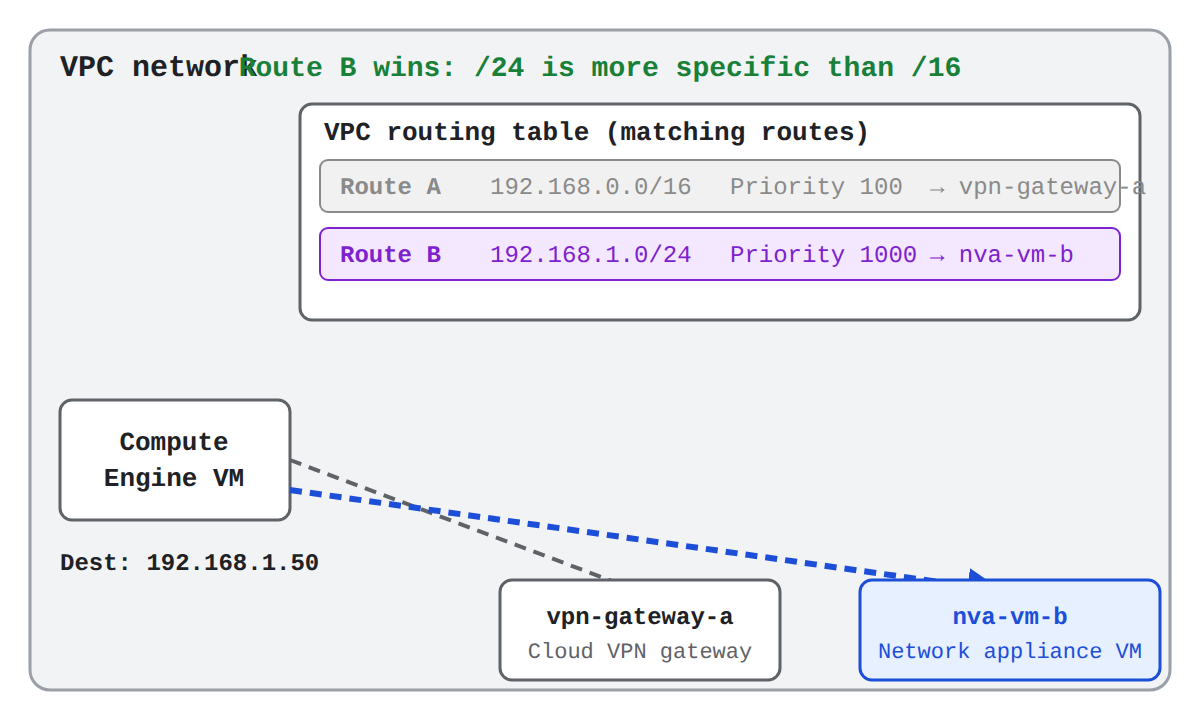
Route B, because the VPC routing table prioritizes the longest prefix match over the numerical priority value
Route B, because the VPC routing table prioritizes the longest prefix match over the numerical priority value
What Longest Prefix Matching Is
Longest prefix match (LPM) is the foundational IP routing algorithm used by Google Cloud VPC routing tables to determine the most specific route destination for any given outbound packet. When a packet matches multiple route ranges, the router evaluates the subnet mask length (prefix length) before assessing any other routing attributes.
How It Resolves the Routing Conflict
In this scenario, the packet's destination is 192.168.1.50. This IP address falls within both defined static routes:
- Route A:
192.168.0.0/16(prefix length/16, spanning192.168.0.0to192.168.255.255) - Route B:
192.168.1.0/24(prefix length/24, spanning192.168.1.0to192.168.1.255)
Because /24 represents a longer, more specific CIDR prefix than /16, the VPC routing engine selects Route B immediately. Numerical priority is only evaluated when two or more routes share the exact same destination CIDR prefix.
Key Principles of GCP Routing Logic
- Specificity first: The routing table always prioritizes the most specific destination CIDR range (longest prefix match).
- Priority as a tiebreaker: Numerical priority (where lower numbers represent higher priority) is only compared when destination prefixes are identical.
- Independent next hops: The next-hop type (such as a VPN gateway, an instance, or an interconnect) does not override prefix specificity.
- Deterministic forwarding: Traffic matching a
/24route will never fall back to a/16route unless the/24route is modified or deleted.
Why This Is Optimal
Understanding that prefix length takes precedence over numerical priority is essential for designing predictable VPC network topologies, hub-and-spoke models, and next-generation firewall inspection paths.
Route A, because a lower numerical priority value takes precedence over destination prefix length
Route A, because a lower numerical priority value takes precedence over destination prefix length
What Numerical Priority Is
Route priority in Google Cloud is a numeric attribute between 0 and 65535 used to rank routes. Lower numerical values signify higher precedence (for example, priority 100 is preferred over priority 1000).
Why It Doesn't Meet the Requirement
While Route A has a lower numerical priority (100) than Route B (1000), numerical priority is only evaluated as a tiebreaker after the routing table evaluates the prefix length. Because Route B (/24) is more specific than Route A (/16), Route B wins during the longest prefix match phase, and the priority values are never compared.
Key Characteristics and Limitations
- Secondary evaluation: Priority values are ignored when comparing routes with different CIDR prefix lengths.
- Tiebreaker role: Priority only applies when two routes have exact identical destination CIDR blocks (e.g., two distinct routes both targeting
192.168.1.0/24).
This Answer Would Be Correct If
Both Route A and Route B had the exact same destination CIDR prefix (for example, if both routes targeted 192.168.1.0/24). In that case, Route A would be selected because its priority of 100 is lower and therefore preferred over 1000.
Route A, because next hops pointing to Cloud VPN gateways are always evaluated before VM instances
Route A, because next hops pointing to Cloud VPN gateways are always evaluated before VM instances
What Next-Hop Types Are
In Google Cloud VPCs, next hops specify the resource or gateway that receives traffic matching the route. Examples of valid next hops include Cloud VPN gateways, Cloud Interconnect attachments, default internet gateways, and Compute Engine virtual machine instances.
Why It Doesn't Meet the Requirement
Google Cloud routing order does not inherently rank next-hop types above one another based on resource type. A route pointing to a Cloud VPN gateway does not automatically override a route pointing to a VM instance or appliance. Instead, route selection is strictly governed by longest prefix match, followed by numerical priority.
Key Characteristics and Limitations
- Next-hop independence: Routing precedence is determined by the route's destination prefix and priority, not the hardware or service type of the next hop.
- Custom static routes: Custom routes pointing to VM instances are fully supported and behave identically under standard VPC routing rules.
This Answer Would Be Correct If
Google Cloud implemented hardcoded resource-type hierarchies that favored managed VPN services over virtual appliances, but GCP VPC routing uses standard IP prefix evaluation rules instead.
Neither route alone, because the VPC automatically distributes traffic across both paths using Equal-Cost Multi-Path (ECMP)
Neither route alone, because the VPC automatically distributes traffic across both paths using Equal-Cost Multi-Path (ECMP)
What Equal-Cost Multi-Path (ECMP) Is
Equal-Cost Multi-Path (ECMP) is a routing mechanism that load-balances traffic across multiple next hops simultaneously when multiple matching routes exist.
Why It Doesn't Meet the Requirement
In Google Cloud VPC networks, ECMP is only triggered when multiple routes satisfy two strict conditions simultaneously:
- They must have the exact same destination prefix length.
- They must have the exact same numerical priority.
In this scenario, Route A and Route B differ in both destination prefix length (/16 vs. /24) and priority (100 vs. 1000). Because Route B is a longer prefix match, traffic is forwarded exclusively through Route B, and ECMP hashing is not performed.
Key Characteristics and Limitations
- ECMP requirements: Requires identical destination CIDRs and identical priority values.
- Hash-based distribution: ECMP balances 5-tuple flows across matching next hops, but only among truly identical paths.
This Answer Would Be Correct If
Route A and Route B both targeted 192.168.1.0/24 and both were configured with an identical priority (such as 100), allowing the VPC network to distribute traffic across both next hops.
Try the scenario
VPC route selection: longest prefix match vs numerical priority
Change the inputs and watch how the outcome changes.
Change the packet's destination, Route B's prefix, or Route B's priority to see which route the VPC routing table picks.
Try 10 interactive questions like this one, free
Answer them yourself and get your score the moment you finish. No account needed.
Full access includes
- 2,014 practice questions across all 4 exam domains
- Every answer explained: why it is right, and why the others are not
- Scout, an AI tutor that answers your follow-up questions
- Readiness tracking by domain, so you know when to book the exam
Related free sample questions
Keep the momentum going with these hand-picked practice scenarios
FundamentalAssociate Cloud Engineer
Network-Tagged Custom Static Routes
Adding custom static routes in a VPC
FundamentalAssociate Cloud Engineer
Custom Static Route Priority Override
Adding custom static routes in a VPC
FundamentalAssociate Cloud Engineer
Gcloud Custom VPC Subnet Creation
Creating a VPC with subnets (e.g., custom mode VPC, Shared VPC)
FundamentalAssociate Cloud Engineer
LogEntry MonitoredResource Field
Viewing specific log message details in Cloud Logging
FundamentalAssociate Cloud Engineer
Cloud Run Min-Instances vs Max-Instances
Configuring autoscaling for a Cloud Run application
AdvancedProfessional Cloud DevOps Engineer
GKE Accelerated Patch Auto-Upgrades
Safe and secure patching and upgrading practices
Last updated