Fundamental
Prepare and test your skills

Fundamental
Prepare and test your skills
Regional and Global Quotas in Google Cloud
Free sample question with answers and detailed explanation below. The Associate Cloud Engineer practice bank has an additional 2,014 practice questions.Try 10 free realistic questions: instant score, no credit card, and no account required.
An enterprise is planning a multi-region deployment across us-central1 and europe-west1 to ensure high availability and disaster recovery for their cloud application. During the architecture planning phase, the engineering team evaluates how Google Cloud enforces resource constraints and quotas across both regions.
How do regional quotas differ from global quotas when deploying resources across multiple regions?
Explanations
Regional quotas represent a shared capacity pool that dynamically shifts between regions as resources are deployed, whereas global quotas require manual pre-allocation per region.
Regional quotas represent a shared capacity pool that dynamically shifts between regions as resources are deployed, whereas global quotas require manual pre-allocation per region.
What Dynamic Quota Pooling Is
Dynamic quota pooling implies that quota allowances fluctuate automatically between regions depending on where compute resources are spun up in real time.
Why It Doesn't Meet the Requirement
Google Cloud does not dynamically shift regional quotas between regions. Each region has its own explicitly defined, static quota allocation. If your project has a quota of 24 vCPUs in us-central1 and 24 vCPUs in europe-west1, consuming all 24 vCPUs in us-central1 does not borrow unused quota from europe-west1. Deploying a 25th vCPU in us-central1 will immediately fail with a quota exhaustion error unless an explicit quota increase is requested for that specific region.
Key Characteristics and Limitations
- Static Allocation: Regional quotas are fixed numbers assigned per region per project until modified by a user request or automated policy.
- No Dynamic Transfer: Unused quota in one region cannot compensate for a shortage in another region.
- Separate Tracking: The Quotas page in the Google Cloud Console tracks utilization metrics on a per-region metric basis.
This Answer Would Be Correct If
Google Cloud supported automatic regional quota rebalancing where unused regional headroom was dynamically transferred to high-utilization regions, but quotas are strictly fixed per region.
Regional quotas apply independently to each specific region within a project, so resource usage in us-central1 does not reduce available quota in europe-west1, whereas global quotas apply across the entire project regardless of region.
Regional quotas apply independently to each specific region within a project, so resource usage in us-central1 does not reduce available quota in europe-west1, whereas global quotas apply across the entire project regardless of region.
What Regional and Global Quotas Are
In Google Cloud, quotas are resource constraints applied at various scopes to prevent unexpected resource consumption, prevent service overloads, and ensure fair resource distribution. The Cloud Quotas system monitors and enforces limits based on defined geographic boundaries, primarily regional quotas and global quotas.
How it meets the Multi-Region Requirement
- Regional Quotas: These limits are scoped strictly to a single geographic region for a specific project. For example, your CPU quota, memory limits, or regional external IP address allowances in
us-central1are completely isolated from those ineurope-west1. Deploying 50 vCPUs inus-central1only consumes quota allocated tous-central1and has zero impact on your capacity to launch instances ineurope-west1. - Global Quotas: These limits apply project-wide across all regions collectively. Resources that operate globally—such as global firewall rules, managed DNS zones, global load balancers, or Cloud Build rate limits—draw from a single unified pool across the entire project.
Regional vs Global Quotas Across Two Regions
Set Relationship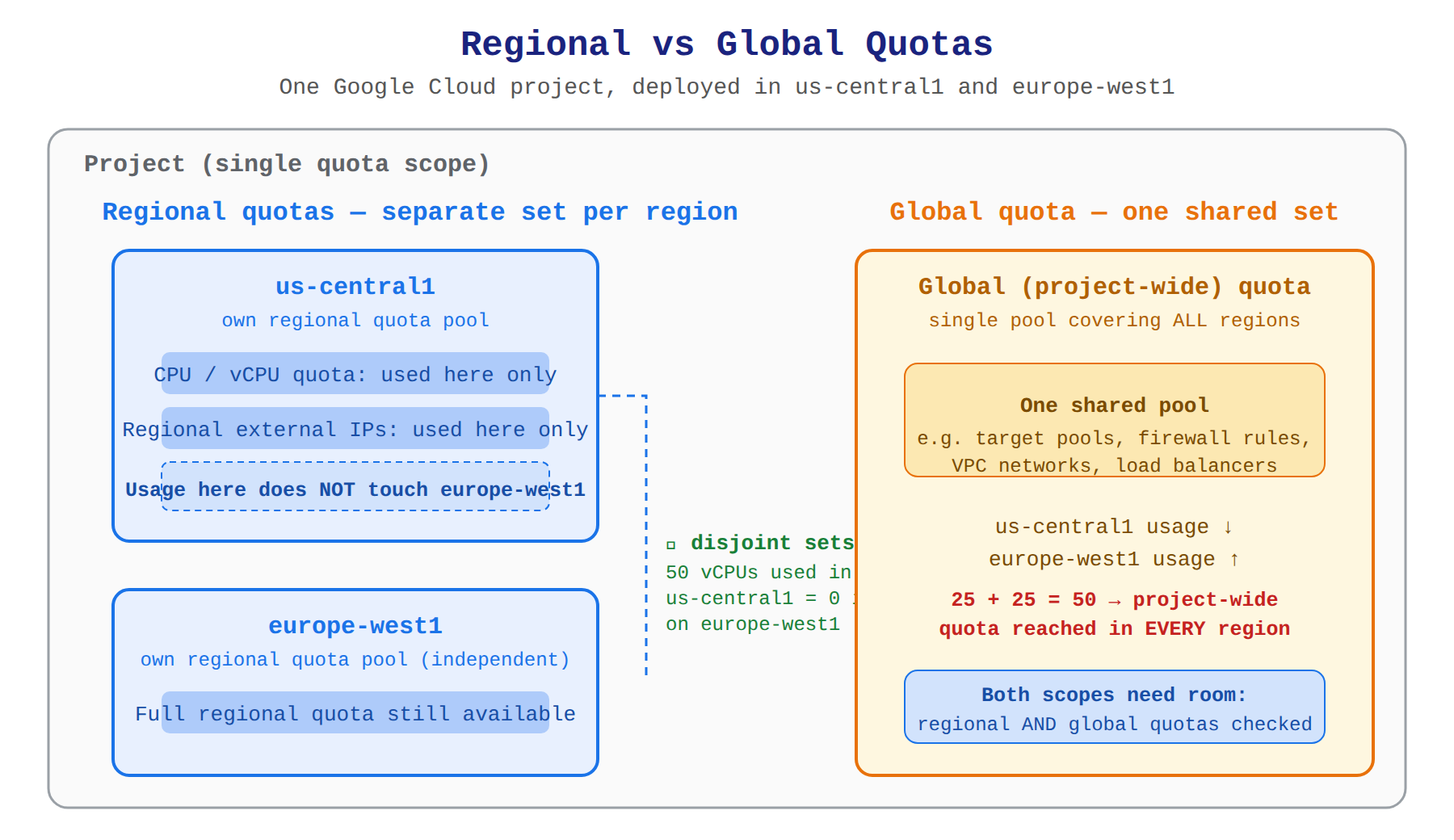
Key Advantages and Capabilities
- Predictable Capacity Planning: Engineers can plan and request quota increases for specific regions independently based on localized demand.
- Fault Isolation: Exhausting a regional quota in one region does not block deployments or autoscale events in a secondary disaster recovery region.
- Independent Adjustments: Organizations can request quota adjustments for specific high-traffic regions without altering project settings across the rest of the world.
- Resource Management: Global quotas prevent excessive creation of shared infrastructure assets across projects.
Why This Is Optimal
Understanding quota scope is essential for architecting reliable cross-region systems. Regional isolation ensures that scaling activities or regional spikes in one location will never starve or compromise the standby capacity needed in another disaster recovery region.
Regional quotas apply only to single-zone compute resources, whereas global quotas apply exclusively to external internet egress traffic leaving Google Cloud.
Regional quotas apply only to single-zone compute resources, whereas global quotas apply exclusively to external internet egress traffic leaving Google Cloud.
What Zonal, Regional, and Global Resources Are
Google Cloud categorizes infrastructure resources and constraints into zonal, regional, multiregional, and global scopes based on their failure domains and accessibility.
Why It Doesn't Meet the Requirement
- Regional Quotas Cover Multiple Scopes: Regional quotas apply to both zonal resources (such as Compute Engine VM instances and local disks residing in a specific zone within that region) and regional resources (such as regional managed instance groups, regional external IP addresses, and regional Cloud Run services).
- Global Quotas Are Not Restricted to Egress Traffic: Global quotas govern a wide variety of project-level resources and APIs, such as Cloud DNS managed zones, global forwarding rules, global VPC network configurations, and IAM policy bindings, rather than solely internet egress.
Key Characteristics and Limitations
- Zonal Resources: Live in a single zone (e.g., individual Compute Engine VMs) but are constrained by regional quotas (e.g., total regional vCPUs).
- Regional Resources: Deployed redundantly across zones in a region (e.g., regional MIGs) and governed by regional quotas.
- Global Resources: Spanned project-wide (e.g., VPC networks, global load balancers) and governed by global quotas.
This Answer Would Be Correct If
Regional quotas were named zonal quotas and only applied to single-datacenter assets, while global quotas were exclusively dedicated to network egress bandwidth monitoring.
Regional quotas automatically increase when multiple regions are active in a project, whereas global quotas are fixed system limits that can never be modified.
Regional quotas automatically increase when multiple regions are active in a project, whereas global quotas are fixed system limits that can never be modified.
What System Limits and Quota Adjustments Are
In Google Cloud, there is a fundamental distinction between quotas (which have default values that can typically be increased upon request) and system limits (which are fixed architectural boundaries that cannot be changed).
Why It Doesn't Meet the Requirement
- Regional Quotas Do Not Auto-Increase: Simply deploying resources into multiple regions does not automatically increase your default regional quotas. Default quotas are predetermined when a project is created and remain unchanged until you submit a quota increase request or project spending history prompts automatic adjustments.
- Global Quotas Can Often Be Increased: Many global quotas (such as Cloud DNS managed zones per project or API rate limits) can be increased via the Google Cloud Console or Cloud Quotas API, provided they are standard quotas rather than hard system limits.
Key Characteristics and Limitations
- Quotas vs. Limits: Quotas protect against accidental overspend and service saturation, while system limits reflect hard platform architectural constraints.
- Explicit Requests: Quota adjustments require explicit submission via the Quotas & System Limits console or automated quota adjusters.
- Regional Independence: Adding a secondary region introduces that region's default quota, but does not increase existing regional limits.
This Answer Would Be Correct If
Activating new regions automatically granted proportional multiplier bonuses to project-wide resource caps, and global quotas were categorized solely as immutable platform limits.
Try 10 interactive questions like this one, free
Answer them yourself and get your score the moment you finish. No account needed.
Full access includes
- 2,014 practice questions across all 4 exam domains
- Every answer explained: why it is right, and why the others are not
- Scout, an AI tutor that answers your follow-up questions
- Readiness tracking by domain, so you know when to book the exam
Related free sample questions
Keep the momentum going with these hand-picked practice scenarios
FundamentalAssociate Cloud Engineer
Rate Quotas vs Allocation Quotas
Assessing quotas and requesting increases
FundamentalAssociate Cloud Engineer
Google Cloud Quota Increase Request
Assessing quotas and requesting increases
FundamentalAssociate Cloud Engineer
Helm Templates and Values Files
Infrastructure as code tooling (e.g., Fabric FAST, Config Connector, Terraform, Helm)
FundamentalAssociate Cloud Engineer
Google Cloud Directory Sync One-Way Synchronization
Managing users and groups in Cloud Identity (manually and automated)
FundamentalAssociate Cloud Engineer
BigQuery Multi-Region Location Redundancy
Maintaining multi-region redundancy across data solutions
AdvancedProfessional Cloud DevOps Engineer
Cloud Monitoring Multi-Project Metrics Scope
Application performance monitoring
Last updated