Fundamental
Prepare and test your skills

Fundamental
Prepare and test your skills
Allowing Public HTTP with VPC Ingress Rules
Free sample question with answers and detailed explanation below. The Associate Cloud Engineer practice bank has an additional 2,014 practice questions.Try 10 free realistic questions: instant score, no credit card, and no account required.
An organization is deploying a fleet of web servers on Compute Engine instances inside a Virtual Private Cloud (VPC) network. The web servers must accept incoming public web traffic on TCP port 80.
All existing lower-priority default rules blocking unapproved traffic must remain intact, and the new rule must apply strictly to inbound requests.
Which combination of firewall rule attributes should the administrator configure to allow this traffic?
Explanations
Direction: Ingress; Action: Allow; Source filter: IPv4 ranges (0.0.0.0/0); Protocol and port: tcp:80; Priority: 1000
Direction: Ingress; Action: Allow; Source filter: IPv4 ranges (0.0.0.0/0); Protocol and port: tcp:80; Priority: 1000
What the Solution Is
In Google Cloud VPC networking, a VPC firewall rule with ingress direction inspects and filters incoming traffic directed toward virtual machine instances. Firewall rules are defined by specific attributes including traffic direction, action, source or destination filters, protocols, ports, and rule priority.
How It Meets the Requirements
- Direction (Ingress): Specifically filters incoming network packets sent from external or internal sources toward the target Compute Engine instances.
- Action (Allow): Permits matching network packets to pass through to the destination instances rather than dropping them.
- Source Filter (
0.0.0.0/0): Specifies the entire IPv4 address space, allowing legitimate incoming web requests from any public client on the internet. - Protocol and Port (
tcp:80): Accurately restricts access exclusively to standard HTTP web traffic over the TCP transport layer, blocking unintended protocols and ports. - Priority (1000): Evaluates before the implied default deny ingress rule (which resides at priority
65535), ensuring traffic is permitted while honoring normal rule evaluation ordering.
Ingress Allow tcp:80 Beats Implied Deny
Process Flow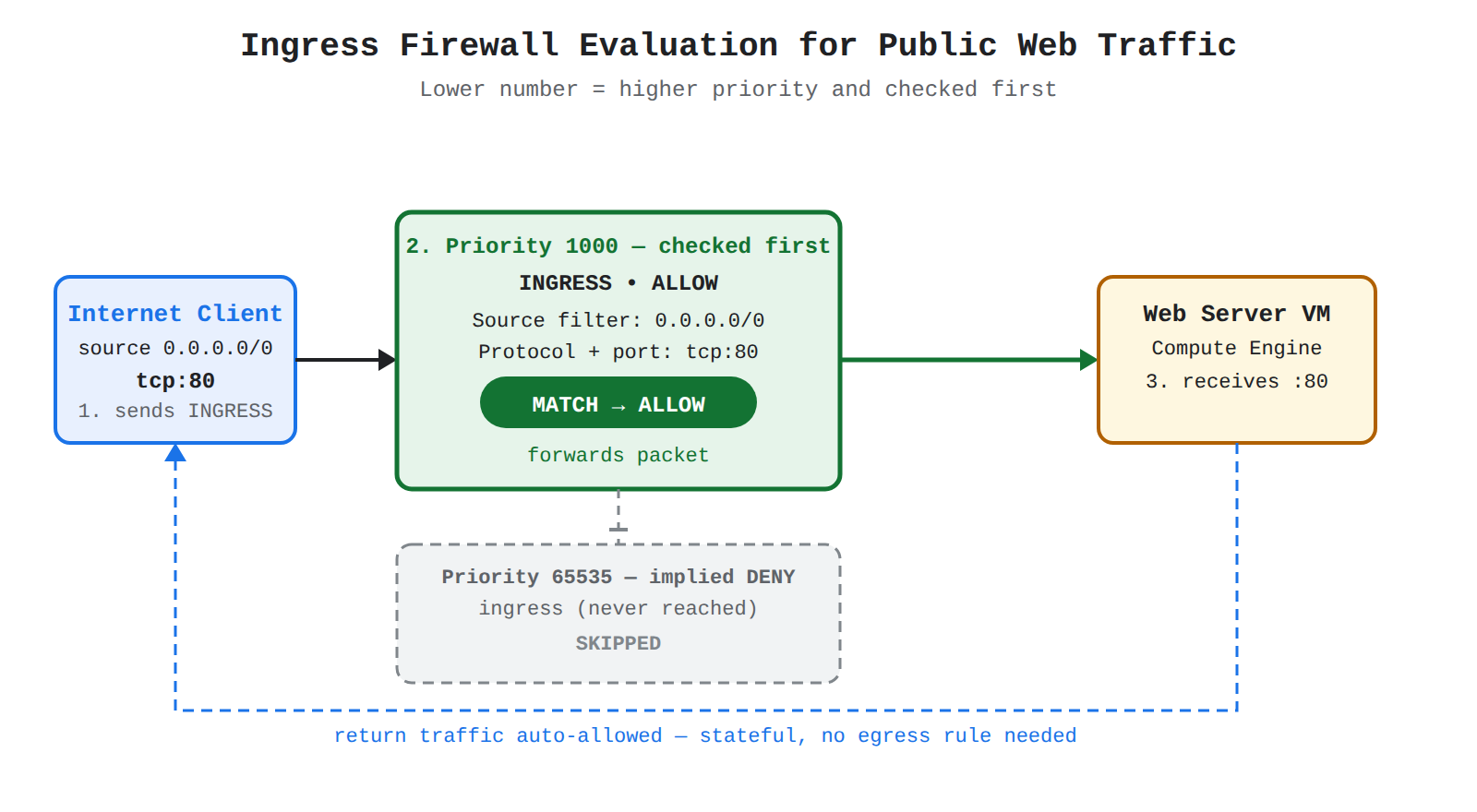
Key Advantages and Capabilities
- Granular Traffic Control: Restricts exposure strictly to the necessary port and protocol without opening unnecessary network paths.
- Stateful Filtering: Allows bidirectional communication once an ingress session is established; return traffic is automatically permitted regardless of egress rules.
- Predictable Evaluation Order: Priority integers (from
0to65535) ensure rules with lower numerical values take precedence over higher numerical values. - VPC-Wide Scalability: Easily targets specific instances via network tags or service accounts as the environment scales.
Why This Is Optimal
This configuration directly satisfies all security and operational criteria with minimal attack surface exposure. It enforces strict protocol and port constraints on inbound connections while using a standard priority value that properly precedes Google Cloud's default catch-all rules.
Direction: Ingress; Action: Deny; Source filter: IPv4 ranges (0.0.0.0/0); Protocol and port: udp:80; Priority: 1000
Direction: Ingress; Action: Deny; Source filter: IPv4 ranges (0.0.0.0/0); Protocol and port: udp:80; Priority: 1000
What the Option Is
This rule explicitly rejects incoming UDP packets arriving on port 80 from all IPv4 addresses at a priority of 1000.
Why It Doesn't Meet the Requirement
- Incorrect Action: The requirement states that web servers must accept incoming traffic, but this rule uses the Deny action, which actively drops traffic.
- Incorrect Protocol: Standard HTTP web traffic operates over the TCP transport protocol, not UDP. Blocking UDP port 80 does not enable web browsing.
- Fails to Allow Traffic: Setting a deny rule does not fulfill the need to permit HTTP requests reaching the web server.
Key Characteristics and Limitations
- Deny Action: Drops matched packets immediately and ceases further firewall rule evaluation for matching criteria.
- UDP Transport Layer: Used for connectionless protocols (such as DNS queries or streaming media), not traditional HTTP/1.1 or HTTP/2 web traffic.
- Superfluous Deny: Default VPC firewall configurations already drop unallowed ingress packets via the implied default deny rule.
This Answer Would Be Correct If
The organization needed to actively mitigate an amplification attack over UDP on port 80 before any other rules were processed.
Additional Context
Standard web traffic requires the TCP three-way handshake to establish reliable connections, making TCP the essential protocol attribute for HTTP/HTTPS web endpoints.
Direction: Ingress; Action: Allow; Destination filter: IPv4 ranges (0.0.0.0/0); Protocol and port: icmp:80; Priority: 65535
Direction: Ingress; Action: Allow; Destination filter: IPv4 ranges (0.0.0.0/0); Protocol and port: icmp:80; Priority: 65535
What the Option Is
This configuration attempts to permit Internet Control Message Protocol (ICMP) traffic using an invalid port specification and the lowest possible priority (65535).
Why It Doesn't Meet the Requirement
- Incorrect Protocol: ICMP operates at the network layer to send diagnostic and control messages (such as
ping). It does not transport HTTP application payload data. - Invalid Protocol/Port Combination: ICMP does not utilize TCP or UDP port numbers, making
icmp:80syntactically invalid. - Incorrect Filter Parameter: Ingress rules in VPC firewall rules filter based on source IP ranges, not destination IP ranges.
- Lowest Evaluation Priority: A priority of
65535is reserved for implied default rules and is overridden by any custom rule with a lower numerical priority (1–65534).
Key Characteristics and Limitations
- ICMP Protocol: Primarily used for diagnostic utilities like
pingandtraceroute. - Rule Priority Scale: Priority ranges from
0(highest priority) to65535(lowest priority). - Parameter Mismatch: Ingress rules mandate source specifications (IPs, tags, or service accounts) to determine origins of allowed traffic.
This Answer Would Be Correct If
The goal was to configure the lowest-priority default fallback rule to allow network diagnostics across the entire VPC.
Additional Context
When creating custom allow rules in Google Cloud, administrators should assign priority values between 0 and 65534 (typically 1000 by default) so that they take precedence over default system rules.
Direction: Egress; Action: Allow; Destination filter: IPv4 ranges (0.0.0.0/0); Protocol and port: tcp:80; Priority: 1000
Direction: Egress; Action: Allow; Destination filter: IPv4 ranges (0.0.0.0/0); Protocol and port: tcp:80; Priority: 1000
What the Option Is
This configuration creates an egress firewall rule intended to manage outbound traffic leaving Compute Engine VM instances toward external destination IP addresses.
Why It Doesn't Meet the Requirement
- Incorrect Direction: The requirement is to allow incoming traffic from external clients reaching the web servers. An egress rule controls traffic leaving the VM instances, not inbound requests.
- VPC Firewall Stateful Nature: Google Cloud firewall rules are stateful. When incoming traffic is allowed by an ingress rule, responses sent back to the client are automatically permitted without needing a matching egress rule.
- Default Behavior Redundancy: Google Cloud VPC networks already include a default implied egress rule allowing all outbound traffic at priority
65535.
Key Characteristics and Limitations
- Egress Focus: Regulates outgoing packets where the VM is the source and the target is an external or internal destination.
- Destination Parameter Requirement: Uses destination IP ranges rather than source IP ranges to filter traffic.
- No Inbound Protection: Does not open ports or allow external requests to reach listening services on VMs.
This Answer Would Be Correct If
The requirement called for restricting outbound communication from backend database servers so they could only contact external software repositories on port 80.
Additional Context
Confusing ingress (inbound) and egress (outbound) is a common misconception when configuring network firewalls. Ingress rules require source filters, whereas egress rules require destination filters.
Try 10 interactive questions like this one, free
Answer them yourself and get your score the moment you finish. No account needed.
Full access includes
- 2,014 practice questions across all 4 exam domains
- Every answer explained: why it is right, and why the others are not
- Scout, an AI tutor that answers your follow-up questions
- Readiness tracking by domain, so you know when to book the exam
Related free sample questions
Keep the momentum going with these hand-picked practice scenarios
FundamentalAssociate Cloud Engineer
Cloud Run Internal Ingress Setting
Creating and applying Cloud Next Generation Firewall (Cloud NGFW) policies with ingress and egress rules and attributes (e.g., action, source, destination, targets, protocols, ports)
FundamentalAssociate Cloud Engineer
Hierarchical Firewall Policy Folder Enforcement
Creating and applying Cloud Next Generation Firewall (Cloud NGFW) policies with ingress and egress rules and attributes (e.g., action, source, destination, targets, protocols, ports)
FundamentalAssociate Cloud Engineer
Cloud Run Revision Tags and Traffic Splitting
Adjusting application traffic splitting parameters (e.g., Cloud Run, Cloud Run functions, GKE)
FundamentalAssociate Cloud Engineer
Personalized Service Health Relevance Status
Viewing the Personalized Service Health dashboard
FundamentalAssociate Cloud Engineer
Cloud Storage Lifecycle Asynchronous Execution
Setting object lifecycle management policies for Cloud Storage buckets
FundamentalGenerative AI Leader
Supervised Learning vs Rule-Based Programming
Explaining how Google Cloud's AI platform provides users with control over their data (e.g., security, privacy, governance, open and leading first party models, pre-built and customizable solutions, agents)
Last updated